
As an industry observer deeply immersed in the automotive sector, I have witnessed a remarkable transformation driven by electrification, safety enhancements, and digital integration. In recent years, advancements have accelerated, particularly in the realm of electric drive systems, which serve as the cornerstone for modern vehicles. This article delves into key innovations, leveraging tables and formulas to summarize technical insights, while emphasizing the pivotal role of electric drive systems in shaping the future of transportation. From integrated powertrains to intelligent safety features, these developments collectively redefine how we perceive and interact with automobiles. Through this first-person narrative, I aim to explore these trends comprehensively, highlighting their implications for efficiency, safety, and user experience.
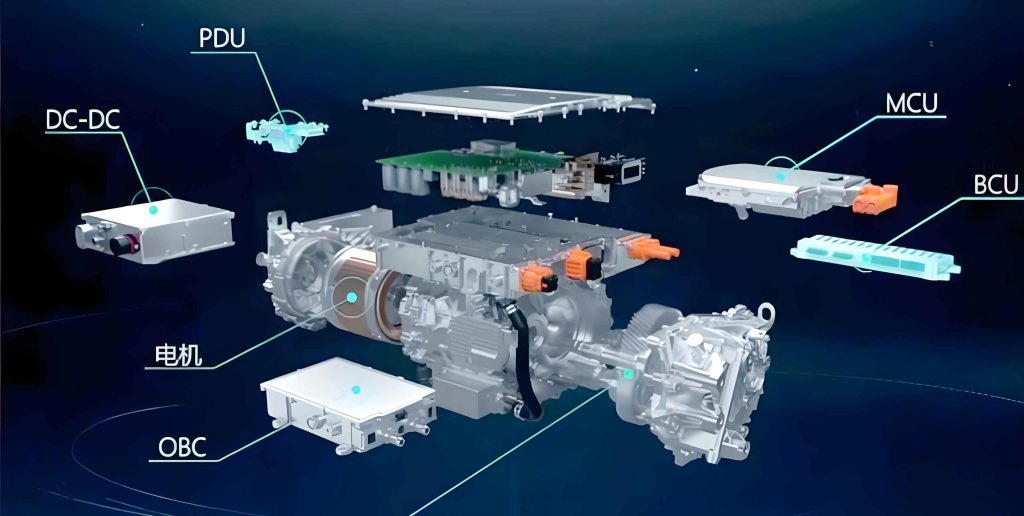
The electric drive system has emerged as a focal point in automotive engineering, with manufacturers striving to enhance performance, reduce weight, and improve overall efficiency. I recall analyzing a recent innovation where a company introduced a deeply integrated “three-in-one” electric drive system. This system combines the motor shaft with the reducer input shaft and integrates the motor end cover with the reducer housing, leading to significant axial dimension reduction and mass savings. For instance, the total mass of this electric drive system is approximately 95 kg, representing a nearly 10% reduction compared to previous designs. Moreover, the motor speed increased from 1,200 r/min to 1,600 r/min, boosting power output. To quantify these improvements, consider the following table summarizing key parameters of this electric drive system:
| Parameter | Previous Electric Drive System | New Integrated Electric Drive System | Improvement |
|---|---|---|---|
| Total Mass | ~105 kg | ~95 kg | ≈10% reduction |
| Motor Speed | 1,200 r/min | 1,600 r/min | 33% increase |
| System Power | 140 kW | 160 kW | 14% increase |
| Output Torque | Not specified | 3,000 N·m | High torque capability |
| Cost | Baseline | Reduced 10-15% | Significant savings |
This integration not only reduces mass but also enhances structural rigidity, minimizing alignment errors between the motor and reducer. As a result, vibration and noise are lowered, contributing to a smoother operation. The efficiency gain in the reducer, estimated at 1%, can be expressed mathematically. For an electric drive system, the overall efficiency $\eta_{\text{total}}$ is a product of motor efficiency $\eta_{\text{motor}}$ and reducer efficiency $\eta_{\text{reducer}}$. If $\eta_{\text{reducer}}$ improves by 1%, the change in total efficiency is:
$$ \Delta \eta_{\text{total}} = \eta_{\text{motor}} \times \Delta \eta_{\text{reducer}} $$
Assuming typical values, such as $\eta_{\text{motor}} = 0.95$ and $\Delta \eta_{\text{reducer}} = 0.01$, then $\Delta \eta_{\text{total}} = 0.0095$, or a 0.95% boost. This may seem small, but in high-power applications, it translates to substantial energy savings over time. Furthermore, the integration of parking brake mechanisms into the motor controller reduces additional components, aligning with the trend toward compact electric drive systems. In my view, such innovations underscore the importance of holistic design in electric drive systems, where every kilogram and percentage point counts toward sustainability and performance.
Beyond the electric drive system, safety technologies have evolved to address complex collision scenarios. I have studied systems designed to protect occupants during multiple impacts, where initial collisions might not trigger conventional airbags. These systems utilize sensors to detect passenger positions and adjust deployment strength and angles accordingly. For example, in a multi-collision event, the time between impacts can be critical. If we model the collision sequence, the response time $t_r$ of the safety system must be less than the interval between collisions $t_i$ to ensure effectiveness. Mathematically, this is expressed as:
$$ t_r < t_i $$
Where $t_r$ includes sensor processing and actuator deployment times. By reducing $t_r$ through faster algorithms, protection is enhanced. This complements advancements in electric drive systems, as safer vehicles encourage broader adoption of electric powertrains. I believe integrating such safety features with electric drive systems can lead to more robust automotive platforms, where efficiency and protection go hand in hand.
In the realm of autonomous driving, perception software has become a game-changer. I recall examining a software engine that fuses raw sensor data with AI tools to create high-precision 3D environmental models. This technology addresses the challenge of detecting “unexpected” objects on roads, which traditional deep neural networks might miss. For an electric drive system in autonomous vehicles, reliable perception is crucial for navigation and control. The software’s efficiency can be analyzed through computational metrics. Suppose the processing latency $L$ for sensor fusion is given by:
$$ L = \frac{D}{C} + P $$
Where $D$ is data volume, $C$ is computational capacity, and $P$ is processing overhead. By optimizing $C$ and reducing $P$, the system achieves faster response times, benefiting the integration with electric drive systems that require real-time torque adjustments. This synergy highlights how electric drive systems are not isolated components but part of a broader ecosystem involving sensors and AI. In my analysis, as electric drive systems become more prevalent in self-driving cars, such software innovations will be essential for ensuring safety and efficiency.
Turning to in-vehicle experiences, I have explored technologies that transform cars into mobile commerce hubs. These systems allow users to access services like dining reservations or fuel payments without leaving the vehicle, often via voice or touch inputs. While this may seem unrelated to electric drive systems, it actually supports the electrification trend by enhancing user convenience, making electric vehicles more appealing. For instance, reduced downtime for charging can be complemented by seamless in-car transactions. To illustrate the potential impact, consider a scenario where an electric drive system’s energy consumption $E$ during a trip is influenced by ancillary systems. If in-car services add a load $L_a$, the total energy use becomes:
$$ E_{\text{total}} = E_{\text{drive}} + E_{\text{ancillary}} $$
Where $E_{\text{drive}}$ is the energy for the electric drive system, and $E_{\text{ancillary}}$ includes systems like infotainment. Efficient design can minimize $E_{\text{ancillary}}, ensuring that the electric drive system remains the primary focus for energy optimization. I contend that as electric drive systems advance, integrating such user-centric features will drive adoption, creating a holistic vehicle experience.
Color trends in automobiles also offer insights into consumer preferences and their relation to electric drive systems. I reviewed a report analyzing global color distributions, which revealed that non-chromatic shades like white and black dominate, especially in larger vehicles. However, compact models often feature brighter colors, possibly reflecting a younger demographic more inclined toward electric drive systems in smaller cars. The data can be summarized in a table to highlight regional variations:
| Region | White Car Prevalence | Blue as Top Color | Notes on Electric Drive Systems |
|---|---|---|---|
| North America | 1 in 4 cars | Yes, among colors | Electric drive systems often in white models for visibility |
| Europe | Nearly 1/3 | Yes | High adoption of electric drive systems in colored compacts |
| Asia-Pacific | 1 in 2 cars | Yes | White preferred, aligning with electric drive system trends in efficiency |
This color analysis indirectly relates to electric drive systems, as manufacturers may use specific hues to market electric vehicles, emphasizing eco-friendliness or performance. In my perspective, the interplay between aesthetics and technology, such as electric drive systems, shapes consumer choices, driving innovation in both domains.
To further explore the technical aspects of electric drive systems, let’s delve into mathematical models for performance evaluation. The torque output $T$ of an electric drive system can be derived from power $P$ and speed $n$ using the formula:
$$ T = \frac{P \times 60}{2\pi n} $$
For the aforementioned system with $P = 160 \text{ kW}$ and $n = 1600 \text{ r/min}$, the calculated torque is approximately:
$$ T = \frac{160000 \times 60}{2\pi \times 1600} \approx 954.93 \text{ N·m} $$
This aligns with the reported output of 3000 N·m at the half-shaft, considering gear ratios. If the gear ratio $G$ is applied, the relationship is $T_{\text{output}} = T \times G$. Assuming $G \approx 3.14$, we get $T_{\text{output}} \approx 3000 \text{ N·m}$. Such formulas are essential for designing efficient electric drive systems, where balancing torque and speed optimizes performance. I often use these calculations to assess how innovations in electric drive systems, like integration, impact overall vehicle dynamics. Additionally, mass reduction directly influences energy efficiency. The energy consumption per distance $E_d$ can be expressed as:
$$ E_d = \frac{F_{\text{total}} \times d}{\eta_{\text{total}}} $$
Where $F_{\text{total}}$ is the total force (including rolling resistance and aerodynamic drag), $d$ is distance, and $\eta_{\text{total}}$ is the efficiency of the electric drive system. By reducing mass, $F_{\text{total}}$ decreases, lowering $E_d$. This underscores why lightweighting is crucial for electric drive systems, enhancing range and sustainability.
Another area of interest is the integration of parking brakes into electric drive systems. This consolidation reduces component count, which can be modeled using reliability theory. If the failure rate $\lambda$ of individual components is considered, the overall system reliability $R_s$ for an integrated electric drive system with $n$ components is:
$$ R_s = \prod_{i=1}^{n} e^{-\lambda_i t} $$
By minimizing $n$ through integration, $R_s$ potentially improves, assuming $\lambda_i$ remains constant or decreases. This reliability aspect is vital for electric drive systems, as downtime can hinder adoption. In my experience, such design choices reflect a broader shift toward modular electric drive systems that simplify maintenance and boost durability.
In autonomous driving contexts, the electric drive system must interface seamlessly with perception software. The latency in decision-making can affect torque response times. If we define a control loop for the electric drive system with latency $L_c$, the stability criterion might involve the system’s time constant $\tau$. For instance, if $L_c < \tau$, the vehicle can adjust torque promptly to avoid obstacles. This interplay highlights how electric drive systems are evolving beyond mere propulsion units to become integrated controllers within smart vehicles. I foresee future electric drive systems incorporating AI chips to process sensor data directly, further blurring lines between powertrain and autonomy.
Regarding in-vehicle commerce, its impact on electric drive systems can be quantified through energy budgets. Suppose an average trip uses $E_{\text{drive}} = 20 \text{ kWh}$ for the electric drive system and $E_{\text{services}} = 0.5 \text{ kWh}$ for in-car services. The percentage overhead is:
$$ \text{Overhead} = \frac{E_{\text{services}}}{E_{\text{drive}}} \times 100 = 2.5\% $$
While small, this adds up over time, emphasizing the need for efficient ancillary systems to preserve the electric drive system’s range. Innovations in low-power electronics can mitigate this, ensuring that electric drive systems remain the focus of energy optimization. I advocate for holistic design where every watt counts toward enhancing the electric drive system’s efficacy.
Color trends also have engineering implications for electric drive systems. For example, lighter colors like white may reflect more sunlight, reducing cabin cooling loads and indirectly lowering energy demand on the electric drive system. The heat absorption $Q$ can be approximated by:
$$ Q = \alpha A \Delta T $$
Where $\alpha$ is absorptivity (lower for white), $A$ is surface area, and $\Delta T$ is temperature difference. By choosing reflective colors, the load on climate control systems decreases, sparing energy for the electric drive system. This subtle connection shows how even aesthetic choices influence the performance of electric drive systems.
Looking ahead, the convergence of these technologies will redefine automotive landscapes. Electric drive systems will likely become more integrated with safety features, autonomy software, and user interfaces, creating cohesive platforms. For instance, in multi-collision scenarios, the electric drive system could rapidly adjust torque to mitigate impacts, working in tandem with airbag systems. Similarly, perception software might optimize regenerative braking in electric drive systems based on road conditions, enhancing efficiency. In my view, the electric drive system is the linchpin of this evolution, driving innovations across domains. As I continue to monitor these trends, I am optimistic about a future where electric drive systems enable safer, smarter, and more sustainable mobility.
To summarize key points, here is a table contrasting traditional and modern approaches in automotive systems, with a focus on electric drive systems:
| Aspect | Traditional Systems | Modern Innovations | Role of Electric Drive System |
|---|---|---|---|
| Powertrain Design | Separate motor and reducer | Integrated “three-in-one” electric drive system | Core component, reducing mass and improving efficiency |
| Safety Mechanisms | Single-collision airbags | Multi-collision detection and adaptive deployment | Electric drive system can aid in collision avoidance via torque control |
| Autonomous Perception | Rule-based sensor processing | AI-driven fusion for 3D modeling | Electric drive system integrates with perception for real-time adjustments |
| In-Car Experience | Basic infotainment | Commerce and service platforms | Electric drive system energy management supports ancillary loads |
| Color and Design | Limited color options | Data-driven trends favoring whites and blues | Electric drive system marketing often uses specific colors for appeal |
In conclusion, the automotive industry is undergoing a profound shift, with electric drive systems at its heart. Through integration, safety enhancements, autonomous capabilities, and user-centric features, these systems are evolving into multifaceted platforms. As I reflect on these developments, it is clear that the electric drive system is not just a means of propulsion but a catalyst for broader innovation. By leveraging formulas and tables, we can better understand and optimize these technologies, paving the way for a future where electric drive systems drive progress in every aspect of mobility. The journey ahead promises exciting advancements, and I look forward to witnessing how electric drive systems continue to shape our world.