
As an automotive technician specializing in electronic control systems, I have spent years diagnosing and repairing modern engines, where the motor control unit plays a pivotal role. In this article, I will share my firsthand experiences and analytical insights into fault diagnosis technology, emphasizing the critical functions of the motor control unit. Through detailed case studies, I aim to illustrate how systematic approaches, combined with data analysis and technical knowledge, can effectively resolve complex engine issues. The motor control unit, often referred to as the engine’s brain, continuously monitors and adjusts parameters to ensure optimal performance, making its understanding essential for any diagnostician.
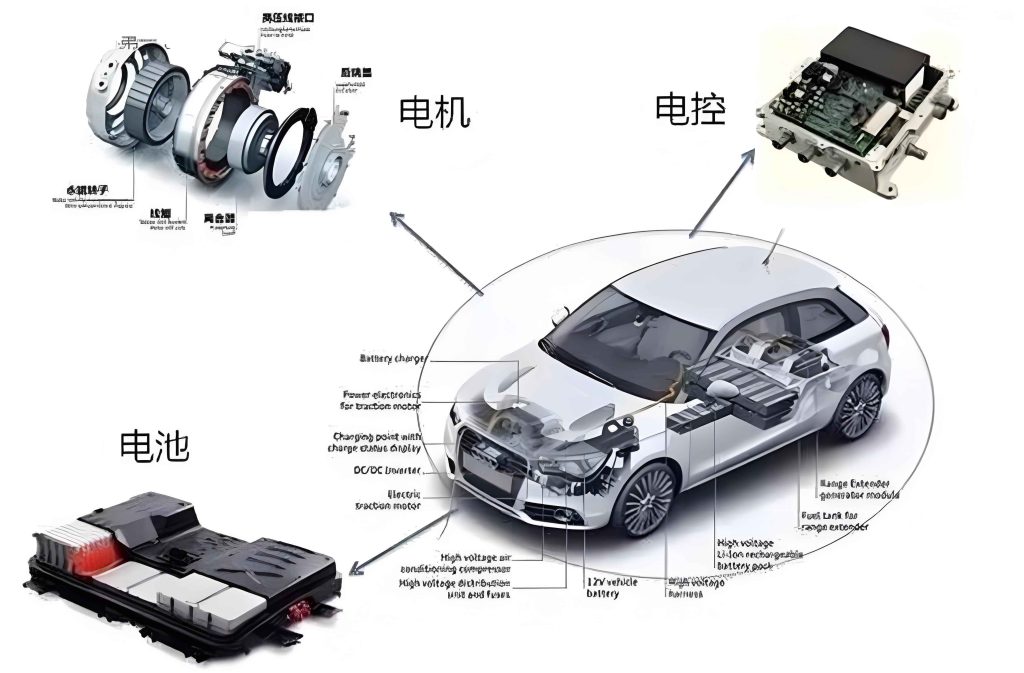
Automotive electronic control engines represent a significant advancement in vehicle technology, integrating sophisticated systems managed by the motor control unit. This unit precisely regulates ignition timing, fuel injection, air-fuel ratios, and emission controls via inputs from sensors like oxygen sensors, pressure sensors, and temperature sensors. The motor control unit processes these inputs in real-time to command actuators such as fuel injectors and ignition coils. A typical system can be modeled with key equations; for instance, the ideal air-fuel ratio is maintained using stoichiometric calculations: $$ \lambda = \frac{\text{Actual air-fuel ratio}}{\text{Stoichiometric air-fuel ratio}} $$ where λ is controlled by the motor control unit to approach 1 for optimal combustion. Faults often arise from deviations in these parameters, necessitating robust diagnostic techniques.
My diagnostic toolkit primarily includes scan tools like IDS (Integrated Diagnostic System), multimeters, and pressure gauges, supplemented by data stream analysis. The motor control unit stores fault codes when anomalies exceed thresholds, but many intermittent issues require deeper investigation. I often begin by verifying fault phenomena, as symptoms can be misleading. For example, rough idle might stem from fuel, ignition, or mechanical problems, all monitored by the motor control unit. To systematize diagnosis, I rely on tables to catalog common faults. Below is a summary of frequent electronic control engine issues I’ve encountered:
| Fault Category | Typical Symptoms | Key Sensors Involved | Motor Control Unit Actions |
|---|---|---|---|
| Ignition Misfire | Rough idle, power loss, fault light | Crankshaft position, knock sensors | Adjusts timing, triggers fault codes |
| Fuel System Issues | Hard start, stalling, poor fuel economy | Fuel pressure, oxygen sensors | Modulates injection pulse width |
| Emission Control Failures | Increased emissions, performance drop | O₂ sensors, EGR valves | Manages recirculation and catalyst efficiency |
| Turbocharger Problems | Boost loss, sluggish acceleration | Boost pressure, MAP sensors | Controls wastegate via solenoid valves |
To understand the motor control unit’s role better, consider its operational logic: it uses algorithms to compute actuator outputs based on sensor inputs. For fuel injection, the injection duration $$ t_{inj} $$ is calculated as: $$ t_{inj} = K \cdot \frac{m_{air}}{\rho_{fuel}} \cdot f(T, P) $$ where K is a calibration constant, \( m_{air} \) is air mass flow, \( \rho_{fuel} \) is fuel density, and f(T, P) corrects for temperature and pressure. The motor control unit continuously updates this to maintain stoichiometry, but faults in sensors or actuators can disrupt the loop, leading to issues like those in my case studies.
In one notable case, I handled a medium sedan with a 2.0L turbocharged engine where the engine fault light illuminated and idle was rough. Using IDS, I retrieved fault code P0302 for cylinder 2 misfire. The motor control unit had detected irregular combustion through crankshaft speed variations. Initial analysis suggested ignition or fuel causes; swapping spark plugs and ignition coils ruled out ignition. Data stream analysis revealed abnormal fuel pressure decay after shutdown: $$ P(t) = P_0 e^{-t/\tau} $$ where \( P_0 \) is initial pressure and τ is time constant. In this instance, τ was abnormally small, indicating leakage. Inspecting injectors showed cylinder 2 injector leaking, confirmed by visual drips and pressure tests. Replacing it restored normal pressure, and the motor control unit cleared the fault after a drive cycle. This case highlighted how the motor control unit’s monitoring capabilities, combined with data analysis, pinpoint issues efficiently.
| Fault Phenomenon | Fault Code | Diagnostic Tools Used | Key Data Stream Observations | Root Cause | Resolution |
|---|---|---|---|---|---|
| Engine fault light on, rough idle | P0302 (misfire cylinder 2) | IDS, pressure gauge, multimeter | Rapid fuel pressure drop post-shutdown, cylinder-specific misfire counts | Leaking fuel injector in cylinder 2 | Replace injector, reset motor control unit |
Another challenging case involved a compact car with intermittent stalling at idle. The motor control unit stored code P0192 for low fuel rail pressure sensor input. Data streams showed erratic high-pressure sensor readings: $$ V_{out} = S \cdot P + V_{offset} $$ where S is sensitivity and \( V_{offset} \) is offset voltage. During idle, \( V_{out} \) sporadically dropped to zero, causing the motor control unit to enrich mixture unnecessarily, leading to stalls. Circuit testing showed normal wiring, but sensor replacement resolved it. This underscored the motor control unit’s dependency on accurate sensor data; even minor signal distortions can cause significant drivability issues. I’ve compiled common sensor failures and their impacts:
| Sensor Type | Typical Failure Mode | Effect on Motor Control Unit | Diagnostic Approach |
|---|---|---|---|
| Fuel Pressure Sensor | Signal drift or loss | Incorrect fuel delivery calculations | Compare data stream with mechanical gauge readings |
| Oxygen Sensor | Slow response or poisoning | Erratic air-fuel ratio adjustments | Monitor λ oscillations via scan tool |
| Throttle Position Sensor | Dead spots or hysteresis | Poor throttle response and idle control | Graph voltage sweep during throttle movement |
| Camshaft Position Sensor | Intermittent signal | Misfires and timing errors | Check waveform with oscilloscope |
A particularly subtle issue was a large SUV with hard cold starts but no fault codes. The motor control unit showed normal data streams initially, but extended monitoring revealed high-pressure fuel pump leakage. The pressure decay formula $$ \Delta P = \frac{Q \cdot t}{V} $$ where Q is leakage rate, t is time, and V is volume, indicated excessive flow. Replacing the pump solved it, emphasizing that the motor control unit might not always flag slow leaks without driving cycles. In such cases, I rely on comparative data analysis against known good values, often using statistical methods to identify outliers in sensor readings.
Turbocharger-related faults also frequently involve the motor control unit, as seen in a sedan with power loss after repair. No codes were present, but data streams showed low boost pressure: $$ P_{boost} = P_{atm} + \rho \cdot v^2 / 2 $$ simplified for ideal flow, where v is air velocity. Inspection revealed a cracked vacuum hose to the wastegate solenoid, controlled by the motor control unit. This prevented boost buildup, reducing effective torque: $$ T = \frac{P \cdot 60}{2\pi N} $$ where T is torque, P is power, and N is rpm. The motor control unit attempted compensation by adjusting fuel, but physical limits caused power loss. Replacing the hose restored normal operation, highlighting how the motor control unit’s commands rely on intact actuator pathways.
Throughout these cases, I’ve learned that effective diagnosis hinges on understanding the motor control unit’s algorithms and limitations. For instance, it uses adaptive strategies to compensate for wear, but these can mask faults until severe. Regular updates to calibration software are crucial, as the motor control unit’s logic evolves. I often employ mathematical models to simulate engine behavior; one useful equation is the engine speed dynamics model: $$ J \frac{d\omega}{dt} = T_e – T_l – T_f $$ where J is inertia, ω is angular speed, \( T_e \) is engine torque, \( T_l \) is load torque, and \( T_f \) is friction torque. Deviations in predicted versus actual ω can indicate issues like misfires or drag, monitored by the motor control unit via crankshaft sensors.
To enhance diagnostic efficiency, I’ve developed a step-by-step framework that integrates motor control unit data with mechanical checks. First, I verify customer complaints and scan for codes. Next, I analyze live data streams, focusing on parameters like fuel trim, ignition advance, and sensor voltages. If codes are absent, I compare data to benchmarks or use relative compression tests via crank speed analysis. For intermittent faults, I log data over drive cycles to capture anomalies. Below is a table summarizing my diagnostic protocol:
| Step | Action | Tools Required | Role of Motor Control Unit |
|---|---|---|---|
| 1. Initial Verification | Reproduce symptoms, visual inspection | Scan tool, basic hand tools | Provides fault codes and freeze frame data |
| 2. Code Retrieval | Read and document DTCs (Diagnostic Trouble Codes) | IDS or OBD-II scanner | Stores codes based on self-diagnostics |
| 3. Data Stream Analysis | Monitor live sensor and actuator data | Scan tool with graphing capability | Streams real-time parameters for trend analysis |
| 4. Component Testing | Test sensors, actuators, and circuits | Multimeter, oscilloscope, pressure gauge | Reference values often derived from motor control unit specs |
| 5. Functional Tests | Perform actuations like fuel pump prime or injector pulses | Scan tool bidirectional controls | Commands actuators directly to verify operation |
| 6. Verification | Clear codes, test drive, confirm repair | Scan tool, road test equipment | Monitors systems post-repair for recurrence |
In addition to practical steps, theoretical knowledge aids diagnosis. For example, the motor control unit manages fuel injection using pulse width modulation, where injector on-time $$ t_{on} $$ is derived from: $$ t_{on} = \frac{m_{fuel}}{\dot{m}_{inj}} $$ with \( m_{fuel} \) being fuel mass per cycle and \( \dot{m}_{inj} \) injector flow rate. Faults like clogged injectors alter \( \dot{m}_{inj} \), causing lean conditions detected by oxygen sensors. The motor control unit then adjusts long-term fuel trims, which I monitor via scan tools. Significant trim values (e.g., beyond ±10%) often indicate underlying issues like vacuum leaks or fuel delivery problems, all interconnected through the motor control unit’s adaptive strategies.
Another aspect is ignition system diagnostics, where the motor control unit controls coil charging time based on battery voltage and engine speed. The ignition energy $$ E = \frac{1}{2} L I^2 $$ where L is coil inductance and I is primary current, must suffice for spark generation. Using an oscilloscope, I trace ignition waveforms to identify faults like shorted coils, which the motor control unit might flag as misfires. In many cases, the motor control unit’s misfire detection algorithm uses crankshaft acceleration patterns: $$ \alpha = \frac{\Delta \omega}{\Delta t} $$ where α is angular acceleration, with deviations indicating combustion irregularities. This sophisticated monitoring allows early detection but requires precise interpretation.
Looking ahead, advancements in motor control unit technology, such as integrated AI for predictive diagnostics, will revolutionize fault finding. However, core principles remain: the motor control unit is the nexus of engine control, and its data is invaluable. I routinely educate apprentices on its functions, emphasizing that a deep understanding of its interactions with sensors and actuators reduces guesswork. For instance, the motor control unit’s closed-loop control for emissions relies on oxygen sensor feedback; slow sensors can cause oscillations in air-fuel ratio, detectable as rich/lean swings in data streams.
To conclude, my experiences underscore that successful fault diagnosis in automotive electronic control engines blends art and science. The motor control unit provides a wealth of information, but its effective use requires systematic analysis, supported by tools and theoretical models. By sharing these cases and methodologies, I hope to contribute to the collective knowledge of technicians and educators, fostering more efficient and accurate repairs. As vehicles evolve, the motor control unit’s role will only expand, making continuous learning essential for anyone in this field.