
In the era of rapid technological advancement, new energy vehicles (NEVs) have emerged as a pivotal force in the automotive industry’s transformation. As an enthusiast and researcher in automotive engineering, I have witnessed firsthand the shift toward electrification and intelligence. The electronic control system, often termed the “brain” of an NEV, plays a critical role in ensuring safety, efficiency, and reliability. This system integrates hardware and software to manage power distribution, motor operation, and energy optimization. However, with the growing adoption of NEVs, issues related to system failures and maintenance have become prominent, posing challenges for widespread deployment. In this article, I will delve into the composition, fault diagnosis methods, and maintenance strategies for NEV electronic control systems, emphasizing the motor control unit as a core component. By leveraging tables, formulas, and practical insights, I aim to provide a comprehensive guide that enhances understanding and addresses real-world concerns.
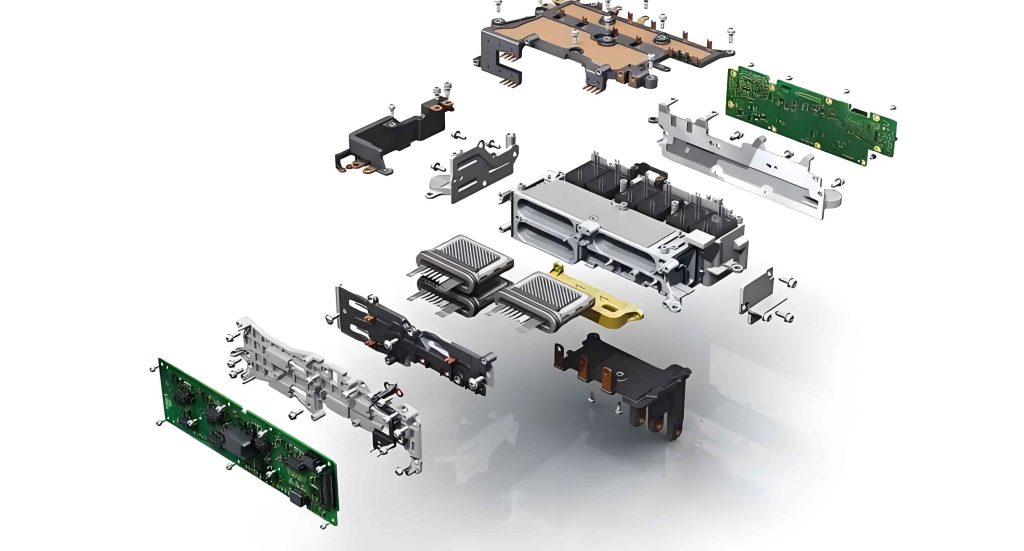
The electronic control system of an NEV is a complex network that coordinates various subsystems. From my perspective, it comprises both hardware and software elements working in tandem. The hardware includes components like the battery management system (BMS), motor control unit (MCU), vehicle control unit (VCU), onboard charger, and DC/DC converter. Each of these units has a specific function: for instance, the motor control unit regulates the torque and speed of the electric motor based on driver inputs, while the VCU acts as a central coordinator. The software aspect involves operating systems and algorithms that enable real-time decision-making. To clarify this structure, I have summarized the key components in Table 1.
| Component | Primary Function | Key Parameters |
|---|---|---|
| Battery Management System (BMS) | Monitors battery voltage, current, temperature; estimates state of health (SOH) | Voltage (V), Current (A), Temperature (°C) |
| Motor Control Unit (MCU) | Controls electric motor operation via torque and speed modulation | Torque (Nm), Speed (rpm), Efficiency (%) |
| Vehicle Control Unit (VCU) | Coordinates subsystems for optimal energy management | Power demand (kW), Energy consumption (kWh) |
| Onboard Charger | Charges the high-voltage battery pack safely | Charging rate (kW), Voltage range (V) |
| DC/DC Converter | Converts high-voltage DC to low-voltage DC for auxiliary systems | Input voltage (V), Output voltage (V), Efficiency (%) |
Among these, the motor control unit is particularly vital, as it directly influences driving performance and energy efficiency. I often emphasize that the motor control unit must handle high-frequency switching and precise control algorithms. Its operation can be modeled using equations such as the torque equation for an electric motor: $$T = k_t \cdot I$$ where \(T\) is torque, \(k_t\) is the torque constant, and \(I\) is current. Similarly, the power loss in the motor control unit due to switching can be expressed as $$P_{loss} = f_{sw} \cdot (E_{on} + E_{off})$$ where \(f_{sw}\) is switching frequency, and \(E_{on}\) and \(E_{off}\) are energy losses per switch. These formulas help in understanding the underlying physics and potential failure modes.
Fault diagnosis in NEV electronic control systems is a multi-faceted challenge. Based on my experience, I categorize diagnosis methods into three primary approaches: fault code-based, data analysis-based, and simulation model-based. Each method has its strengths and limitations, and they often complement each other in practice.
First, fault code-based diagnosis is a conventional yet effective method. When a fault occurs, the system logs specific codes in the controller’s memory. By connecting a diagnostic tool, technicians can retrieve these codes to identify faulty components. For example, a code related to the motor control unit might indicate overcurrent or overheating. However, this method is limited to detectable faults and may miss intermittent issues. To illustrate, I have compiled common fault codes associated with the motor control unit in Table 2.
| Fault Code | Description | Possible Causes |
|---|---|---|
| MCU_001 | Overcurrent in inverter circuit | Short circuit, load surge, sensor failure |
| MCU_002 | High temperature in power module | Cooling system failure, ambient heat, excessive load |
| MCU_003 | Communication error with VCU | Wiring issue, software glitch, connector fault |
| MCU_004 | Torque sensor deviation | Calibration error, sensor degradation, noise interference |
Second, data analysis-based diagnosis leverages the vast amounts of data generated by NEVs. With sensors collecting real-time parameters like voltage, current, and temperature, big data techniques can be applied. I often use machine learning algorithms to predict failures before they occur. For instance, the health state of the motor control unit can be assessed using a degradation model: $$SOH_{MCU} = 1 – \alpha \cdot \int_{0}^{t} P_{loss}(t) \, dt$$ where \(SOH_{MCU}\) is the state of health of the motor control unit, \(\alpha\) is a degradation coefficient, and \(P_{loss}(t)\) is time-dependent power loss. By analyzing historical data, patterns such as gradual efficiency drops can signal impending faults. Table 3 compares different data analysis techniques for fault diagnosis.
| Technique | Application | Advantages |
|---|---|---|
| Correlation Analysis | Identifies relationships between parameters (e.g., temperature vs. current) | Simple, quick insights |
| Regression Models | Predicts system behavior based on input variables | Quantitative predictions, handles multiple variables |
| Time Series Analysis | Detects anomalies in sequential data (e.g., sensor readings) | Captures temporal trends, useful for prognostics |
| Machine Learning (e.g., SVM, Neural Networks) | Classifies fault types from complex datasets | High accuracy, adapts to new data |
Third, simulation model-based diagnosis involves creating digital twins of the electronic control system. I frequently use software like MATLAB/Simulink to build models that replicate real-world behavior. By injecting faults into the simulation, such as a malfunction in the motor control unit, I can observe how the system responds. For example, a model of the motor control unit might include equations for inverter dynamics: $$V_{dc} = L \frac{di}{dt} + R i + V_{emf}$$ where \(V_{dc}\) is DC link voltage, \(L\) is inductance, \(R\) is resistance, \(i\) is current, and \(V_{emf}\) is back EMF. Comparing simulation outputs with actual data helps pinpoint discrepancies and diagnose issues. This method is especially useful for understanding complex interactions, such as how a fault in the motor control unit affects overall vehicle performance.
Moving to maintenance strategies, I advocate for a proactive approach to ensure long-term reliability. Traditional reactive repairs are insufficient for NEVs due to their intricate systems. Instead, I propose three key strategies: preventive maintenance, modular replacement, and remote diagnosis and repair.
Preventive maintenance focuses on anticipating failures before they happen. By continuously monitoring the motor control unit and other components, I can schedule interventions based on condition rather than time. For example, the remaining useful life (RUL) of the motor control unit can be estimated using a Weibull distribution model: $$RUL_{MCU} = \beta \cdot \left( -\ln(1 – F(t)) \right)^{1/\eta}$$ where \(\beta\) and \(\eta\) are shape and scale parameters, and \(F(t)\) is the failure probability. Implementing such models allows for optimized maintenance plans, reducing downtime and costs. In practice, I recommend regular checks of cooling systems and software updates for the motor control unit to mitigate common issues.
Modular replacement simplifies repairs by dividing the electronic control system into interchangeable modules. When a fault is isolated to a specific module, such as the motor control unit, it can be swapped out quickly without replacing the entire system. This strategy relies on standardized interfaces and design. I have outlined the benefits in Table 4, emphasizing how it streamlines service operations. For instance, a faulty motor control unit can be replaced in minutes if modules are pre-configured, minimizing vehicle off-road time.
| Aspect | Benefit | Example |
|---|---|---|
| Repair Time | Reduced by up to 50% compared to full system repair | Motor control unit swap takes 30 minutes vs. 2 hours |
| Cost Efficiency | Lower parts cost as only faulty module is replaced | Cost savings of 40% on average |
| Skill Requirements | Less technical expertise needed for module replacement | Technicians trained quickly on modular procedures |
| Inventory Management | Simplified stocking of modules rather than whole systems | Reduced warehouse space and logistics complexity |
Remote diagnosis and repair leverage connectivity to enhance maintenance efficiency. Through telematics, I can access vehicle data in real-time, analyze faults from a distance, and even perform software updates over-the-air (OTA). For example, if the motor control unit shows anomalous behavior, I can remotely adjust control parameters or schedule a service visit. This approach reduces the need for physical inspections and accelerates response times. The process often involves data transmission via CAN bus, with analysis done on cloud platforms. A formula for data transmission rate might be $$R = B \log_2(1 + SNR)$$ where \(R\) is rate, \(B\) is bandwidth, and \(SNR\) is signal-to-noise ratio, ensuring reliable communication for diagnosis.
In conclusion, the evolution of NEV electronic control systems demands innovative fault diagnosis and maintenance strategies. From my perspective, integrating methods like fault code analysis, data-driven models, and simulations provides a robust framework for addressing failures. Emphasizing the motor control unit throughout this discussion highlights its centrality in system performance. Maintenance approaches such as preventive care, modular replacement, and remote interventions not only improve reliability but also lower operational costs. As NEVs continue to advance, I believe that ongoing research in these areas will be crucial for sustaining growth and user trust. By adopting these strategies, stakeholders can ensure that electronic control systems remain resilient and efficient throughout the vehicle lifecycle.
To further elaborate, let’s consider some mathematical models that underpin these strategies. For fault diagnosis, a common approach is using Kalman filters to estimate system states. For the motor control unit, the state-space representation might be: $$\dot{x} = A x + B u + w$$ $$y = C x + v$$ where \(x\) is the state vector (e.g., current, temperature), \(u\) is control input, \(y\) is measured output, and \(w\) and \(v\) are process and measurement noise. By comparing estimated states with actual readings, faults can be detected early. Similarly, for preventive maintenance, the failure rate \(\lambda(t)\) of the motor control unit can be modeled with a bathtub curve: $$\lambda(t) = \frac{\beta}{\eta} \left( \frac{t}{\eta} \right)^{\beta-1}$$ where \(\beta\) is the shape parameter indicating infant mortality, constant failure, or wear-out phases.
In practice, I recommend combining these models with real-world data. For instance, collecting operational data from the motor control unit over time allows for calibration of parameters. Table 5 summarizes key formulas used in this article for quick reference.
| Formula | Description | Application |
|---|---|---|
| $$T = k_t \cdot I$$ | Torque equation for electric motor | Motor control unit performance analysis |
| $$P_{loss} = f_{sw} \cdot (E_{on} + E_{off})$$ | Power loss in switching devices | Efficiency evaluation of motor control unit |
| $$SOH_{MCU} = 1 – \alpha \cdot \int_{0}^{t} P_{loss}(t) \, dt$$ | State of health estimation for motor control unit | Preventive maintenance planning |
| $$RUL_{MCU} = \beta \cdot \left( -\ln(1 – F(t)) \right)^{1/\eta}$$ | Remaining useful life prediction | Condition-based maintenance scheduling |
| $$V_{dc} = L \frac{di}{dt} + R i + V_{emf}$$ | Inverter dynamics equation | Simulation model for motor control unit fault injection |
| $$R = B \log_2(1 + SNR)$$ | Data transmission rate formula | Remote diagnosis communication efficiency |
Ultimately, the success of these strategies hinges on continuous innovation and collaboration. As I explore this field, I see immense potential in integrating artificial intelligence with traditional engineering practices. For example, deep learning algorithms can enhance fault detection in the motor control unit by processing high-dimensional sensor data. Moreover, standardization of modules and protocols will facilitate wider adoption of modular replacement and remote services. By staying abreast of these developments, we can ensure that NEV electronic control systems meet the demands of tomorrow’s mobility landscape.
In summary, this article has provided an in-depth look at fault diagnosis and maintenance for NEV electronic control systems. Through a first-person lens, I have shared insights on system composition, diagnostic methods, and proactive strategies, with a focus on the motor control unit. The use of tables and formulas aims to clarify complex concepts and offer practical tools. As the industry evolves, I am confident that these approaches will contribute to safer, more reliable, and cost-effective NEVs, paving the way for a sustainable automotive future.