
In recent years, driven by national policies such as the “Photovoltaic Plus” model and the “Blue Book on the Development of New Power Systems,” China has witnessed rapid advancement in distributed photovoltaic (PV) generation technology, with its installed capacity continuously rising. However, the integration of distributed PV systems into the grid has led to increasingly prominent issues, including three-phase current imbalance, increased line losses, and voltage excursions beyond normal limits. Among these, voltage overruns are a primary factor affecting the safe and stable operation of distribution networks.
To address voltage violation problems caused by PV grid connection, some research proposes reducing the active power output of PV generation. Yet, this approach may limit the distribution network’s ability to absorb solar energy. Regarding reactive power regulation, studies have considered the reactive power regulation potential of PV inverters, proposing coordinated multi-inverter power regulation models and hierarchical voltage coordination control strategies to enhance PV consumption and balancing capabilities. However, the available reactive regulation capacity may sometimes be insufficient to bring voltages back within the normal range.
Given the inherent coordinative potential of power systems, the future grid is evolving towards an interactive operational model involving the “network, generation side, and consumption side.” As a controllable load resource, the battery electric vehicle (BEV) participating in the centralized dispatch of the distribution network can help promote the integration of renewable energy and build a clean, low-carbon, safe, and efficient energy system. Furthermore, the emergence of Vehicle-to-Grid (V2G) technology provides an innovative control method for improving distribution network stability. Some scholars have made progress in voltage optimization research for distribution networks containing battery electric vehicles, applying situational awareness technology for joint regulation with reactive power compensation devices, or using combined droop and voltage support control from charging stations. Other strategies involve real-time coordinated voltage regulation between on-load tap changers and battery electric vehicles based on approximate dynamic programming. While these studies have achieved certain results, they often do not cover the coordinated regulation of PV generation and battery electric vehicles. Some research considers the variability of BEV battery capacity and state of charge (SOC), proposing distributed control strategies based on consensus algorithms to efficiently utilize the limited energy storage of BEV batteries, yet without considering the economic cost of voltage regulation. Other work incorporates the optimization control costs of various resources but employs algorithms like Particle Swarm Optimization (PSO), which carries the risk of converging to local optima, hindering the discovery of the optimal regulation configuration.
Based on the above, this paper proposes a distribution network voltage optimization model aimed at minimizing both voltage deviation and control costs. The model considers the regulation capabilities of PV systems and battery electric vehicles and employs the Marine Predators Algorithm (MPA) to solve it. Case analysis demonstrates that MPA can effectively determine the optimal configuration for BEVs and PV to achieve minimal voltage deviation. Moreover, MPA exhibits superior convergence efficiency and solution diversity in solving such optimization problems.
1. BEV Load and Distribution Network Operation Model
1.1 Stochastic Load Model for Battery Electric Vehicles
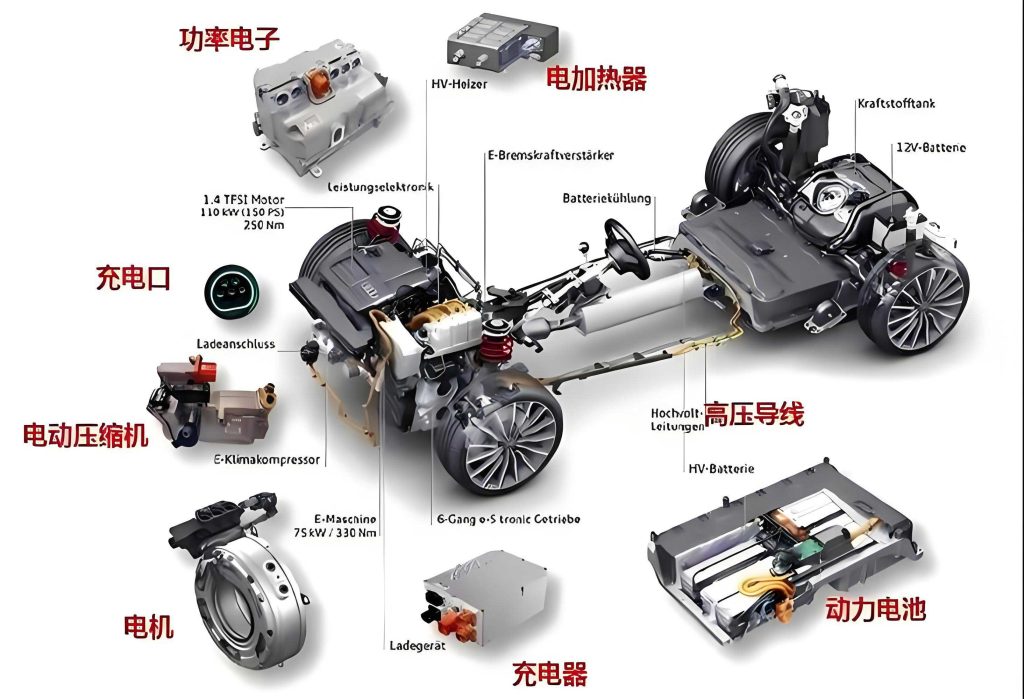
In this study, it is assumed that battery electric vehicles can respond to grid dispatch needs, exchanging energy with the power system via V2G technology when the grid requires additional power. Given the significant uncertainty in BEV driving distance, charging demand, and grid connection timing, the management strategy must first ensure that user travel needs are met.
Analyzing data on household car usage patterns reveals that daily driving distance follows a lognormal distribution. Therefore, the daily driving distance $s$ for a BEV user can be approximated by the probability density function described by Eq. (1):
$$f_s ( x ) = \frac{1}{x} \cdot \frac{1}{\sigma_s \sqrt{2\pi}} \exp \left( -\frac{(\ln x – \mu_s )^2}{2\sigma_s^2} \right)$$
where $\mu_s$ is the expected value of the daily driving distance, taken as 3.2, and $\sigma_s$ is the standard deviation of the daily driving distance, taken as 0.88.
The probability density function for the user’s charging start time $f_{t_{cf}} ( t )$ is as follows:
$$f_{t_{cf}} ( t ) =
\begin{cases}
\frac{1}{\sigma_D \sqrt{2\pi}} \exp \left( -\frac{( t – \mu_D )^2}{2\sigma_D^2} \right), & \mu_D – 12 < t \leq 24 \\[10pt]
\frac{1}{\sigma_D \sqrt{2\pi}} \exp \left( -\frac{( t + 24 – \mu_D )^2}{2\sigma_D^2} \right), & 0 < t \leq \mu_D – 12
\end{cases}$$
where $\mu_D$ is the expected start time of charging for a battery electric vehicle, set to 17.6; $\sigma_D$ is the standard deviation of the charging start time, taken as 3.4; and $t$ is the time point when charging starts.
The probability density function for charging duration $f_{t_c} ( s )$ is given by:
$$f_{t_c} ( s ) = \frac{1}{s\sigma_s \sqrt{2\pi}} \exp \left( -\frac{(\ln P_{sc} – \ln 0.15 – \mu_s )^2}{2\sigma_s^2} \right)$$
where $P_{sc}$ is the charging power of a single BEV.
Since the parameters for each user’s driving behavior are independent and uncorrelated, Monte Carlo simulation sampling techniques can be employed to capture the statistical patterns of these behaviors and predict the daily power demand profile for BEVs. By constructing this load model and incorporating the load demand under a Demand Response (DR) strategy, the grid dispatch center can accurately calculate the adjustable BEV charging or discharging power for each time period.
1.2 Distribution Network Operation Model
1.2.1 Distribution Network Voltage Index
Among the many criteria for evaluating distribution network stability, node voltage stability is a crucial indicator. Let the characteristic value of voltage fluctuation in a distribution network over a single period be $U_{level}$, calculated as follows:
$$U_{level} = \frac{1}{T} \sum_{t=1}^{T} \left( \sum_{i=1}^{N} \left( \frac{U_{i,t} – U_0}{\Delta U_{i, \max}} \right)^2 \right)$$
where $T$ is the total time length of the calculation period; $N$ is the total number of nodes in the distribution network; $U_{i,t}$ and $U_0$ are the voltage at node $i$ at time $t$ and the standard voltage, respectively; and $\Delta U_{i, \max}$ is the maximum allowable voltage deviation for node $i$.
1.2.2 Regulation Cost Indicators
1) PV System Reactive Power Control Cost
PV systems in the network can provide reactive power support because their active power output typically does not reach the inverter’s maximum rated capacity. The relationship between the adjustable reactive power capacity of a PV inverter and its rated capacity can be expressed as:
$$Q_{PV} = \pm \sqrt{S_{PV}^2 – P_{PV}^2}$$
where $Q_{PV}$ is the maximum adjustable reactive power capacity of the PV inverter; $S_{PV}$ is the rated capacity of the PV inverter; and $P_{PV}$ is the active power output of the PV generation.
Considering that PV systems are generally not allowed to reduce their active power output during grid-connected operation, PV inverters should be utilized as controllable reactive power sources to participate in voltage regulation. The reactive power output control cost $C_{PV}$ is expressed as follows:
$$C_{PV} = \sum_{i=1}^{n} k_{PV}^c \cdot |Q_{PV,i,t}|$$
where $k_{PV}^c$ is the cost coefficient for per-unit reactive power regulation of the PV system, taken as 0.32 $/kVar in this paper; $Q_{PV,i,t}$ is the reactive power regulation amount of the PV inverter at node $i$ during period $t$; and $n$ is the number of PV systems connected to the distribution network.
2) Battery Electric Vehicle Compensation Price
If a fleet of battery electric vehicles charges or discharges at a constant power level during a specific period, the compensation model can be established as shown in Eq. (7):
$$C_{EV} = \sum_{i=1}^{N_{EV}} (C_{com} + C_f + C_c) = \sum_{i=1}^{N_{EV}} k_{EV}^c \cdot |P_{EV,i,t}|$$
where $C_{com}$, $C_f$, and $C_c$ represent communication expenses, financial losses, and the cost associated with reduced comfort, respectively; $k_{EV}^c$ is the compensation coefficient for per-unit charging/discharging energy for users, set to 0.473 $/kW in this paper; $P_{EV,i,t}$ is the aggregated charging/discharging power of the battery electric vehicle fleet at node $i$ at time $t$; and $N_{EV}$ is the number of nodes with BEV integration.
2. Distribution Network Voltage Control Model Considering Battery Electric Vehicles
2.1 Objective Function
In this work, to comprehensively consider the economics of PV system operation and battery electric vehicle dispatch, as well as the operational stability of the distribution network, we construct key distribution network indicators and a BEV load model to further optimize the configuration of PV reactive power output and BEV charging/discharging strategies over a dispatch period. The formulated objective function is a weighted sum:
$$\min f = \omega_1 \cdot U_{level} + \omega_2 \cdot (C_{PV} + C_{EV})$$
where $\omega_1$ and $\omega_2$ are weighting factors, balancing voltage quality against regulation cost.
2.2 Constraints
1) Equality Constraints (Power Flow Equations)
$$\begin{cases}
P_{PV,i} – P_{L,i} \pm P_{EV,i} = U_i \sum_{j=1}^{N} U_j (G_{ij} \cos \theta_{ij} + B_{ij} \sin \theta_{ij}) \\[5pt]
Q_{PV,i} – Q_{L,i} = U_i \sum_{j=1}^{N} U_j (G_{ij} \sin \theta_{ij} – B_{ij} \cos \theta_{ij})
\end{cases}$$
where $P_{PV,i}$, $Q_{PV,i}$ are the active and reactive power outputs of the PV source at node $i$; $P_{L,i}$, $Q_{L,i}$ are the active and reactive power of the conventional load at node $i$; $P_{EV,i}$ is the active power exchange (positive for charging, negative for discharging) of the integrated battery electric vehicle fleet at node $i$; $U_i$, $U_j$ are the voltage magnitudes at nodes $i$ and $j$; and $G_{ij}$, $B_{ij}$, $\theta_{ij}$ are the conductance, susceptance, and voltage phase angle difference between nodes $i$ and $j$, respectively.
2) PV System Reactive Power Output Constraints
$$Q_{PV\min,i} \leq Q_{PV,i,t} \leq Q_{PV\max,i}$$
where $Q_{PV\min,i}$, $Q_{PV\max,i}$ are the lower and upper limits of the adjustable reactive power capacity for the PV source at node $i$.
3) Battery Electric Vehicle Charging/Discharging Power Constraints
$$\begin{cases}
P_{EV\min,c}^i \leq P_{EV,c}^{i,t} \leq P_{EV\max,c}^i \\[5pt]
P_{EV\min,d}^i \leq P_{EV,d}^{i,t} \leq P_{EV\max,d}^i
\end{cases}$$
where $P_{EV,c}^{i,t}$, $P_{EV,d}^{i,t}$ are the controllable aggregate charging and discharging power of the battery electric vehicle fleet at node $i$ at time $t$; $P_{EV\max,c}^i$, $P_{EV\min,c}^i$ and $P_{EV\max,d}^i$, $P_{EV\min,d}^i$ are the maximum and minimum controllable charging and discharging powers for the BEV fleet at node $i$, respectively.
4) Battery Electric Vehicle State of Charge (SOC) Constraints
$$SOC_{i,\min} \leq SOC_i(t) \leq SOC_{i,\max}, \quad SOC_i(T_{depart}) \geq SOC_{i,req}$$
This ensures the SOC of each BEV fleet remains within safe bounds and meets the user’s required SOC at the scheduled departure time.
5) Node Voltage Security Constraints
$$U_{\min} \leq U_{i,t} \leq U_{\max}$$
where $U_{\min}$ and $U_{\max}$ are the permissible minimum and maximum voltage limits, typically ±7% of the nominal voltage.
3. The Marine Predators Algorithm (MPA)
The Marine Predators Algorithm (MPA) is a novel nature-inspired metaheuristic developed based on the foraging behavior of marine predators. The algorithm’s design is inspired by the movement patterns of predators like sharks and tunas during hunting, particularly mimicking their Lévy and Brownian motion strategies, and considering the efficient encounter rate between predator and prey. MPA reflects the natural selection principles in marine ecology and exhibits notable adaptability, rapid search capability, and excellent optimization performance.
3.1 Algorithmic Principles
In the initialization phase, MPA establishes the starting positions for both prey and predators. An Elite matrix $\mathbf{E}$ is formed using the fittest predator individuals:
$$\mathbf{E} = \begin{bmatrix}
X_{I_{1,1}} & X_{I_{1,2}} & \cdots & X_{I_{1,d}} \\
X_{I_{2,1}} & X_{I_{2,2}} & \cdots & X_{I_{2,d}} \\
\vdots & \vdots & \ddots & \vdots \\
X_{I_{n,1}} & X_{I_{n,2}} & \cdots & X_{I_{n,d}}
\end{bmatrix}_{n \times d}$$
where $n$ is the population size, $d$ is the problem dimension, and $X_{I_{n,d}}$ is the position of the $n^{th}$ elite in the $d^{th}$ dimension. Simultaneously, a Prey matrix $\mathbf{P}$ is constructed based on the uniform distribution of prey positions, as in Eq. (13). The optimization process is divided into three main phases based on velocity ratio, corresponding to different iterative stages.
Phase 1: High Velocity Ratio (Exploration Phase)
This occurs in the first third of iterations ($Iter \leq \frac{1}{3}Max\_Iter$). Prey moves faster than predators. Predators stay still, while prey performs Brownian motion. The update rule is:
$$\begin{aligned}
&\mathbf{S}_i = \mathbf{R}_B \otimes (\mathbf{E}_i – \mathbf{R} \otimes \mathbf{P}_i) \\
&\mathbf{P}_i = \mathbf{P}_i + 0.5 \cdot \mathbf{R} \otimes \mathbf{S}_i
\end{aligned}$$
where $\mathbf{R}_B$ is a vector of random numbers based on Brownian motion, $\mathbf{R}$ is a vector of uniform random numbers in [0,1], and $\otimes$ denotes element-wise multiplication.
Phase 2: Unit Velocity Ratio (Exploitation-Exploration Phase)
This occurs in the middle third of iterations ($\frac{1}{3}Max\_Iter < Iter < \frac{2}{3}Max\_Iter$). Predator and prey move at similar speeds. The population is split: the first half (prey) follows Lévy motion (Eq. 15), while the second half (predators) follows Brownian motion (Eq. 16).
$$\begin{aligned}
&\text{For } i=1,…,n/2: \\
&\quad \mathbf{S}_i = \mathbf{R}_L \otimes (\mathbf{E}_i – \mathbf{R} \otimes \mathbf{P}_i) \\
&\quad \mathbf{P}_i = \mathbf{P}_i + 0.5 \cdot \mathbf{R} \otimes \mathbf{S}_i \\[10pt]
&\text{For } i=n/2+1,…,n: \\
&\quad \mathbf{S}_i = \mathbf{R}_B \otimes (\mathbf{R}_B \otimes \mathbf{E}_i – \mathbf{P}_i) \\
&\quad \mathbf{P}_i = \mathbf{E}_i + 0.5 \cdot CF \otimes \mathbf{S}_i
\end{aligned}$$
where $\mathbf{R}_L$ is a vector based on Lévy flight, and $CF$ is an adaptive parameter controlling step size: $CF = \left(1 – \frac{Iter}{Max\_Iter}\right)^{\left(2 \frac{Iter}{Max\_Iter}\right)}$.
Phase 3: Low Velocity Ratio (Exploitation Phase)
This occurs in the final third of iterations ($Iter \geq \frac{2}{3}Max\_Iter$). Predators move faster than prey. Predators perform intensive Lévy flight for local search:
$$\begin{aligned}
&\mathbf{S}_i = \mathbf{R}_L \otimes (\mathbf{R}_L \otimes \mathbf{E}_i – \mathbf{P}_i) \\
&\mathbf{P}_i = \mathbf{E}_i + 0.5 \cdot CF \otimes \mathbf{S}_i
\end{aligned}$$
Additionally, MPA incorporates environmental effects like Fish Aggregating Devices (FADs) or eddy formation to avoid local optima. With a probability $FADs$ (e.g., 0.2), positions are updated as:
$$\mathbf{P}_i = \begin{cases}
\mathbf{P}_i + CF [\mathbf{X}_{min} + \mathbf{R} \otimes (\mathbf{X}_{max} – \mathbf{X}_{min})] \otimes \mathbf{U} & \text{if } r \leq FADs \\
\mathbf{P}_i + [FADs(1-r) + r] (\mathbf{P}_{r1} – \mathbf{P}_{r2}) & \text{if } r > FADs
\end{cases}$$
where $\mathbf{U}$ is a binary vector, $r$ is a random number, $\mathbf{X}_{max/min}$ are the bounds, and $\mathbf{P}_{r1}, \mathbf{P}_{r2}$ are random prey positions.
4. Solution Methodology: MPA for Voltage Optimization
The MPA is implemented to solve the proposed voltage optimization model. The control variables include the reactive power output of each PV system ($Q_{PV,i,t}$) and the active power exchange of each battery electric vehicle fleet ($P_{EV,i,t}$) for all time periods $t$ in the scheduling horizon. The solution process is as follows:
Step 1: Input distribution network data, PV and battery electric vehicle fleet parameters, load profiles, and MPA parameters (population size $n$, maximum iterations $Max\_Iter$, $FADs$).
Step 2: Initialize the MPA population. Each individual in the population represents a potential solution vector containing all control variables for all time steps.
Step 3: For each individual, run a power flow calculation (e.g., forward-backward sweep) for the distribution network for each time period $t$ using the control variable values from the solution vector.
Step 4: Calculate the objective function value $f$ from Eq. (8) for each individual, considering the resulting voltage profile ($U_{level}$) and the regulation costs ($C_{PV}+C_{EV}$).
Step 5: Identify the elite (best) solutions and update the Elite matrix $\mathbf{E}$.
Step 6: Update the positions of all individuals (prey/predators) in the population according to the MPA rules (Phases 1-3 and FADs effect) based on the current iteration count.
Step 7: Check termination criteria (e.g., reaching $Max\_Iter$). If not met, go to Step 3.
Step 8: Output the best-found solution, which provides the optimal schedule for PV reactive power and battery electric vehicle charging/discharging power.
5. Case Study and Analysis
5.1 Test System and Data
The proposed method is tested on a modified IEEE 33-node radial distribution system. The base values are 0.315 MVA and 0.38 kV. The maximum allowable voltage deviation is set to ±7%, with the substation (root) voltage at 1.07 p.u. Power flow is solved using the forward-backward sweep method. Three PV systems are integrated at nodes 3, 10, and 17, each with an inverter rated at 0.3 MVA. The 24-hour PV active power output profile is shown in the simulation. Battery electric vehicle fleets are assumed to be connected at nodes 15 and 32, with aggregated capacities of 0.45 MW and 0.36 MW, respectively. The charging/discharging power limit per BEV fleet is 4 kW. The daily conventional load curve for the system is utilized. The BEV stochastic load is generated via Monte Carlo simulation based on the models in Section 1.1. The weighting factors in the objective function are set as $\omega_1=0.7$ and $\omega_2=0.3$ to prioritize voltage quality while considering cost.
5.2 Performance of the Optimization Algorithm
To verify the effectiveness of the Marine Predators Algorithm for solving the proposed model, its performance is compared with the standard Particle Swarm Optimization (PSO) algorithm. Both algorithms are run with a population size of 50 for 500 iterations. The convergence curves of the best objective function value are analyzed.
The results indicate that the PSO algorithm requires over 400 iterations to converge to a near-optimal solution. In contrast, the MPA converges to a better solution in fewer than 100 iterations. This demonstrates that MPA has a faster convergence speed and higher convergence precision for this high-dimensional, nonlinear mixed-integer optimization problem, effectively reducing the risk of getting trapped in local optima.
5.3 Voltage Profile Optimization Results
The voltage profiles at critical nodes (nodes 3, 10, and 18) are examined under three scenarios: 1) Base case with PV at normal output and uncoordinated BEV charging; 2) Optimized case using PSO; 3) Optimized case using MPA.
In the base case, significant voltage violations occur during midday (due to high PV reverse power flow) and in the evening (due to high load and no PV generation). Both optimization algorithms successfully adjust the PV reactive power and schedule the battery electric vehicle fleets (using V2G during peaks and strategic charging during off-peak or high-PV periods) to bring all node voltages within the permissible limits [0.93, 1.07] p.u. However, the voltage profile obtained by the MPA-based optimization is flatter and exhibits smaller overall deviation ($U_{level}$) compared to the PSO result, indicating superior voltage quality regulation.
5.4 Economic Analysis of Coordinated Control
The total regulation cost and the achieved voltage deviation index are compared for different optimization runs. The following table summarizes key results:
| Optimization Scenario | Voltage Deviation Index $(U_{level})$ | Total Regulation Cost [\$] $(C_{PV}+C_{EV})$ | Weighted Objective Value $(f)$ |
|---|---|---|---|
| Uncoordinated (Base Case) | 15.72 | 0.00 | 11.00 (Calculated) |
| PSO-based Optimization | 2.85 | 1145.68 | 5.02 |
| MPA-based Optimization | 2.41 | 1065.61 | 4.59 |
| MPA (Ignoring Cost, $\omega_2=0$) | 2.08 | 1345.63 | 1.46 (Voltage only) |
The analysis reveals that using MPA while considering costs leads to a total regulation cost of \$1065.61, which is \$80.07 lower than the cost found by PSO (\$1145.68). Furthermore, when the MPA-based optimization explicitly considers the regulation cost (with $\omega_2=0.3$), it achieves significant cost savings of \$280.02 compared to the scenario where MPA solely minimizes voltage deviation (ignoring cost, resulting in a cost of \$1345.63). This validates the economic efficiency of the proposed coordinated model and the ability of MPA to find a cost-effective solution without compromising voltage stability. The integration of battery electric vehicles as a flexible resource is crucial to achieving this economic benefit, as their scheduling provides an additional, often cheaper, control lever compared to relying solely on PV reactive power support.
6. Conclusion
This paper proposed a comprehensive voltage optimization model for distribution networks with high penetration of distributed photovoltaics and battery electric vehicles. The model simultaneously minimizes node voltage deviation and the economic cost associated with utilizing PV reactive power support and scheduling battery electric vehicle charging/discharging. The Marine Predators Algorithm (MPA) was effectively applied to solve this complex, constrained optimization problem.
The main conclusions are as follows:
- The established model, when solved with MPA, successfully determines optimal schedules for PV reactive power output and battery electric vehicle active power exchange. By considering the respective constraints of these resources, it effectively mitigates voltage violations caused by PV fluctuations and peak loads, leading to a flatter and more stable voltage profile across the distribution network.
- The coordinated use of battery electric vehicles (via V2G) and PV inverters provides a more robust and economically efficient solution for voltage control compared to using either resource in isolation. The model explicitly balances grid performance (voltage quality) with operational cost.
- The Marine Predators Algorithm proves to be highly suitable for this type of distribution network optimization problem. Comparative analysis with the standard Particle Swarm Optimization algorithm demonstrates that MPA possesses faster convergence speed, higher solution quality, and better ability to avoid local optima. It efficiently finds a solution that yields lower total regulation cost and better voltage regulation.
Future work could involve incorporating more detailed models of battery degradation for the battery electric vehicles, considering three-phase unbalanced power flow, and testing the approach on larger, real-world distribution networks with stochastic renewable generation and load.