
As an engineer and researcher in the field of energy storage, I have witnessed a paradigm shift with the advent of solid-state battery systems. These innovative power sources are poised to revolutionize everything from portable electronics to grid-scale applications, offering unprecedented safety, efficiency, and longevity. In this comprehensive analysis, I will delve into the intricacies of solid-state battery technology, exploring its fundamental principles, comparative advantages, mathematical modeling, and diverse applications. The journey toward more reliable and sustainable energy storage begins with understanding why solid-state battery solutions are garnering such widespread attention.
The core innovation of a solid-state battery lies in its use of a solid electrolyte instead of the liquid or gel electrolytes found in conventional lithium-ion batteries. This seemingly simple substitution unlocks a host of benefits. Solid electrolytes, often composed of ceramics, polymers, or composites, eliminate the risk of leakage and thermal runaway—a common failure mode in liquid electrolytes that can lead to fires. Furthermore, the solid-state architecture enables the use of high-capacity lithium metal anodes, dramatically increasing energy density. From my perspective, the transition to solid-state battery design is not merely an incremental improvement but a foundational change that addresses the critical limitations of current energy storage media.
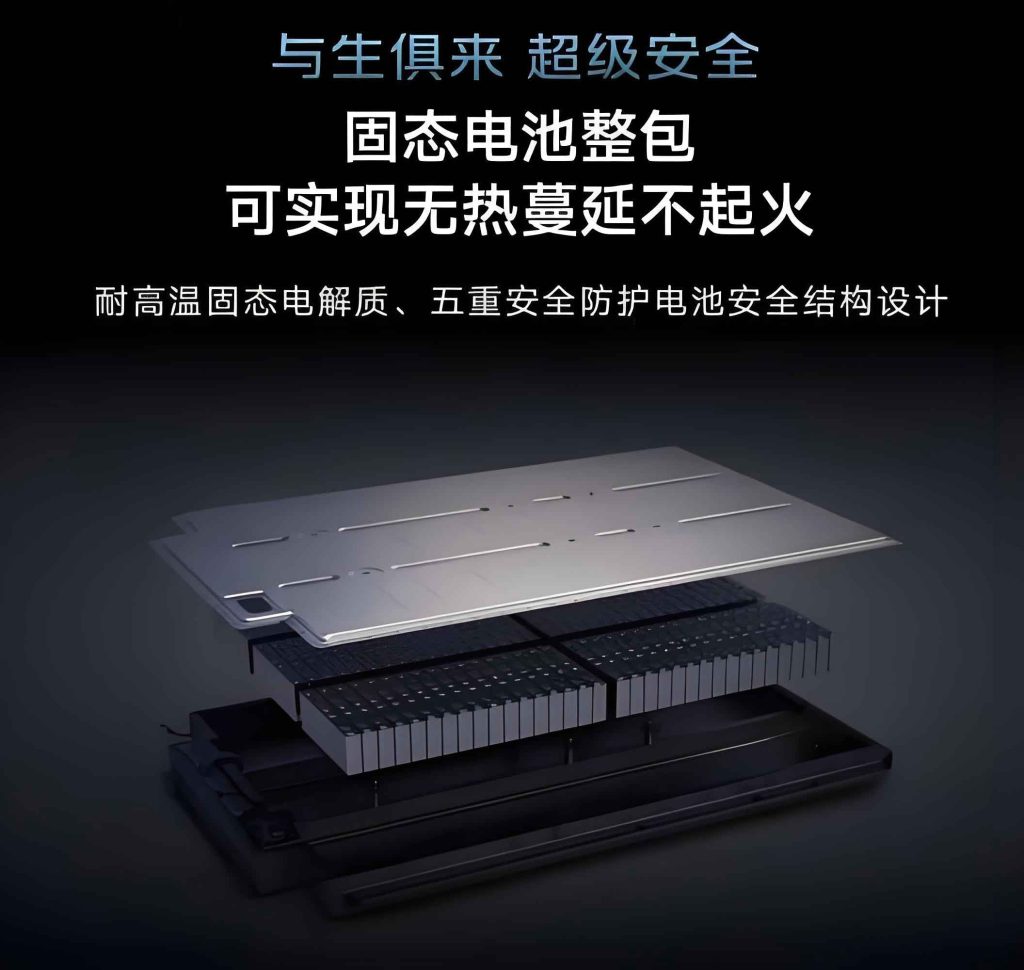
To appreciate the performance metrics of a solid-state battery, we must first examine the key parameters that define any energy storage device. Energy density, power density, cycle life, and safety are paramount. The energy density of a battery, often expressed in watt-hours per kilogram (Wh/kg), determines how much energy it can store relative to its weight. For a solid-state battery, this value can be significantly higher than that of traditional lithium-ion batteries. We can represent the theoretical energy density using the formula:
$$ E_d = \frac{n \times F \times V}{M} $$
where \( E_d \) is the gravimetric energy density, \( n \) is the number of electrons transferred per molecule, \( F \) is Faraday’s constant (approximately 96485 C/mol), \( V \) is the average cell voltage, and \( M \) is the molar mass of the active materials. In a solid-state battery utilizing a lithium metal anode, the value of \( n \) and the effective voltage \( V \) are optimized, leading to an \( E_d \) that can exceed 500 Wh/kg in advanced designs. This is a leap forward compared to the 250-300 Wh/kg typical of commercial lithium-ion cells.
Power density, which relates to how quickly energy can be delivered or absorbed, is another critical factor. The solid electrolyte’s ionic conductivity, denoted by \( \sigma_i \), directly impacts this. While early solid electrolytes suffered from low conductivity, recent advancements in materials science have yielded compounds with \( \sigma_i \) values rivaling liquid electrolytes, often above 10 mS/cm at room temperature. The power capability can be modeled using the relation for power density \( P_d \):
$$ P_d = \frac{V^2}{4 \times R_i \times m} $$
Here, \( R_i \) is the internal resistance (inversely related to \( \sigma_i \)) and \( m \) is the mass. A solid-state battery with a high-conductivity electrolyte minimizes \( R_i \), enabling high power output suitable for applications like electric vehicles requiring rapid acceleration.
Let’s compare the solid-state battery with other common storage technologies. The table below summarizes the essential characteristics, highlighting why the solid-state battery is considered a superior alternative in many scenarios.
| Technology | Energy Density (Wh/kg) | Power Density (W/kg) | Cycle Life (cycles) | Safety Risk | Typical Applications |
|---|---|---|---|---|---|
| Solid-State Battery | 300 – 500+ | 500 – 2000+ | > 1000 | Very Low | EVs, Wearables, Grid Storage |
| Lithium-Ion Battery (Liquid) | 150 – 300 | 250 – 1000 | 500 – 1500 | Moderate to High | Consumer Electronics, EVs |
| Supercapacitor | 1 – 10 | 1000 – 10000 | > 100,000 | Low | Memory Backup, Power Buffers |
| Nickel-Metal Hydride | 60 – 120 | 200 – 500 | 300 – 800 | Low | Hybrid Vehicles, Toys |
| Lead-Acid | 30 – 50 | 100 – 500 | 200 – 500 | Low (but toxic) | Automotive Starters, UPS |
As evident, the solid-state battery excels in energy density while maintaining excellent safety—a combination that is hard to achieve with liquid electrolytes. The cycle life of a solid-state battery is also enhanced because the solid interface reduces parasitic side reactions and dendrite formation, which typically degrade lithium-ion cells. Dendrite growth, a major failure mechanism, can be described by a modified diffusion equation. The growth rate \( v_d \) of lithium dendrites in a liquid electrolyte is often proportional to the current density \( j \):
$$ v_d \propto j \times \exp\left(\frac{-E_a}{kT}\right) $$
where \( E_a \) is the activation energy, \( k \) is Boltzmann’s constant, and \( T \) is temperature. In a solid-state battery, the mechanical strength of the solid electrolyte suppresses dendrite propagation, effectively increasing \( E_a \) and reducing \( v_d \) to near zero. This translates directly into longer operational life, making the solid-state battery ideal for applications where reliability over many charge-discharge cycles is paramount.
The application spectrum for solid-state battery technology is vast. In energy harvesting systems, such as those powered by solar, thermal, or kinetic sources, a solid-state battery serves as an efficient buffer storage element. Unlike supercapacitors, which offer high power but low energy density, a solid-state battery provides sufficient energy capacity to sustain microcontrollers, sensors, and memory through periods of low or no harvest. The charge retention in a solid-state battery is superior due to lower self-discharge rates, modeled by the self-discharge current \( I_{sd} \):
$$ I_{sd} = I_0 \times \exp\left(-\frac{\Delta G}{RT}\right) $$
Here, \( I_0 \) is a pre-exponential factor, \( \Delta G \) is the Gibbs free energy change of parasitic reactions, \( R \) is the gas constant, and \( T \) is temperature. The inert nature of solid electrolytes raises \( \Delta G \), minimizing \( I_{sd} \) and allowing energy to be stored for weeks or months—a critical feature for maintenance-free IoT devices.
In wearable technology, the form factor and safety of a solid-state battery are unparalleled. Its thin-film variants can be fabricated directly onto flexible substrates, enabling seamless integration into clothing, smartwatches, and medical patches. The volumetric energy density \( E_v \), given by \( E_v = E_d \times \rho \) where \( \rho \) is density, remains high even in ultra-thin configurations. Moreover, the absence of toxic or flammable materials makes the solid-state battery biocompatible, addressing concerns for direct skin contact or implantable devices.
Manufacturing and integration present both challenges and opportunities. Fabricating a solid-state battery often involves processes akin to semiconductor manufacturing, such as physical vapor deposition or sol-gel techniques. This compatibility with integrated circuit (IC) production lines allows for monolithic integration of power storage with logic circuits, paving the way for “battery-on-chip” solutions. The cost per unit energy, while currently higher than mature lithium-ion technology, is projected to decline sharply with scale. A simplified cost model can be expressed as:
$$ C_{total} = C_{materials} + C_{processing} + C_{packaging} $$
For a solid-state battery, \( C_{materials} \) may be higher due to specialty electrolytes, but \( C_{processing} \) benefits from automation and \( C_{packaging} \) is reduced because fewer safety enclosures are needed. Over the product’s entire lifecycle, the total cost of ownership often favors the solid-state battery due to its durability and elimination of replacement needs.
To further illustrate the performance envelopes, consider the following table comparing specific solid-state battery chemistries under development. Each variant offers trade-offs between conductivity, stability, and energy density.
| Solid Electrolyte Type | Ionic Conductivity at 25°C (S/cm) | Voltage Window (V) | Compatibility with Li Anode | Estimated Energy Density (Wh/kg) | Key Challenges |
|---|---|---|---|---|---|
| Oxide-based (e.g., LLZO) | 10-3 to 10-4 | 0 – 5 | Excellent | 400 – 600 | Brittleness, High Temp Sintering |
| Sulfide-based (e.g., LGPS) | 10-2 to 10-3 | 0 – 5 | Good | 350 – 500 | Moisture Sensitivity, Cost |
| Polymer-based (e.g., PEO) | 10-5 to 10-4 | 0 – 4 | Moderate | 200 – 300 | Low Conductivity at RT |
| Halide-based (e.g., Li3YCl6) | 10-3 to 10-2 | 0 – 4.5 | Excellent | 300 – 450 | Hy groscopicity |
The evolution of these materials is accelerating, driven by computational screening and advanced characterization. The ionic transport in a solid electrolyte follows the Arrhenius law, where conductivity \( \sigma_i(T) = A \exp(-E_a / kT) \). By engineering materials with lower \( E_a \), researchers are pushing the solid-state battery toward room-temperature performance that matches or exceeds liquids.
Another fascinating aspect is the integration of solid-state battery units into larger systems for grid storage. Here, scalability and cycle life are crucial. A grid-scale solid-state battery bank can provide frequency regulation, peak shaving, and backup power. The efficiency \( \eta \) of such a system during a charge-discharge cycle is given by:
$$ \eta = \frac{E_{discharge}}{E_{charge}} \times 100\% $$
For a solid-state battery, \( \eta \) can exceed 99% due to minimal ohmic losses and negligible side reactions. This high efficiency, coupled with long calendar life, reduces levelized cost of storage (LCOS), a metric defined as:
$$ LCOS = \frac{C_{capital} + \sum_{t=1}^{N} \frac{C_{O\&M} + C_{replacement}}{(1+r)^t}}{\sum_{t=1}^{N} \frac{E_{output, t}}{(1+r)^t}} $$
where \( C_{capital} \) is initial cost, \( C_{O\&M} \) is operation and maintenance, \( C_{replacement} \) is replacement cost, \( r \) is discount rate, \( N \) is lifetime in years, and \( E_{output} \) is annual energy output. The solid-state battery’s longevity and low maintenance drive down \( C_{O\&M} \) and \( C_{replacement} \), making it economically attractive over decades of service.
In consumer electronics, the solid-state battery enables thinner devices with longer runtime. The elimination of bulky safety circuits reduces parasitic weight and volume. Consider a smartphone battery: its capacity \( C \) in ampere-hours (Ah) relates to energy \( E \) via \( E = C \times V \times 3600 \) joules. With a solid-state battery offering higher \( V \) and \( C \) in the same volume, user experience improves markedly. Moreover, fast-charging capabilities are enhanced because the solid electrolyte can withstand higher current densities without degradation. The charging time \( t_{charge} \) can be approximated by:
$$ t_{charge} = \frac{C}{I_{charge}} \times \frac{1}{\eta_{charge}} $$
where \( I_{charge} \) is charging current and \( \eta_{charge} \) is charging efficiency. For a solid-state battery, \( I_{charge} \) can be increased safely, slashing \( t_{charge} \) to minutes rather than hours.
Environmental impact is a growing concern, and here the solid-state battery shines. Its materials are often more abundant and less toxic than cobalt-rich lithium-ion chemistries. End-of-life recycling is simplified because the solid components are easier to separate. The life cycle assessment (LCA) of a solid-state battery shows a lower carbon footprint per kWh stored compared to incumbent technologies. We can quantify this with an emission factor \( EF \):
$$ EF = \frac{GHG_{total}}{E_{lifetime}} $$
where \( GHG_{total} \) is total greenhouse gas emissions from cradle to grave and \( E_{lifetime} \) is total energy delivered over the battery’s life. The robustness of the solid-state battery boosts \( E_{lifetime} \), thereby reducing \( EF \).
Looking ahead, research directions for solid-state battery technology include interface engineering, to reduce resistance at electrode-electrolyte junctions, and exploration of novel lithium-free anodes like silicon or tin. The ultimate goal is a commercial solid-state battery that is cost-competitive, high-performing, and universally adoptable. In my view, the convergence of nanotechnology, machine learning for material discovery, and advanced manufacturing will accelerate this timeline.
In conclusion, the solid-state battery represents a transformative leap in energy storage. Its superior energy density, safety, and longevity address the core limitations of current systems. From wearables to electric vehicles to grid infrastructure, the solid-state battery is poised to become the backbone of a sustainable energy future. As development continues, we can expect even more innovative form factors and integrations, solidifying the role of solid-state battery technology in powering our world.