
The widespread adoption of new energy vehicles has led to increasingly stringent requirements for the cold-weather adaptability of electric vehicles (EVs), directly impacting demands for cabin heating performance and efficiency. To address this, researchers have proposed utilizing the electric drive system as a heat source. This approach offers a dual advantage: it can recover and utilize waste heat generated during normal operation of the electric drive system to improve overall energy efficiency, and it can also enable the electric drive system to actively generate heat, supplementing the vehicle’s thermal management system and enhancing performance in extreme cold conditions.
This article focuses on the active heating functionality of the electric drive system. Traditionally, developing this function requires extensive experimental testing to establish the complex relationship between heating capability and influencing factors such as output torque, rotational speed, current, and motor angle. This process is costly and time-consuming. To streamline development, this work conducts a detailed mechanistic analysis of the active heating process. Based on this analysis, a comprehensive simulation model for the electric drive system active heating function is established. The accuracy of this model is subsequently verified through experimentation. This model serves as a powerful tool for simulating the active heating function, allowing developers to obtain critical data on heating power and its influencing factors through simulation rather than relying solely on physical tests. This approach significantly reduces development cycles and costs, laying a solid foundation for efficient function design and optimization.
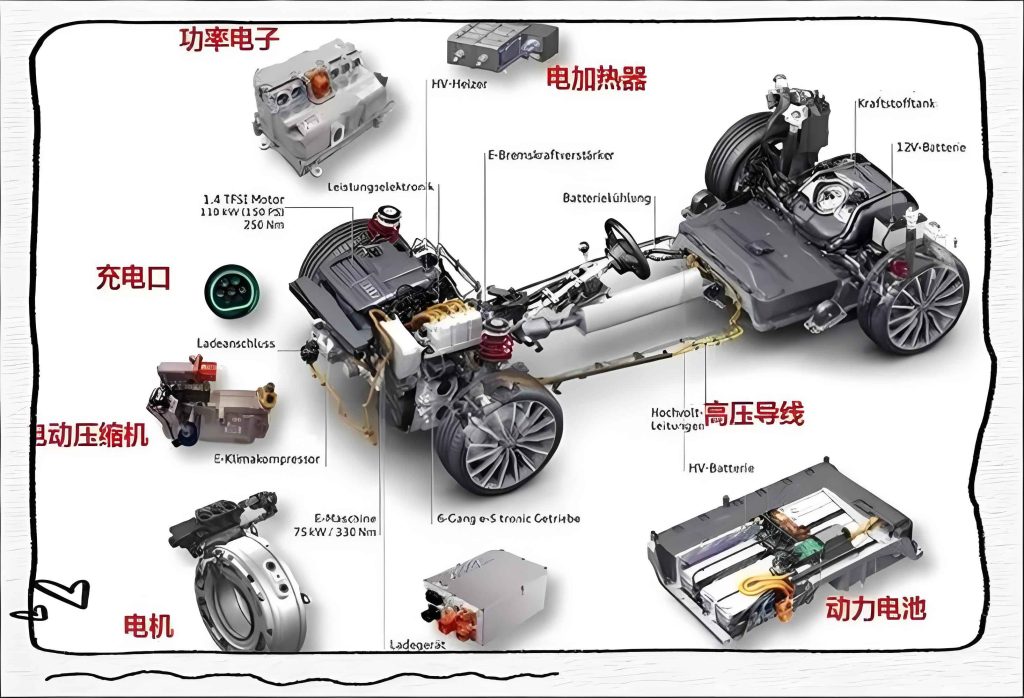
1. Theoretical Analysis of Heat Generation in Electric Drive Systems
The primary heat sources within an electric drive system during active heating are the inverter’s power modules (e.g., IGBTs and diodes) and the motor stator (comprising windings and the iron core). The system can operate in two primary modes: static heating (vehicle stationary, motor at zero speed) and dynamic heating (vehicle in motion). The following sections detail the theoretical basis for estimating losses, i.e., heat generation, in these key components.
1.1 Power Module Loss Estimation in the Motor Controller
The inverter typically uses a three-phase full-bridge configuration. Each bridge leg consists of an Insulated Gate Bipolar Transistor (IGBT) and an anti-parallel diode. Losses in these power modules are categorized into switching losses and conduction losses.
1.1.1 Switching Losses
The switching loss energy per switching event can be approximated based on datasheet parameters:
$$E_{sw}(i(t)) = E_{sw}(I_n, U_n) \cdot \frac{U_{DC}}{U_n} \cdot \frac{i(t)}{I_n}$$
where \(E_{sw}(I_n, U_n)\) is the switching loss energy provided in the datasheet at the test current \(I_n\) and test voltage \(U_n\), \(U_{DC}\) is the actual DC-link voltage, and \(i(t)\) is the instantaneous current. For a sinusoidal motor phase current with amplitude \(I_m\) and frequency \(f_m\), and with an inverter switching frequency \(f_{sw}\), the average switching power loss per device over a half current cycle can be derived. The total three-phase switching loss is:
$$P_{sw} = 6 \cdot f_{sw} \cdot E_{sw}(I_n, U_n) \cdot \frac{I_m}{I_n} \cdot \frac{U_{DC}}{U_n} \cdot \frac{2}{\pi}$$
A more concise form is often used:
$$P_{sw} = 6 f_{sw} E_{sw}(I_n, U_n) \frac{I_m U_{DC}}{\pi I_n U_n}$$
1.1.2 Conduction Losses
Conduction losses occur when the device is in the on-state. For the IGBT, the loss is calculated by integrating the product of the current and the on-state voltage drop over the conduction interval. The on-state voltage characteristic is typically modeled as \(V_{ce}(i) = V_{ce0} + r_{ce} \cdot i\), where \(V_{ce0}\) is the threshold voltage and \(r_{ce}\) is the on-state resistance. The conduction loss for all IGBTs in the three-phase bridge is:
$$P_{cond,IGBT} = \frac{6}{T} \int_0^T [V_{ce0} + r_{ce} \cdot i(t)] \cdot i(t) \cdot D(t) \, dt$$
where \(D(t)\) is the pulse-width modulation (PWM) duty cycle for the active switch, and \(T\) is the period of the motor current.
1.1.3 Diode Conduction Losses
When the IGBT is off, the inductive load current freewheels through the anti-parallel diode. Diode conduction loss is modeled similarly, with its characteristic \(V_f(i) = V_{f0} + r_f \cdot i\). The loss for all diodes is:
$$P_{cond,Diode} = \frac{6}{T} \int_0^T [V_{f0} + r_f \cdot i(t)] \cdot i(t) \cdot [1 – D(t)] \, dt$$
1.2 Motor Stator Loss Estimation
Losses in the motor stator, which convert electrical energy into heat, primarily consist of copper losses in the windings and iron losses (core losses) in the laminated steel.
1.2.1 Winding Copper Losses
Copper loss is the simplest to calculate, being the Joule heating due to the stator resistance \(R_s\) (per phase):
$$P_{cu} = (I_u^2 + I_v^2 + I_w^2) \cdot R_s = 3 I_{rms}^2 R_s$$
where \(I_u, I_v, I_w\) are the RMS phase currents and \(I_{rms}\) is the RMS current per phase.
1.2.2 Stator Iron Losses
Core loss is more complex, depending on flux density and frequency. The Bertotti loss separation model is widely used, which breaks down the total core loss \(P_{fe}\) into hysteresis, eddy current, and excess loss components:
$$P_{fe} = m \left( k_h f B_m^\alpha + k_c f^2 B_m^2 + k_e f^{1.5} B_m^{1.5} \right)$$
where \(m\) is the mass of the stator core, \(f\) is the frequency of the magnetic field (related to electrical frequency), \(B_m\) is the peak flux density, and \(k_h\), \(k_c\), \(k_e\) are the hysteresis, eddy current, and excess loss coefficients, respectively. Often, for simplicity and when operating in a typical range, the exponents are approximated, and the formula is used with empirical coefficients obtained from the steel manufacturer’s data sheets.
2. Active Heating Function Model
The active heating control strategy intentionally operates the electric drive system in a non-optimal efficiency point to maximize heat generation. The foundational motor equations in the d-q reference frame govern this operation:
$$T_e = \frac{3}{2} p \left[ \psi_f i_q + (L_d – L_q) i_d i_q \right] \tag{1}$$
$$i_d^2 + i_q^2 \le I_{max}^2 \tag{2}$$
$$(\psi_f + L_d i_d)^2 + (L_q i_q)^2 \le \left( \frac{U_{max}}{\omega_r} \right)^2 \tag{3}$$
where \(T_e\) is electromagnetic torque, \(p\) is pole pairs, \(\psi_f\) is permanent magnet flux linkage, \(L_d, L_q\) are d- and q-axis inductances, \(I_{max}\) is the maximum current, \(U_{max}\) is the maximum phase voltage, and \(\omega_r\) is the electrical rotor speed.
2.1 Static Active Heating Model
In static mode, the vehicle is stationary. To produce zero torque (\(T_e=0\)) while drawing current, equation (1) dictates that \(i_q\) must be controlled to zero. The heating is then controlled solely by the d-axis current \(i_d\). The three-phase currents become DC values dependent on the rotor angle \(\theta\):
$$
\begin{aligned}
i_u &= \sqrt{\frac{2}{3}} i_d \cos \theta \\
i_v &= \sqrt{\frac{2}{3}} i_d \cos(\theta – 2\pi/3) \\
i_w &= \sqrt{\frac{2}{3}} i_d \cos(\theta + 2\pi/3)
\end{aligned}
$$
We define the static heating current as \(I_{h,static} = \sqrt{2/3} \, i_d\). With the rotor locked, the motor primarily contributes copper loss: \(P_{cu,static} = 3 \cdot (I_{h,static}^2/3) \cdot R_s = I_{h,static}^2 R_s\). The inverter duty cycles are determined by the resistive voltage drop: \(D_x = 1/2 + (R_s i_x)/U_{DC}\).
Combining the power module loss models (with constant duty cycles) and the copper loss, the total static heating power \(P_{heat,static}\) can be expressed as a function of heating current \(I_h\), rotor angle \(\theta\), and switching frequency \(f_{sw}\):
$$
\begin{aligned}
P_{heat,static}(I_h, \theta, f_{sw}) &= P_{sw} + P_{cond,IGBT} + P_{cond,Diode} + P_{cu,static} \\
&= 6 f_{sw} E_{sw} \frac{I_h U_{DC}}{\pi I_n U_n} + I_h^2 R_s \\
&\quad + \frac{3}{U_{DC}} \left[ (V_{ce0}+V_{f0}) \cdot I_h \cdot \kappa_1(\theta) + (r_{ce}+r_f) \cdot I_h^2 \cdot \kappa_2(\theta) \right]
\end{aligned}
$$
where \(\kappa_1(\theta)\) and \(\kappa_2(\theta)\) are functions encapsulating the angle-dependent terms from the integration of the duty cycles.
2.2 Dynamic Active Heating Model
In dynamic mode, the vehicle is moving, and the motor produces torque. To activate heating, the control strategy deviates from the Maximum Torque Per Ampere (MTPA) trajectory, increasing the current magnitude for a given torque, often by injecting negative d-axis current (field-weakening) or positive d-axis current (field-strengthening, if possible). The phase current is sinusoidal. We define the dynamic heating current as the peak phase current: \(I_{h,dynamic} = \sqrt{2/3} \sqrt{i_d^2 + i_q^2}\).
For a phase current \(i(t) = I_h \cos(\omega_e t)\), the PWM duty cycle is \(D(t) = \frac{1}{2}[1 + M \cos(\omega_e t + \phi)]\), where \(M\) is the modulation index and \(\phi\) is the phase angle between voltage and current. The total dynamic heating power incorporates switching losses, conduction losses (which now involve integrating sinusoidal currents with sinusoidal duty cycles), copper losses (\(3 \cdot (I_h/\sqrt{2})^2 R_s\)), and the core losses from equation (1.2.2):
$$
P_{heat,dynamic}(I_h, \omega_r, f_{sw}) = P_{sw} + P’_{cond,IGBT} + P’_{cond,Diode} + P_{cu} + P_{fe}
$$
The conduction loss integrals \(P’_{cond}\) yield terms proportional to \(I_h\) and \(I_h^2\), modulated by factors involving \(M\) and \(\phi\).
3. Simulation of the Active Heating Function
Using the derived models, simulations can be performed to understand the relationship between heating power and key parameters. The simulation parameters for a sample electric drive system are listed below.
| Parameter | Value |
|---|---|
| DC Input Voltage (\(U_{DC}\)) | 400 V |
| Motor Peak Phase Current (\(I_{max}\)) | 0 – 500 A |
| Maximum Motor Speed | 15,000 rpm |
| Stator Winding Resistance (\(R_s\)) | 8.6 mΩ |
| Stator Core Mass (\(m\)) | 9.45 kg |
| Core Steel Type | DW310-35 |
| Number of Pole Pairs (\(p\)) | 4 |
| Power Module Rating | 750 V / 820 A |
| Switching Frequency Range (\(f_{sw}\)) | 5,000 – 9,000 Hz |
The product \(M \cos \phi\) (modulation index times power factor) appears in the dynamic conduction loss integrals. Analysis shows that its value has a relatively small impact (within ±3% of the mid-point value) on the total loss calculation across a wide current range. Therefore, for simulation efficiency, a constant value of \(M \cos \phi = 0.5\) is used.
Core loss coefficients for DW310-35 steel are derived from manufacturer data using curve fitting:
$$k_h = 0.0228, \quad k_c = 5.89 \times 10^{-5}, \quad k_e = 5.28 \times 10^{-18}$$
The core loss formula becomes:
$$P_{fe} = 9.45 \left( 0.0228 f B_m^{1.8} + 5.89\times10^{-5} f^2 B_m^2 + 5.28\times10^{-18} f^{1.5} B_m^{1.5} \right)$$
3.1 Simulation Cases and Results
Case 1: Static Heating – Effect of Rotor Angle and Current.
Simulation conditions: \(f_{sw}=9\) kHz, \(\theta = 0^\circ \text{ to } 90^\circ\), \(I_h = 100 \text{ to } 700\) A.
The results show that heating power varies periodically with rotor angle, with a period of \(60^\circ\). Maximum power occurs at angles \(n \cdot 60^\circ\), and minimum power at \(n \cdot 60^\circ + 30^\circ\), where \(n\) is an integer. Power increases with current.
| Heating Current \(I_h\) (A) | Heating Power @ \(\theta=0^\circ\) (kW) | Heating Power @ \(\theta=90^\circ\) (kW) |
|---|---|---|
| 300 | 2.67 | 2.50 |
| 400 | 4.37 | 4.13 |
| 500 | 6.49 | 6.15 |
Case 2: Static Heating – Effect of Switching Frequency.
Simulation conditions: \(\theta=90^\circ\), \(I_h = 100 \text{ to } 700\) A, \(f_{sw} = 5 \text{ to } 9\) kHz.
The results confirm that for a given current, heating power increases linearly with switching frequency due to the proportional increase in switching losses.
Case 3: Dynamic Heating – Effect of Rotor Speed and Current.
Simulation conditions: \(f_{sw}=9\) kHz, Speed = \(1,000 \text{ to } 12,000\) rpm, \(I_h = 100 \text{ to } 700\) A.
The results indicate that for a fixed current and switching frequency, heating power increases with motor speed. This is primarily due to the increase in core losses (\(P_{fe}\)) and, to a lesser extent, changes in conduction loss integration, which are proportional to frequency.
| Heating Current \(I_h\) (A) | Heating Power @ 2,000 rpm (kW) | Heating Power @ 9,000 rpm (kW) |
|---|---|---|
| 350 | 3.45 | 4.80 |
| 450 | 5.21 | 6.72 |
| 550 | 7.31 | 9.02 |
Case 4: Dynamic Heating – Effect of Switching Frequency.
Simulation conditions: Speed = \(2,000\) rpm, \(I_h = 100 \text{ to } 700\) A, \(f_{sw} = 5 \text{ to } 9\) kHz.
Similar to the static case, heating power increases with switching frequency in dynamic mode.
3.2 Application of Simulation Results for Function Design
The simulation results provide actionable insights for designing the active heating control strategy in the electric drive system:
- Static Mode Optimization: The control strategy can adjust the rotor angle to near \(n \cdot 60^\circ\) to maximize heating power for a given current, or minimize current for a required power, reducing thermal stress.
- Switching Frequency Control: Implementing variable switching frequency allows fine-tuning of heating power in both static and dynamic modes, especially useful when current is at its limit.
- Dynamic Mode Efficiency: At high motor speeds, the inherent core loss provides significant heat. The strategy can reduce the active heating current to meet the heating demand, thereby improving the overall energy efficiency of the electric drive system.
- Low-Speed Boost: During low-speed operation where core loss is small, the heating power can be boosted by increasing the switching frequency if the current limit is reached.
4. Experimental Verification of the Active Heating Function
An experimental test bench was set up to validate the simulation model. It consisted of the electric drive system unit, a dynamometer, a high-voltage power supply, a cooling system, and power analyzers.
4.1 Test Cases
Static Heating Tests: Conducted at \(U_{DC}=400\) V, \(f_{sw}=9\) kHz, \(i_q=0\), with rotor angles fixed at \(0^\circ\) and \(90^\circ\). Heating current \(I_h\) was varied between 300A and 400A.
Dynamic Heating Tests: Conducted at \(U_{DC}=400\) V, \(f_{sw}=9\) kHz, at constant speeds of 2,000 rpm and 9,000 rpm. Heating current \(I_h\) was varied between 350A and 480A.
4.2 Results and Comparison with Simulation
The deviation between measured power \(P_{meas}\) and simulated power \(P_{sim}\) is calculated as:
$$\sigma = \frac{P_{meas} – P_{sim}}{P_{meas}} \times 100\%$$
The comparison for selected test points is shown below.
| Mode | Condition | \(I_h\) (A) | \(P_{meas}\) (kW) | \(P_{sim}\) (kW) | Deviation \(\sigma\) |
|---|---|---|---|---|---|
| Static | \(\theta=0^\circ\) | 350 | 3.53 | 3.42 | +3.1% |
| 372 | 3.91 | 3.76 | +3.8% | ||
| 408 | 4.57 | 4.38 | +4.2% | ||
| Static | \(\theta=90^\circ\) | 350 | 3.35 | 3.21 | +4.2% |
| 372 | 3.70 | 3.53 | +4.6% | ||
| 408 | 4.38 | 4.13 | +5.7% | ||
| Dynamic | 2,000 rpm | 387 | 4.02 | 3.92 | +2.5% |
| 434 | 4.92 | 4.69 | +4.7% | ||
| 484 | 5.96 | 5.57 | +6.5% | ||
| Dynamic | 9,000 rpm | 387 | 5.51 | 5.29 | +4.0% |
| 434 | 6.44 | 6.09 | +5.4% | ||
| 484 | 7.65 | 7.01 | +8.4% |
Analysis:
- For static heating, the deviation between experiment and simulation is within approximately 6%. The predicted trend of power variation with rotor angle is confirmed.
- For dynamic heating, deviations are within about 8%. The model correctly predicts the increase in heating power with rotational speed.
- The consistent positive deviation (simulation slightly lower than experiment) can be attributed to the model not accounting for secondary loss mechanisms like rotor losses or mechanical losses, and minor simplifications in loss coefficients. The model’s accuracy is deemed sufficient for design and analysis purposes.
5. Conclusion
This work presented a thorough analysis and modeling approach for the active heating function in electric vehicle electric drive systems. The key conclusions are:
- Mechanistic models for both static and dynamic active heating modes were developed based on fundamental power electronics and motor loss theory. These models express heating power as a function of key control variables: heating current (\(I_h\)), rotor position (\(\theta\)) for static mode, rotor speed (\(\omega_r\)) for dynamic mode, and inverter switching frequency (\(f_{sw}\)).
- Simulation studies using these models revealed important functional relationships:
- In static mode, heating power oscillates with a \(60^\circ\) period relative to rotor angle, reaching maxima at multiples of \(60^\circ\).
- Heating power increases with the square of the heating current and linearly with switching frequency in both modes.
- In dynamic mode, heating power increases significantly with motor speed due to rising core losses.
- Experimental validation confirmed the model’s accuracy, with deviations generally below 8%. The models correctly capture the primary trends and dependencies.
- The developed simulation model serves as an effective virtual design tool. It enables engineers to explore the design space, optimize control strategies (e.g., angle selection, frequency modulation), and predict heating performance without the need for extensive and costly physical prototyping and testing. This significantly accelerates the development cycle for the active heating function in modern electric drive systems.
- Future work may involve refining the model with more detailed loss mappings, incorporating thermal dynamics to predict component temperatures, and integrating the heating function model into a full vehicle-level thermal management simulation.