
The rapid proliferation of new energy vehicles (NEVs) represents a pivotal shift in the automotive industry towards sustainable transportation. At the heart of these vehicles’ performance, safety, and efficiency lies the motor control unit (MCU). The MCU is a sophisticated electronic controller that governs the electric traction motor, managing critical functions such as torque generation, regenerative braking, and overall powertrain coordination. Its core consists of advanced integrated circuits (ICs) responsible for signal processing, power switching, and real-time computation. However, the operational environment of an automobile—characterized by thermal cycling, vibration, electromagnetic interference, and potential voltage surges—poses significant reliability challenges. Faults within the motor control unit’s integrated circuits can lead to performance degradation, complete system failure, or even safety hazards. Consequently, developing robust, intelligent methodologies for fault diagnosis and maintenance is paramount to ensuring the long-term reliability and trust in NEV technology.
The complexity of modern motor control unit architectures makes fault diagnosis a non-trivial task. A single MCU incorporates numerous subsystems: microcontroller units (MCUs), gate driver ICs, power modules (like IGBTs or SiC MOSFETs), current/voltage sensors, and communication transceivers. A fault in any of these components can manifest in various ways, often with ambiguous symptoms. Traditional diagnostic methods, heavily reliant on manual inspection and standardized error code interpretation, are increasingly inadequate. They are often time-consuming, require deep expert knowledge, and may fail to identify incipient or intermittent faults. The challenge, therefore, is to move from reactive, code-based diagnostics to proactive, intelligent systems capable of precise fault isolation and predictive maintenance guidance.
The foundation of any intelligent diagnostic system is a comprehensive understanding of potential failure modes. Faults within the motor control unit can be broadly categorized, and specific diagnostic signatures can be identified for each. The table below summarizes common fault types and their associated physical manifestations and diagnostic parameters.
| Fault Category | Specific Examples | Typical Manifestations | Key Diagnostic Parameters/Signals |
|---|---|---|---|
| Power Stage Faults | Open-circuit or short-circuit in power switches (MOSFETs/IGBTs); Gate driver failure; DC-link capacitor degradation. | Overcurrent alarms, torque ripple, uncontrolled motor operation, abnormal heating. | Phase currents ($$I_a, I_b, I_c$$), DC-link voltage ($$V_{dc}$$), gate drive signals, switch junction temperature (estimated or measured). |
| Sensor Faults | Bias, drift, or complete failure of current or voltage sensors; Resolver/encoder signal loss. | Erroneous torque control, unstable speed, system shutdown due to implausible signal checks. | Sensor output values, parity/consistency between redundant sensors, signal-to-noise ratio. |
| Signal Processing & Control Faults | Microcontroller core faults; Memory corruption (RAM/Flash); ADC/DAC malfunction; PWM generation faults. | Software crashes, frozen control loops, corrupted communication, incorrect PWM output duty cycles. | CPU load, watchdog timer resets, memory checksums, ADC reference voltage, PWM signal symmetry and frequency. |
| Communication Faults | CAN/LIN bus errors; Physical layer damage to transceivers; Protocol stack errors. | Loss of communication with other ECUs, corrupted message frames, bus-off state. | Bus error counters (REC, TEC), signal quality on CAN_H/CAN_L, message acknowledgment status. |
| Thermal & Supply Faults | Overheating of ICs or power modules; Under-voltage or over-voltage on supply rails (e.g., 5V, 3.3V). | Performance derating, sudden shutdown, logic errors in digital circuits. | IC temperature (from internal diode or external sensor), supply rail voltages ($$V_{dd}$$, $$V_{core}$$). |
Intelligent Fault Diagnosis Methodologies
Moving beyond basic fault code reading (DTCs), modern intelligent diagnosis for the motor control unit leverages a multi-layered approach combining model-based, data-driven, and hybrid techniques.
1. Enhanced Model-Based Diagnosis with Analytical Redundancy
This method utilizes mathematical models of the motor control unit and its associated powertrain to generate expected values for key parameters. Discrepancies between measured and model-predicted values, called residuals, are analyzed to isolate faults. For instance, a model of the three-phase permanent magnet synchronous motor (PMSM) controlled by the MCU can be used.
The voltage equations in the rotor reference frame (d-q) are:
$$
\begin{aligned}
V_d &= R_s I_d + L_d \frac{dI_d}{dt} – \omega_e L_q I_q \\
V_q &= R_s I_q + L_q \frac{dI_q}{dt} + \omega_e (L_d I_d + \lambda_f)
\end{aligned}
$$
Where $$V_d, V_q$$ and $$I_d, I_q$$ are the voltages and currents, $$R_s$$ is stator resistance, $$L_d, L_q$$ are inductances, $$\lambda_f$$ is permanent magnet flux linkage, and $$\omega_e$$ is electrical speed. By comparing the estimated currents (using measured voltages and speed) with the actual measured currents from the sensors, residuals $$r_d$$ and $$r_q$$ are generated:
$$
\begin{aligned}
r_d &= I_d^{measured} – I_d^{estimated}(V_d, \omega_e, …) \\
r_q &= I_q^{measured} – I_q^{estimated}(V_q, \omega_e, …)
\end{aligned}
$$
A significant deviation in $$r_q$$, for example, could indicate a fault in the q-axis current sensor or a corresponding power stage fault affecting that axis. This model-based approach is highly effective for detecting sensor and actuator faults but requires accurate system models.
2. Data-Driven Diagnosis Using Machine Learning
This is a powerful complement to model-based methods, especially for faults difficult to model analytically (e.g., gradual performance degradation, solder joint cracking). It involves collecting large volumes of operational data from the motor control unit under both healthy and various fault conditions. Features are then extracted from time-series signals (currents, voltages, temperatures) and used to train classifiers.
Feature Extraction: Raw signals are transformed into informative features. Common techniques include:
– Statistical Features: Mean, variance, skewness, kurtosis of current/voltage signals.
– Frequency-Domain Features: Amplitudes at specific harmonics from Fast Fourier Transform (FFT). For instance, certain switch faults induce characteristic harmonics.
– Time-Frequency Features: Using Wavelet Transform to capture transients and non-stationary behaviors: $$WT(a,b) = \frac{1}{\sqrt{|a|}} \int_{-\infty}^{\infty} x(t) \psi^*(\frac{t-b}{a}) dt$$ where $$x(t)$$ is the signal, $$\psi$$ is the mother wavelet, and $$a, b$$ are scale and translation parameters.
Machine Learning Models: The extracted feature vectors $$ \mathbf{x} = [x_1, x_2, …, x_n]^T $$ are fed into classifiers:
– Support Vector Machine (SVM): Seeks the optimal hyperplane to separate different fault classes. The decision function for a new sample is: $$ f(\mathbf{x}) = \text{sign}\left( \sum_{i=1}^{m} \alpha_i y_i K(\mathbf{x}_i, \mathbf{x}) + b \right) $$ where $$\alpha_i$$ are Lagrange multipliers, $$y_i$$ are class labels, and $$K$$ is a kernel function (e.g., Radial Basis Function).
– Artificial Neural Networks (ANN) / Deep Learning: Multi-layer networks can automatically learn hierarchical features from raw or minimally processed data. A simple feedforward network’s output for fault classification is: $$ \hat{y} = \sigma(\mathbf{W}_L \cdot \sigma(\mathbf{W}_{L-1} \cdot … \sigma(\mathbf{W}_1 \mathbf{x} + \mathbf{b}_1)… + \mathbf{b}_{L-1}) + \mathbf{b}_L) $$ where $$\mathbf{W}$$ and $$\mathbf{b}$$ are weights and biases, and $$\sigma$$ is an activation function like ReLU.
These data-driven models, once trained, can rapidly classify real-time data from the motor control unit into specific fault categories with high accuracy.
3. Hybrid Diagnostic Systems
The most robust framework combines the strengths of both approaches. A rule-based or model-based layer can handle simple, well-understood faults quickly (e.g., overcurrent shutdown). Simultaneously, a data-driven ML layer can analyze complex signal patterns to identify subtle or compound faults. The outputs from both layers are fused in a decision-making module to provide a final, confident diagnosis.
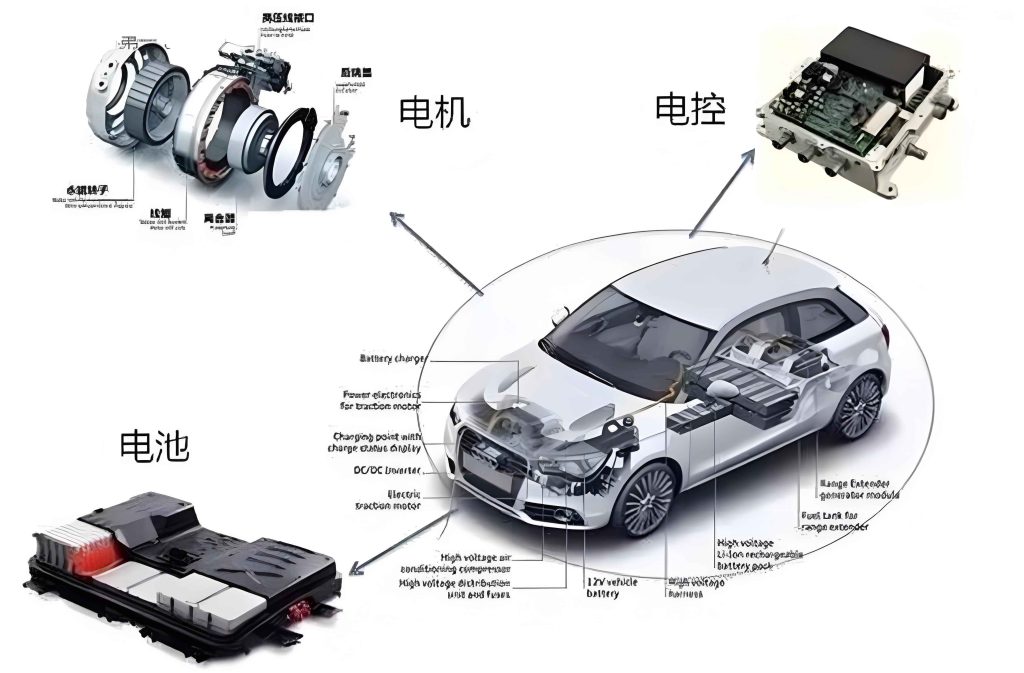
The architectural complexity of a modern motor control unit necessitates a systematic diagnostic approach. A typical intelligent fault diagnosis system encompasses several integrated modules, as outlined below:
| System Module | Core Function | Key Technologies/Components |
|---|---|---|
| Data Acquisition Layer | High-fidelity, synchronous sampling of analog (current, voltage, temp) and digital (PWM, status) signals from the MCU. | High-resolution ADCs, isolated sensors, digital isolators, real-time data buffers. |
| Signal Processing & Feature Extraction Engine | Filters noise, extracts time-domain, frequency-domain, and time-frequency features from raw signals. | Digital filters (FIR/IIR), FFT processors, Wavelet Transform algorithms, statistical computing blocks. |
| Diagnostic Reasoning Core | Executes the diagnostic logic. Contains the model-based observers, pre-trained ML models (SVM, ANN), and a knowledge base of fault trees/rules. | Embedded processors (e.g., DSP cores), model execution engine, ML inference accelerator (e.g., NPU). |
| Decision Fusion & Localization | Combines evidence from multiple diagnostic streams to pinpoint the faulty sub-component (e.g., “Phase C high-side IGBT open-circuit”). | Dempster-Shafer theory, Bayesian networks, or weighted voting algorithms. |
| User Interface & Reporting | Presents diagnosis results, fault severity, confidence level, and suggested repair actions to the technician. | Graphical dashboards on diagnostic tools, augmented reality (AR) overlays for repair guidance. |
| Cloud Connectivity & Learning | Anonymized fault data is uploaded to a cloud platform for continuous model retraining and improvement, creating a fleet-wide knowledge base. | Secure telematics, cloud-based ML training pipelines, over-the-air (OTA) model updates for the diagnostic system. |
Intelligent Maintenance Methodology
Diagnosis is only the first step. An intelligent maintenance strategy leverages the diagnostic output to guide efficient, correct, and proactive repair actions. This transforms the maintenance process from a manual, experience-based task into a guided, optimized procedure.
1. Maintenance Decision Support Systems (MDSS)
Based on the precise fault localization from the diagnostic system, the MDSS retrieves or generates a tailored repair procedure. This system utilizes a dynamic maintenance knowledge graph that links:
– Fault Identifiers (e.g., “IC202 – Voltage Regulator – Output Low”)
– Affected Components (e.g., specific IC, surrounding passive components)
– Required Tools (e.g., soldering iron with specific tip, hot air gun, multimeter)
– Repair Steps (e.g., “1. Disconnect battery. 2. Measure resistance between pin 5 and GND…”)
– Safety Warnings (e.g., “Capacitor C105 may remain charged”)
– Post-Repair Validation Tests (e.g., “Run motor at 1000 RPM no-load and verify current balance”)
The decision to repair or replace a motor control unit can also be optimized using cost models. A simple decision rule might be:
$$
\text{Action} =
\begin{cases}
\text{Repair on-site} & \text{if } C_{\text{repair}} + D_{\text{downtime}} < C_{\text{replace}} + D_{\text{ship}} \\
\text{Replace unit} & \text{otherwise}
\end{cases}
$$
Where $$C_{\text{repair}}$$ is the cost of parts/labor for repair, $$D_{\text{downtime}}$$ is the cost associated with the repair time, $$C_{\text{replace}}$$ is the cost of a new/remanufactured MCU, and $$D_{\text{ship}}$$ is the delay/cost of obtaining it.
2. Prognostics and Health Management (PHM)
The ultimate goal of intelligent maintenance is to predict failures before they occur. PHM for the motor control unit involves monitoring degradation indicators:
– Gate Driver Health: Monitoring the rise/fall times of gate signals can indicate driver IC aging or gate resistance change.
– DC-Link Capacitor Health: Estimating the Equivalent Series Resistance (ESR) by analyzing ripple current and voltage: $$ ESR \approx \frac{\Delta V_{ripple}}{I_{ripple}} $$. A rising trend in ESR signals impending capacitor failure.
– Thermal Cycling Fatigue: Counting and tracking the amplitude of temperature cycles for major ICs and power modules. The Coffin-Manson relationship can estimate remaining useful life (RUL): $$ N_f = A (\Delta T)^{-\beta} $$ where $$N_f$$ is cycles to failure, $$\Delta T$$ is the temperature swing, and $$A, \beta$$ are material constants.
By tracking these parameters, the system can schedule maintenance during regular service intervals, preventing unexpected breakdowns.
3. Augmented Reality (AR) Assisted Repair
For complex motor control unit repairs, AR glasses can overlay the repair guide directly onto the technician’s field of view. The system, connected to the MDSS, can:
– Highlight the exact faulty component on the physical PCB.
– Display step-by-step instructions next to the real object.
– Show expected voltage readings at test points when the probe is placed.
– Provide real-time verification (e.g., “The measured 3.3V is correct, proceed to next step”).
The architecture of a comprehensive intelligent maintenance system integrates these elements seamlessly.
| System Layer | Function | Inputs | Outputs |
|---|---|---|---|
| Prognostics & Health Monitoring | Continuously assesses degradation parameters and predicts RUL for critical MCU components. | Real-time sensor data (temp, voltage ripple, gate timing), operational load profiles. | Health indices, RUL estimates, early warnings for components like capacitors or power modules. |
| Maintenance Scheduler | Optimizes maintenance timing based on PHM outputs, vehicle usage, and service bay availability. | RUL predictions, fleet management data, logistics constraints. | Recommended service dates and work orders prioritized by criticality. |
| Repair Action Planner | Generates a detailed, context-aware repair procedure upon fault diagnosis or scheduled service. | Fault ID from diagnostic system, MCU part number and revision, available tools/parts inventory. | A structured repair guide with parts list, tool list, step-by-step instructions, and validation tests. |
| Technician Support Interface | Delivers the repair plan to the technician via mobile device, PC, or AR glasses. | Repair Action Plan. | Interactive guides, diagrams, AR overlays, and a means to record measurements and confirm steps. |
| Knowledge & Experience Feedback Loop | Captures repair outcomes, technician notes, and discovered issues to refine future diagnostics and maintenance plans. | Repair results, time-to-fix, encountered complications. | Updated failure rate statistics, improved diagnostic rules, new repair procedures added to the knowledge base. |
Experimental Framework and Performance Evaluation
Validating the proposed intelligent diagnosis and maintenance methods requires a structured experimental approach, typically involving hardware-in-the-loop (HIL) test benches and analysis of field data.
1. Data Collection and Preprocessing
A test bench is established, comprising a functional motor control unit driving a motor emulator (or a real motor on a dyno). Controlled fault injection is performed to simulate the failures listed earlier. High-speed data acquisition systems record multi-channel signals. For a dataset to train and validate ML models, we need samples from all fault classes and the healthy state. Data is then segmented, normalized, and labeled. Feature extraction algorithms process these segments to create the final dataset $$ \mathcal{D} = \{ (\mathbf{x}_1, y_1), (\mathbf{x}_2, y_2), …, (\mathbf{x}_N, y_N) \} $$ where $$y_i$$ is the fault class label.
2. Model Training and Cross-Validation
The dataset is split into training, validation, and test sets. Multiple classifiers (SVM with RBF kernel, Random Forest, Multi-layer Perceptron) are trained. Hyperparameters (e.g., SVM’s $$C$$ and $$\gamma$$, ANN’s layer size) are tuned using the validation set via grid search or Bayesian optimization. Performance is rigorously evaluated using k-fold cross-validation to ensure generalizability. Key performance metrics are calculated on the held-out test set:
$$
\begin{aligned}
\text{Accuracy} &= \frac{TP+TN}{TP+TN+FP+FN} \\
\text{Precision (per class)} &= \frac{TP}{TP+FP} \\
\text{Recall/Sensitivity (per class)} &= \frac{TP}{TP+FN} \\
\text{F1-Score (per class)} &= 2 \cdot \frac{\text{Precision} \cdot \text{Recall}}{\text{Precision} + \text{Recall}}
\end{aligned}
$$
Where TP, TN, FP, FN are True Positives, True Negatives, False Positives, and False Negatives for a given fault class.
3. Results and Comparative Analysis
A hypothetical results table comparing the intelligent system against a traditional DTC-based method might show significant improvement:
| Fault Type | Traditional DTC Method | Intelligent (SVM) Diagnostic | Intelligent (ANN) Diagnostic | Notes |
|---|---|---|---|---|
| Phase-A IGBT Open | Generic “Power Stage Fault” (Low Precision) | F1-Score: 0.94 | F1-Score: 0.97 | Intelligent methods precisely identify the phase and fault nature. |
| Current Sensor Bias (5%) | Often undetected until severe | F1-Score: 0.88 | F1-Score: 0.91 | ML models detect subtle signal deviations missed by simple thresholds. |
| Gate Driver Degradation | Not detectable | F1-Score: 0.82 (Prognostic) | F1-Score: 0.85 (Prognostic) | PHM feature (rise time) enables prediction before hard failure. |
| Overall Diagnostic Accuracy | ~65% | ~92% | ~94% | Intelligent systems offer a substantial leap in accurate fault isolation. |
The experiment would also measure the time from fault occurrence to precise diagnosis. The intelligent system, running on embedded hardware, should achieve this in milliseconds to seconds, far quicker than manual troubleshooting which can take hours.
4. Maintenance Efficiency Gains
An experiment evaluating the maintenance arm would measure:
– Mean Time To Repair (MTTR): The time from starting the repair to successful validation. This should decrease significantly with AR-guided procedures and precise fault localization.
– First-Time Fix Rate (FTFR): The percentage of repairs completed correctly on the first attempt, without misdiagnosis or wrong-part replacement. This should approach 100% with a reliable intelligent system.
– Cost of Maintenance: A reduction in overall costs due to fewer replaced modules (more component-level repairs), less vehicle downtime, and reduced need for expert-level technicians for every fault.
Conclusion and Future Perspectives
The transition to new energy vehicles demands a parallel evolution in after-sales service and reliability engineering. The motor control unit, as a critical and complex subsystem, is a prime candidate for the application of intelligent fault diagnosis and maintenance methodologies. By integrating model-based analysis, advanced signal processing, and machine learning, diagnostic systems can achieve unprecedented levels of accuracy and specificity in fault isolation. Coupling this with intelligent maintenance systems that provide guided repair procedures, prognostic health monitoring, and augmented reality support transforms field service from a reactive, costly burden into a proactive, efficient, and data-driven activity.
The future trajectory of this field points towards even tighter integration and autonomy. Federated learning could allow motor control units across entire fleets to collaboratively improve diagnostic models without compromising data privacy. The integration of these intelligent capabilities directly into the motor control unit’s own silicon (e.g., on-chip monitoring IP and diagnostic co-processors) will enable true self-diagnosis and health reporting. Furthermore, the convergence of digital twin technology—creating a high-fidelity virtual replica of the physical motor control unit—will enable ultra-realistic simulation for fault investigation, repair procedure validation, and technician training. Ultimately, the goal is to create a self-aware, maintainable motor control unit ecosystem that maximizes vehicle uptime, safety, and longevity, thereby supporting the sustainable future promised by electric mobility.