
As I reflect on the rapid advancements in technology, it becomes evident that innovation across multiple scientific disciplines is converging to shape a sustainable future. In recent times, significant milestones have been achieved, from the establishment of international standards for refractory materials to breakthroughs in chemical experimentation, all of which indirectly or directly influence the development of critical energy solutions like the solid-state battery. This article delves into these interconnected progressions, with a primary focus on how solid-state battery technology is poised to revolutionize industries, driven by global collaborative efforts and cutting-edge research. I will explore the technical intricacies, challenges, and prospects, emphasizing the pivotal role of solid-state battery systems in addressing contemporary energy demands. Through detailed analysis, including tables and mathematical formulations, I aim to provide a comprehensive perspective on why solid-state battery innovations are paramount for our technological evolution.
The concept of a solid-state battery represents a paradigm shift in energy storage, moving away from traditional liquid electrolytes to solid alternatives. This transition promises enhanced safety, higher energy density, and longer lifespan, making solid-state battery designs crucial for applications ranging from electric vehicles to grid storage. In my view, the recent emphasis by governmental bodies on advancing solid-state battery technology underscores its strategic importance. For instance, initiatives aimed at bolstering innovation in solid-state battery components align with broader goals of reducing carbon emissions and improving energy efficiency. The solid-state battery approach leverages solid electrolytes, which mitigate risks such as leakage and thermal runaway, common in conventional lithium-ion batteries. As I analyze these developments, it is clear that the solid-state battery is not merely an incremental improvement but a transformative technology that could redefine energy paradigms.
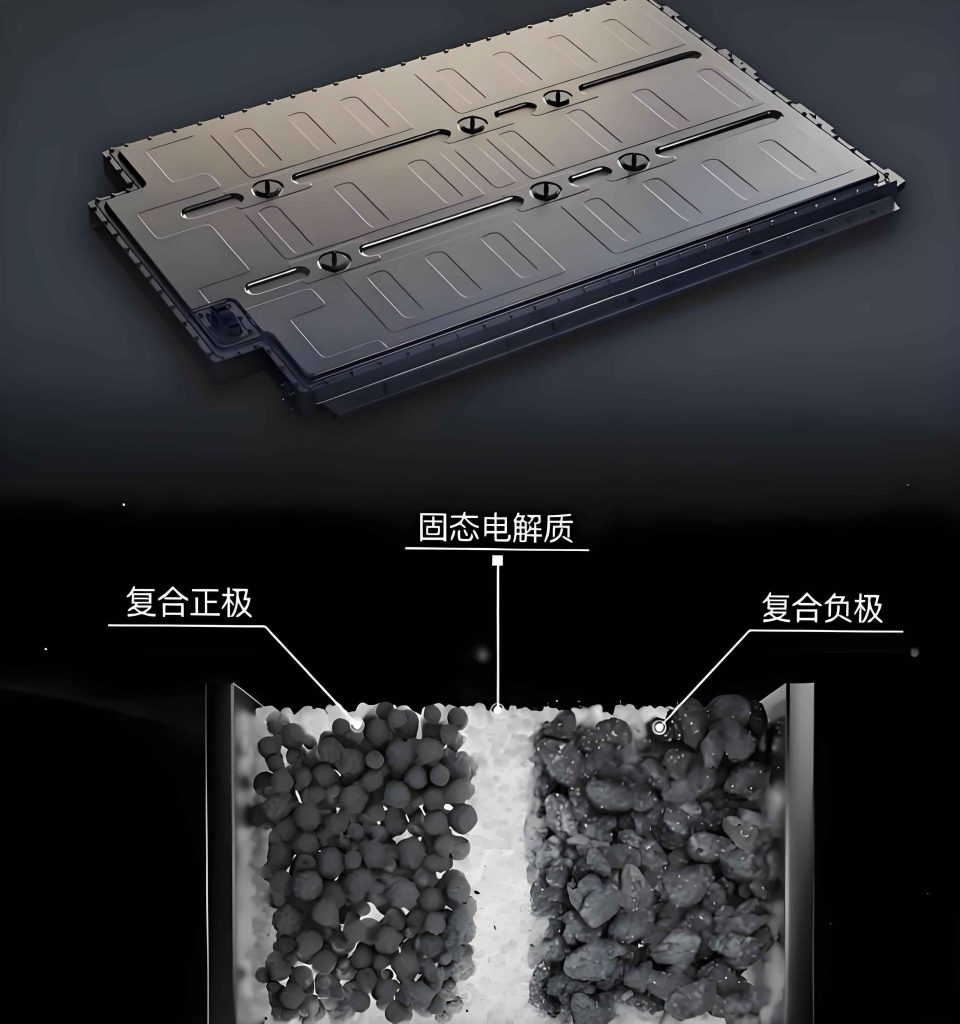
To understand the superiority of solid-state battery systems, one must examine their fundamental principles. In a typical solid-state battery, the electrolyte is a solid material, often ceramic or polymer-based, which facilitates ion transport between the anode and cathode. This structure can be represented by electrochemical equations. For example, the charge-discharge reaction in a lithium-based solid-state battery can be modeled as follows: $$ \text{Li}^+ + e^- \rightleftharpoons \text{Li} $$ at the anode, and $$ \text{LiCoO}_2 \rightleftharpoons \text{Li}_{1-x}\text{CoO}_2 + x\text{Li}^+ + x e^- $$ at the cathode, where the solid electrolyte enables ion migration. The overall cell voltage, $V$, relates to the Gibbs free energy change, $\Delta G$, via $$ V = -\frac{\Delta G}{nF} $$, with $n$ being the number of electrons transferred and $F$ as Faraday’s constant. Such formulations highlight the theoretical advantages of solid-state battery configurations, including potential for higher voltage and stability.
However, the journey toward commercializing solid-state battery technology is fraught with challenges. Recent discussions have highlighted issues like material compatibility, interfacial resistance, and manufacturing scalability. In the context of electric vehicles, for instance, solid-state battery solutions must overcome hurdles such as low-temperature performance and high production costs. I believe that interdisciplinary collaborations, akin to those seen in refractory materials standardization, are essential. The development of international standards for testing refractory materials, which involve high-temperature compressive strength, parallels the need for robust evaluation metrics for solid-state battery components. Just as refractory materials endure extreme conditions in industrial furnaces, solid-state battery electrolytes must withstand operational stresses without degradation. This synergy underscores how advancements in material science can propel solid-state battery innovations forward.
To illustrate the comparative benefits, consider the following table that contrasts key parameters between traditional lithium-ion batteries and solid-state battery designs:
| Parameter | Traditional Lithium-Ion Battery | Solid-State Battery |
|---|---|---|
| Electrolyte Type | Liquid organic solvent | Solid ceramic/polymer |
| Energy Density (Wh/kg) | 150-250 | 300-500 (projected) |
| Safety | Prone to leakage and thermal runaway | High resistance to flammability |
| Operating Temperature Range | -20°C to 60°C | -40°C to 100°C (potential) |
| Cycle Life | 500-1000 cycles | 1000-5000 cycles (expected) |
| Cost per kWh | $100-$150 | $200-$300 (current estimate) |
This table underscores why solid-state battery technology is garnering attention; its projected energy density and safety profile could address critical pain points in electric mobility. Moreover, the solid-state battery’s potential for wider temperature operation aligns with efforts to mitigate issues like slow charging in cold climates, as noted in recent policy discussions. In my analysis, the data suggests that incremental improvements in solid-state battery formulations could yield disproportionate gains in overall system performance.
The role of material science in advancing solid-state battery components cannot be overstated. Refractory materials, for example, are integral to manufacturing processes that produce high-temperature components for battery systems. The recent adoption of an international standard for testing the high-temperature compressive strength of refractory materials—a first of its kind—exemplifies how standardized methodologies can enhance quality control. This standard, developed through global collaboration, ensures that materials used in environments like solid-state battery production furnaces meet rigorous benchmarks. I see this as a metaphor for the solid-state battery ecosystem: just as consistent testing protocols drive material reliability, unified research efforts can accelerate solid-state battery development. The mathematical relationship for compressive strength, $\sigma_c = \frac{F}{A}$, where $F$ is force and $A$ is area, applies equally to refractory samples and solid-state battery layers under stress, emphasizing the universal principles at play.
Furthermore, chemical experimentation plays a pivotal role in discovering novel materials for solid-state battery applications. The innovative project on thermochromic spin-crossover materials, recognized in a national competition, illustrates how fundamental research can translate into practical technologies. Such materials, which change properties with temperature, might inspire adaptive components for solid-state battery systems, such as self-regulating electrolytes. The underlying theory involves ligand field effects and energy transitions, describable via equations like the ligand field stabilization energy: $$ \text{LFSE} = -0.4 \Delta_o \cdot n_{t_{2g}} + 0.6 \Delta_o \cdot n_{e_g} $$ for octahedral complexes, where $\Delta_o$ is the crystal field splitting parameter. This conceptual framework can be extended to solid-state battery materials, where ion mobility in solid electrolytes relates to similar energetic considerations. Thus, the cross-pollination between chemical research and solid-state battery engineering is vital for breakthroughs.
In addressing the technical bottlenecks of solid-state battery technology, one must consider interfacial phenomena. The solid-solid interface between electrolyte and electrodes often introduces high resistance, impeding ion flow. This can be modeled using electrochemical impedance spectroscopy, represented by an equivalent circuit with resistors and capacitors. For instance, the interfacial resistance, $R_{int}$, contributes to total cell impedance, $Z$, as $$ Z = R_{bulk} + R_{int} + \frac{1}{j\omega C_{dl}} $$, where $R_{bulk}$ is bulk resistance, $C_{dl}$ is double-layer capacitance, and $\omega$ is angular frequency. Reducing $R_{int}$ is a key focus in solid-state battery research, often through material engineering or surface treatments. I anticipate that insights from high-temperature material studies, like those in refractory standards, could inform strategies to optimize these interfaces in solid-state battery assemblies.
The global push for solid-state battery advancements is reflected in strategic plans that prioritize innovation chains. Initiatives aimed at deploying new system power batteries and all-solid-state metal lithium batteries highlight the commitment to overcoming existing limitations. In my perspective, the integration of solid-state battery technology into broader energy ecosystems—such as hybrid systems combining batteries with fuel cells—could unlock synergies. For example, hydrogen storage systems might complement solid-state battery networks for grid stability. The thermodynamic efficiency of such integrated systems can be expressed as $$ \eta = \frac{W_{out}}{Q_{in}} $$, where $W_{out}$ is work output and $Q_{in}$ is heat input, but for solid-state battery applications, round-trip efficiency metrics are more relevant: $$ \eta_{rt} = \frac{E_{discharge}}{E_{charge}} \times 100\% $$. These formulas underscore the importance of holistic design in maximizing solid-state battery performance.
To delve deeper into material aspects, the following table summarizes key solid electrolyte candidates for solid-state battery systems, along with their properties:
| Solid Electrolyte Material | Ionic Conductivity (S/cm) at 25°C | Stability vs. Lithium | Application in Solid-State Battery |
|---|---|---|---|
| Li7La3Zr2O12 (LLZO) | ~10-4 | High | Cathode/separator layers |
| Li10GeP2S12 (LGPS) | ~10-2 | Moderate | High-power cells |
| Polyethylene Oxide (PEO) | ~10-5 | Low | Flexible batteries |
| Li3PS4 (sulfide glass) | ~10-3 | Moderate | Scalable manufacturing |
This table highlights the diversity of approaches in solid-state battery electrolyte development. Each material presents trade-offs; for instance, sulfide-based electrolytes offer high conductivity but may react with moisture, necessitating controlled environments akin to those in refractory processing. I contend that ongoing research into these materials, fueled by academic competitions and industrial collaborations, will drive the solid-state battery market toward viability. The mathematical optimization of conductivity involves Arrhenius behavior: $$ \sigma = \sigma_0 \exp\left(-\frac{E_a}{kT}\right) $$, where $E_a$ is activation energy, $k$ is Boltzmann’s constant, and $T$ is temperature. For solid-state battery electrolytes, minimizing $E_a$ is crucial to achieve room-temperature performance, a goal that parallels efforts in high-temperature material stabilization.
Beyond technical specifications, the economic and environmental implications of solid-state battery adoption are profound. The production of solid-state battery components often requires energy-intensive processes, but advancements in refractory standards could lead to more efficient kilns and furnaces, reducing carbon footprints. In my assessment, the lifecycle analysis of a solid-state battery must account for factors like raw material sourcing and recyclability. Equations such as the net energy ratio, $$ \text{NER} = \frac{E_{output}}{E_{input}} $$, where $E_{output}$ is energy delivered over the battery’s life and $E_{input}$ is energy for production, can guide sustainable solid-state battery designs. If solid-state battery technologies achieve higher energy densities and longer lives, the NER could surpass that of conventional batteries, aligning with global sustainability targets.
The interplay between policy, research, and industry is critical for solid-state battery proliferation. Recent forums have emphasized the need to address supply chain issues, such as semiconductor shortages, which also affect battery management systems in solid-state battery packs. By fostering innovation ecosystems—where academic experiments inform industrial practices—we can accelerate solid-state battery deployment. I envision a future where solid-state battery systems are ubiquitous, from electric vehicles to portable electronics, supported by robust material standards and continuous chemical innovation. The diffusion of solid-state battery technology can be modeled using logistic growth curves: $$ P(t) = \frac{K}{1 + e^{-r(t-t_0)}} $$, where $P(t)$ is market penetration, $K$ is carrying capacity, $r$ is growth rate, and $t_0$ is the inflection point. With concerted efforts, the solid-state battery market could see rapid adoption in the coming decades.
In conclusion, the convergence of advancements in refractory material standards, chemical experimentation, and strategic policy focus heralds a new era for energy storage, centered on the solid-state battery. As I have explored, the solid-state battery represents a multifaceted innovation with the potential to address safety, performance, and environmental challenges. Through detailed tables and mathematical formulations, I have illustrated the technical foundations and comparative advantages of solid-state battery technology. The ongoing global collaborations, akin to those in standard-setting bodies, will be instrumental in overcoming remaining hurdles. Ultimately, the solid-state battery is not just a technological milestone but a cornerstone for a sustainable energy future, and its continued development warrants unwavering attention and investment.