
In modern industrial applications, the electric drive system has become a cornerstone for efficient and controllable power transmission, particularly in sectors like oil drilling. As someone deeply involved in power quality studies, I have observed that the integration of variable frequency drive (VFD) technology in oil rig electric drive systems introduces significant harmonic distortions, which can compromise the reliability and performance of the entire power network. This article delves into the harmonic analysis and suppression strategies for such systems, emphasizing the critical role of the electric drive system in ensuring operational stability. Through detailed mathematical modeling, tabular data, and practical solutions, I aim to provide a comprehensive guide that highlights the importance of mitigating harmonic pollution in these complex environments.
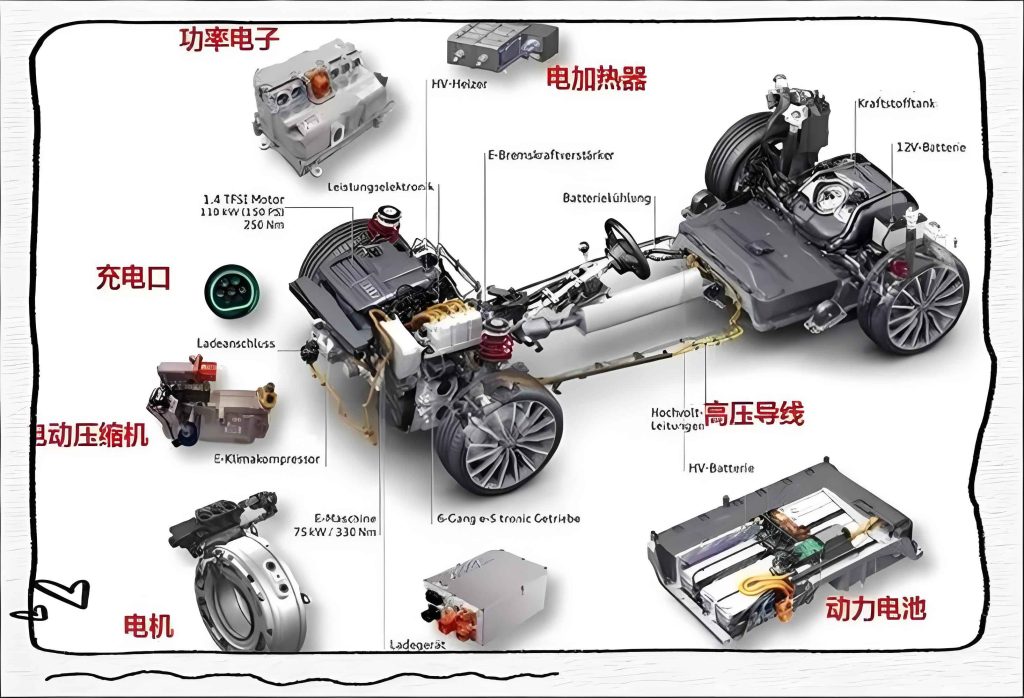
The electric drive system in oil rigs typically relies on VFD-based configurations, where multiple diesel generators supply power to a common AC bus, feeding various loads like mud pumps, drawworks, and rotary tables. This setup, while enhancing flexibility, inherently generates harmonics due to the non-linear characteristics of power electronic converters. From my perspective, understanding these harmonic phenomena is essential for maintaining power quality, especially in isolated grids where even minor distortions can lead to equipment malfunction. In this discussion, I will explore the underlying mechanisms, quantify the harmonic impacts through rigorous calculations, and propose effective suppression techniques that have been validated in real-world scenarios.
To begin, let’s examine the structure of a typical oil rig VFD electric drive system. It comprises a generation side with parallel diesel generators outputting AC voltage, which is then distributed via a 600V AC bus to multiple VFD units. Each VFD unit includes a rectifier stage—often using diodes or thyristors—a DC link capacitor for filtering, and an inverter stage with IGBTs to produce variable frequency AC power for driving induction motors. This configuration is pivotal in the electric drive system, enabling precise speed control for drilling operations. However, the rectification and inversion processes are major sources of harmonics. For instance, the input current waveform during rectification is non-sinusoidal, resembling a pulsed shape that can be decomposed into harmonic components using Fourier analysis. The general expression for a periodic current waveform is given by:
$$ i(t) = I_0 + \sum_{n=1}^{\infty} \left( a_n \cos(n\omega t) + b_n \sin(n\omega t) \right) $$
where \( I_0 \) is the DC component, \( a_n \) and \( b_n \) are Fourier coefficients, \( \omega \) is the fundamental angular frequency, and \( n \) denotes the harmonic order. In VFD systems, the predominant harmonics are typically of orders \( 6k \pm 1 \) (where \( k = 1, 2, 3, \dots \)), such as the 5th, 7th, 11th, and 13th harmonics, arising from the six-pulse rectifier topology. This harmonic injection into the AC bus can cause voltage distortion, leading to issues like overheating, resonance, and interference with sensitive equipment. As I analyze these effects, it becomes clear that the electric drive system must be designed with robust harmonic mitigation in mind.
Moving to harmonic analysis, the distortion severity depends on factors like load conditions and system impedance. In oil rig operations, various drilling modes—such as normal drilling, high-pressure drilling, and back-reaming—present different harmonic profiles due to the combination of active VFD units. For example, during back-reaming, multiple mud pumps and drawworks operate at full load, resulting in significant harmonic aggregation. To quantify this, I employ harmonic superposition principles. When multiple harmonic sources feed into the same bus, the total harmonic current for a specific order \( h \) can be calculated. If the phase angles are known, the superposition formula is:
$$ I_h = \sqrt{I_{h1}^2 + I_{h2}^2 + 2 I_{h1} I_{h2} \cos \theta_h } $$
where \( I_{h1} \) and \( I_{h2} \) are the harmonic currents from two sources, and \( \theta_h \) is the phase difference. In cases where phase angles are uncertain, a statistical approach is used:
$$ I_h = \sqrt{I_{h1}^2 + I_{h2}^2 + K_h I_{h1} I_{h2} } $$
with \( K_h \) being a coefficient that varies with harmonic order, as tabulated below:
| Harmonic Order \( h \) | 5 | 7 | 11 | 13 | >13 |
|---|---|---|---|---|---|
| \( K_h \) | 1.28 | 0.72 | 0.18 | 0.08 | 0 |
These formulas are crucial for assessing the cumulative harmonic impact in the electric drive system. To illustrate, consider a back-reaming operation on a 7000m drill rig, where two mud pumps (each with dual 600 kW motors), a drawworks (with dual 800 kW motors), and a rotary table (with a single 600 kW motor at half-load) are active. The harmonic currents generated by each component can be computed based on typical distortion percentages. For instance, a single mud pump motor might contribute harmonic currents as follows: 32% for the 5th harmonic, 14.5% for the 7th, 8.4% for the 11th, and so on, relative to its fundamental current. By aggregating these using the superposition method, the total harmonic current injected into the 600V bus can be determined. Below is a summarized table of harmonic current calculations for this scenario:
| Component | 5th Harmonic (A) | 7th Harmonic (A) | 11th Harmonic (A) | 13th Harmonic (A) | 17th Harmonic (A) | 19th Harmonic (A) |
|---|---|---|---|---|---|---|
| Mud Pump (per unit) | 429.44 | 194.59 | 112.73 | 67.10 | 60.39 | 42.94 |
| Drawworks (per unit) | 572.80 | 259.55 | 150.36 | 89.50 | 80.55 | 57.28 |
| Rotary Table (half-load) | 107.52 | 48.72 | 28.22 | 16.80 | 15.12 | 10.75 |
| Total Aggregated | 1297.51 | 499.54 | 238.33 | 136.13 | 118.37 | 84.17 |
From these currents, the corresponding harmonic voltages on the bus can be derived using the system impedance. Assuming a short-circuit capacity of 11 MVA for the generator set, the harmonic voltage for order \( h \) is given by \( U_h = I_h \cdot Z_h \), where \( Z_h \) is the impedance at that frequency. The total harmonic voltage distortion (THD) is then computed as:
$$ \text{THD}_U = \frac{ \sqrt{ \sum_{h=2}^{\infty} U_h^2 } }{ U_1 } \times 100\% $$
For this case, the calculated THD reaches approximately 20.17%, which exceeds typical limits of 5-8% set by standards like IEEE 519. This level of distortion can severely affect other connected loads, such as lighting and auxiliary equipment, underscoring the need for effective harmonic suppression in the electric drive system.
To address these challenges, I propose a dual approach for harmonic suppression in the VFD electric drive system. First, installing input line reactors on the thyristor-based rectifier stages can mitigate higher-order harmonics by increasing the impedance, thereby smoothing the current waveform. The effectiveness of this method can be analyzed through the reduction in harmonic current injection. For a reactor with inductance \( L \), the impedance at harmonic frequency \( f_h \) is \( Z_h = 2\pi f_h L \), which attenuates the harmonic current proportionally. Second, and more comprehensively, employing active power filters (APFs) offers dynamic harmonic compensation. APFs operate by injecting counter-harmonic currents that cancel out the distortions, based on real-time detection using techniques like the instantaneous reactive power theory. The compensation current \( i_c(t) \) is generated as:
$$ i_c(t) = – \sum_{h \neq 1} i_h(t) $$
where \( i_h(t) \) are the detected harmonic components. This approach not only suppresses harmonics but also improves power factor, enhancing the overall efficiency of the electric drive system. In practice, for an oil rig with multiple VFD units, a centralized APF unit rated at 300A per phase can be connected to the 600V bus, as shown in system diagrams. The integration of APFs with the existing electric drive system ensures minimal disruption while providing significant power quality benefits.
The superiority of this combined solution is evident from实测 data. Before implementation, the voltage waveform on the 600V bus exhibited severe distortion, with noticeable spikes and irregularities. After adding input reactors and deploying APFs, the waveform becomes nearly sinusoidal. Quantitative comparisons further validate the improvement. For instance, in a typical operating condition, the current THD reduced from 31.6% to 3.1%, and the voltage THD dropped from 18.0% to 2.3%. Additionally, the power factor improved from 0.83 to 0.94, reducing reactive power demand. The table below summarizes these results, highlighting the positive impact on the electric drive system:
| Parameter | Before Suppression | After Suppression |
|---|---|---|
| Current THD | 31.6% | 3.1% |
| 5th Harmonic Current | 63.7 A | 2.8 A |
| 7th Harmonic Current | 8.2 A | 2.2 A |
| Voltage THD | 18.0% | 2.3% |
| Average Work Current | 218 A | 195 A |
| Power Factor (PF) | 0.83 | 0.94 |
These outcomes demonstrate that the proposed harmonic suppression measures effectively restore power quality, ensuring reliable operation of the entire electric drive system. From an engineering perspective, the investment in such technologies pays off through reduced maintenance costs and enhanced equipment lifespan. Moreover, as oil rigs often operate in remote locations with limited grid support, maintaining a clean power supply is critical for safety and productivity. The electric drive system, being the heart of drilling operations, benefits immensely from these advancements, paving the way for more sustainable and efficient industrial practices.
In conclusion, harmonic analysis and suppression are vital for optimizing the performance of oil rig VFD electric drive systems. Through detailed mathematical modeling, including Fourier series and superposition formulas, I have shown how harmonics originate and aggregate under various loading conditions. The calculated voltage distortion levels, such as the 20.17% THD in back-reaming scenarios, justify the need for proactive mitigation. By implementing input line reactors and active power filters, significant reductions in harmonic content are achievable, as evidenced by the实测 data showing THD improvements to below 3%. This holistic approach not only addresses immediate power quality issues but also enhances the long-term reliability of the electric drive system. As technology evolves, further integration of digital signal processing and adaptive control in APFs could offer even greater precision in harmonic compensation. Ultimately, prioritizing harmonic management in electric drive systems ensures that industrial applications like oil drilling can meet both operational and environmental standards, contributing to a more resilient energy infrastructure.