
In recent years, the rapid advancement of new energy vehicles has been driven by policy support and technological innovation. As a key component, the electric drive system, which integrates the motor, electronic control, and reducer, has undergone significant evolution. From my perspective as a researcher in this field, I will explore the development trends of electric drive systems and the corresponding lubricant requirements, focusing on performance aspects such as thermal, electrical, and material compatibility. The integration and optimization of the electric drive system are crucial for enhancing vehicle efficiency and sustainability, and lubricants play a vital role in ensuring its reliability and longevity.
The classification of new energy vehicles includes various types, such as pure electric vehicles (BEVs), plug-in hybrid electric vehicles (PHEVs), and fuel cell electric vehicles (FCEVs). Among these, BEVs and PHEVs are expected to dominate the market due to their environmental benefits and technological maturity. The following table summarizes the main categories and examples:
| Category | Examples |
|---|---|
| Pure Electric Vehicles (BEVs) | Models like those from Tesla and BYD |
| Plug-in Hybrid Electric Vehicles (PHEVs) | Vehicles such as the BYD Tang PHEV |
| Fuel Cell Electric Vehicles (FCEVs) | Examples like the Toyota Mirai |
| Hybrid Electric Vehicles (HEVs) | Traditional hybrids like the Toyota Prius |
| Range-Extended Electric Vehicles (REEVs) | Models such as the Li Xiang ONE |
This diversification highlights the need for specialized lubricants tailored to each vehicle type, particularly for the electric drive system, which is central to BEV performance.
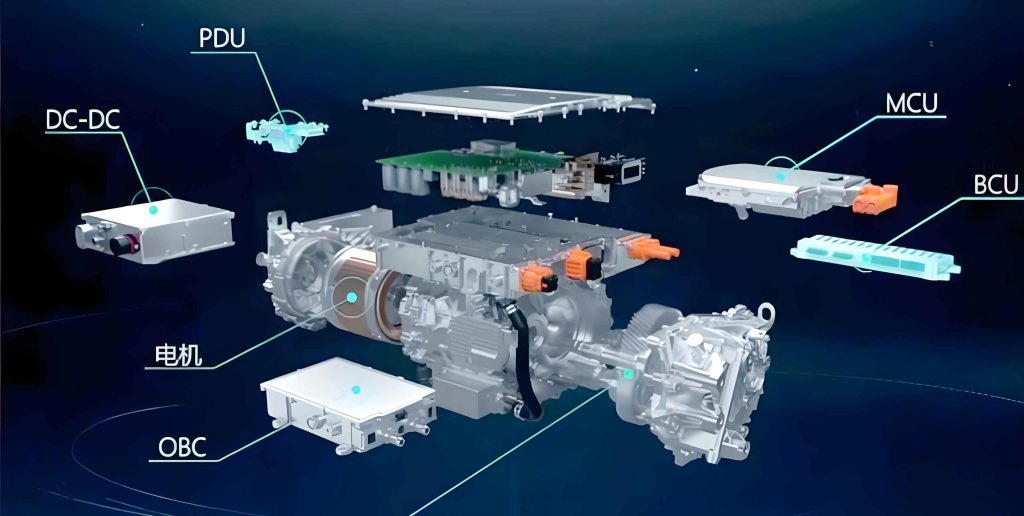
The electric drive system in BEVs has evolved towards higher integration, voltage, and power density. Integration involves combining the motor, inverter, and reducer into a compact unit, often referred to as a “multi-in-one” system. For instance, some manufacturers have developed seven-in-one or eight-in-one systems that include additional components like onboard chargers and DC-DC converters. This integration reduces weight and size but imposes new challenges on lubricants, such as enhanced cooling and material compatibility. The following table illustrates the components in different integrated systems:
| Component | Three-in-One | Five-in-One | Six-in-One | Seven-in-One | Eight-in-One |
|---|---|---|---|---|---|
| Motor | ✓ | ✓ | ✓ | ✓ | ✓ |
| Inverter | ✓ | ✓ | ✓ | ✓ | ✓ |
| Reducer | ✓ | ✓ | ✓ | ✓ | ✓ |
| Onboard Charger (OBC) | ✓ | ✓ | ✓ | ✓ | |
| DC-DC Converter | ✓ | ✓ | ✓ | ✓ | |
| Power Distribution Unit (PDU) | ✓ | ✓ | ✓ | ||
| Battery Management System (BMS) | ✓ | ✓ | |||
| Vehicle Control Unit (VCU) | ✓ |
This trend towards integration necessitates lubricants that can function effectively in complex environments, where the electric drive system components are in close proximity and operate under high stress.
Another key trend is the shift towards higher voltage platforms, such as 800V systems, to enable faster charging and improved efficiency. According to the power formula, $$P = UI$$, where P is power, U is voltage, and I is current, increasing voltage reduces current for the same power output, thereby minimizing heat generation as per Joule’s law: $$Q = I^2 R t$$, where Q is heat, R is resistance, and t is time. This reduction in heat is critical for thermal management in the electric drive system. However, higher voltages demand lubricants with superior insulating properties to prevent electrical breakdown and corrosion.
Moreover, electric drive systems are becoming more efficient and power-dense. High-speed motors, with speeds exceeding 20,000 rpm, are common in modern BEVs. This increases the demand on lubricants for cooling, shear stability, and durability. The torque and power of motors are related to size and speed, and as motors shrink, lubricants must maintain performance under extreme conditions. For example, the relationship between motor parameters can be expressed as: $$T \propto r^2 L$$, where T is torque, r is radius, and L is length. Reducing r and L while increasing speed requires lubricants that can handle higher shear rates and temperatures.
Turning to lubricant performance requirements, the electric drive system imposes unique demands compared to traditional gear oils. Based on industry standards and research, key properties include thermal performance, electrical performance, copper corrosion resistance, friction characteristics, shear stability, oxidation stability, foam resistance, and material compatibility. These are essential for ensuring the reliability and longevity of the electric drive system.
Thermal performance is crucial because the electric drive system generates significant heat during operation. Lubricants must dissipate heat effectively to prevent overheating, especially in oil-cooled motors where the lubricant directly contacts components like stators and rotors. The thermal conductivity of a lubricant can be approximated by the formula: $$M = \rho^{0.8} \cdot \lambda^{0.67} \cdot C_p^{0.33} \cdot \mu^{-0.47}$$, where ρ is density, λ is thermal conductivity, C_p is specific heat capacity, and μ is kinematic viscosity. This shows that lower viscosity oils tend to have better thermal performance, but other factors like base oil type also matter. For instance, Group III base oils, polyalphaolefins (PAOs), and esters often exhibit higher thermal conductivity due to their molecular structure. The table below summarizes typical values for these parameters:
| Parameter | Symbol | Typical Range | Effect on Thermal Performance |
|---|---|---|---|
| Density | ρ | 800-900 kg/m³ | Increases with temperature decrease |
| Thermal Conductivity | λ | 0.1-0.15 W/(m·K) | Higher values improve heat transfer |
| Specific Heat Capacity | C_p | 1.5-2.5 kJ/(kg·K) | Higher values absorb more heat |
| Kinematic Viscosity | μ | 5-10 mm²/s at 100°C | Lower values enhance flow and cooling |
In practice, lubricants for electric drive systems are formulated to optimize these parameters, often using synthetic base oils and additives to achieve the desired thermal management.
Electrical performance is another critical aspect, as lubricants in the electric drive system must insulate against stray currents and prevent electrical breakdown. Key metrics include breakdown voltage and volume resistivity. Breakdown voltage should be high (e.g., ≥45 kV) to avoid arcing, while volume resistivity should be sufficient to minimize current leakage. The presence of metal ions or conductive additives can degrade these properties. For example, the relationship between conductivity and additive concentration can be modeled as: $$\sigma = \sum_i n_i q_i \mu_i$$, where σ is conductivity, n_i is ion concentration, q_i is charge, and μ_i is mobility. Thus, lubricants for electric drive systems often use highly refined base oils and carefully selected additives to maintain high resistivity.
Copper corrosion resistance is vital because copper components, such as windings and connectors, are prevalent in electric drive systems. Traditional gear oils with active sulfur can corrode copper, leading to failures. New test methods, like the hot wire deposition test, have been developed to assess corrosion more accurately. In this test, a copper wire is immersed in lubricant under heat, and resistance changes are monitored to calculate corrosion rates. The corrosion rate can be expressed as: $$\Delta r = k \cdot t$$, where Δr is the change in wire radius, k is a rate constant, and t is time. Lubricants must pass rigorous tests, such as those specified in standards like NB/SH/T 6042-2021, which require copper corrosion ratings of ≤1 after 3 hours at 150°C.
Friction characteristics are essential for protecting gears and bearings in the electric drive system. With high-speed operation and compact designs, lubricants must provide adequate anti-wear and extreme pressure properties without corrosive elements. Tests like the FZG gear scuffing test and FE-8 bearing test are used to evaluate performance. The wear rate can be described by the Archard equation: $$W = k \frac{F_n s}{H}$$, where W is wear volume, k is a wear coefficient, F_n is normal load, s is sliding distance, and H is hardness. Lubricants for electric drive systems often use phosphorus-based or boron-based additives instead of sulfur-based ones to avoid copper corrosion while maintaining wear protection.
Shear stability is important due to the high shear forces in electric drive systems, especially in reducers with gears operating at high speeds. The KRL shear stability test measures viscosity loss after prolonged shear. The viscosity change can be modeled as: $$\Delta \mu = A \cdot \gamma^b \cdot t^c$$, where Δμ is viscosity change, γ is shear rate, t is time, and A, b, c are constants. Lubricants must retain viscosity within specified limits to ensure proper lubrication over the vehicle’s lifespan.
Oxidation stability is crucial because electric drive systems operate at elevated temperatures, which can accelerate oil degradation. Oxidation leads to sludge formation and acid buildup, impairing performance. The oxidation rate can be expressed by the Arrhenius equation: $$k = A e^{-E_a/(RT)}$$, where k is the rate constant, A is the pre-exponential factor, E_a is activation energy, R is the gas constant, and T is temperature. Lubricants with high oxidation stability, achieved through base oil selection and antioxidant additives, are necessary for long service intervals.
Foam resistance is essential to prevent air entrainment, which can reduce cooling efficiency and cause lubrication failures. Standard tests measure foam tendency and stability at different temperatures. The foam volume can be related to surface tension and viscosity: $$V_f \propto \frac{1}{\sigma \cdot \mu}$$, where V_f is foam volume, σ is surface tension, and μ is viscosity. Lubricants for electric drive systems often include defoamants to minimize foam formation.
Material compatibility is a key challenge due to the integration of various materials in the electric drive system, such as plastics, elastomers, and metals. Lubricants must not swell, degrade, or corrode these materials. Standards like T/CAAMTB 130-2023 specify tests for compatibility with materials like fluororubber, where properties like hardness change and volume change are measured. The compatibility can be assessed using solubility parameters: $$\delta = \sqrt{\frac{\Delta H_v – RT}{V_m}}$$, where δ is the solubility parameter, ΔH_v is heat of vaporization, and V_m is molar volume. Matching the lubricant’s solubility parameter with that of the material can enhance compatibility.
In terms of research progress, numerous patents and standards have emerged globally. For instance, companies like Lubrizol and Idemitsu have developed lubricants with improved thermal and electrical properties. In China, standards like NB/SH/T 6042-2021 set specific requirements for lubricants in BEV reducers, including thermal conductivity (≥0.13 W/(m·K) at 20°C) and breakdown voltage (≥45 kV). The table below summarizes some key requirements from this standard:
| Property | Test Method | Requirement |
|---|---|---|
| Kinematic Viscosity at 100°C | GB/T 265 | ≤7.0 mm²/s |
| Copper Corrosion (150°C, 3h) | GB/T 5096 | ≤1 rating |
| Thermal Conductivity at 20°C | ASTM D7896 | ≥0.13 W/(m·K) |
| Breakdown Voltage | GB/T 507 | ≥45 kV |
| Volume Resistivity at 25°C | GB/T 5654 | ≥100 Ω·m |
| FZG Gear Scuffing Test | CEC L-84-02 | ≥6 failure load stage |
These requirements reflect the evolving needs of electric drive systems and guide lubricant development. From my perspective, future research should focus on advanced base oils, such as esters and PAOs, and novel additives that enhance multiple properties simultaneously. For example, using branched diesters as base oil components can improve thermal conductivity, while polymeric viscosity index improvers can maintain shear stability.
In conclusion, the electric drive system in pure electric vehicles is undergoing rapid transformation, driven by trends like integration, high voltage, and high power density. These changes impose new demands on lubricants, requiring enhanced thermal, electrical, and material compatibility properties. Through ongoing research and standardization, lubricants are evolving to meet these challenges, ensuring the reliability and efficiency of electric drive systems. As the industry moves towards multi-motor configurations and even higher integration, lubricant technology will continue to play a critical role in enabling the next generation of electric vehicles. The electric drive system is at the heart of this evolution, and its lubrication needs will remain a key area of innovation for years to come.