
The relentless pursuit of higher energy density in electrochemical energy storage has undeniably propelled technological advancements, but it has also cast a long shadow over the paramount concern of safety. As a researcher deeply embedded in the field, I have witnessed the lithium-ion battery (LIB) technology evolve from powering our pocket devices to becoming the heart of electric vehicles (EVs) and grid-scale storage. This expansion in application and scale has been accompanied by an increased, and highly visible, frequency of safety incidents. These events, often characterized by thermal runaway—an uncontrollable self-heating state—leading to fire or explosion, have rightfully sparked public anxiety and intense scientific scrutiny. The central dilemma remains: how do we reconcile the demand for greater energy storage with the fundamental requirement for absolute safety? In my view, the most promising avenue to resolve this conflict lies not in incremental improvements to liquid electrolyte-based systems, but in a foundational shift towards solid-state battery technology.
The core vulnerability of conventional LIBs stems from their organic liquid electrolytes. These electrolytes are typically composed of flammable carbonate solvents and thermally unstable lithium salts. Under abusive conditions such as overcharge, internal short circuit, or exposure to high temperatures, these components can decompose exothermically, triggering a cascade of reactions with the electrode materials that culminates in thermal runaway. The analysis of field incidents strongly suggests a correlation between higher energy density chemistries, like those using high-nickel layered oxide cathodes (LiNixMnyCozO2, NMC), and a statistically higher propensity for safety-related failures compared to more stable but lower-energy alternatives like lithium iron phosphate (LiFePO4, LFP). This inherent trade-off necessitates a multi-layered safety approach, which I categorize into three pillars: intrinsic safety, passive safety, and active safety.
| Safety Pillar | Core Objective | Key Strategies at Cell/System Level | Inherent Limitations in LIBs |
|---|---|---|---|
| Intrinsic Safety | Minimize the inherent hazard potential of the cell chemistry and construction. | Material stabilization (coatings, dopants), flame-retardant additives, high-quality manufacturing. | Fundamental instability of high-energy cathodes and liquid electrolyte remains. |
| Passive Safety | Contain and mitigate the effects of a single cell failure to prevent system-wide propagation. | Thermal management (cooling, heating), cell-to-cell thermal insulation, fire-resistant module design. | Adds weight, volume, and cost. Combustible gas from liquid electrolyte fuels propagation. |
| Active Safety | Detect early warning signals of impending failure to allow for preventive system shutdown. | Monitoring voltage/temperature anomalies, gas detection (H2, CO), cloud-based data analytics. | Warning time can be short; sensor integration is challenging with corrosive liquid electrolyte. |
While these strategies have significantly improved the reliability of modern LIB systems, they often address the symptoms rather than the root cause. This is where the paradigm of the solid-state battery presents a revolutionary opportunity. By replacing the volatile liquid electrolyte with a solid ion conductor, we fundamentally alter the thermodynamic and kinetic landscape of failure modes. A solid-state battery is not merely an incremental step; it is a re-imagination of the battery’s internal architecture, offering a path to concurrently elevate energy density and safety. The promise of the solid-state battery extends across all three safety pillars, potentially simplifying system design while delivering superior performance.
The development of solid-state batteries is not monolithic; it progresses along several parallel tracks defined by the chemistry of the solid electrolyte. Each class presents unique trade-offs between ionic conductivity, electrochemical stability, mechanical properties, and manufacturability. Understanding these is crucial to evaluating their safety propositions.
| Electrolyte Class | Exemplary Materials | Room-Temp Ionic Conductivity (S cm-1) | Key Advantages | Primary Safety-Related Challenges |
|---|---|---|---|---|
| Polymer | PEO-LiTFSI, PEO-LiFSI | ~10-4 to 10-3 | Flexible, easy processing, good interfacial contact. | Limited oxidative stability, flammable at high temps. |
| Oxide | Garnet (LLZO), NASICON (LATP), Perovskite (LLTO) | 10-4 to 10-3 | Excellent stability vs. Li metal, wide electrochemical window. | Brittle, high interfacial resistance, grain boundary issues. |
| Sulfide | LGPS, Li3PS4, Li6PS5Cl | 10-4 to 10-2 (highest) | Very high ionic conductivity, good mechanical ductility. | Sensitivity to moisture (H2S release), narrow electrochemical window. |
| Thin-Film | LiPON | ~10-6 | Excellent stability, enables ultra-thin cells. | Low conductivity, limited to micro-battery scale. |
The ionic conductivity $\sigma_{ion}$ of a solid electrolyte is a critical parameter, often described by the Arrhenius equation for thermally activated ion hopping:
$$
\sigma_{ion} T = A \exp\left(-\frac{E_a}{k_B T}\right)
$$
where $A$ is the pre-exponential factor, $E_a$ is the activation energy for ion migration, $k_B$ is Boltzmann’s constant, and $T$ is the absolute temperature. While sulfide electrolytes currently lead in room-temperature performance, ongoing research on doped and engineered oxide and polymer systems aims to close this gap.
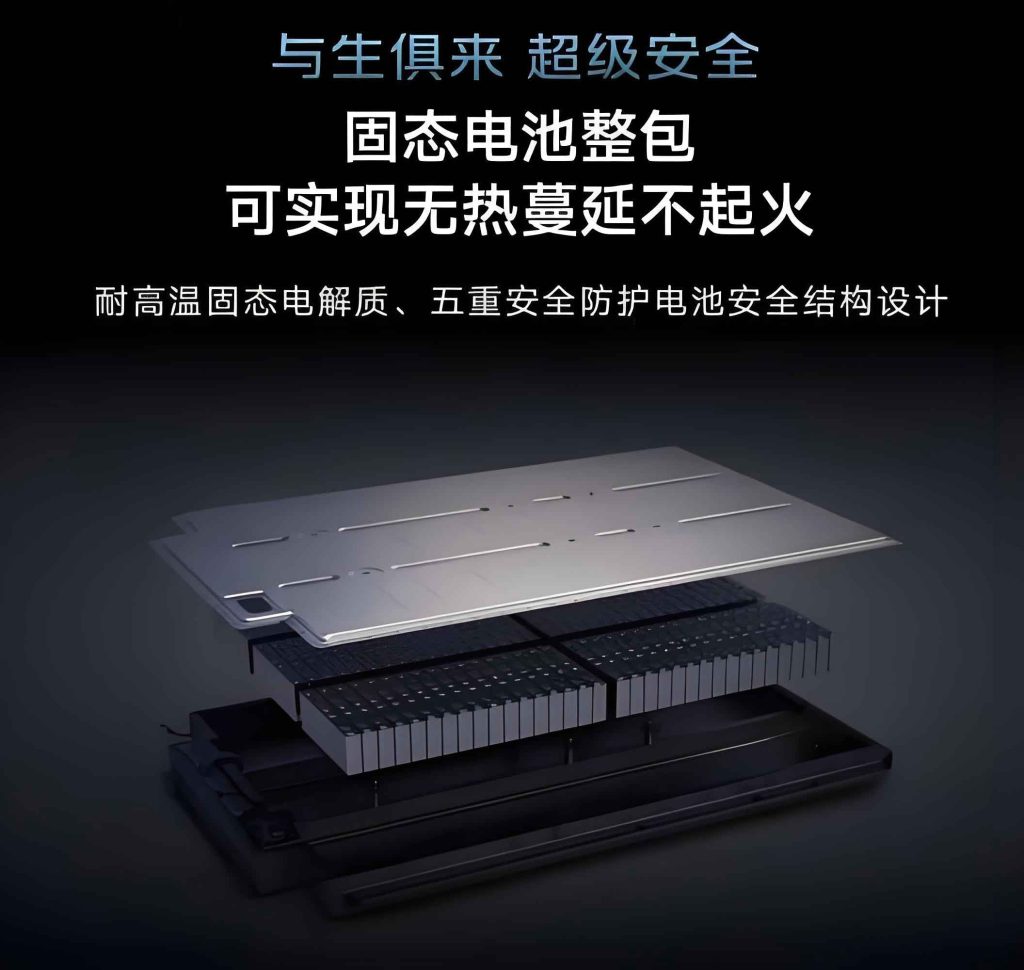
The transition to a solid-state battery architecture unlocks transformative safety advantages at every level of the device hierarchy, from the material interfaces to the full system. Let us dissect these advantages systematically.
Intrinsic Safety Enhancement at the Material Level
The most fundamental safety gain in a solid-state battery comes from the removal of the flammable organic solvent. The thermodynamic stability of most inorganic solid electrolytes far exceeds that of their liquid counterparts. Consider the total heat release $Q_{total}$ during a worst-case thermal runaway event, which can be approximated as a sum of the enthalpy changes of individual decomposition reactions:
$$
Q_{total} = \sum_i \Delta H_i \cdot m_i
$$
where $\Delta H_i$ and $m_i$ are the specific enthalpy and mass of component $i$. In a solid-state battery, the component with the highly negative $\Delta H$ for exothermic decomposition—the liquid solvent—is either absent or drastically reduced. This directly lowers the $Q_{total}$, reducing the overall hazard severity.
Furthermore, the interfaces in a solid-state battery exhibit superior thermal stability. In a conventional LIB, the solid-electrolyte interphase (SEI) on the anode is a metastable, organic-rich layer that decomposes at relatively low temperatures (60-120°C), releasing heat and triggering further reactions. In contrast, the interface between a lithium metal anode and a stable oxide solid electrolyte (e.g., Li7La3Zr2O12 or LLZO) shows no significant exothermic reaction until temperatures exceed 250°C. This dramatically raises the onset temperature for thermal runaway, effectively widening the safe operating window of the battery.
Solid electrolytes can also act as kinetic barriers. When used as coatings on cathode particles, they can physically impede the direct exothermic reaction between delithiated (oxygen-releasing) cathode surfaces and other cell components, slowing down the rate of heat generation $dQ/dt$. This “retarding” effect can be crucial, as it extends the time between the initiation of an abuse condition and the point of no return, providing a larger window for active safety systems to intervene.
Cell-Level Design Innovations Enabled by Solid-State Batteries
The properties of solid electrolytes enable novel cell designs that are impossible with liquid systems, each with significant safety implications.
1. Suppression of Chemical Crosstalk: In a leaking or ruptured LIB, gaseous species (like oxygen from the cathode or hydrogen from anode reactions) can migrate and create secondary hazards. A dense, impermeable solid electrolyte layer can act as an effective barrier, compartmentalizing such reactions and preventing this dangerous crosstalk.
2. Enhanced Abuse Tolerance: The mechanical strength of many solid electrolytes allows them to function as robust separators that are far more resistant to penetration by lithium dendrites or external crush forces than microporous polymer separators. This directly improves safety against internal short circuits caused by mechanical abuse or cycling. The wider electrochemical stability window of many solid electrolytes also increases tolerance to electrical abuse like overcharge.
3. Bipolar Stacking: This is a quintessential design enabled by the solid-state battery. In a bipolar design, cells are stacked directly in series without extra metallic current collectors or tabs between them. The solid electrolyte prevents ionic cross-talk and self-discharge. The safety benefits are multifold: it reduces the overall current in the stack (as current flows through the thin, large-area interconnects), minimizes heat generation during operation, and significantly simplifies the module assembly, reducing points of potential failure. The heat generation $P_{gen}$ in a bipolar stack during operation can be compared to a conventional parallel-tab design, often showing lower overall resistive heating.
4. Manufacturing Defect Tolerance: The generally higher stability of interfaces in a solid-state battery may provide a larger margin for error against certain manufacturing defects. For instance, minor metallic impurities or local electrode irregularities that might lead to a “soft short” and gradual heating in a liquid system could be better tolerated or result in a less catastrophic failure mode in a solid-state configuration due to the absence of a continuous liquid phase to facilitate widespread reaction.
System-Level Safety Simplification
The advantages at the material and cell level cascade upwards, profoundly simplifying and improving safety management at the battery pack and system level.
1. Mitigation of Thermal Runaway Propagation: The absence of a significant volume of flammable solvent means that a failing cell in a solid-state battery pack generates minimal combustible gas. This starves the chain reaction of fuel, making it vastly more difficult for a single cell’s thermal event to propagate to its neighbors. The heat release from one cell is also lower and potentially slower. This drastically reduces the burden on inter-cell thermal insulation materials, potentially allowing for more compact and lighter battery packs while still meeting strict “no propagation” safety targets. The classic criterion for propagation, that the heat dissipated to the environment is less than the heat transferred to the adjacent cell, becomes much easier to satisfy:
$$
hA(T_{failed} – T_{ambient}) < \kappa A \frac{(T_{failed} – T_{neighbor})}{d}
$$
Where $h$ is the heat transfer coefficient, $A$ is area, $T$ are temperatures, $\kappa$ is thermal conductivity, and $d$ is distance. A lower $T_{failed}$ and reduced heat generation rate make this inequality easier to maintain.
2. Expanded Thermal Management Design Space: With a higher intrinsic thermal runaway onset temperature, the solid-state battery system can operate safely within a wider temperature range. This reduces the peak cooling demand during fast charging or high-power operation. Conversely, the often-discussed low-temperature performance issues of some solid electrolytes might necessitate more sophisticated heating strategies, but the fundamental safety at low temperature is improved by virtually eliminating the risk of lithium plating followed by violent exothermic reaction with the electrolyte—a key failure mode in liquid LIBs.
3. Advanced Active Safety and Sensing Integration: The solid-state environment is inherently more compatible with embedded sensors. Corrosion and compatibility issues that plague sensors in liquid electrolytes are eliminated. This opens the door for lifelong, in-situ monitoring of mechanical strain, precise local temperature, and even interfacial impedance within each cell. Such rich, real-time data streams could feed into machine learning algorithms for predictive health management, moving far beyond the simple voltage/temperature monitoring of today. The early warning time $\Delta t_{warning}$ could be significantly extended because the slower kinetics of failure in a solid-state battery provide a more gradual evolution of these sensor signals.
| Aspect | Conventional Lithium-Ion Battery | Solid-State Battery |
|---|---|---|
| Primary Hazard Source | Flammable liquid electrolyte (solvent + salt). | Stable solid electrolyte; hazard shifted to electrode reactions. |
| Failure Initiation Temperature | Low (e.g., SEI decomposition ~60-120°C). | High (e.g., Li/oxide interface >250°C). |
| Heat Release Rate ($dQ/dt$) | High and rapid once initiated. | Potentially slower due to kinetic barriers. |
| Propagation Risk | High (fueled by solvent combustion and gas). | Substantially lower (no fuel for fire spread). |
| Key Safety Strategies | Heavy reliance on passive (insulation, cooling) and active (early warning) systems to manage an inherently risky chemistry. | Intrinsic safety is greatly enhanced, reducing the burden and complexity of passive/active systems. |
The journey towards commercially viable, mass-produced solid-state batteries is undeniably challenging. The key hurdles are no longer primarily about bulk ionic conductivity, but about engineering stable, low-resistance interfaces throughout the battery’s life and developing scalable, cost-effective manufacturing processes. The interfacial resistance $R_{int}$ is a critical parameter, governed by factors such as chemical compatibility, wettability (or rather, solid-solid contact), and the formation of interphases:
$$
R_{int} = \int \frac{1}{\sigma_{interface}(x)} dx
$$
Achieving and maintaining a low $R_{int}$ against volume changes of electrodes during cycling is a central research focus.
A pragmatic path forward is the concept of a hybrid or quasi-solid-state battery. This involves using a solid electrolyte framework (e.g., a porous separator infused with a solid electrolyte or a polymer matrix) with a small amount of liquid electrolyte to “wet” the interfaces and reduce initial resistance. This approach can deliver a significant portion of the safety benefit by dramatically reducing the flammable electrolyte content, while leveraging existing manufacturing know-how. The progression can be seen as moving along a continuum from liquid-dominated to solid-dominated systems, with the ultimate goal being the all-solid-state battery.
In conclusion, the safety limitations of conventional lithium-ion batteries are intrinsically linked to their liquid electrolytes. While layered safety strategies have made them usable, the pursuit of higher energy density continuously strains this paradigm. The solid-state battery emerges not as a mere alternative, but as a necessary evolution. By fundamentally altering the core chemistry to use a solid electrolyte, the solid-state battery attacks the safety problem at its root. It promises to dramatically increase intrinsic safety, which in turn simplifies passive containment strategies and enables more robust active monitoring. This creates the long-sought design space where ultra-high energy density (e.g., through lithium metal anodes) and exceptional safety can coexist. The realization of this promise hinges on overcoming interfacial and manufacturing challenges. However, the trajectory is clear: the future of safe, high-performance energy storage is solid. The solid-state battery represents the most coherent and promising pathway to turn this future into reality, ensuring that the next generation of electrochemical storage is not only more powerful but also fundamentally more trustworthy.