
The pervasive challenge of performance degradation in lithium-ion batteries at low temperatures remains a significant bottleneck for the widespread adoption and reliability of electric vehicles (EVs). This degradation manifests as severely reduced available capacity, diminished power output, and heightened risks during charging, such as lithium plating. While external heating methods exist, internal self-heating techniques offer superior efficiency and uniformity. This article delves into an innovative internal heating strategy that ingeniously repurposes the vehicle’s existing electric drive system as the active heating element. I will explore the limitations of conventional methods, detail a proposed multi-period offset-square-wave injection algorithm, provide a thorough theoretical analysis of the underlying principles, and synthesize key experimental validations to demonstrate its feasibility and effectiveness.
The operational envelope of lithium-ion batteries is critically constrained by temperature. As temperatures fall below 0°C, ionic conductivity within the electrolyte drops drastically, and charge transfer resistance at the electrode interfaces increases. This dual effect leads to the symptoms familiar to EV users in cold climates: a sudden, pronounced reduction in driving range and a loss of acceleration power. Furthermore, attempting to charge a cold battery at standard rates can force lithium ions to plate onto the anode surface instead of intercalating, a process that permanently damages the cell and creates a serious safety hazard. Therefore, an effective pre-conditioning or heating method is not merely an enhancement but a necessity for reliable operation in diverse climates. Traditional solutions have involved external heaters (like Positive Temperature Coefficient (PTC) elements or fluid circuits), which are inherently inefficient due to thermal losses through interfaces and add cost, weight, and complexity. True internal heating, which generates heat directly within the cell, presents a more elegant solution. The challenge has been to achieve this without adding dedicated, costly hardware. This is where the vehicle’s intrinsic powertrain—the battery, inverter, and motor—becomes the focus. The core idea is to manipulate the electric drive system to circulate an alternating current (AC) through the battery pack. The current passes through the battery’s internal resistance, generating Joule heat ($P = I_{rms}^2 R_{int}$) directly and uniformly within the cells themselves.
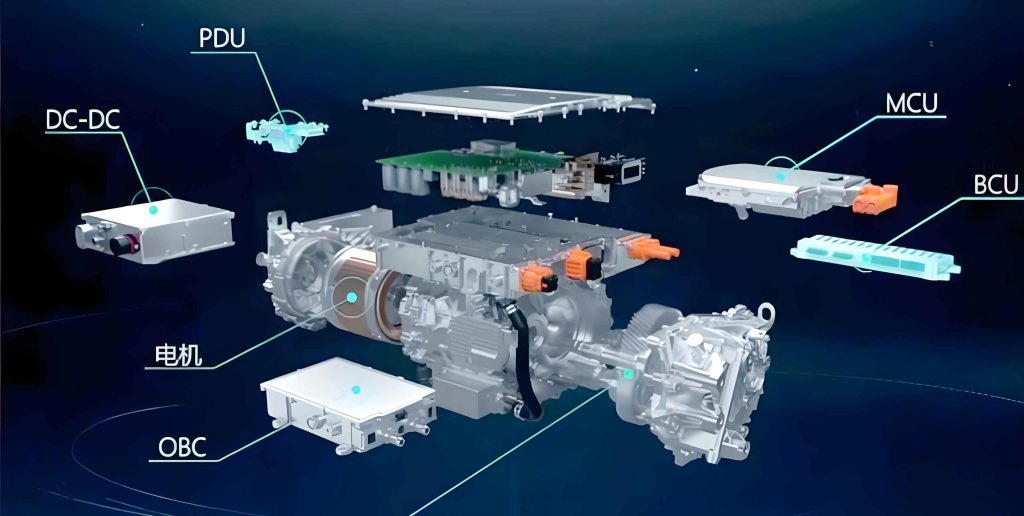
My analysis begins with a review of existing internal heating approaches, which contextualizes the advancement offered by electric drive system-based methods. They can be broadly categorized as follows:
| Method Category | Description | Key Advantages | Key Disadvantages |
|---|---|---|---|
| External Heating | PTC heaters, heating mats, fluid jackets. | Simple control, commercially available. | Slow, inefficient, uneven heating, adds mass/volume. |
| Internal – Structural | Embedded nickel foil (“All-Climate Battery”). | Very fast heating rates. | Reduces energy density, complex cell manufacturing, safety concerns with internal switches. |
| Internal – External Circuit | Dedicated DC-DC or LC resonant circuits attached to battery terminals. | Good control over current frequency/amplitude. | Requires additional, costly power electronics, increasing system complexity and weight. |
| Internal – Drive System | Using the motor and inverter to generate AC current. | No extra hardware; uses existing high-power components; efficient. | Control algorithm complexity; must ensure zero torque output. |
The most promising direction, from a system integration and cost perspective, is the last one: leveraging the electric drive system. The fundamental setup is elegantly simple. During a vehicle standstill (parking or pre-conditioning), the traction motor is stationary. The three-phase windings of the motor, fed by the inverter, act as a balanced three-phase inductive load. By commanding specific voltage vectors from the inverter, we can control the current drawn from the high-voltage battery. If we command these voltages to alternate, we can create an alternating current on the DC bus, which is sourced directly from the battery pack. This completes a loop where the battery supplies current, which is dissipated as heat in the battery’s own internal resistance and also in the motor windings, with the primary heating target being the battery.
The central technical problem is how to control the inverter to generate this bus AC while guaranteeing that the motor produces zero net torque. A known technique in motor control for sensorless position estimation at zero speed is high-frequency signal injection. Typically, a high-frequency rotating or pulsating voltage vector is superimposed on the fundamental control voltages. The motor’s saliency causes a current response that can be decoded to find the rotor position. Crucially, the high-frequency excitation produces a negligible average torque. This principle can be adapted for heating. The conventional high-frequency square-wave injection method for sensorless control involves injecting a positive voltage vector along the estimated d-axis for half the injection period and a negative vector for the other half. While this does create a pulsating current on the DC bus, my analysis and experimental evidence show it has limitations for heating: the excited bus current frequency is twice the injection frequency, and the amplitude of the bus current is heavily dependent on this injection frequency and has limited adjustability.
I propose an enhanced method termed the Multi-Period Offset-Square-Wave Injection. This strategy provides independent and flexible control over the amplitude and frequency of the battery heating current. The core modifications to the standard motor vector control are:
- The q-axis current reference is set to zero ($i_{q}^* = 0$) to eliminate torque production.
- A DC (or very low frequency) current offset is injected on the d-axis ($i_{d,offset}^*$).
- A high-frequency square-wave voltage signal is superimposed on the d-axis voltage command. This square wave has a period that is a multiple (N) of the fundamental PWM switching period, allowing the heating frequency ($f_{heat} = 1/(N \cdot T_{sw})$) to be decoupled from and much lower than the PWM frequency.
The “offset” is key. By combining a DC current bias with the AC voltage injection, we effectively create a pulsating voltage vector whose magnitude in the positive and negative halves of the cycle is asymmetrical. This asymmetry, when processed through the inverter’s space vector modulation (SVM), leads to a dramatic change in how the DC bus current is synthesized. In traditional symmetric injection, the bus current during the positive and negative voltage halves tends to be symmetric and bipolar. With the DC offset, the modulation can be biased such that for a large portion of the AC cycle, the bus current flows in one direction with a large magnitude, reversing only briefly with a smaller magnitude or vice-versa, depending on the sign of $i_{d,offset}^*$. This results in a high-amplitude, low-frequency AC current on the DC bus, ideal for efficient Joule heating. The governing equation for the idealized power is:
$$P_{heat} \approx \left( I_{batt, rms} \right)^2 \cdot R_{int}(T, SOC)$$
where $I_{batt, rms}$ is the root-mean-square value of the excited AC current on the battery side, and $R_{int}$ is the battery’s highly temperature-dependent internal resistance.
The flexibility of this method is its major strength. The heating power can be regulated by three independent knobs:
- D-axis DC Current Offset ($i_{d,offset}^*$): Increasing the absolute value of this offset directly increases the amplitude of the dominant portion of the bus current.
- High-Frequency Voltage Amplitude ($V_{inj}$): Increasing this amplifies the switching action’s effect, also increasing bus current ripple and overall $I_{batt, rms}$.
- Injection Frequency ($f_{inj}$): This determines the fundamental frequency of the bus AC. There exists an optimal point based on the system impedance (battery inductance, bus capacitance, motor inductance).
Experimental studies on a test bench using a 200 kW PMSM drive and a 73 kWh Lithium Iron Phosphate (LFP) battery pack validate the theory. The following table summarizes key experimental findings that differentiate the proposed method from conventional injection:
| Injection Method | Conditions (f_inj, V_inj, I_dc) | Resulting Bus Current (I_batt, rms) | Key Observation |
|---|---|---|---|
| Conventional Square-Wave | 2.5 kHz, 0.3 pu, 0 A | 3.4 A | Very low current, bus freq = 5 kHz. |
| Conventional Square-Wave | 1.25 kHz, 0.3 pu, 0 A | 46.5 A | Higher current, bus freq = 2.5 kHz. Limited by V_inj only. |
| Multi-Period (no offset) | 1.25 kHz, 0.3 pu, 0 A | 34.5 A | Less effective than conventional at same frequency. |
| Multi-Period Offset (Proposed) | 2.5 kHz, 0.15 pu, -100 A | 52.7 A | Higher current at same bus freq, with room to increase further via I_dc & V_inj. |
A parameter sweep revealed an optimal injection frequency for the specific test system. With $i_{d,offset}^* = -160A$ and $V_{inj} = 0.15$ pu, the bus current peaked at a 6-division ratio (injection frequency = PWM freq / 6). Furthermore, the relationship between control variables and output was confirmed:
| Variable Changed | Trend in I_batt,rms | Physical Reason |
|---|---|---|
| Increase $|i_{d,offset}^*|$ | Increases | Biases the modulation deeper into active vector regions, increasing conduction intervals. |
| Increase $V_{inj}$ | Increases | Increases the commanded voltage vector magnitude, demanding more current from the battery. |
| Decrease $f_{inj}$ (to a point) | Increases, then decreases | Lower frequency allows current to build to a higher value per cycle, but too low a frequency may interact negatively with system LC dynamics. |
The method also exhibits a beneficial self-regulating property. As the battery warms up, its internal resistance $R_{int}$ decreases. For a fixed set of injection parameters ($i_{d,offset}^*$, $V_{inj}$, $f_{inj}$), a lower $R_{int}$ leads to a higher $I_{batt, rms}$, as the circuit impedance is reduced. This increased current partially compensates for the reduced resistance, helping to maintain a relatively constant heating power or even increase it as temperature rises, thereby accelerating the heating process.
The ultimate validation was performed in a full-vehicle environmental chamber. With the chamber set to -20°C and the battery soaked to that temperature, the algorithm was activated with parameters pushed to the system’s safe limits ($i_{d,offset}^* = -350A$, $V_{inj} = 0.25$ pu, $f_{inj} = PWM/6$), generating a 300 Arms bus current. The result was a temperature rise from -20°C to -10°C in just 442 seconds, corresponding to an average heating rate of approximately 1.36°C/min. This is significantly faster than typical external PTC-based heaters, which often struggle to achieve 0.5°C/min for a large pack, and it accomplishes this without a single added component, purely through intelligent software control of the electric drive system.
In conclusion, the multi-period offset-square-wave injection method represents a highly practical and effective solution for low-temperature battery self-heating in electric vehicles. Its principal advantage is the complete utilization of existing powertrain hardware—the battery, inverter, and motor—transforming the electric drive system into a powerful, controllable heating unit. The method provides flexible and independent control over heating current amplitude and frequency, integrates seamlessly into standard field-oriented control frameworks, and ensures zero torque output for safety. Experimental results confirm the theoretical principles, demonstrating the ability to generate high-amplitude, frequency-tunable AC currents in the battery and achieve rapid pack heating rates under realistic low-temperature conditions. This approach effectively addresses a critical barrier to EV performance in cold climates, enhancing usability, longevity, and safety without incurring additional hardware costs or complexity.