
In modern electric vehicles, the electric drive system serves as the core powertrain component, replacing traditional internal combustion engines. As a result, noise, vibration, and harshness (NVH) performance has become increasingly critical for passenger comfort. Within the electric drive system, the reducer is a primary source of noise, particularly whining noise, which is a high-frequency tonal sound easily perceived by the human ear. With the absence of engine masking effects in electric vehicles, background noise is lower, making reducer whining more prominent and demanding stringent control measures. In this study, I focus on analyzing and optimizing the whining noise issue in a single-motor electric drive system reducer, employing a comprehensive approach that integrates dynamic simulation, parameter optimization, and experimental validation.
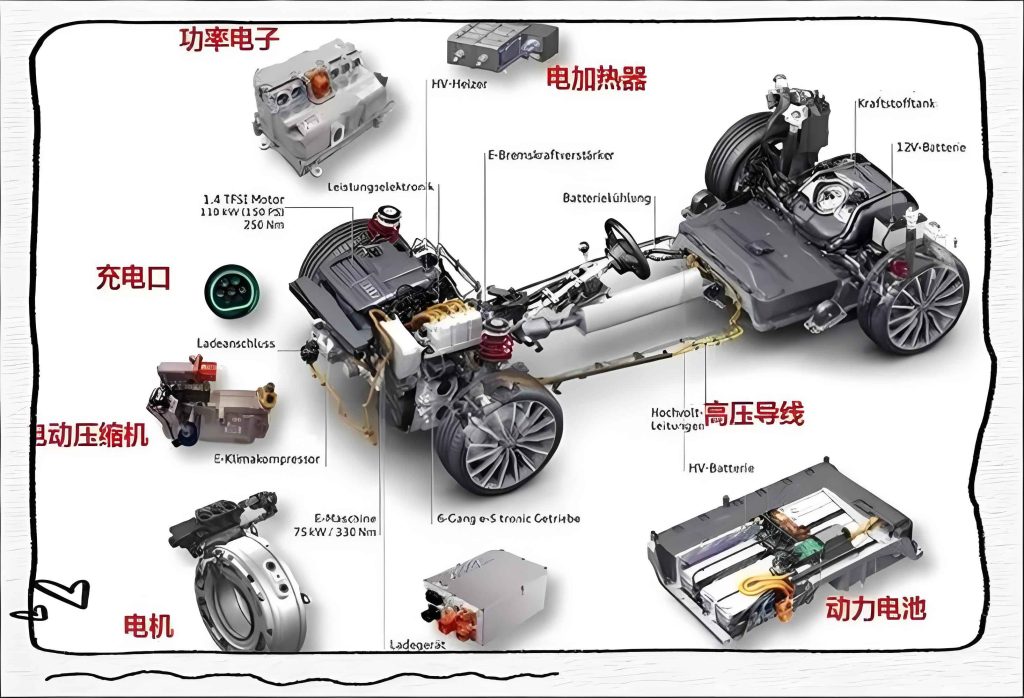
The electric drive system under investigation features a two-stage, three-shaft reducer. During整车 NVH subjective evaluations, pronounced whining noise was detected in two acceleration ranges: 30–50 km/h (corresponding to input speeds of 2,300–3,200 rpm at 30% of maximum motor torque) and 90–110 km/h (input speeds of 6,350–7,500 rpm at 70% of maximum motor torque). Objective testing revealed that the 22nd order noise, associated with the first-stage gear mesh, exceeded the target limit by 5 dB, indicating a significant NVH issue. This problem underscores the need for a detailed analysis of the electric drive system to identify root causes and implement effective solutions.
Whining noise in an electric drive system reducer stems from dynamic excitations generated during gear meshing. It is a steady-state noise characterized by order components related to gear tooth counts. The mechanism involves three key aspects: vibration excitation source, transmission path, and system response. The excitation source arises from gear meshing dynamics, influenced by factors such as gear macro-parameters, micro-geometry modifications, contact stress distribution, transmission error, time-varying mesh stiffness, and manufacturing errors. The transmission path includes components like gear webs, shafts, and bearings, which transfer vibrations to the reducer housing. The system response involves housing stiffness, modal characteristics, and coupled resonances. When excitation frequencies align with structural modal frequencies, resonance occurs, amplifying noise. Thus, optimizing the electric drive system requires a holistic approach addressing all these facets.
To investigate the whining noise, I began by examining potential manufacturing and assembly errors. Disassembly and inspection of the reducer showed that most components met tolerance specifications, except for the first-stage gears, which exhibited deviations in tip relief and individual pitch errors. However, replacing these gears with qualified ones did not significantly reduce the noise, indicating that manufacturing errors were not the primary cause. This led me to focus on dynamic performance analysis using a virtual prototype model.
I developed a detailed dynamics simulation model of the electric drive system reducer using specialized software. The model incorporated finite element representations for shafts, gear webs, differential housing, and reducer housing to capture accurate stiffness, mass, and modal properties. Calibration was performed based on bench test and vehicle test results, including gear contact pattern tests and vibration noise measurements. The calibrated model showed strong agreement with experimental data, ensuring reliability for subsequent analysis. For instance, gear contact patterns from simulation matched those from physical tests, and vibration responses aligned with measured spectra. This validated model served as the foundation for in-depth analysis of the electric drive system.
The vibration excitation source was analyzed by evaluating transmission error, mesh stiffness, and dynamic mesh force for the first-stage gears. Transmission error (TE) is a critical indicator of meshing performance, defined as the deviation between the theoretical and actual positions of the driven gear. It can be expressed as: $$TE(t) = \theta_2(t) – \frac{N_1}{N_2} \theta_1(t)$$ where \(\theta_1\) and \(\theta_2\) are the rotational angles of the driving and driven gears, and \(N_1\) and \(N_2\) are their tooth numbers. In the problem工况, TE peak-to-peak values were 0.54 μm and 1.09 μm, which are relatively high. Mesh stiffness, denoted as \(k_m(t)\), varies periodically due to changing tooth contact conditions. Its fluctuation was calculated as: $$\Delta k_m = \max(k_m(t)) – \min(k_m(t))$$ yielding values of 2.06 N/(μm·mm) and 1.84 N/(μm·mm) for the two torque conditions. Dynamic mesh force \(F_d(t)\) is derived from the product of mesh stiffness and transmission error: $$F_d(t) = k_m(t) \cdot TE(t)$$ Analysis showed pronounced peaks in \(F_d(t)\) at specific speeds, such as 0.62 kN/μm and 1.53 kN/μm for the lower speed range, and 0.96 kN/μm and 1.99 kN/μm for the higher range. These excitation levels required reduction to mitigate whining noise in the electric drive system.
| Parameter | 30% Torque Condition | 70% Torque Condition |
|---|---|---|
| Transmission Error (Peak-to-Peak, μm) | 0.54 | 1.09 |
| Mesh Stiffness Fluctuation (N/(μm·mm)) | 2.06 | 1.84 |
| Dynamic Mesh Force Peak (kN/μm) | 0.62, 1.53 | 0.96, 1.99 |
The transmission path analysis focused on the support stiffness of components like gear webs and shafts. Insufficient stiffness can increase gear misalignment, exacerbating transmission error and dynamic forces. System deformation simulations revealed significant axial deformation in the first-stage driven gear web, indicating inadequate support stiffness. This necessitated structural optimization to enhance rigidity. The electric drive system’s integrity depends on robust transmission paths to minimize vibration transfer.
System vibration response was evaluated through coupled modal analysis and frequency response functions. The results identified multiple modal frequencies near the excitation frequencies in the problem speed ranges, leading to resonance. For example, at input speeds of 2,513 rpm and 6,853 rpm, modal frequencies coincided with the 22nd order excitation, causing amplified vibrations. The response can be modeled using the equation of motion: $$M\ddot{x} + C\dot{x} + Kx = F(t)$$ where \(M\), \(C\), and \(K\) are mass, damping, and stiffness matrices, \(x\) is displacement, and \(F(t)\) is the excitation force from gear meshing. Resonance occurs when the excitation frequency \(f_e\) matches the natural frequency \(f_n\): $$f_e = \frac{N \cdot n}{60}$$ where \(N\) is the gear tooth count and \(n\) is the input speed in rpm. Avoiding such overlaps is crucial for noise reduction in the electric drive system.
Based on the analysis, I devised optimization strategies targeting the excitation source, transmission path, and system response. For the excitation source, gear macro-parameters and micro-geometry modifications were optimized. Macro-parameters include tooth numbers and contact ratio. The contact ratio \(\epsilon\) is given by: $$\epsilon = \epsilon_a + \epsilon_b$$ where \(\epsilon_a\) is the transverse contact ratio and \(\epsilon_b\) is the axial contact ratio. Increasing \(\epsilon\) improves load distribution and reduces TE. Two tooth number schemes were proposed: Scheme 1 with 29/70 teeth and Scheme 2 with 31/75 teeth, while maintaining the overall gear ratio. These changes alter the excitation frequency to avoid resonance. Micro-geometry modifications, such as tip relief, lead crowning, and profile slope, were optimized to ensure even contact stress distribution and minimize TE. The optimization aimed to achieve TE peak-to-peak values below 0.5 μm and mesh stiffness fluctuations under 1.5 N/(μm·mm).
| Optimization Scheme | Driving Gear Teeth | Driven Gear Teeth | Excitation Frequency at 2,513 rpm (Hz) | Excitation Frequency at 6,853 rpm (Hz) |
|---|---|---|---|---|
| Original | 22 | 53 | 921 | 2,512 |
| Scheme 1 | 29 | 70 | 1,215 | 3,312 |
| Scheme 2 | 31 | 75 | 1,298 | 3,541 |
For the transmission path, the first-stage driven gear web was redesigned to increase stiffness. The web thickness was enlarged from 10 mm to 15 mm, and lightening holes were added to control weight. The rim thickness was also increased to better support the teeth. This structural enhancement reduces deformation under load, thereby decreasing misalignment and excitation in the electric drive system.
The optimization results showed significant improvements. For Scheme 1, TE peak-to-peak values dropped to 0.32 μm and 0.45 μm for the two torque conditions, and mesh stiffness fluctuations reduced to 1.41 N/(μm·mm) and 0.81 N/(μm·mm). Dynamic mesh force peaks were lowered and shifted away from critical speeds. Similarly, Scheme 2 achieved TE values of 0.26 μm and 0.31 μm, with mesh stiffness fluctuations of 1.71 N/(μm·mm) and 0.88 N/(μm·mm). The contact ratios also increased, as summarized below:
| Parameter | Original Scheme | Scheme 1 | Scheme 2 |
|---|---|---|---|
| Transverse Contact Ratio | 1.51 | 1.73 | 1.85 |
| Axial Contact Ratio | 2.66 | 2.98 | 3.11 |
| Total Contact Ratio | 4.17 | 4.72 | 4.96 |
To predict noise reduction, I calculated the sound power level for the gear mesh orders. The sound power \(L_W\) can be estimated from vibration velocity \(v\) using: $$L_W = 10 \log_{10}\left(\frac{v^2 \rho c A}{W_0}\right)$$ where \(\rho\) is air density, \(c\) is sound speed, \(A\) is radiating area, and \(W_0\) is reference power. For both optimized schemes, the 29th and 31st order noise levels (corresponding to the new tooth numbers) were predicted to be below 35 dB, meeting the target. This demonstrates the effectiveness of the optimizations for the electric drive system.
Experimental validation was conducted by manufacturing prototypes of the optimized schemes and performing vehicle NVH tests. The results confirmed substantial noise reduction. For Scheme 1, the first-stage gear order noise decreased by 11 dB(A) compared to the original, while Scheme 2 achieved a 14 dB(A) reduction. Both schemes met the 35 dB(A) target, with noise levels consistently lower across the speed ranges. This validates the simulation-based optimization approach and highlights the importance of integrated design for electric drive system NVH performance.
In conclusion, addressing whining noise in an electric drive system reducer requires a multifaceted strategy encompassing vibration excitation control, transmission path reinforcement, and system response management. Through dynamic simulation modeling, I identified key issues such as high transmission error, mesh stiffness variation, and modal resonance. Optimization of gear macro-parameters and micro-geometry, along with structural enhancements, significantly reduced excitation sources. Changing gear tooth numbers avoided resonance frequencies, while improved web stiffness minimized deformation. Experimental tests verified the optimizations, achieving noise targets and enhancing overall NVH performance. This study provides a comprehensive methodology for the正向 development of quiet electric drive systems, emphasizing that successful noise reduction hinges on detailed analysis and holistic design adjustments. Future work could explore advanced materials or active control techniques to further refine the electric drive system’s acoustic characteristics.