
The rapid global transition towards sustainable energy has propelled the new energy vehicle (NEV) industry into an era of unprecedented growth. At the heart of every NEV lies the electric drive system, a complex assembly whose performance, efficiency, and reliability are paramount to the overall vehicle dynamics. Within this critical system, the DC-Link capacitor serves as a fundamental component, acting as a vital energy buffer between the high-voltage battery pack and the inverter. Its primary functions are to smooth voltage fluctuations, filter high-frequency noise generated by the inverter’s switching actions, and supply high pulse currents, thereby ensuring stable and efficient operation of the entire electric drive system. As power density demands increase, effective thermal management of this component becomes non-negotiable. Excessive heat can degrade the dielectric material, increase equivalent series resistance (ESR), and ultimately lead to premature capacitor failure, compromising the entire electric drive system. This article presents a comprehensive, first-person perspective on a co-simulation workflow utilizing MATLAB, ANSYS Q3D Extractor, and ANSYS Icepak to accurately model, predict, and analyze the thermal behavior of DC-Link capacitors, providing a robust theoretical foundation for their selection and thermal design within modern electric drive systems.
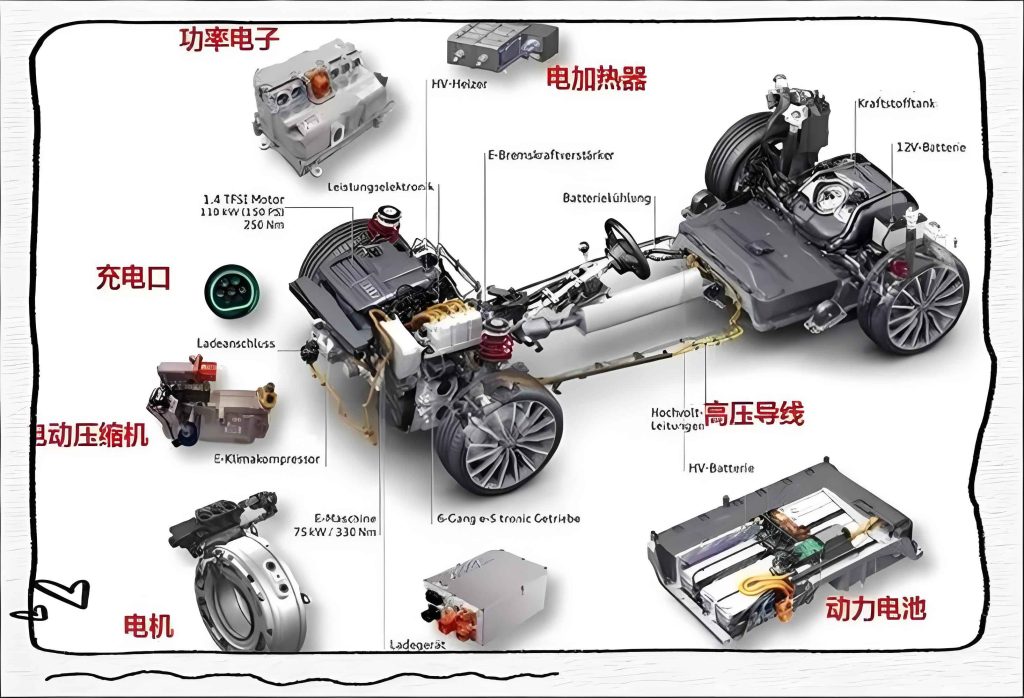
The selection of capacitor technology for the demanding environment of an electric drive system is critical. While multiple capacitor families exist, their suitability varies greatly based on electrical and thermal requirements. The table below provides a comparative analysis of the primary capacitor types considered for high-power applications.
| Capacitor Type | Dielectric Material | Key Advantages | Key Disadvantages | Suitability for EV DC-Link |
|---|---|---|---|---|
| Ceramic Capacitor (MLCC) | Ceramic (e.g., X7R, C0G) | Very small size, excellent high-frequency response, non-polar, high stability. | Limited capacitance value, strong capacitance derating with DC bias, potential for microphonics and cracking. | Low. Used for high-frequency decoupling but insufficient for bulk energy storage. |
| Electrolytic Capacitor (Aluminum) | Aluminum Oxide Film with Electrolyte | Very high capacitance-to-volume ratio, low cost. | Polarized, relatively high ESR and ESL, limited lifetime (especially at high temperature), dry-out failure mechanism. | Moderate to Low. Historically used but being phased out due to reliability and performance limitations in harsh electric drive system environments. |
| Film Capacitor (e.g., Polypropylene) | Polymer Film (e.g., PP, PET) | Non-polar, very low ESR/ESL, high ripple current capability, self-healing property, excellent temperature stability, long lifetime. | Lower volumetric capacitance compared to electrolytics, higher cost per microfarad. | High. The preferred choice due to robustness, performance, and reliability in electric drive system applications. |
Given the analysis above, the metallized polypropylene film capacitor emerges as the definitive choice for the DC-Link in modern electric drive systems. Its structure is optimized for performance: a wound cell consisting of metallized dielectric films acts as the capacitive element, which is then impregnated with a resin (like epoxy) for mechanical stability and partial heat transfer. This assembly is housed in a case, typically aluminum, with insulating bushings. Thick copper bars or terminals are connected to the film windings to carry the high currents. Understanding this physical structure is the first step in creating an accurate thermal model.
The imperative for thermal analysis stems from the non-ideal, lossy behavior of real-world capacitors. In an ideal capacitor, energy is stored and released without loss. However, in a physical DC-Link capacitor within an electric drive system, several mechanisms convert electrical energy into heat, threatening its operational integrity. The primary loss mechanisms can be summarized as follows.
- Dielectric Loss (P_d): Caused by the polarization and relaxation of dipoles within the polypropylene film under a time-varying electric field. This loss is proportional to the capacitance, frequency, and square of the voltage, and is characterized by the dissipation factor (tan δ).
$$P_d = 2 \pi f C V_{rms}^2 \cdot \tan \delta$$ - Equivalent Series Resistance (ESR) Loss (P_esr): This encompasses losses from the resistance of the metallized electrodes, the leads, and terminals. It is the dominant loss component at high ripple currents and is frequency-dependent.
$$P_{esr} = I_{rms}^2 \cdot ESR(f)$$
Where $I_{rms}$ is the root-mean-square value of the ripple current flowing through the capacitor. - Leakage Current Loss (P_lk): A small DC current that flows through the dielectric due to its finite insulation resistance (IR). This loss is typically negligible compared to the others under normal operating conditions.
$$P_{lk} = V_{DC}^2 / IR$$
The total power loss ($P_{total}$) generated within the capacitor, which serves as the heat source for thermal simulation, is the sum of these components:
$$P_{total} = P_d + P_{esr} + P_{lk}$$
For practical engineering analysis, especially concerning thermal response, the losses are often consolidated into a single frequency-dependent ESR term, as the dielectric loss can be effectively integrated into a measured or calculated ESR value. Therefore, the dominant thermal source model simplifies to $P_{total} \approx I_{rms}^2 \cdot ESR(f, T)$.
Accurately modeling the heat dissipation path is equally crucial. A simplified yet effective thermal resistance network model for a DC-Link capacitor can be conceptualized. Heat generated in the wound film core ($Q_{core}$) flows through several paths: radially through the impregnation resin to the aluminum case ($R_{th, core-case}$), and from the case to the ambient environment via conduction through mounts and convection/radiation ($R_{th, case-amb}$). Simultaneously, heat from the high-current copper terminals ($Q_{terminals}$) conducts along the busbar and is also transferred to the case and ambient. The hottest spot, typically located at the core’s center, is the critical temperature for reliability assessments. This conceptual model guides the setup of the detailed 3D computational fluid dynamics (CFD) simulation.
| Component | Loss Mechanism | Governing Formula | Role in Thermal Model |
|---|---|---|---|
| Film Dielectric | Dielectric Loss | $P_d = 2 \pi f C V^2 \tan\delta$ | Integrated into core volume heat source. |
| Metallized Electrodes & Connections | ESR (Resistive) Loss | $P_{esr} = I_{rms}^2 \cdot ESR$ | Primary core volume heat source. |
| Copper Terminals/Busbar | Joule Heating | $P_{bar} = I_{rms, bar}^2 \cdot R_{dc}(T)$ | Discrete heat source on terminal geometry. |
| Complete Assembly | Thermal Resistance Network | $\Delta T = Q \cdot R_{th}$ | Governs temperature rise from source to ambient. |
The proposed co-simulation methodology breaks down the complex electro-thermal problem into sequential, manageable stages performed by specialized software tools. This workflow ensures that the electrical operating conditions, which determine the loss magnitudes, are accurately derived before being imported into the thermal solver.
Stage 1: Electrical System Simulation & Core Loss Calculation with MATLAB
The first step involves determining the electrical stress on the DC-Link capacitor within the context of the complete electric drive system. Using MATLAB/Simulink, we build a system-level model of the inverter and motor drive. This model simulates the switching behavior of the insulated-gate bipolar transistors (IGBTs) or silicon carbide (SiC) MOSFETs to calculate the time-domain current waveform drawn from the DC-Link. The key output is the ripple current $I_{rms}$.
$$I_{rms} = \sqrt{\frac{1}{T} \int_0^T i_{cap}^2(t) \, dt}$$
For a rapid estimation, analytical formulas can be employed. For a three-phase two-level inverter driving a permanent magnet synchronous motor (PMSM), the approximate RMS ripple current can be related to the output phase current $I_{ph}$ and modulation index $m$:
$$I_{rms, cap} \approx I_{ph} \sqrt{ \frac{\sqrt{3}}{4\pi} m + \frac{\sqrt{3}}{\pi} \left( \frac{m^2}{8} – \frac{m^3}{3\pi} \right) }$$
Once $I_{rms}$ is obtained, the power loss in the capacitor’s core is calculated using the simplified model, relying on the ESR data provided by the capacitor manufacturer, which is often a function of frequency and temperature.
$$P_{core} = I_{rms}^2 \cdot ESR(f_{sw}, T)$$
This value, $P_{core}$, is the volumetric heat generation rate (in W) that will be applied to the capacitor’s winding model in the thermal simulation.
Stage 2: Parasitic Extraction & Busbar Loss Calculation with ANSYS Q3D Extractor
The copper terminals and busbars connecting the capacitor to the inverter are significant sources of heat due to their non-negligible resistance. To calculate this loss accurately, we must account for their 3D geometry, which influences current distribution and AC resistance due to skin and proximity effects at the high switching frequencies of the electric drive system.
- Geometry Import and Material Assignment: The 3D CAD model of the capacitor assembly, focusing on the copper terminals/busbars, is imported into Q3D.
- Source and Sink Setup: Net ports are defined at the connection points where current enters and exits the busbar structure.
- Frequency Sweep Setup: A frequency sweep is performed, covering the relevant harmonics of the inverter’s switching frequency (e.g., from DC to several hundred kHz).
- RLCG Matrix Extraction: Q3D solves the quasi-static electromagnetic fields to extract the frequency-dependent resistance $R(f)$ and inductance $L(f)$ matrices for the defined nets.
- Loss Calculation: Using the extracted $R(f)$ for the busbar net and the spectral components of the current waveform from Stage 1, the total power loss in the busbar is computed. For a current defined by its spectral components $I_n$ at frequencies $f_n$:
$$P_{busbar} = \sum_{n} I_n^2 \cdot R(f_n)$$
This $P_{busbar}$ value represents a discrete heat source attached to the busbar geometry in the subsequent thermal model.
| Simulation Stage | Software Tool | Primary Objective | Key Output | Transferred to Next Stage As |
|---|---|---|---|---|
| System Electrical Analysis | MATLAB/Simulink | Determine operating ripple current $I_{rms}$ of the DC-Link. | Ripple current spectrum, $I_{rms}$ value. | Input for loss calculations. |
| Parasitic & Busbar Loss | ANSYS Q3D Extractor | Extract frequency-dependent resistance of 3D busbar geometry. | Power loss $P_{busbar}$. | Discrete heat source value and geometry. |
| Consolidated Loss Model | – | Combine core loss and busbar loss. | Total heat source map: $P_{core}$ (volumetric), $P_{busbar}$ (on geometry). | Input boundary condition for thermal solver. |
| 3D Thermal Analysis | ANSYS Icepak | Solve for temperature distribution and heat flow. | Temperature field, hotspot $T_{max}$, heat flux vectors. | Final performance metric for design assessment. |
Stage 3: 3D Thermal Simulation with ANSYS Icepak
With all heat sources quantified, the final stage is the thermal analysis. The detailed 3D geometry of the capacitor—including the aluminum case, the internal winding block (simplified as a solid block with anisotropic thermal conductivity if needed), the epoxy fill, the insulating bushings, and the copper busbars—is imported into Icepak.
- Material Properties Assignment: Accurate temperature-dependent thermal properties (conductivity, specific heat, density) are assigned to each material (Aluminum, Copper, Epoxy, Polypropylene film equivalent).
- Heat Source Definition: The losses calculated previously are applied:
- The core loss $P_{core}$ is applied as a uniform volumetric heat generation to the winding block.
- The busbar loss $P_{busbar}$ is applied as a surface or solid heat source on the copper terminal geometry.
- Boundary Condition Setup: Realistic boundary conditions are applied. This includes:
- Convection: A convective heat transfer coefficient (h) is applied to the external surfaces of the capacitor case and busbars. The value of ‘h’ can be derived from system-level CFD simulations of the electric drive system enclosure or from empirical correlations for the expected coolant (air or liquid) flow.
- Radiation: Surface-to-ambient radiation is often enabled, especially for air-cooled systems.
- Contact Resistance: Thermal contact resistances can be defined at interfaces like the busbar-to-case mounting point to improve model fidelity.
- Meshing and Solving: A suitable mesh is generated, refining around small features and expected thermal gradients. The steady-state (or transient) energy equation is then solved.
$$\nabla \cdot (k \nabla T) + \dot{q} = 0$$
where $k$ is thermal conductivity and $\dot{q}$ is the volumetric heat generation rate. - Post-Processing and Analysis: The results are analyzed to identify:
- The maximum temperature ($T_{max}$) within the capacitor winding, which is critical for lifespan prediction using the Arrhenius equation.
- The temperature distribution across the case and terminals.
- Heat flow vectors, showing the primary paths for heat dissipation from the core to the ambient.
This comprehensive thermal map allows us to evaluate if the design meets derating guidelines, identify potential hotspots, and assess the effectiveness of the thermal interface and cooling strategy for the electric drive system.
The integration of MATLAB, Q3D, and Icepak creates a powerful virtual prototyping environment for DC-Link capacitors. This co-simulation approach offers significant advantages over isolated or overly simplified analyses. It enables a precise linkage between the electrical operating conditions of the electric drive system and the resulting thermal performance of one of its most critical components. By accurately predicting the temperature rise and hotspot locations, engineers can make informed decisions regarding capacitor selection (based on its rated temperature and ripple current capability), optimize busbar geometry to minimize parasitic resistance, and design effective cooling strategies—all before physical prototyping. This not only enhances the reliability and longevity of the electric drive system but also reduces development time and cost through virtual testing and design iteration. As electric drive systems continue to evolve towards higher voltages, faster switching speeds, and greater power densities, the role of such high-fidelity, multi-domain co-simulation methodologies will only become more indispensable in delivering efficient, robust, and sustainable vehicle electrification solutions.