
In the development of modern battery electric cars, Noise, Vibration, and Harshness (NVH) performance is a critical factor influencing passenger comfort and overall vehicle quality. Resonance noise, in particular, poses a significant challenge due to the coupling of system natural frequencies with external excitation frequencies. This article, from my perspective as an NVH engineer, delves into a case study of a pure electric multi-purpose vehicle (MPV) experiencing a pronounced 480 Hz “whooshing” noise during acceleration, coasting, and constant-speed operations. The investigation follows a systematic “source-path-response” methodology, employing spectral analysis, modal testing, and computer-aided engineering (CAE) simulations to identify and mitigate the issue. Key focus is placed on the drive motor assembly in this battery electric car, highlighting how structural resonances can degrade acoustic quality. Through detailed analysis and optimization of the motor mounting structure, the constrained mode frequency was successfully elevated, eliminating the objectionable noise. This comprehensive discussion aims to provide insights into resonance noise control strategies for battery electric cars, emphasizing practical engineering solutions supported by theoretical principles, tables, and mathematical formulations.
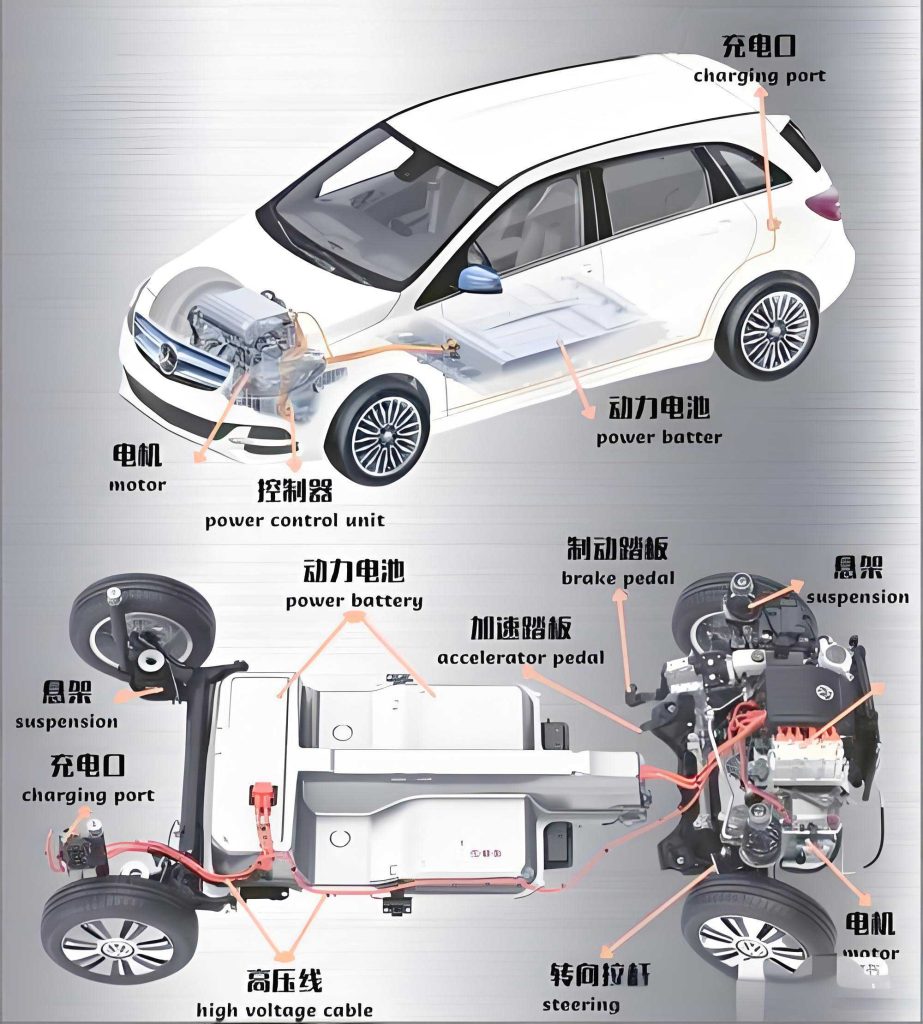
The proliferation of battery electric cars has revolutionized automotive design, bringing forth unique NVH characteristics distinct from internal combustion engine vehicles. In battery electric cars, the absence of engine mask noise often exposes other sound sources, such as drive motor whine, gear meshing, and structural resonances. Resonance noise occurs when a component’s natural frequency aligns with an excitation frequency, leading to amplified vibrations and radiated sound. For battery electric cars, this is exacerbated by lightweight construction and the broad frequency content of electromagnetic forces from motors. The “source-path-response” paradigm is fundamental: the source (e.g., motor forces) generates vibrations that travel through paths (e.g., mounts, chassis) to create a response (e.g., interior noise). Understanding and controlling these elements is paramount for enhancing the comfort of battery electric cars.
In this specific battery electric car—an MPV model—road testing revealed an intrusive 480 Hz tonal noise resembling a bee swarm or “whooshing” sound. Subjectively, it was deemed unacceptable, especially at speeds above 80 km/h. To quantify the issue, interior noise measurements were taken using microphones positioned at key locations, such as the driver’s ear and rear passenger seats. Time-frequency analysis, including Fast Fourier Transform (FFT) and order tracking, was employed. The noise was persistent across operating conditions, indicating a structural resonance rather than a transient phenomenon. The spectral data showed a distinct resonance band centered at 480 Hz, with contributions from motor electromagnetic orders (4th to 8th). Filtering this band via digital signal processing confirmed its role as the primary contributor to the poor sound quality. This initial diagnosis steered the investigation toward the drive system of the battery electric car.
The drive system in this battery electric car featured a rear-mounted electric motor integrated with a rigid axle. The motor’s electromagnetic forces act as the primary excitation source. The vibration transmission path can be modeled as a series of mechanical impedances. Let the motor force be \( F_m(\omega) \), where \( \omega \) is the angular frequency. The vibration response at the interior \( X_i(\omega) \) can be expressed as:
$$ X_i(\omega) = H_{sp}(\omega) \cdot F_m(\omega) $$
where \( H_{sp}(\omega) \) is the frequency response function encompassing the transfer path from source to response. For this battery electric car, the path included motor mounts, axle, suspension components (dampers, springs, trailing arms, lateral links), and body structure. Airborne noise from motor casing radiation also contributed, but structural transmission was dominant based on the noise character. To dissect the problem, acceleration sensors were placed on the motor casing, active side of the drive axle, and passive side of the drive axle. Vibration waterfall plots revealed a consistent 480 Hz resonance across these points, while suspension isolation met targets, ruling out path inefficiencies as the root cause. This pointed to a local structural resonance within the drive unit.
Modal analysis is crucial for identifying resonant frequencies. The natural frequency \( f_n \) of a component is given by:
$$ f_n = \frac{1}{2\pi} \sqrt{\frac{k}{m}} $$
where \( k \) is stiffness and \( m \) is mass. For complex assemblies, experimental modal analysis (EMA) and finite element analysis (FEA) are used. In this battery electric car, EMA was conducted on the drive motor, axle, and mounting brackets using impact hammer testing and accelerometers. The motor’s constrained mode—where it is fixed to the structure—was found at 480 Hz, exhibiting a rotational deformation around the Y-axis. The mounting bracket showed high strain energy at this frequency, indicating it was a weak link. CAE simulations corroborated this, with modal shapes matching experimental results. The bracket’s design, an L-shaped plate with 5 mm thickness and two-point attachment to the axle, resulted in insufficient stiffness. The resonance condition occurs when the excitation frequency \( f_e \) matches \( f_n \), leading to amplified response per the equation for a single-degree-of-freedom system:
$$ \frac{X}{F} = \frac{1}{k – m\omega^2 + jc\omega} $$
where \( c \) is damping. In battery electric cars, motor orders vary with speed, and the 480 Hz band aligned with critical orders during common driving scenarios, thus causing persistent noise.
To systematically address the issue, potential solutions were evaluated from source, path, and receiver perspectives. For battery electric cars, source control might involve motor design modifications to reduce electromagnetic force harmonics, but this is costly and time-consuming. Path control could include adding damping materials or optimizing suspension bushings, but testing indicated adequate isolation. Receiver control, such as interior acoustic treatments, might mask but not eliminate the noise. Thus, the most effective approach was to shift the constrained modal frequency away from the excitation band by increasing stiffness. The mounting bracket was redesigned: thickness increased from 5 mm to 7 mm, reinforcing ribs added at bends, and the attachment to the axle changed from two-point to three-point fixation. This altered the stiffness matrix \( K \) in the FEA model, elevating the natural frequency. The new design aimed to push the mode beyond 550 Hz, outside the dominant excitation range for this battery electric car.
The optimization process involved detailed CAE simulations. The updated bracket design was modeled, and modal analysis performed. The predicted frequency rose to 565 Hz. A prototype bracket was manufactured and tested on the vehicle. Experimental modal analysis confirmed the mode at 580 Hz, a significant increase from 480 Hz. The improvement can be quantified by the stiffness enhancement factor. Assuming mass remains constant, the frequency ratio relates to stiffness change:
$$ \frac{f_{new}}{f_{old}} = \sqrt{\frac{k_{new}}{k_{old}}} $$
Here, \( \frac{580}{480} \approx 1.208 \), implying \( k_{new} \approx 1.46 \, k_{old} \), a 46% stiffness increase. This effectively decoupled the resonance from the excitation frequencies in the battery electric car. Road tests were then conducted to validate interior noise reduction. The results showed elimination of the 480 Hz resonance band, with sound pressure levels dropping by approximately 30 dB(A) at that frequency. The table below summarizes key data before and after optimization for the battery electric car:
| Parameter | Before Optimization | After Optimization |
|---|---|---|
| Motor Constrained Mode Frequency | 480 Hz | 580 Hz |
| Interior Noise at 480 Hz (80 km/h) | 45 dB(A) | 15 dB(A) |
| Bracket Thickness | 5 mm | 7 mm |
| Attachment Points to Axle | 2 | 3 |
| Stiffness Increase (Estimated) | Base | 46% |
Further analysis of the excitation spectrum in battery electric cars is essential. The motor electromagnetic forces contain harmonics that depend on motor speed \( N \) (in rpm) and pole pair number \( p \). The fundamental electrical frequency \( f_e \) is:
$$ f_e = \frac{N \cdot p}{120} $$
For this battery electric car, the motor had 8 poles (4 pole pairs), so at 3000 rpm, \( f_e = 200 \, \text{Hz} \). The radial force waves, which excite structural modes, often occur at multiples of this frequency. The 480 Hz resonance coincided with the 2.4th order of \( f_e \), aligning with motor harmonics during acceleration and cruising. The table below illustrates how motor orders map to frequencies at various speeds for this battery electric car:
| Vehicle Speed (km/h) | Motor Speed (rpm) | Fundamental Frequency \( f_e \) (Hz) | 4th Order Harmonic (Hz) | 8th Order Harmonic (Hz) |
|---|---|---|---|---|
| 60 | 2250 | 150 | 600 | 1200 |
| 80 | 3000 | 200 | 800 | 1600 |
| 100 | 3750 | 250 | 1000 | 2000 |
Note that the problematic 480 Hz band fell between these harmonics, indicating it was not a direct electromagnetic order but a structural resonance excited by broad-band content. This underscores the importance of holistic NVH design in battery electric cars, where structural modes must be tailored to avoid such overlaps.
The success of this optimization highlights several best practices for battery electric cars. First, early integration of NVH considerations in design phases can prevent costly late-stage changes. Second, combined testing and simulation are invaluable; CAE tools like FEA enable rapid design iterations, while EMA provides validation. Third, the “source-path-response” framework should guide troubleshooting. For this battery electric car, focusing on the mounting bracket—a path element—proved efficient. The three-point attachment improved moment resistance, reducing rotational compliance. The added ribs increased bending stiffness, which for a plate can be approximated by:
$$ D = \frac{E t^3}{12(1-\nu^2)} $$
where \( D \) is flexural rigidity, \( E \) is Young’s modulus, \( t \) is thickness, and \( \nu \) is Poisson’s ratio. Increasing \( t \) from 5 mm to 7 mm raises \( D \) by a factor of \( (7/5)^3 = 2.744 \), significantly boosting natural frequency. Additionally, the multi-point fixation alters boundary conditions, further elevating modes.
Future work for battery electric cars could explore active noise cancellation or advanced materials like composites for brackets to achieve lightweight yet stiff designs. Moreover, machine learning algorithms could predict resonance risks from digital twins, streamlining development. The lessons from this case are transferable to other electric vehicles, including sedans and SUVs, as the drive system configurations share similarities. Ensuring superior NVH in battery electric cars is not just about silence but about crafting a pleasant acoustic environment that enhances the driving experience.
In conclusion, resonance noise in battery electric cars, exemplified by the 480 Hz “whooshing” issue in this MPV, can be effectively diagnosed and resolved through systematic engineering. By identifying the drive motor’s constrained modal resonance as the root cause and optimizing the mounting bracket stiffness and attachment scheme, the noise was eliminated. This approach underscores the interplay between structural dynamics and acoustic performance in battery electric cars. The use of spectral analysis, modal testing, and CAE simulations, complemented by mathematical models, provides a robust framework for NVH refinement. As battery electric cars continue to evolve, prioritizing such detailed NVH work will be essential for meeting consumer expectations and advancing automotive technology.