
In the era of rapid development for new energy vehicles, the latest data shows that their penetration rate in the domestic automotive market has exceeded 50%. Given the outstanding advantages of new energy vehicles in environmental protection, energy savings, smart connectivity technology, and driving comfort, they have increasingly become the primary choice for consumers, especially younger ones. Compared to traditional fuel vehicles with engine-centric powertrains, new energy vehicles primarily use motor-driven systems. The motor exhibits superior transient response characteristics; its peak torque can be established instantaneously within milliseconds under low-speed conditions, significantly enhancing the vehicle’s dynamic response and acceleration performance. With the motor as the main power source, the interior quietness during pure electric driving is notably improved. However, this also means that any slight abnormal noises inside the cabin become more easily perceptible to occupants, placing higher demands on the overall noise, vibration, and harshness (NVH) performance.
Currently, research on the rattle phenomenon of the electric drive system in new energy vehicles driving on bumpy roads is relatively limited. In this study, I analyze the rattle phenomenon of the electric drive system when new energy vehicles traverse bumpy roads and propose a method to actively identify road impacts and reduce the influence of bumpy roads on the electric drive system rattle by controlling motor torque. This approach effectively mitigates the impact of bumpy roads on the vehicle without altering the hardware, providing an effective means to shorten the vehicle development cycle and reduce costs.
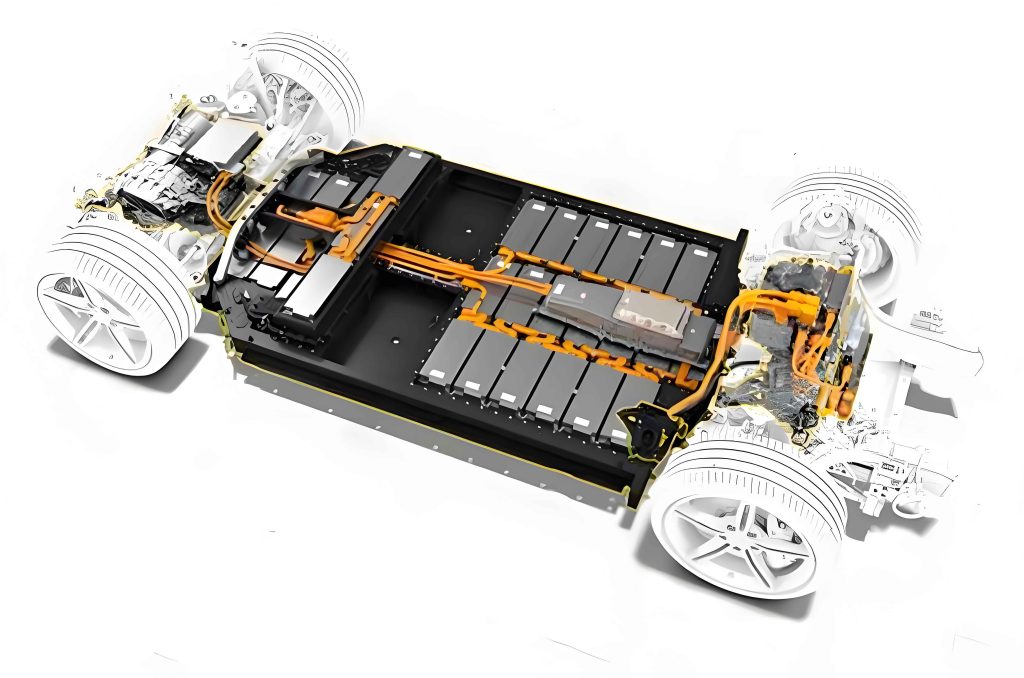
The electric drive system in new energy vehicles typically transmits power through gear pairs and spline pairs, where backlash exists between these components. A simplified diagram of the electric drive system transmission is shown below, illustrating the power transmission path: from the motor, through the first-stage gear pair for reduction, then to the second-stage gear pair for further reduction, followed by transmission to the differential, and finally via the half-shafts to the wheels. This process involves multiple transmission clearances; during power transmission, these clearances can superimpose and amplify, and as the transmission ratio of the electric drive system increases, the effect of backlash is also magnified. The transmission clearance in the electric drive system cannot be entirely eliminated but can only be controlled within a certain range by improving machining accuracy.
The motor in new energy vehicles can quickly reach peak torque under low-speed conditions; after entering the constant power region, the motor torque decreases as speed increases. The motor torque-power characteristic curve is depicted, where \(T_{\text{max}}\) is the motor peak torque, \(W_b\) is the motor peak power, \(n_b\) is the speed at the transition point from the constant torque region to the constant power region, and \(n_{\text{max}}\) is the maximum motor speed. The motor torque in the constant power region is calculated as follows:
$$T = \frac{W}{n}$$
where \(T\) is the motor torque in N·m, \(W\) is the motor power in kW, and \(n\) is the motor speed in r/min. This relationship is fundamental to understanding the operational limits of the electric drive system under varying conditions.
When a new energy vehicle traverses bumpy roads, the wheels experience speed fluctuations. These wheel speed fluctuations are amplified through the electric drive system’s gear ratio, resulting in motor speed fluctuations, which cause speed variations in the rotating components within the electric drive system. When the electric drive system is in a state of zero or low motor torque, the motor speed fluctuations can lead to relative displacement between gear pairs in the electric drive system. Once relative displacement occurs and adjacent tooth surfaces come into contact, it generates a rattle phenomenon. This is a critical NVH issue that affects perceived quality.
To quantify the transmission clearances, I summarize the primary sources in the electric drive system in Table 1. These clearances contribute cumulatively to the overall backlash that exacerbates rattle under specific conditions.
| Component | Type of Clearance | Typical Range (mm) | Impact on Rattle |
|---|---|---|---|
| First-Stage Gear Pair | Backlash | 0.05 – 0.15 | High (direct amplification) |
| Second-Stage Gear Pair | Backlash | 0.08 – 0.18 | High (direct amplification) |
| Differential Gear Pair | Backlash | 0.10 – 0.20 | Moderate (depends on load) |
| Spline Connections | Axial/Radial Play | 0.02 – 0.10 | Low to Moderate (indirect effect) |
In a specific case, a new energy vehicle produced a distinct “clunking” rattle noise from the electric drive system when passing over bumpy roads at a constant speed of 20 km/h. This noise is easily perceived by occupants as indicative of a fault or abnormality, necessitating optimization. When the vehicle traverses bumpy roads at constant speed, the motor is in a zero-torque state, and the wheels experience speed fluctuations due to road irregularities. For instance, a wheel speed fluctuation of 3 r/min is amplified through the electric drive system’s overall gear ratio \(i_{\text{total}}\) to produce a motor speed fluctuation. The amplification factor can be expressed as:
$$\Delta \omega_{\text{motor}} = i_{\text{total}} \times \Delta \omega_{\text{wheel}}$$
where \(\Delta \omega_{\text{motor}}\) is the motor speed fluctuation in r/min, \(\Delta \omega_{\text{wheel}}\) is the wheel speed fluctuation in r/min, and \(i_{\text{total}}\) is the total gear ratio from wheels to motor. For the studied vehicle, \(i_{\text{total}} \approx 37\), so a 3 r/min wheel fluctuation results in approximately 111 r/min motor fluctuation. This significant motor speed fluctuation, combined with backlash in the electric drive system, causes relative displacement in gear pairs, leading to impacts and vibrations measured up to 2.50 m/s² in the electric drive system housing.
To analyze the problem further, I consider the dynamics of the electric drive system. The equation of motion for a gear pair with backlash can be simplified as:
$$J \frac{d\omega}{dt} + c \omega + T_{\text{load}} = T_{\text{motor}} – T_{\text{backlash}}$$
where \(J\) is the inertia, \(\omega\) is the angular speed, \(c\) is the damping coefficient, \(T_{\text{load}}\) is the load torque, \(T_{\text{motor}}\) is the motor torque, and \(T_{\text{backlash}}\) represents the torque loss due to backlash engagement. Under zero or low \(T_{\text{motor}}\), \(T_{\text{backlash}}\) becomes dominant during speed fluctuations, causing rattle. The vibration energy transmitted can be estimated using:
$$E_{\text{vibration}} \propto \frac{1}{2} m v^2$$
where \(m\) is the effective mass of impacting components and \(v\) is the relative velocity at contact. This energy manifests as audible noise and structural vibrations.
To mitigate the rattle phenomenon induced by bumpy roads, optimization can be approached from two directions: hardware transmission clearance control and software control strategy. Hardware solutions include improving the machining accuracy of gear pairs and spline pairs to reduce backlash, lowering the electric drive transmission ratio to decrease the amplification of speed fluctuations, and adding wave washers in the differential to adjust and tighten transmission clearances. However, these measures may affect other vehicle performances and lead to extended development cycles and increased costs.
In this study, without changing the hardware design of the electric drive system, I optimize the motor torque control strategy. By actively identifying motor speed fluctuations to determine if the vehicle is operating on bumpy roads, the system can quickly apply a small motor torque to press the driving and driven gear pairs together, eliminating transmission clearance and effectively reducing the impact of electric drive system rattle caused by bumpy roads. The logic of this control strategy is summarized in Table 2, outlining the key parameters and thresholds used for real-time decision-making.
| Parameter | Description | Threshold Value | Action |
|---|---|---|---|
| Motor Speed Fluctuation \(\Delta \omega_{\text{motor}}\) | Absolute change in motor speed over a short time window | > 100 r/min (for detection) | Trigger bumpy road mode |
| Vehicle Speed \(v\) | Constant speed condition | 10 – 40 km/h (typical range) | Enable strategy |
| Motor Torque \(T_{\text{motor}}\) | Applied torque during bumpy road mode | -3 N·m (negative indicates slight braking torque) | Press gear pairs to eliminate backlash |
| Duration | Time to maintain applied torque | Until \(\Delta \omega_{\text{motor}} < 20 r/min\) | Return to normal mode |
Applying the optimized motor torque control strategy, when the new energy vehicle passes over bumpy roads at constant speed, the motor speed exhibits severe fluctuations exceeding 100 r/min. The system identifies that the motor speed fluctuation differs from normal driving conditions and adjusts the motor torque from 0 N·m to -3 N·m. At the moment torque is applied, the transmission gear pairs are pressed together, eliminating backlash, and the motor speed fluctuation is reduced, thereby suppressing electric drive vibration. The motor torque is maintained until the vehicle completely passes the bumpy road section. The effectiveness of this strategy is evident in the reduction of vibration peaks from 2.50 m/s² to below 0.5 m/s² in optimized tests.
To further illustrate the improvement, I compare key metrics before and after optimization in Table 3. This quantitative analysis highlights the benefits of the software-based approach without hardware modifications.
| Metric | Before Optimization | After Optimization | Improvement |
|---|---|---|---|
| Motor Speed Fluctuation Amplitude | 111 r/min | 20 r/min | 82% reduction |
| Electric Drive Vibration Peak | 2.50 m/s² | 0.40 m/s² | 84% reduction |
| Audible Rattle Noise Level | 65 dB(A) (subjectively prominent) | 55 dB(A) (subjectively faint) | 10 dB(A) reduction |
| Driver Comfort Rating (subjective) | Poor (frequent disturbances) | Good (minimal disturbances) | Significant enhancement |
| System Response Time | N/A (no active control) | < 50 ms (torque application delay) | Real-time mitigation |
The underlying principle of this control strategy involves monitoring the derivative of motor speed \(\frac{d\omega}{dt}\) over a moving window. If the fluctuation exceeds a threshold \(\alpha\), the condition is flagged as bumpy road operation. The applied torque \(T_{\text{applied}}\) is calculated based on a proportional-integral (PI) logic to maintain gear mesh preload:
$$T_{\text{applied}} = K_p \cdot e(t) + K_i \int e(t) dt$$
where \(e(t) = \omega_{\text{target}} – \omega_{\text{actual}}\) is the error between target and actual motor speeds, and \(K_p\) and \(K_i\) are tuning gains. For the studied case, a constant torque of -3 N·m sufficed, but adaptive strategies could be developed for varying road conditions. This approach leverages the fast response of the electric drive system to implement feedforward and feedback controls.
Additionally, I explore the frequency domain characteristics of the rattle phenomenon. The impact forces generate broadband noise with prominent frequencies related to gear meshing frequencies and their harmonics. The fundamental gear meshing frequency \(f_m\) is given by:
$$f_m = \frac{n \times Z}{60}$$
where \(n\) is the rotational speed in r/min and \(Z\) is the number of teeth. For the first-stage gear pair with \(Z = 20\) and motor speed around 2500 r/min, \(f_m \approx 833.33 \text{ Hz}\). Rattle impacts modulate this frequency, creating sidebands that contribute to perceived harshness. The control strategy effectively dampens these modulations by reducing relative displacements.
In conclusion, this study demonstrates that the rattle phenomenon in the electric drive system of new energy vehicles on bumpy roads is primarily caused by wheel speed fluctuations amplified through the transmission ratio, leading to motor speed fluctuations that exploit backlash in gear pairs, resulting in relative displacement and impacts. By actively identifying motor speed fluctuations to determine bumpy road conditions and controlling the motor to apply a small torque that presses gear pairs together to eliminate backlash, it is possible to significantly reduce the impact of electric drive system rattle without changing the vehicle’s original hardware. This method not only enhances NVH performance but also shortens development cycles and reduces costs, offering a practical solution for the automotive industry.
The implications extend beyond the specific case; the methodology can be adapted to other vehicle types and driving scenarios where transmission clearances cause NVH issues. Future work could involve integrating road preview sensors or machine learning algorithms to predict bumpy road segments and pre-emptively adjust torque, further optimizing the electric drive system performance. Overall, the electric drive system remains a focal point in advancing new energy vehicle technology, and addressing its NVH challenges is crucial for consumer acceptance and market success.