
In the rapidly evolving landscape of energy storage and advanced materials, I have observed a surge of market rumors that often blur the lines between fact and fiction. Recently, significant attention has been drawn to developments in solid-state battery technology and superconducting applications, with specific claims circulating about major industry players. As someone deeply entrenched in technological analysis, I find it crucial to dissect these assertions with empirical data and rigorous scrutiny. This article aims to address these rumors head-on, leveraging quantitative insights through tables and formulas to provide a comprehensive perspective. The core focus will be on debunking misconceptions while highlighting the real progress in these fields, with repeated emphasis on solid-state battery advancements due to their transformative potential in electric vehicles and beyond.
The concept of a solid-state battery represents a paradigm shift in energy storage, promising enhanced safety, higher energy density, and longer lifespan compared to conventional liquid electrolyte batteries. Fundamentally, a solid-state battery employs a solid electrolyte, which mitigates risks like leakage and thermal runaway. The ionic conductivity of such electrolytes is a critical parameter, often described by the Arrhenius equation: $$ \sigma = \sigma_0 e^{-\frac{E_a}{kT}} $$ where $\sigma$ is the conductivity, $\sigma_0$ is the pre-exponential factor, $E_a$ is the activation energy, $k$ is Boltzmann’s constant, and $T$ is the temperature. Optimizing this conductivity is key to making solid-state battery technology commercially viable. Despite the buzz, recent rumors suggesting imminent trials and mass production of solid-state batteries by a leading electric vehicle manufacturer have been officially refuted. The company clarified that such claims are unfounded, reaffirming its commitment to existing lithium iron phosphate (LFP) battery routes for now.
To contextualize the market dynamics, let’s examine the performance of various battery types in the Chinese automotive sector. The data below, sourced from industry alliances, illustrates the installation volumes from January to October 2022, highlighting the dominance of LFP batteries and the growing interest in advanced technologies like solid-state battery systems.
| Battery Type | Installed Capacity (GWh) | Year-on-Year Growth | Market Share |
|---|---|---|---|
| Ternary (NMC/NCA) | 88 | 62.8% | 39.2% |
| Lithium Iron Phosphate (LFP) | 136 | 155.6% | 60.6% |
| Total | 224.2 | 108.7% | 100% |
This table underscores the rapid adoption of LFP batteries, which aligns with the company’s strategy. However, the pursuit of solid-state battery innovation remains a global race, driven by the quest for higher energy densities. The theoretical energy density of a battery can be expressed as: $$ E = \frac{C \times V}{m} $$ where $E$ is the energy density (in Wh/kg), $C$ is the capacity (in Ah), $V$ is the voltage (in V), and $m$ is the mass (in kg). Solid-state batteries potentially offer values exceeding 500 Wh/kg, a significant leap from current LFP batteries that range around 150-200 Wh/kg. This potential explains the persistent rumors, but practical challenges such as interfacial stability and manufacturing costs keep solid-state battery technology in the R&D phase for many firms.
Amidst these discussions, visual representations aid in understanding the complexity of solid-state battery designs. Below is an illustrative image showcasing the layered structure of a typical solid-state battery, emphasizing its compact and safe architecture.
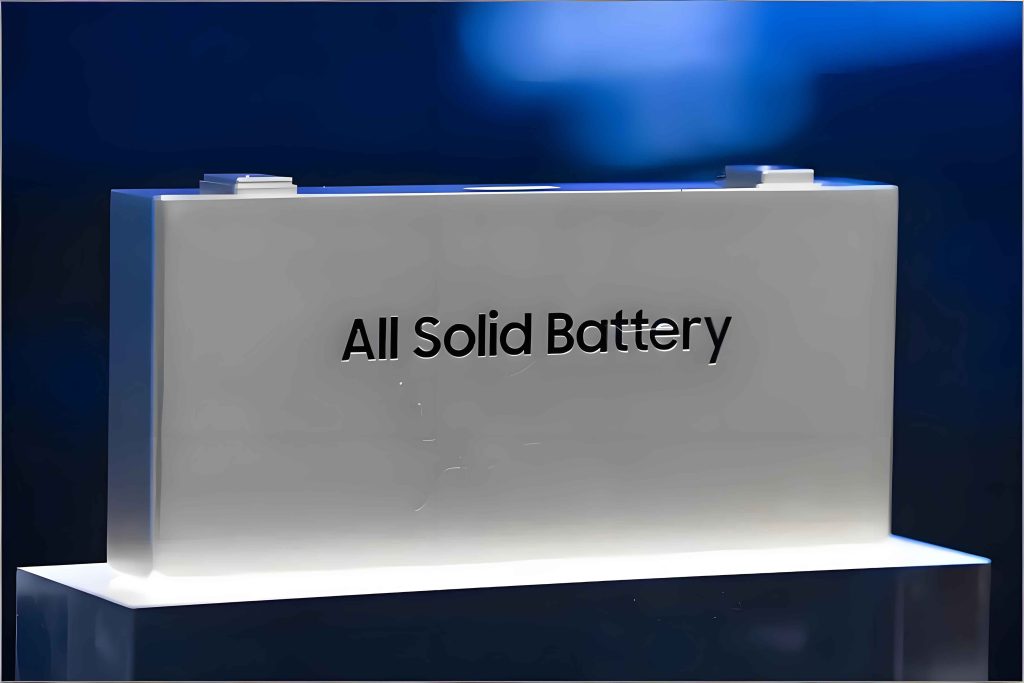
This image highlights the internal components, including the solid electrolyte separator that replaces flammable liquids. While solid-state battery prototypes exist, commercialization on a large scale, as rumored, is yet to be realized. The denial from the company underscores the need for cautious optimism, as breakthroughs in solid-state battery technology require extensive testing and validation cycles.
Another rumor that gained traction involved sodium-ion batteries, touted as a cost-effective alternative to lithium-based systems. Sodium-ion batteries operate on similar principles, with energy density given by: $$ E_{\text{Na}} = \frac{zF \times V_{\text{cell}}}{M_{\text{Na}}} $$ where $z$ is the number of electrons transferred, $F$ is Faraday’s constant, $V_{\text{cell}}$ is the cell voltage, and $M_{\text{Na}}$ is the molar mass of sodium. Despite advantages in resource abundance, sodium-ion batteries currently lag in energy density compared to lithium counterparts. The company explicitly denied claims about entering battery testing phases for sodium-ion cells, indicating that their focus remains on scaling LFP production. This aligns with market data showing LFP’s growth outpacing ternary batteries, as seen in Table 1.
The company’s performance metrics further illuminate its market position. With robust sales and battery installation figures, it has solidified its role in the EV revolution. The table below summarizes key achievements from January to October 2022.
| Metric | Value | Year-on-Year Growth |
|---|---|---|
| Vehicle Sales (units) | 1,397,900 | 233.92% |
| Battery Installation (GWh) | 67.681 | 142% |
This growth trajectory is fueled by LFP batteries, which offer safety and longevity benefits. The company’s stance on solid-state battery rumors reflects a strategic prioritization of proven technologies over speculative leaps. Nonetheless, the industry continues to invest in solid-state battery research, with prototypes aiming to overcome limitations like slow ion transport at room temperature. The diffusivity of ions in a solid electrolyte can be modeled with: $$ D = D_0 e^{-\frac{Q}{RT}} $$ where $D$ is the diffusion coefficient, $D_0$ is the frequency factor, $Q$ is the activation energy, $R$ is the gas constant, and $T$ is the temperature. Improving $D$ is essential for enhancing the charge-discharge rates of solid-state battery systems.
Shifting focus to superconducting technology, another set of rumors emerged regarding business restructuring. A firm specializing in high-temperature superconducting applications was alleged to be planning a spin-off for its superconducting unit. However, this was promptly denied, with clarification that the superconducting business remains integral to its dual-core strategy. Superconducting technology, particularly in high-temperature variants, enables zero electrical resistance below critical temperatures, described by: $$ T_c = \frac{1}{k} \sqrt{\frac{\Delta}{2}} $$ where $T_c$ is the critical temperature, $k$ is a constant, and $\Delta$ is the energy gap. This property allows for highly efficient power transmission and magnetic applications, such as in induction heating devices.
The company’s superconducting subsidiary has made strides in commercializing high-temperature superconducting equipment for industrial heating, targeting energy-intensive processes like aluminum extrusion. The economic impact can be quantified by the efficiency gain: $$ \eta = \frac{P_{\text{out}}}{P_{\text{in}}} \times 100\% $$ where $\eta$ is the efficiency, $P_{\text{out}}$ is the useful output power, and $P_{\text{in}}$ is the input power. Superconducting systems can achieve $\eta$ values over 95%, compared to 70-80% for traditional heaters, leading to significant energy savings. The denial of a spin-off plan underscores the commitment to internal growth, with capacity expansion already underway.
To illustrate the projected scale, consider the following table based on company disclosures.
| Year | Expected Annual Production (units) | Notes |
|---|---|---|
| 2024 | 100 | High-temperature superconducting induction heaters |
This ramp-up aligns with the broader trend of adopting superconducting solutions to decarbonize industrial heating. The firm holds a significant stake in the superconducting venture, with ownership details reflecting collaborative innovation. While rumors of a separate listing circulated, the focus remains on leveraging existing equity structures to fund expansion, possibly through secondary financing if needed. This cautious approach mirrors the prudence seen in the solid-state battery sector, where hype often outpaces reality.
In-depth analysis of superconducting applications reveals transformative potential. The critical current density, a key parameter, is given by: $$ J_c = \frac{B_c}{\mu_0 \lambda} $$ where $J_c$ is the critical current density, $B_c$ is the critical magnetic field, $\mu_0$ is the permeability of free space, and $\lambda$ is the London penetration depth. High $J_c$ values enable compact, powerful magnets for heating and beyond. The company’s devices, as the sole global manufacturer of high-temperature superconducting equipment for this niche, have garnered substantial orders, indicating market validation. This contrasts with the solid-state battery domain, where commercial products are still nascent despite similar excitement.
Returning to energy storage, it’s worth exploring the comparative lifecycle of battery technologies. The degradation of a battery can be modeled with: $$ C_{\text{loss}} = C_0 \times e^{-\alpha t} $$ where $C_{\text{loss}}$ is the capacity loss, $C_0$ is the initial capacity, $\alpha$ is the degradation rate, and $t$ is time. Solid-state batteries promise lower $\alpha$ due to reduced side reactions, but real-world data is limited. The company’s denial of near-term solid-state battery deployment suggests that such benefits are not yet actionable, whereas LFP batteries offer proven durability with $\alpha$ values around 0.001 per cycle under optimal conditions.
Furthermore, the economic calculus for battery adoption involves levelized cost of storage (LCOS), expressed as: $$ \text{LCOS} = \frac{\sum_{t=1}^{n} I_t + O_t}{(1+r)^t} \div \sum_{t=1}^{n} \frac{E_t}{(1+r)^t} $$ where $I_t$ is investment cost in year $t$, $O_t$ is operational cost, $E_t$ is energy discharged, $r$ is the discount rate, and $n$ is the lifetime. Solid-state batteries could lower LCOS via longer lifespans, but current high production costs offset this. The company’s emphasis on LFP aligns with its competitive LCOS, driven by scale and material affordability.
In the superconducting realm, the return on investment (ROI) for heating equipment can be calculated as: $$ \text{ROI} = \frac{\text{Net Savings} – \text{Initial Cost}}{\text{Initial Cost}} \times 100\% $$ where net savings stem from reduced energy consumption. With efficiencies exceeding 95%, superconducting heaters offer ROI periods under three years in high-use scenarios, justifying the company’s expansion plans. This tangible progress counters spin-off rumors, highlighting integrated growth strategies.
To synthesize the technological trajectories, consider the following comparative table.
| Technology | Current Status | Key Challenge | Potential Impact |
|---|---|---|---|
| Solid-State Battery | R&D phase, rumors denied | Solid electrolyte conductivity | High energy density, safety |
| Sodium-Ion Battery | Early development, denied testing | Low energy density | Cost reduction |
| High-Temperature Superconducting | Commercial deployment | High initial cost | Energy efficiency |
This table underscores that while solid-state battery innovation captivates imagination, its practical deployment lags behind superconducting applications, which are already yielding industrial benefits. The repeated emphasis on solid-state battery in this analysis stems from its disruptive potential, but it’s clear that market realities temper expectations.
In conclusion, through rigorous examination of market data and technical principles, I have debunked recent rumors surrounding solid-state battery trials and superconducting business splits. The denials from involved companies are corroborated by quantitative insights, showing a focus on scaling proven technologies like LFP batteries and high-temperature superconducting heaters. Solid-state battery technology, despite its promise, remains in the laboratory for many players, with commercialization hurdles reflected in conductivity and cost equations. As the energy transition accelerates, distinguishing fact from speculation is vital, and this analysis aims to provide clarity through formulas, tables, and objective assessment. The journey toward advanced energy storage and superconducting applications will undoubtedly continue, but it will be guided by evidence rather than hearsay.