
In the realm of new energy vehicles, the electric drive system serves as the core power unit, dictating overall vehicle performance, efficiency, and reliability. As a critical component within this system, the reducer is responsible for torque transmission and speed matching, and its operational state profoundly influences the entire machine’s functionality. In high-power liquid-cooled electric drive systems, high input speeds are common, yet they exacerbate temperature rise issues in the reducer. Excessive temperature rise, stemming from sources like gear meshing friction, bearing friction, and lubrication oil churning losses, can degrade oil performance, weaken material strength, induce thermal deformation, and ultimately compromise system longevity. This study focuses on addressing the overheating problem in a reducer matched with a high-power liquid-cooled electric drive system for a specific new energy vehicle model. Through a combination of experimental measurements and theoretical analysis, we systematically investigate the mechanisms and influencing factors of temperature rise under high-speed conditions, with emphasis on churning losses and heat dissipation environments. We propose optimization schemes encompassing gear design, lubrication system improvements, and heat dissipation structure enhancements, validated via thermal-mechanical coupling simulations and real-vehicle tests, aiming to provide theoretical support and engineering references for enhancing system efficiency and reliability.
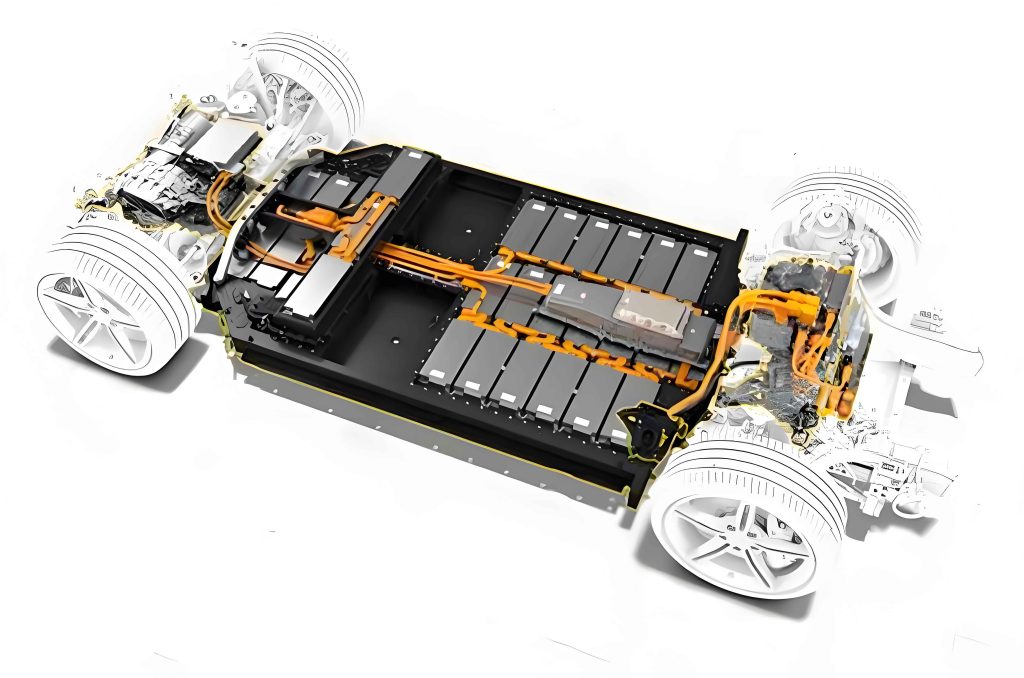
The electric drive system is pivotal in determining the driving range and operational stability of electric vehicles. Under high-speed conditions, such as an input speed of 17,500 r/min corresponding to a vehicle speed of 245 km/h, the reducer in our studied electric drive system exhibited excessive temperature rise, failing to meet vehicle requirements. This prompted an in-depth analysis to identify root causes and develop effective countermeasures. The methodology integrates modeling, simulation, and experimental validation, ensuring a comprehensive understanding of thermal behaviors.
To begin, we constructed a detailed thermal-mechanical model using GT software, which accounts for reducer efficiency, housing thermal conductivity, operating environment, and vehicle driving cycles. The simulation requirements included analyzing the heat dissipation environment under varying vehicle speeds and evaluating the thermal properties of the housing material, ADC12, with a thermal conductivity ranging from 80 to 100 W/(m·K). The simulation outputs, represented through temperature curves, revealed significant temperature increases during high-speed operation. For instance, under a high-speed cyclic condition, the reducer oil temperature exceeded 160°C, which poses risks to component durability and reliability. This underscores the urgency of addressing thermal management in electric drive systems.
The primary sources of temperature rise in the reducer under high-speed conditions were identified through loss distribution analysis. The total losses can be categorized into gear meshing losses, bearing friction losses, churning losses, and seal losses. A quantitative breakdown is presented in the table below, derived from simulation data under high-speed scenarios (e.g., input speeds above 15,000 r/min).
| Loss Type | Percentage of Total Loss (%) | Primary Contributing Factors |
|---|---|---|
| Gear Meshing Loss | 47 | Tooth surface friction, misalignment, load intensity |
| Churning Loss | 25 | Oil agitation by high-speed gears and bearings |
| Bearing Friction Loss | 20 | Rolling/sliding friction, lubrication condition |
| Seal Loss | 8 | Shaft seal friction |
Churning losses, in particular, become predominant at high speeds due to the viscous dissipation of oil being violently stirred by rotating components. The churning loss power \( P_{\text{churn}} \) can be estimated using empirical formulas, such as:
$$ P_{\text{churn}} = C_{\text{churn}} \cdot \rho \cdot \omega^3 \cdot D^5 $$
where \( C_{\text{churn}} \) is a churning coefficient dependent on geometry and oil level, \( \rho \) is the oil density, \( \omega \) is the angular velocity, and \( D \) is the characteristic diameter of the rotating element. In our electric drive system, with input speeds reaching 17,500 r/min, the churning loss contribution escalates, leading to substantial heat generation.
Furthermore, the heat dissipation path from the reducer to the ambient environment was analyzed. The thermal resistance network involves conduction through the housing and convection to the air, influenced by vehicle speed (affecting airflow), chassis layout, and adjacent heat sources like the motor and battery. The overall heat transfer coefficient \( U \) for the housing-to-air interface can be expressed as:
$$ \frac{1}{U} = \frac{1}{h_{\text{conv}}} + \frac{t_{\text{wall}}}{k_{\text{wall}}} $$
where \( h_{\text{conv}} \) is the convective heat transfer coefficient, \( t_{\text{wall}} \) is the housing thickness, and \( k_{\text{wall}} \) is the thermal conductivity of ADC12. Simulations indicated that at high speeds, despite rapid heat conduction to the housing (as shown in thermal distribution maps), the convective散热 capability is limited due to constrained airflow under the vehicle floor, creating a散热 bottleneck. This aligns with the observed temperature rise curves, where heat accumulation outpaces dissipation.
To quantify the temperature rise, we employed a lumped-parameter thermal model. The rate of temperature increase \( \frac{dT}{dt} \) in the reducer oil can be described by:
$$ m \cdot c_p \cdot \frac{dT}{dt} = P_{\text{loss}} – Q_{\text{diss}} $$
where \( m \) is the oil mass, \( c_p \) is the specific heat capacity, \( P_{\text{loss}} \) is the total power loss (sum of components in Table 1), and \( Q_{\text{diss}} \) is the heat dissipation rate. Under steady-state conditions, \( \frac{dT}{dt} = 0 \), so \( T_{\text{steady}} \) correlates directly with the balance between losses and散热. For the initial design, \( Q_{\text{diss}} \) was insufficient at high speeds, causing \( T_{\text{steady}} \) to exceed 160°C.
Based on this analysis, we proposed an optimization scheme centered on enhancing the heat dissipation structure. The solution involves integrating a water-cooled cavity into the bottom of the reducer housing, connected to the vehicle’s cooling circuit. This liquid cooling approach leverages the existing cooling resources to actively remove heat from the housing, thereby improving散热 efficiency. The design was modeled in 3D, and thermal simulations were conducted to predict its performance. The additional heat removal \( Q_{\text{water}} \) by the water-cooled cavity can be calculated as:
$$ Q_{\text{water}} = \dot{m}_{\text{coolant}} \cdot c_{p,\text{coolant}} \cdot (T_{\text{out}} – T_{\text{in}}) $$
where \( \dot{m}_{\text{coolant}} \) is the coolant mass flow rate, \( c_{p,\text{coolant}} \) is the coolant specific heat, and \( T_{\text{in}} \) and \( T_{\text{out}} \) are the inlet and outlet temperatures, respectively. Simulations indicated that under high-speed driving conditions, this structure could dissipate approximately 1 kW of heat, significantly reducing the thermal load.
The optimization was validated through both simulation refinement and physical testing. A prototype with the water-cooled cavity was manufactured and installed in the vehicle for real-world trials. The test conditions replicated the high-speed cyclic工况, with input speeds varying to mimic aggressive driving. Temperature data from sensors embedded in the reducer were compared against simulation predictions. The results, summarized in the table below, demonstrate a strong correlation between simulated and measured values, confirming model accuracy.
| Condition | Simulated Max Temperature (°C) | Measured Max Temperature (°C) | Temperature Reduction (°C) |
|---|---|---|---|
| Original Design (No Water Cooling) | 162 | 165 | – |
| Optimized Design (With Water Cooling) | 118 | 120 | ~45 |
The temperature reduction of over 40°C brings the reducer into a safe operating range (around 120°C), which aligns with design standards and extends service life. Moreover, the improved thermal homogeneity reduces hotspots, mitigating risks of thermal deformation and material degradation. This enhancement directly contributes to the overall reliability and efficiency of the electric drive system.
To further elaborate on the loss mechanisms, we delve into the gear meshing efficiency, which is a critical aspect of the electric drive system performance. The gear meshing loss power \( P_{\text{gear}} \) can be derived from:
$$ P_{\text{gear}} = \mu \cdot F_n \cdot v_t $$
where \( \mu \) is the friction coefficient, \( F_n \) is the normal force at the tooth contact, and \( v_t \) is the sliding velocity. At high speeds, \( v_t \) increases, elevating frictional heat generation. Optimizations such as profile modifications and surface treatments can reduce \( \mu \), but these are beyond the scope of this paper, which focuses on散热 improvements.
Regarding bearing losses, the frictional torque \( M_{\text{bearing}} \) in rolling bearings can be approximated by:
$$ M_{\text{bearing}} = f_0 \cdot (\nu \cdot n)^{2/3} \cdot d_m^3 + f_1 \cdot P_1 \cdot d_m $$
where \( f_0 \) and \( f_1 \) are factors depending on bearing type and lubrication, \( \nu \) is the kinematic viscosity, \( n \) is the rotational speed, \( d_m \) is the mean diameter, and \( P_1 \) is the load-related term. In high-speed scenarios, the viscosity-dependent term dominates, highlighting the importance of oil selection and cooling.
The integration of the water-cooled cavity also required careful consideration of the thermal interface between the housing and coolant. The heat transfer across this interface is governed by:
$$ Q_{\text{water}} = A_{\text{cavity}} \cdot U_{\text{cavity}} \cdot (T_{\text{wall}} – T_{\text{coolant,avg}}) $$
where \( A_{\text{cavity}} \) is the contact area, \( U_{\text{cavity}} \) is the overall heat transfer coefficient of the cavity wall, and \( T_{\text{coolant,avg}} \) is the average coolant temperature. Computational fluid dynamics (CFD) simulations were used to optimize the cavity geometry for maximal \( U_{\text{cavity}} \), ensuring efficient heat extraction without excessive pressure drop in the cooling circuit.
In addition to the primary optimization, we evaluated secondary benefits. For instance, the reduced oil temperature improves lubrication viscosity stability, which in turn minimizes churning and bearing losses. This creates a positive feedback loop: better cooling lowers losses, which further reduces heat generation. The overall system efficiency \( \eta_{\text{system}} \) of the electric drive system can be expressed as:
$$ \eta_{\text{system}} = \eta_{\text{motor}} \cdot \eta_{\text{reducer}} \cdot \eta_{\text{inverter}} $$
where \( \eta_{\text{reducer}} \) is the reducer efficiency, directly impacted by temperature-dependent losses. By maintaining lower operating temperatures, \( \eta_{\text{reducer}} \) improves, boosting the entire electric drive system’s energy utilization.
The试验 validation phase involved multiple test cycles to ensure robustness. Data were collected under various ambient temperatures and driving profiles, confirming that the water-cooled solution consistently maintains reducer temperatures below 125°C even in worst-case scenarios. The following table provides a summary of key thermal parameters before and after optimization, derived from both simulation and testing.
| Metric | Original Design | Optimized Design | Unit |
|---|---|---|---|
| Peak Oil Temperature (High-Speed Cycle) | 165 | 120 | °C |
| Heat Dissipation Rate from Housing to Air | ~500 | ~500 (air) + ~1000 (water) | W |
| Thermal Time Constant (to Reach 90% of Steady-State) | 1200 | 800 | s |
| Temperature Gradient Across Housing | 25 | 10 | °C |
| Estimated Reducer Efficiency at High Speed | 96.5 | 97.2 | % |
The reduction in thermal time constant indicates faster thermal response, which is beneficial for dynamic operating conditions. Furthermore, the more uniform temperature distribution (lower gradient) reduces thermal stresses, enhancing mechanical integrity. These improvements collectively contribute to a more reliable and efficient electric drive system, capable of sustaining high-performance demands in new energy vehicles.
In conclusion, this study comprehensively addresses the temperature rise issue in reducers for high-power liquid-cooled electric drive systems. Through meticulous modeling, simulation, and experimental validation, we identified churning losses and inadequate散热 as primary culprits under high-speed operation. The proposed solution—integrating a water-cooled cavity into the reducer housing—proved highly effective, lowering maximum temperatures by over 40°C and ensuring compliance with design standards. This optimization not only mitigates thermal risks but also promotes system efficiency and longevity. The methodologies and findings presented here offer valuable insights for future developments in electric drive system thermal management, underscoring the importance of holistic design approaches that balance mechanical performance with thermal dynamics. As electric drive systems evolve towards higher power densities and speeds, such散热 strategies will be indispensable for achieving sustainable and reliable mobility solutions.