
In the rapidly evolving landscape of new energy vehicles, the integration of powertrain components has become a critical trend to enhance efficiency, reduce weight, and improve overall performance. As part of an innovative project team, we are dedicated to developing an advanced intelligent electric drive system that addresses these challenges. This system is designed to achieve higher efficiency, greater power density, and enhanced safety, leveraging cutting-edge technologies in power electronics, control algorithms, and thermal management. Throughout this article, we will delve into the key functionalities of our electric drive system, supported by technical details, formulas, and tables to provide a comprehensive overview. Our goal is to showcase how this intelligent electric drive system can revolutionize the automotive industry by offering smarter, safer, and more reliable propulsion solutions.
The core of our project revolves around a holistic approach to electric drive system design, focusing on integration, intelligence, and adaptability. The electric drive system serves as the heart of electric vehicles, converting electrical energy into mechanical motion while managing various operational parameters. With the increasing demand for longer range, faster charging, and robust safety, our team has prioritized the development of a modular and scalable electric drive system. This system incorporates multiple subsystems, including power inverters, motor controllers, sensors, and thermal management units, all working in harmony to deliver optimal performance. In the following sections, we will explore each functional aspect in detail, emphasizing the technological innovations that set our electric drive system apart from conventional solutions.
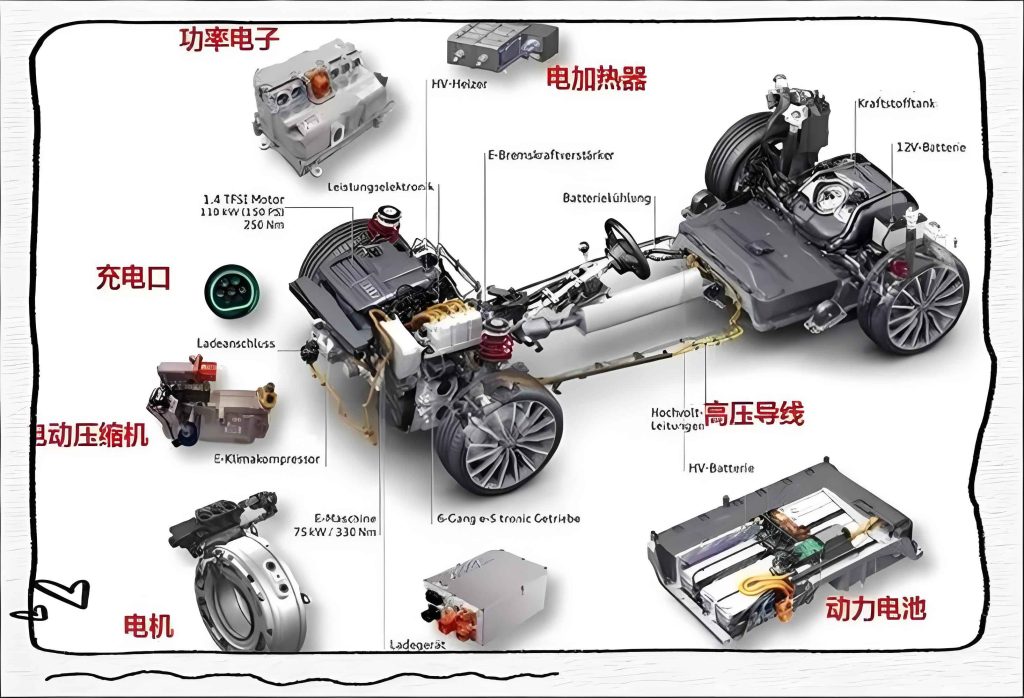
One of the foundational elements of our electric drive system is the implementation of advanced motor control algorithms. Utilizing technologies such as IGBT, SiC, and MOSFET-based power switches, we achieve precise and efficient control of the main drive motor. Key algorithms like Field-Oriented Control (FOC), Direct Torque Control (DTC), and adaptive control strategies are employed to ensure stable and safe operation. For instance, in FOC, the three-phase currents of the motor are transformed into a two-axis coordinate system (d-q frame) to decouple torque and flux control. This is represented by the following equations:
$$ \mathbf{I}_{dq} = \mathbf{T}(\theta_e) \mathbf{I}_{abc} $$
where \(\mathbf{T}(\theta_e)\) is the transformation matrix dependent on the electrical angle \(\theta_e\). The voltage equations in the d-q frame are:
$$ V_d = R_s I_d + L_d \frac{dI_d}{dt} – \omega_e L_q I_q $$
$$ V_q = R_s I_q + L_q \frac{dI_q}{dt} + \omega_e (L_d I_d + \lambda_m) $$
Here, \(R_s\) is the stator resistance, \(L_d\) and \(L_q\) are the d- and q-axis inductances, \(\omega_e\) is the electrical angular velocity, and \(\lambda_m\) is the permanent magnet flux linkage. These formulas enable us to optimize torque production and minimize losses, contributing to the overall efficiency of the electric drive system. Additionally, adaptive control algorithms allow the system to adjust to parameter variations and disturbances, ensuring robustness across diverse operating conditions. To illustrate the performance gains, Table 1 summarizes a comparison between traditional control methods and our enhanced algorithms in terms of efficiency and response time.
| Control Algorithm | Efficiency (%) | Torque Response Time (ms) | Applicability to Electric Drive System |
|---|---|---|---|
| Basic PWM Control | 85-90 | 10-15 | Limited integration |
| Field-Oriented Control (FOC) | 92-95 | 5-8 | High integration |
| Direct Torque Control (DTC) | 90-93 | 3-6 | Moderate integration |
| Adaptive FOC/DTC Hybrid | 94-97 | 2-5 | Optimal for intelligent electric drive system |
Beyond motor control, our electric drive system incorporates a multi-sensor fusion framework for real-time monitoring and diagnostics. This functionality is crucial for achieving higher safety integrity levels (ASIL) in automotive applications. By integrating data from various sensors—such as current sensors, voltage sensors, temperature sensors, and vibration sensors—we can detect anomalies and predict potential failures in components like the motor, gearbox, and power electronics. The sensor fusion algorithm is based on a Kalman filter approach, which combines measurements to estimate the system state accurately. The state-space representation is:
$$ \mathbf{x}_{k} = \mathbf{A} \mathbf{x}_{k-1} + \mathbf{B} \mathbf{u}_{k-1} + \mathbf{w}_{k-1} $$
$$ \mathbf{z}_{k} = \mathbf{H} \mathbf{x}_{k} + \mathbf{v}_{k} $$
where \(\mathbf{x}_{k}\) is the state vector (e.g., motor speed, temperature), \(\mathbf{u}_{k}\) is the control input, \(\mathbf{z}_{k}\) is the measurement vector, \(\mathbf{A}\) and \(\mathbf{B}\) are system matrices, \(\mathbf{H}\) is the observation matrix, and \(\mathbf{w}_{k}\) and \(\mathbf{v}_{k}\) are process and measurement noise, respectively. This enables the electric drive system to perform self-diagnosis for faults like bearing wear, insulation breakdown, or gear tooth damage. Table 2 lists common fault types and their detection methods within our electric drive system, highlighting the diagnostic capabilities.
| Fault Type | Affected Component | Detection Method | Impact on Electric Drive System |
|---|---|---|---|
| Stator Winding Short | Electric Motor | Current harmonic analysis | Reduced efficiency, overheating |
| IGBT Overheating | Power Inverter | Temperature monitoring with thresholding | System shutdown risk |
| Gearbox Misalignment | Transmission | Vibration spectrum analysis | Increased noise, wear |
| Bearing Degradation | Rotating Assembly | Acoustic emission sensing | Potential seizure |
| Sensor Failure | Monitoring System | Data inconsistency checks | Loss of diagnostic accuracy |
Thermal management is another critical aspect of our intelligent electric drive system, especially given the integration of multiple heat-generating components like IGBTs, permanent magnets, bearings, and gears. To address this, we have developed a comprehensive thermal network model using finite element simulation and experimental validation. The heat transfer within the electric drive system can be described by partial differential equations, such as the heat conduction equation:
$$ \rho c_p \frac{\partial T}{\partial t} = \nabla \cdot (k \nabla T) + \dot{q} $$
where \(\rho\) is density, \(c_p\) is specific heat capacity, \(k\) is thermal conductivity, \(T\) is temperature, and \(\dot{q}\) is the heat generation rate per unit volume. For practical implementation, we simplify this into a lumped-parameter thermal network, where each component is represented by thermal resistances and capacitances. The governing equation for a node in such a network is:
$$ C_i \frac{dT_i}{dt} = \sum_{j} \frac{T_j – T_i}{R_{ij}} + Q_i $$
Here, \(C_i\) is the thermal capacitance of node \(i\), \(T_i\) is its temperature, \(R_{ij}\) is the thermal resistance between nodes \(i\) and \(j\), and \(Q_i\) is the heat input. This model allows us to predict and control temperatures in real-time, preventing overheating and extending the lifespan of the electric drive system. Table 3 provides typical thermal parameters for key components in our electric drive system, based on simulation data.
| Component | Thermal Resistance (°C/W) | Thermal Capacitance (J/°C) | Maximum Allowable Temperature (°C) |
|---|---|---|---|
| IGBT Module | 0.5-1.0 | 50-100 | 150 |
| Permanent Magnet | 2.0-3.0 | 20-40 | 180 |
| Motor Stator | 1.5-2.5 | 100-200 | 200 |
| Gearbox Housing | 0.8-1.5 | 150-300 | 120 |
| Bearings | 3.0-5.0 | 10-20 | 90 |
Energy efficiency is further enhanced through bidirectional energy conversion capabilities in our electric drive system. This function enables regenerative braking, where kinetic energy during deceleration is converted back into electrical energy and stored in the battery. The control strategy for energy recovery involves managing the inverter operation in motoring and generating modes. The power flow during regeneration can be expressed as:
$$ P_{regen} = \eta_{inv} \eta_{batt} \cdot \frac{1}{2} J \omega_m \frac{d\omega_m}{dt} $$
where \(P_{regen}\) is the regenerated power, \(\eta_{inv}\) and \(\eta_{batt}\) are the efficiencies of the inverter and battery system, \(J\) is the moment of inertia, and \(\omega_m\) is the mechanical angular velocity. By optimizing this process, our electric drive system can improve the vehicle’s range by up to 15-20%, depending on driving conditions. The control algorithm adjusts the torque command based on pedal input and system state, ensuring seamless transitions between driving and regeneration. To quantify the benefits, Table 4 shows energy recovery rates under different scenarios for our electric drive system.
| Driving Scenario | Initial Speed (km/h) | Deceleration Rate (m/s²) | Energy Recovered (Wh) | Contribution to Range Extension (%) |
|---|---|---|---|---|
| Urban Stop-and-Go | 50 | -2.0 | 30-40 | 5-10 |
| Highway Off-Ramp | 100 | -3.0 | 80-100 | 10-15 |
| Downhill Descent | 60 | -1.5 | 50-70 | 8-12 |
| Aggressive Braking | 80 | -5.0 | 40-60 | 6-9 |
Finally, the integration of comprehensive functional safety strategies elevates the reliability of our electric drive system. By adhering to automotive safety standards like ISO 26262, we implement redundancy, fault tolerance, and fail-safe mechanisms. The safety goals are defined based on hazard analysis and risk assessment, targeting ASIL D for critical functions. For example, the electric drive system includes dual-channel monitoring for motor control signals, where any discrepancy triggers a safe state transition. The probability of failure per hour (PFH) for safety-critical functions is calculated using:
$$ PFH = \lambda_{du} \cdot DC \cdot t_{CE} $$
where \(\lambda_{du}\) is the dangerous undetected failure rate, \(DC\) is the diagnostic coverage, and \(t_{CE}\) is the average time to failure. Our design achieves a PFH below \(10^{-8}\) per hour, ensuring high integrity. Table 5 outlines key safety mechanisms embedded in the electric drive system, covering various failure modes.
| Safety Mechanism | Targeted Failure Mode | Diagnostic Coverage (%) | ASIL Level |
|---|---|---|---|
| Redundant Current Sensing | Sensor drift or fault | 99 | ASIL C |
| Watchdog Timer for Controller | Software freeze | 95 | ASIL B |
| Thermal Shutdown Circuit | Overheating of IGBTs | 98 | ASIL D |
| Encoder Signal Validation | Motor position error | 97 | ASIL C |
| Power Supply Monitoring | Voltage drops or surges | 96 | ASIL B |
In summary, our new generation intelligent electric drive system represents a significant leap forward in electric vehicle technology. By combining advanced control algorithms, multi-sensor diagnostics, precise thermal management, bidirectional energy conversion, and robust functional safety, we have created a system that not only meets but exceeds current industry demands. The electric drive system is designed to be modular, scalable, and adaptable, making it suitable for a wide range of vehicle platforms. As the automotive world shifts towards electrification, innovations like this electric drive system will play a pivotal role in shaping the future of transportation. We are confident that our contributions will drive progress towards more efficient, safe, and sustainable mobility solutions.
Looking ahead, further research and development will focus on enhancing the intelligence of the electric drive system through machine learning algorithms for predictive maintenance and optimization. Integration with vehicle-to-grid (V2G) technologies and autonomous driving systems will also expand the capabilities of the electric drive system. Continuous testing and validation in real-world environments will ensure that our electric drive system remains at the forefront of innovation, delivering unparalleled performance and reliability. The journey towards perfecting the electric drive system is ongoing, and we are committed to pushing the boundaries of what is possible in electric propulsion.