
As the new energy vehicle market enters the post-subsidy era, industry consolidation is accelerating, placing significant financial pressure on整车 manufacturers and intensifying competition. In this context,整车 manufacturers and suppliers must collaboratively share the cost burdens, with component integration emerging as a key strategy for cost reduction. The highly integrated electric drive system has thus become a pivotal innovation, offering weight reduction, lower costs, and enhanced power density. Globally, companies are aggressively developing integrated electric drive technologies, making such systems a prevailing trend in pure electric passenger vehicles. This article, from my perspective as an industry observer, delves into the current state, advantages, challenges, and future directions of integrated electric drive systems, emphasizing their critical role in advancing electric mobility.
The electric drive system is the core of pure electric vehicles, comprising a high-performance traction motor, power electronics control unit, and gear reducer. With rapid advancements in automotive technology and the widespread application of integrated circuits and power electronics, the benefits of mechatronic integration in electric drive systems have become increasingly evident. These systems offer high energy density, improved efficiency, and lower maintenance, driving their adoption in pure electric passenger cars. Initially, electric drive systems lacked integration, with components like the motor, controller, and reducer separately arranged and connected via wiring harnesses, leading to complex and bulky assemblies. Over time, integration has become mainstream, involving direct connections between motor and controller terminals, shared cooling channels, and combined housings for the motor and reducer. These designs, once hindered by technical barriers, are now feasible due to breakthroughs, prompting major manufacturers to prioritize deep integration in electric drive system development.
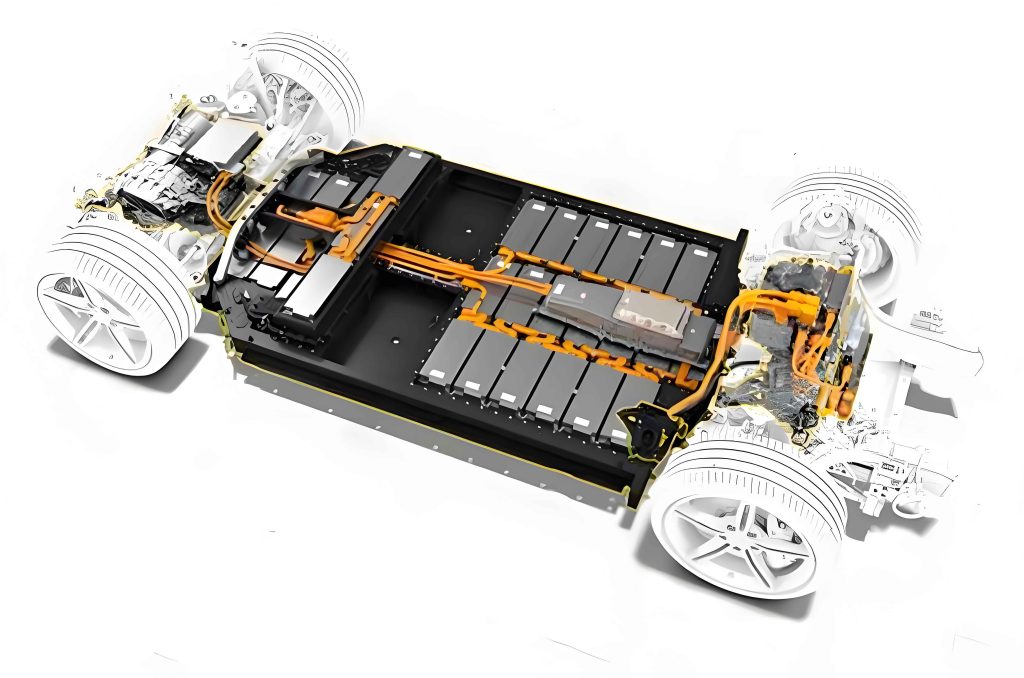
Integrated electric drive systems offer numerous advantages. First, they reduce volume and weight through compact packaging, minimizing installation space and overall mass. This integration eliminates redundant连接 materials, directly lowering costs. Second, the streamlined layout enhances vehicle packaging flexibility, maximizing passenger and storage space while reducing energy consumption and extending range due to weight savings. Third, integration simplifies interfaces, shortening transmission paths and improving system efficiency by reducing connectors, wires, and管路. However, integrated electric drive systems also pose challenges. They require multidimensional development and validation, particularly in thermal management, as reduced surface area complicates散热. Issues like NVH (noise, vibration, and harshness), EMC (electromagnetic compatibility), safety, and component coordination demand rigorous attention from manufacturers and suppliers. For consumers, integration may raise reliability concerns and increase repair times and costs if individual components fail, underscoring the need for robust quality control.
To quantify these aspects, consider the following table summarizing key advantages and disadvantages of integrated electric drive systems:
| Advantages | Disadvantages |
|---|---|
| Reduced volume and weight, enhancing power density | Complex thermal management due to reduced散热 surface |
| Lower cost via fewer连接 materials | Increased NVH and EMC challenges |
| Improved efficiency through shorter transmission paths | Higher reliability risks and维修 complexity |
| Flexible vehicle packaging and space optimization | Demands协同 development across components |
The evolution of integrated electric drive systems has progressed from simple to complex configurations. Early systems featured a two-in-one (2-in-1) design, integrating the motor and reducer with the axle into an electric drive bridge. This reduced component distances and enhanced compactness, though连接 remained somewhat complex. Subsequently, three-in-one (3-in-1) systems emerged, combining the motor, controller, and reducer into a single unit. Major suppliers globally have adopted this approach, offering solutions like平台化 designs that cater to varying power and torque needs, speeding up development cycles. For instance, some systems achieve speeds up to 21,000 r/min, delivering high performance and efficiency. Domestically, while起步 later, Chinese brands have made strides, with systems featuring wide efficiency ranges, low IGBT losses, and optimized energy consumption around 15 kWh/100 km. A comparison of domestic and international 3-in-1 electric drive systems is shown below:
| Parameter | Domestic Systems | International Systems |
|---|---|---|
| Drive Motor Power Density (kW/kg) | 2.5–3.5 | 2.5–3.5 |
| Maximum Motor Speed (r/min) | ~12,000 | >16,000 |
| Motor Controller Power Density (kW/L) | ~15 | 20–25 |
| Reducer Maximum Input Speed (r/min) | ~12,000 | >16,000 |
| Integration Level | Moderate | High |
Beyond 3-in-1, some companies探索 multi-in-one integrations, such as an eight-in-one system that additionally incorporates the车载 charger, DC-DC converter, power distribution unit, and vehicle controller. While this further reduces size and improves cooling efficiency, it may compromise flexibility in vehicle packaging. These innovations highlight the ongoing push toward greater integration in electric drive systems.
Looking ahead, several前沿 trends are shaping the development of integrated electric drive systems. First, motor高速化 is becoming imperative. Higher-speed motors boost power density, reduce size and cost, and enhance dynamic performance. Current market offerings typically reach around 12,000 r/min, but advancements in materials and technology are enabling speeds exceeding 16,000 r/min, particularly in premium electric vehicles. The power density of an electric drive system can be expressed as: $$ \text{Power Density} = \frac{P}{V} $$ where \( P \) is the power output in kW and \( V \) is the volume in liters. For高速 motors, this density improves significantly due to reduced inertia and higher rotational energy. Additionally, efficiency \( \eta \) relates to speed \( n \) and torque \( T \) as: $$ \eta = \frac{T \cdot \omega}{P_{\text{input}}} $$ where \( \omega = 2\pi n / 60 \) is the angular velocity. Higher speeds allow motors to operate closer to peak efficiency points, reducing losses.
Second, multi-speed gearboxes are gaining traction. Most current integrated electric drive systems use a single-speed reducer, which is simple and cost-effective but suffers from efficiency and torque drop-offs at high speeds. Multi-speed designs, such as two-speed gearboxes, enable motors to operate within optimal efficiency ranges, improving both performance and economy. For example, a two-speed system can adjust gear ratios to maintain high efficiency during极速 and low-load conditions. The overall system efficiency \( \eta_{\text{system}} \) with a multi-speed reducer can be modeled as: $$ \eta_{\text{system}} = \eta_{\text{motor}} \cdot \eta_{\text{gear}} \cdot \eta_{\text{controller}} $$ where \( \eta_{\text{gear}} \) varies with gear ratio selection. By optimizing gear shifts, the electric drive system minimizes energy waste, crucial for extending vehicle range.
Third,平台化 design is essential for scalability and cost reduction. The automotive industry thrives on economies of scale, and platform-based electric drive systems allow for shared components across different vehicle models, reducing R&D costs and time-to-market. By categorizing systems into small, medium, and large power platforms, manufacturers can standardize parts like stators and gearboxes. The table below illustrates a platform化 approach for永磁同步 integrated electric drive systems:
| Platform | Stator Diameter (mm) | Peak Power (kW) | Peak Torque (N·m) |
|---|---|---|---|
| Small Power | 160 | 30–120 | 40–200 |
| Medium Power | 180–220 | 80–160 | 180–300 |
| Large Power | >220 | 160–340 | 300–400 |
This platform化 strategy not only cuts procurement costs but also facilitates technology sharing, accelerating market adoption of integrated electric drive systems. In my view, as the纯电动 vehicle market seeks rapid scaling, such designs will become ubiquitous.
In conclusion, the integration of electric drive systems is an inevitable trend driven by technological progress and market demands. This article has analyzed the benefits and drawbacks of integration, reviewed current applications from 2-in-1 to multi-in-one systems, and explored前沿 trends like高速化, multi-speed gearboxes, and平台化. The electric drive system remains the heart of纯电动 vehicles, and its continuous evolution toward deeper integration will be pivotal in enhancing competitiveness, efficiency, and sustainability. For the foreseeable future, high-speed, multi-speed, and platform-based 3-in-1 electric drive systems will dominate R&D efforts, shaping the next generation of electric mobility. As we advance, addressing challenges in thermal management, NVH, and reliability will be crucial to unlocking the full potential of these integrated solutions, ensuring that the electric drive system continues to propel the industry forward.