
In modern electric drive systems, the planet gear ring plays a critical role in ensuring efficient power transmission and noise, vibration, and harshness (NVH) performance. With the increasing demand for higher precision in electric drive systems, traditional soft nitriding processes and post-heat treatment machining accuracy of grade 9 are no longer sufficient. This article explores the advanced machining processes for planet gear rings in electric drive systems, addressing common challenges and providing detailed solutions. We focus on heat treatment deformation control and tooth profile finishing, defining process methods to enhance stability through small-batch validation. Induction press quenching technology improves process efficiency, while internal honing ensures gear accuracy requirements. The integration of these technologies is essential for meeting the stringent standards of contemporary electric drive systems.
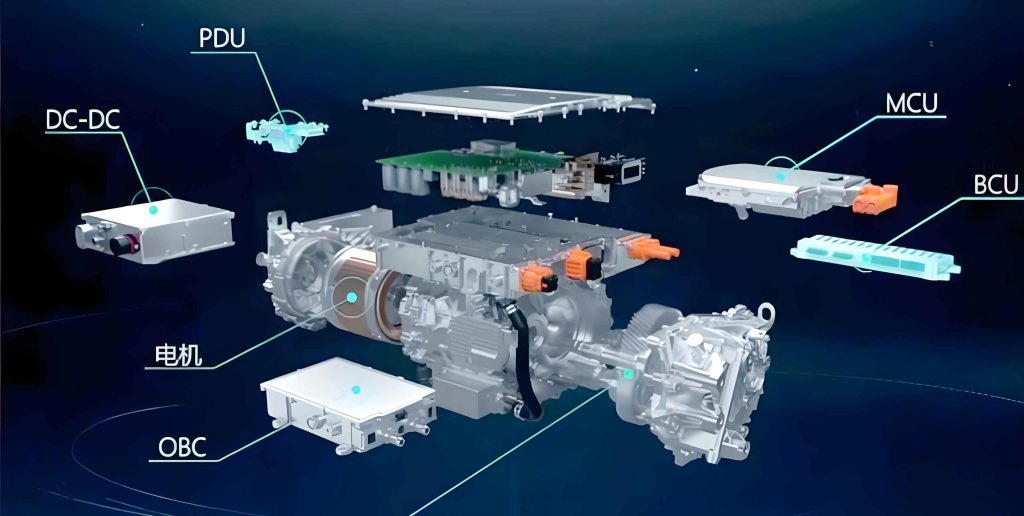
The planet gear ring, a thin-walled component with a diameter often exceeding 200 mm and a wall thickness of approximately 5 mm, requires meticulous machining to achieve the desired geometric and surface quality. The shift toward electric drive systems has necessitated higher gear accuracy, typically grade 6 or better, with tight tolerances for tooth profile errors, helix deviations, and surface roughness. This article details the machining sequence, material selection, heat treatment, and finishing processes, emphasizing the innovations that enable mass production while maintaining precision. We will discuss each step in the context of electric drive system applications, highlighting how process optimization contributes to overall system performance.
Machining Process Flow for Planet Gear Ring
The machining of planet gear rings involves multiple stages, from rough turning to final finishing. The process flow is designed to minimize distortion and ensure dimensional stability, especially given the thin-walled nature of the component. Below is a summary of the key machining operations:
| Operation | Process Name | Positioning Reference | Key Parameters |
|---|---|---|---|
| OP10 | Fine Turning | Clamp outer diameter, locate end face | Roundness ≤ 0.03 mm, end face runout ≤ 0.02 mm |
| OP20 | Fine Turning | Expand inner diameter, locate end face | Use end-pressure chuck, clamping force control |
| OP30 | Gear Hobbing (External Spline) | Expand inner diameter, locate end face | Generating motion based on gear-to-rack principle |
| OP50 | Internal Gear Hobbing/Skiving | Clamp outer circle, locate end face | Continuous cutting, dry machining possible |
| OP60 | Heat Treatment | Inner hole, locate end face | Carburizing, tempering, induction press quenching |
| OP70 | Press Quenching | Upper/lower dies, mandrel | Induction heating: 830°C for 47 s, cooling at 30°C for 28 s |
| OP80 | Hard Turning | Pitch circle centering, upper face clamp, lower face locate | Allowance 0.18–0.22 mm per side, roundness control |
| OP90 | Internal Honing | Clamp outer circle, locate end face | Tooth profile accuracy grade 6, surface roughness Rz = 2.5 µm |
This sequence ensures that each operation builds upon the previous one, with careful attention to clamping and positioning to avoid distortion. The electric drive system demands such precision to achieve optimal NVH characteristics and longevity. The following sections delve into each process, discussing challenges and solutions.
Key Issues and Countermeasures in Gear Ring Machining
Machining thin-walled gear rings for electric drive systems presents unique challenges, particularly in maintaining geometric accuracy during and after heat treatment. We address these issues with targeted strategies.
1. Fine Turning
Fine turning involves removing excess material with a cutting tool to achieve precise shape, dimensions, and surface quality. The process requires relative motion between workpiece and tool, appropriate tool material, and optimal tool geometry. For planet gear rings, clamping-induced deformation is a major concern, as excessive clamping force can cause runout and out-of-roundness.
Solution: In OP20, we recommend using an end-pressure chuck with controlled clamping pressure. The clamping force should be optimized to balance anti-cutting force requirements and minimal distortion. The positioning scheme, as illustrated in simulations, involves centering on the inner diameter and applying axial pressure on the end face. This ensures end face runout ≤ 0.02 mm and roundness ≤ 0.03 mm, critical for subsequent operations in electric drive system components.
The cutting parameters can be expressed mathematically to relate clamping force (F_c), cutting force (F_t), and deformation (δ). For a thin-walled ring, the deformation under clamping can be approximated by:
$$ \delta = \frac{F_c \cdot r^3}{3EI} $$
where \( r \) is the radius, \( E \) is Young’s modulus, and \( I \) is the moment of inertia. By controlling \( F_c \), we minimize δ to within tolerance limits.
2. Gear Hobbing (External Spline)
Gear hobbing is a generating process that mimics the meshing of a gear and rack. As the hob rotates, it translates axially, and the workpiece rotates synchronously to produce the desired tooth profile. The kinematics can be described by the gear ratio between hob and workpiece. For electric drive system gears, accuracy in tooth spacing and profile is paramount.
The hobbing process parameters include hob speed (N_h), feed rate (f), and depth of cut (a_p). The theoretical tooth profile generated by a hob with module m and pressure angle α is given by the involute equation:
$$ r_b = \frac{m \cdot z}{2} \cos \alpha $$
where \( r_b \) is the base circle radius and z is the number of teeth. Ensuring precise motion control avoids errors in tooth form that could compromise electric drive system performance.
3. Internal Gear Hobbing/Skiving
Traditional internal gear machining methods like shaping or broaching have limitations for thin-walled rings. We adopt internal gear hobbing or skiving, which combines hobbing and shaping principles for continuous cutting. This offers advantages such as higher efficiency (40–50% faster than shaping) and dry machining capability, reducing coolant costs.
Why not broaching? Broaching requires dedicated broaches that are difficult to modify for thermal deformation adjustments. For rings over 200 mm in diameter, broach maintenance and inventory costs are prohibitive. Internal skiving allows flexible adjustment of pressure angle (\( f_{H\alpha} \)) and helix angle (\( f_{H\beta} \)) residuals through thermal deformation tests, making it ideal for electric drive system gear production.
The skiving process involves simultaneous rotational and axial motions. The cutting velocity \( v_c \) and feed per tooth \( f_z \) are critical parameters. The material removal rate (MRR) can be calculated as:
$$ \text{MRR} = a_p \cdot f \cdot v_c $$
where \( a_p \) is the depth of cut, and \( f \) is the feed rate. Optimizing these parameters ensures efficient machining while maintaining accuracy for electric drive system gears.
4. Heat Treatment
Heat treatment, including carburizing and quenching, enhances the mechanical properties of gear rings. For electric drive systems, the material is typically 20MnCrS5 or 16MnCrS5, with requirements for surface hardness (≥59 HRC), core hardness (33–45 HRC), and effective case depth (0.3–0.7 mm). However, thin-walled rings are prone to distortion during heating and cooling, leading to tooth profile errors (e.g., radial runout \( F_r \) and cumulative pitch error \( F_p \) exceeding 0.15 mm).
Solution: Induction press quenching technology controls distortion effectively. The process involves induction heating followed by rapid cooling under pressure from dies and a mandrel. The key parameters are summarized below:
| Stage | Temperature (°C) | Time (s) | Remarks |
|---|---|---|---|
| Induction Heating | 830 | 47 | Electromagnetic induction heating |
| Cooling | 30 | 28 | Quenching under pressure |
| Demolding | — | 10 | Release from dies |
The induction heating efficiency is high, suitable for mass production in electric drive system manufacturing. The temperature profile during heating can be modeled using the heat conduction equation:
$$ \frac{\partial T}{\partial t} = \alpha \nabla^2 T + \frac{q}{\rho c_p} $$
where \( T \) is temperature, \( t \) is time, \( \alpha \) is thermal diffusivity, \( q \) is heat generation rate, \( \rho \) is density, and \( c_p \) is specific heat. Controlling heating and cooling rates minimizes distortion. However, core hardness control is challenging with these materials; thus, material selection and process validation are crucial for electric drive system durability.
5. Hard Turning
Hard turning is performed on heat-treated gear rings with hardness above 59 HRC. The challenge lies in maintaining roundness and avoiding clamping deformation. The fixture must center on the gear pitch circle and apply axial pressure with minimal distortion.
Solution: Allowance uniformity is critical—0.18–0.22 mm per side. Too much allowance risks case depth integrity; too little causes vibration marks. The fixture should use separate centering and end-pressure controls, with programmable centering displacement and pressure adjustment. A large contact area disperses clamping force. The clamping sequence: first center, then apply end pressure. This ensures roundness within specifications for electric drive system gears.
The cutting force in hard turning can be estimated using mechanistic models. For a given tool geometry and workpiece material, the tangential force \( F_t \) is:
$$ F_t = K_c \cdot a_p \cdot f $$
where \( K_c \) is the specific cutting force. By optimizing \( a_p \) and \( f \), we reduce forces that contribute to deformation.
6. Internal Honing
Internal honing is a finishing process that uses a honing gear with abrasive grains to improve tooth profile accuracy and surface roughness. For electric drive system gears, this process ensures grade 6 accuracy with tight tolerances: tooth profile error \( f_{H\alpha} \pm 8 \mu m \), helix error \( f_{H\beta} \pm 8 \mu m \), crowning tolerance \( \pm 3 \mu m \), and surface roughness \( R_z = 2.5 \mu m \).
Challenges and solutions:
- Clamping deformation: Simulated analysis shows two deformation modes. Use a multi-segment expansion chuck (at least 12 segments) to reduce clamping pressure and counteract centrifugal forces.
- Surface roughness: Select appropriate abrasive grain size and optimize honing parameters through testing.
- Tooth flank twist control: Employ VSD (a proprietary technology) dressing and complex honing motions to control twist. Parameters are set via the HMI interface.
The honing process involves internal meshing between workpiece and honing gear. The material removal rate in honing can be described as:
$$ \text{MRR} = v_h \cdot A_c \cdot k $$
where \( v_h \) is honing speed, \( A_c \) is contact area, and \( k \) is a constant dependent on abrasive properties. This process is vital for achieving the low noise levels required in electric drive systems.
Conclusion
The machining of planet gear rings for electric drive systems requires a integrated approach to address thin-walled distortion and high precision demands. We have validated a process sequence that includes fine turning, internal skiving, induction press quenching, hard turning, and internal honing. Key takeaways:
- For gear rings over 200 mm in diameter with wall thickness around 5 mm, the proposed process is suitable for mass production, as confirmed through project validation in electric drive system applications.
- The countermeasures for machining challenges, such as controlled clamping and thermal deformation adjustment, are effective but not exclusive; they serve as a reference for further optimization.
- Post-heat treatment machining, particularly hard turning and honing, is critical. Induction press quenching, with its short cycle time (47 s heating, 28 s cooling), requires careful control of core hardness to meet strength and fatigue requirements in electric drive systems.
- For tooth finishing, internal honing offers advantages in twist control without sacrificing efficiency, compared to internal grinding which is limited to smaller diameters and slower for twist correction.
Future work may focus on digital twin simulations to predict deformation and AI-driven parameter optimization. As electric drive systems evolve toward higher power densities and lower NVH, advanced machining technologies will continue to play a pivotal role in gear manufacturing.
Throughout this article, we have emphasized the importance of precision and efficiency in electric drive system components. By leveraging innovations like induction press quenching and internal honing, manufacturers can achieve the stringent standards required for next-generation electric drive systems, ensuring reliability and performance in automotive and industrial applications.