
In the comprehensive process of automotive product development, design, manufacturing, measurement, and validation, defining key characteristics for powertrain matching, chassis assembly, and body laser welding is crucial. Traditional coordinate dimensioning tolerances often fail to accurately and completely express functional requirements or geometric tolerances, leading to inconsistent inspection results due to human interpretation and datum variations. Geometric Dimensioning and Tolerancing (GD&T) addresses this by employing a datum constraint chain that runs through design, process, and measurement, ensuring a unique interpretation of data across all stages. In this article, I will share my experiences and insights on the application of GD&T, particularly focusing on the datum constraint chain concept, in新能源汽车 front suspension systems, electric drive systems, and body laser welding engineering. This approach not only enhances precision but also reduces costs and improves quality in industrial manufacturing.
At its core, GD&T provides a systematic and logical framework for defining geometric tolerances. It revolves around two key tolerance types: profile and position. For instance, flatness can be seen as a极限 case of surface profile, while parallelism and perpendicularity are special cases of position tolerance. This system ensures that all stakeholders—designers, engineers, and inspectors—share a common understanding based on functional requirements. The logical relationships in GD&T are built on product function deployment, virtual assembly, measurement analysis, and datum simulation. During new product development, key functions and characteristics are defined; in process planning, assembly relationships are analyzed; and in trial production, measurement equipment and statistical process control (SPC) methods are applied to understand statistical tolerances (ST) and refine tooling. The datum constraint chain, a concept I first proposed, hierarchically解析 these relationships, emphasizing the importance of datum precedence and simulation in maintaining consistency. As we delve into specific applications, it becomes evident that GD&T is indispensable in modern automotive engineering, particularly in critical systems like the electric drive system, where precision is paramount for performance and reliability.
The datum constraint chain in GD&T is rooted in the principle of datum reference frames (DRFs), which establish a coordinate system for part features. This chain follows a logical hierarchy: primary datums constrain secondary ones, and so on, mimicking real-world assembly and measurement scenarios. For example, in a component, the primary datum (often a functional surface) is simulated as the highest contact points, forming a基准模拟体 that serves as the reference for all subsequent features. This approach eliminates ambiguities and ensures that manufacturing and inspection align with design intent. Below, I summarize the key elements of GD&T’s logical structure using a table and formulas to illustrate its systematic nature.
| Concept | Description | Mathematical Representation |
|---|---|---|
| Profile Tolerance | Controls the form of surfaces or lines relative to a true profile. Surface profile is often used for complex contours. | For a surface profile, the tolerance zone is defined as $$ \text{Tolerance Zone} = \{\text{Points within } \pm t \text{ from the true profile}\} $$ where $$ t $$ is the profile tolerance value. |
| Position Tolerance | Controls the location of features relative to datums. It is expressed as a cylindrical or rectangular zone. | For a hole’s position tolerance: $$ \text{Position Tolerance} = \phi D $$ where $$ D $$ is the diameter of the tolerance zone, and the true position is defined by basic dimensions from datums. |
| Datum Constraint Chain | A hierarchical sequence of datums that establishes reference frames for part features, ensuring functional assembly. | If datums are denoted as $$ A, B, C, \ldots $$, the constraint chain implies $$ A \rightarrow B \rightarrow C \rightarrow \cdots $$, where each datum is constrained by prior ones in the DRF. |
| Statistical Tolerance (ST) | Uses statistical methods to predict variation in assemblies, often applied in SPC for process optimization. | For an assembly of $$ n $$ parts, the statistical tolerance $$ ST $$ can be approximated as $$ ST = \sqrt{\sum_{i=1}^{n} T_i^2} $$ where $$ T_i $$ are individual tolerances, assuming normal distribution. |
In practice, the datum constraint chain is applied across various automotive systems. Let’s explore its implementation in front suspension systems, where it ensures proper wheel alignment and vehicle dynamics. The麦弗逊 suspension, for instance, relies on precise control of components like the subframe and control arms. Key characteristics include installation holes and surfaces that connect the subframe to the body. Using GD&T, we define datums based on functional surfaces—such as the contact areas between subframe and body—and then control related features like摆臂 mounting holes. The datum constraint chain here starts with primary datums A and D (the contact surfaces), which are treated as a co-datum to form a planar coordinate system. Secondary datums B and C are then established to control spatial positions of mounting points. This systematic approach ensures that during manufacturing, fixtures and gauges are designed with the same logic, and measurements via CMMs (Coordinate Measuring Machines) yield consistent results. For example, position tolerances control hole locations, while surface profile tolerances control安装面的 contours, all referenced to the datum chain. This not only improves assembly accuracy but also reduces rework and enhances整车 quality, particularly in electric vehicles where suspension integrity impacts battery and electric drive system performance.
Moving to the electric drive system, GD&T plays a critical role in ensuring the coaxiality of motor and reducer components, which is essential for torque transmission and longevity. The electric drive system, comprising the motor, reducer, and associated parts, requires tight tolerances to prevent misalignment that could lead to轴承 damage or gear failure. In my experience, the key is to define datums that reflect the assembly sequence and functional interfaces. For the reducer housing, which houses bearings and gears, we establish a primary datum A (the mounting face to the axle housing) with a flatness tolerance. Secondary datums B (motor mounting face) and C (定位凸台 cylindrical surface) are then constrained by A, ensuring perpendicularity and coaxiality. The datum constraint chain here is: $$ A \rightarrow B \rightarrow C \rightarrow D $$, where D is the output shaft bearing hole. This chain controls the relative positions of features, such as the distance between datums and the parallelism of axes. By applying position tolerances with maximum material condition (MMC) principles, we accommodate manufacturing variations while maintaining functional integrity. Below, I present a table summarizing the GD&T requirements for a typical reducer housing in an electric drive system, highlighting how each datum contributes to the overall system.
| Feature | Datum Reference | Tolerance Type | Value (mm) | Functional Purpose |
|---|---|---|---|---|
| Mounting Face to Axle | Primary Datum A | Flatness | 0.05 | Establishes main reference for加工 and assembly. |
| Motor Mounting Face | Datum B (constrained by A) | Flatness and Perpendicularity to A | 0.05 | Ensures proper motor alignment in the electric drive system. |
| 定位凸台 Cylinder | Datum C (constrained by A and B) | Cylindricity and Position | ø0.1 | Guarantees coaxiality with motor shaft in the electric drive system. |
| Output Shaft Bearing Hole | Datum D (constrained by A, B, C) | Position Parallel to A and C | ø0.1 | Controls location for bearing installation, critical for electric drive system efficiency. |
To visualize the electric drive system discussed, consider the following image that illustrates its components and assembly relationships. This electric drive system is central to modern EVs, and GD&T ensures its reliable operation through precise tolerance control.
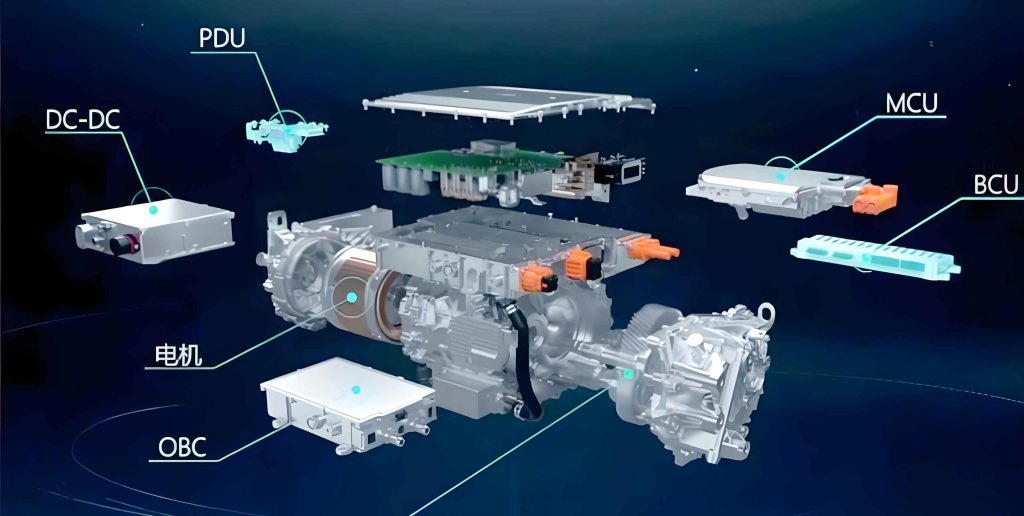
The application of GD&T in the electric drive system extends beyond the reducer to include motor connections and半轴 interfaces. For instance, motor mounting brackets must avoid over-constraint to prevent轴心线弯曲. By defining round holes instead of slots in certain areas, we allow for adjustment during assembly, maintaining coaxiality. This is where statistical tolerances come into play: using SPC data, we can predict variation and set realistic tolerance limits. For example, if the coaxiality error between motor and reducer is modeled as a normal distribution, the probability of exceeding a threshold can be calculated with $$ P(X > \delta) = 1 – \Phi\left(\frac{\delta – \mu}{\sigma}\right) $$, where $$ \mu $$ is the mean error, $$ \sigma $$ is the standard deviation, and $$ \delta $$ is the allowable error. This mathematical approach helps optimize the electric drive system for mass production, reducing costs while ensuring quality. In summary, GD&T’s datum constraint chain provides a robust framework for managing complexities in the electric drive system, from design to measurement.
Another critical area is body laser welding engineering, where GD&T ensures precise fit-up between panels for high-quality welds. Laser welding demands极小的 gaps between components like roof and side panels, typically requiring tolerances within ±0.1 mm. Traditional尺寸公差 often falls short due to cumulative variations in stamping and welding processes. With GD&T, we define datum chains that account for the柔性 nature of sheet metal parts. For a side panel, the primary datum A might be a定位孔 in the A-pillar, with secondary datums B and C controlling other key holes. The datum constraint chain then restricts the welding surfaces through profile tolerances. For example, a 2200 mm long welding edge on a roof panel can be controlled with a surface profile tolerance of ±0.15 mm, referenced to datums A, B, and C. This allows for statistical compensation during tooling调试, as the profile tolerance zone can float within a larger positional zone. The relationship can be expressed as: $$ \text{Surface Profile Zone} \subseteq \text{Position Zone} $$, where the profile zone is $$ \pm 0.15 \text{ mm} $$ and the position zone might be $$ \pm 0.3 \text{ mm} $$. This复合公差控制 ensures that even if parts shift during welding, the final assembly meets aesthetic and structural requirements. Below, a table summarizes the GD&T strategy for laser welding applications, emphasizing how datum targets stabilize parts throughout the process.
| Component | Key Datums | Tolerance Type | Value (mm) | Purpose in Laser Welding |
|---|---|---|---|---|
| Side Panel (Single Part) | A (A-p hole), B (rear hole), C (mid hole) | Position for Holes, Profile for Welding Edge | ø0.1 for holes, ±0.15 for profile | Establishes stable reference for assembly in the electric drive system and body structure. |
| Roof Panel | Referenced to Side Panel Datums | Surface Profile | ±0.15 over 2200 mm length | Ensures gap control for laser welding, critical for sealing and strength. |
| Welding Fixture | Base Plate Datums | Alignment and Clamping | Customized based on GD&T data | Simulates datum constraint chain during production, aiding the electric drive system integration. |
The datum constraint chain in laser welding also involves基准目标 to handle large, flexible panels. For example, on a side panel, additional datum targets (D and E) are defined along the welding edge to prevent窜位 during welding. These targets are constrained by the primary datums, creating a network of control points. Mathematically, if we have $$ n $$ datum targets, their positions can be optimized to minimize variation using least squares fitting: $$ \min \sum_{i=1}^{n} (x_i – x_{i, \text{nominal}})^2 $$ subject to GD&T constraints. This approach reduces rework and improves first-time quality, which is especially important for electric vehicles where body integrity affects aerodynamics and electric drive system packaging. In practice, I’ve seen that implementing GD&T in laser welding projects can shorten模具调试 cycles by up to 30%, as it provides clear guidelines for tooling corrections.
Throughout these applications, the unifying thread is the datum constraint chain’s ability to bridge design, manufacturing, and measurement. In the front suspension system, it ensures wheel alignment; in the electric drive system, it guarantees coaxiality; and in laser welding, it controls panel fit-up. The use of GD&T also facilitates advanced measurement techniques, such as CMM scanning and SpatialAnalyzer software, which rely on datum references for accurate analysis. For instance, when measuring a reducer housing for the electric drive system, the CMM program follows the datum chain to report position and profile deviations, enabling corrective actions. Moreover, GD&T’s compatibility with statistical methods allows for预测性维护 in production lines. By monitoring tolerance stacks over time, we can use control charts with limits like $$ \text{UCL} = \mu + 3\sigma $$ and $$ \text{LCL} = \mu – 3\sigma $$ to detect process shifts early.
In conclusion, the adoption of GD&T and the datum constraint chain in automotive engineering—particularly for suspension, electric drive system, and laser welding applications—represents a paradigm shift toward precision and efficiency. By providing a unambiguous language for geometric tolerances, it eliminates interpretation differences and reduces costs associated with over-tolerancing or rework. The electric drive system, as a cornerstone of modern vehicles, benefits immensely from this approach, ensuring reliable performance and longevity. As we move toward more integrated and electric-centric automotive platforms, GD&T will undoubtedly become even more prevalent, driving innovations in design and manufacturing. I encourage engineers and manufacturers to embrace this system, as it not only enhances product quality but also fosters collaboration across disciplines, ultimately leading to better vehicles for consumers.