
As a researcher focused on the advancement of energy storage systems, I have observed the rapid evolution of battery technologies, driven by the global shift toward vehicle electrification. The demand for high energy density, safety, and reliability in power batteries has never been more critical. Traditional lithium-ion batteries with liquid electrolytes face significant limitations, including insufficient energy density improvement, safety hazards like fire and leakage, and reduced performance in low-temperature conditions. These issues severely impact vehicle range and user satisfaction, prompting extensive research into solid-state batteries. In this review, I will summarize the current development status of solid-state battery technology, analyze key challenges, and provide insights for its application in the automotive industry. The term ‘solid-state battery’ will be frequently emphasized, as it represents a paradigm shift in energy storage solutions.
The concept of a solid-state battery revolves around the use of solid electrolytes instead of liquid ones, eliminating flammable organic solvents and separators. This fundamentally enhances safety by mitigating thermal runaway risks and enables higher energy densities through material optimization. Structurally, solid-state batteries replace the liquid electrolyte and separator with a solid electrolyte layer, which acts as both ion conductor and physical barrier. This design reduces battery weight and volume, potentially doubling energy density compared to conventional systems. The transition from liquid to solid electrolytes marks a critical step toward next-generation batteries, with ‘solid-state battery’ technology poised to redefine electric vehicle performance.
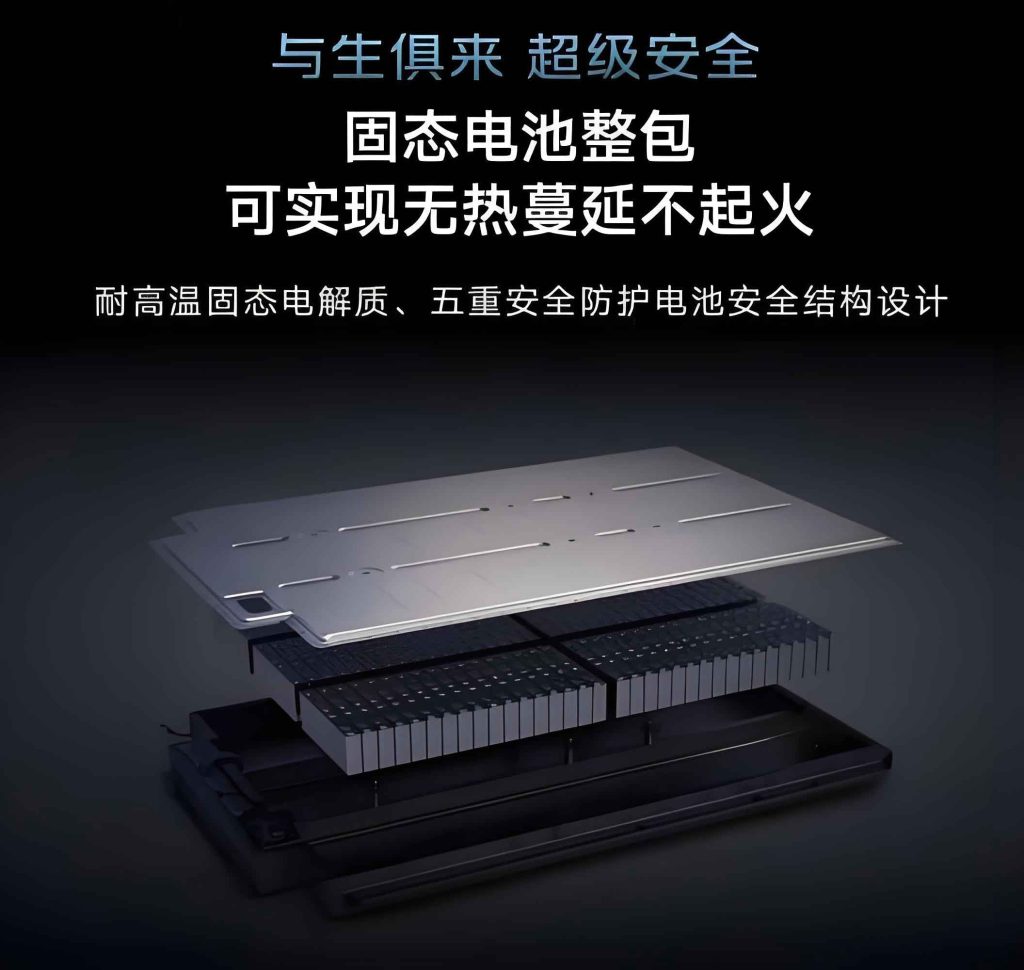
To categorize solid-state batteries, I classify them based on the mass fraction of liquid electrolyte in the cell mixture: liquid (25%), semi-solid (5–10%), quasi-solid (0–5%), and all-solid (0%). The latter three are collectively referred to as solid-state batteries. The core components include solid electrolytes, which are primarily divided into oxides, sulfides, and polymers. Each type exhibits distinct characteristics, as summarized in Table 1. Oxides offer moderate ionic conductivity and excellent stability, sulfides provide high ionic conductivity but face environmental sensitivity, and polymers feature good processability but low room-temperature conductivity. The choice of electrolyte significantly influences the performance of a solid-state battery, impacting factors like energy density and cycle life.
| Solid Electrolyte Type | Ionic Conductivity (S/cm) | Electrochemical Window (V) | Key Advantages | Key Challenges |
|---|---|---|---|---|
| Oxides (e.g., LLZO, LATP) | 10^{-4} to 10^{-3} | >5 | High stability, wide voltage range | Brittleness, interfacial resistance |
| Sulfides (e.g., LGPS) | 10^{-3} to 10^{-2} | ~3 | High ionic conductivity, flexibility | Air sensitivity, cost |
| Polymers (e.g., PEO) | 10^{-5} to 10^{-4} at 60°C | ~4 | Good processability, low cost | Low room-temperature conductivity |
The ionic conductivity of solid electrolytes is a paramount metric, often described by the Arrhenius equation: $$ \sigma = A \exp\left(-\frac{E_a}{k_B T}\right) $$ where \(\sigma\) is the conductivity, \(A\) is a pre-exponential factor, \(E_a\) is the activation energy, \(k_B\) is Boltzmann’s constant, and \(T\) is temperature. For a solid-state battery to compete with liquid counterparts, achieving \(\sigma > 10^{-3}\) S/cm at room temperature is essential. Current research focuses on enhancing this through composite electrolytes, such as mixing oxides with polymers or sulfides, to balance conductivity and stability. The energy density of a solid-state battery can be estimated using: $$ E_d = \frac{C \cdot V}{m} $$ where \(E_d\) is energy density (Wh/kg), \(C\) is capacity (Ah), \(V\) is voltage (V), and \(m\) is mass (kg). By integrating high-voltage cathodes (e.g., nickel-rich NCM) and lithium metal anodes, solid-state batteries aim for \(E_d > 500\) Wh/kg, surpassing the 300 Wh/kg limit of liquid batteries.
Globally, the development of solid-state battery technology is accelerating, with significant investments from industry and governments. In my analysis, I have compiled the progress of key players, as shown in Table 2. Countries like Japan and South Korea lead in sulfide and oxide routes, while China and the United States pursue diverse approaches, including semi-solid transitions. The competitive landscape underscores the strategic importance of solid-state battery innovation for future mobility.
| Region | Representative Entities | Technology Focus | Target Energy Density (Wh/kg) | Commercialization Timeline |
|---|---|---|---|---|
| Japan | Toyota, Panasonic | Sulfide electrolytes | 500 | 2030 |
| South Korea | Samsung SDI, LG Chem | Oxide/sulfide hybrids | 400 | 2025-2028 |
| China | CATL, BYD | Oxide/sulfide, semi-solid | 350-500 | 2025-2030 |
| United States | QuantumScape, Solid Power | Oxide, sulfide | 500 | 2030 |
| Europe | Bosch, BMW | Polymer, sulfide | 300-400 | 2030+ |
The technical challenges in solid-state battery development are multifaceted, primarily centered on electrolyte properties and interfacial issues. As I delve deeper, the key problems include low ionic conductivity, poor electrode-electrolyte contact, dendrite growth, and manufacturing scalability. For instance, the interfacial resistance between solid electrolyte and electrodes can be modeled as: $$ R_{int} = \frac{\delta}{\sigma_{int}} $$ where \(R_{int}\) is interfacial resistance, \(\delta\) is interface thickness, and \(\sigma_{int}\) is interfacial conductivity. To mitigate this, strategies like coating electrodes with buffer layers or using composite electrolytes have been proposed. Table 3 outlines common issues and solutions for different solid electrolytes, highlighting the need for integrated approaches in solid-state battery design.
| Electrolyte Type | Primary Challenge | Proposed Solutions | Impact on Solid-State Battery Performance |
|---|---|---|---|
| Oxides | High interfacial resistance | Surface modification, composite formation | Improves cycle life and rate capability |
| Sulfides | Air instability | Dry room processing, protective coatings | Enhances safety and durability |
| Polymers | Low conductivity at RT | Plasticizers, inorganic fillers | Boosts low-temperature operation |
| All Types | Dendrite penetration | 3D anode structures, pressure application | Prevents short circuits and failure |
In terms of material science, the ionic transference number \(t_+\) is crucial for a solid-state battery, defined as: $$ t_+ = \frac{\sigma_+}{\sigma_+ + \sigma_-} $$ where \(\sigma_+\) and \(\sigma_-\) are cationic and anionic conductivities, respectively. Ideal solid electrolytes exhibit \(t_+ \approx 1\), minimizing polarization. Recent advances in garnet-type oxides (e.g., Li7La3Zr2O12) have achieved \(t_+ > 0.9\), promising for high-power applications. Furthermore, the mechanical properties of solid electrolytes influence dendrite suppression; the shear modulus \(G\) should satisfy \(G > 2G_{Li}\) (where \(G_{Li}\) is lithium’s shear modulus) to resist penetration. This is often expressed as: $$ G_{SE} > \frac{2E_{Li}}{3(1-\nu_{Li})} $$ with \(E_{Li}\) and \(\nu_{Li}\) as lithium’s Young’s modulus and Poisson’s ratio. Such criteria guide the development of robust solid-state battery systems.
The evolution of solid-state battery technology also involves anode and cathode innovations. For anodes, lithium metal offers high capacity (3860 mAh/g) but poses dendrite risks. Pre-lithiated silicon anodes provide a compromise, with capacities around 2000 mAh/g. Cathodes like high-nickel NCM (LiNi0.8Co0.1Mn0.1O2) and lithium-rich manganese oxides (LRMO) enable voltages above 4.5 V. The overall cell reaction for a solid-state battery with lithium metal anode and NCM cathode can be simplified as: $$ \text{Li} + \text{LiNi}_{0.8}\text{Co}_{0.1}\text{Mn}_{0.1}\text{O}_2 \rightleftharpoons \text{Li}_2\text{O} + \text{Ni}_{0.8}\text{Co}_{0.1}\text{Mn}_{0.1}\text{O} $$ though actual mechanisms are more complex. Energy density gains are quantified by: $$ \Delta E_d = \frac{Q_{anode} \cdot V_{cell} – Q_{liquid}}{m_{cell}} $$ where \(Q_{anode}\) and \(Q_{liquid}\) are anode capacities, and \(m_{cell}\) is cell mass. A solid-state battery leveraging these materials can achieve 40-50% higher \(E_d\) than liquid versions.
Manufacturing processes for solid-state batteries differ significantly from conventional methods. Techniques like thin-film deposition, spark plasma sintering, and solution casting are employed for electrolyte fabrication. The cost per kilowatt-hour (kWh) remains a hurdle, often estimated as: $$ \text{Cost} = \frac{C_{mat} + C_{proc}}{E_d} $$ where \(C_{mat}\) is material cost and \(C_{proc}\) is processing cost. Current projections suggest solid-state battery costs may drop below $100/kWh by 2030 with scale-up. Table 4 compares production methods, emphasizing the trade-offs between performance and feasibility for solid-state battery mass production.
| Manufacturing Method | Applicable Electrolyte | Advantages | Disadvantages | Suitability for Solid-State Battery |
|---|---|---|---|---|
| Thin-Film Deposition | Oxides, sulfides | Precise control, high purity | High cost, low throughput | High-energy niche applications |
| Sintering | Oxides | Dense layers, good contact | High temperature, energy-intensive | Bulk production with optimization |
| Solution Processing | Polymers, composites | Scalable, low cost | Solvent residues, lower conductivity | Mass-market semi-solid batteries |
| 3D Printing | All types | Custom geometries, rapid prototyping | Limited resolution, material constraints | Future flexible designs |
Looking ahead, the future of solid-state battery technology hinges on overcoming interfacial and scalability challenges. Hybrid approaches, such as semi-solid batteries with gel electrolytes, serve as transitional solutions, offering improved safety without fully abandoning liquids. Research trends indicate a shift toward composite electrolytes, combining oxides with polymers or sulfides to harness synergistic effects. The ionic conductivity enhancement in composites can be modeled using percolation theory: $$ \sigma_{comp} = \sigma_0 (p – p_c)^t $$ where \(\sigma_{comp}\) is composite conductivity, \(\sigma_0\) is intrinsic conductivity, \(p\) is filler volume fraction, \(p_c\) is percolation threshold, and \(t\) is a critical exponent. For a solid-state battery, targeting \(p > p_c\) ensures continuous ion pathways.
In conclusion, as I reflect on the current landscape, solid-state battery technology stands at the forefront of energy storage innovation. With concerted efforts in material science, interface engineering, and manufacturing, solid-state batteries promise to deliver the high energy density, safety, and reliability demanded by electric vehicles. The journey from lab to market requires continued collaboration across academia and industry, but the potential rewards—such as doubling vehicle range and eliminating fire risks—make it a compelling pursuit. I am optimistic that within this decade, solid-state battery systems will become commercially viable, transforming transportation and beyond. The repeated emphasis on ‘solid-state battery’ throughout this review underscores its pivotal role in shaping a sustainable energy future.