
The global automotive industry is undergoing a profound transformation, propelled by the imperatives of environmental sustainability and technological advancement. The “Industry 4.0” paradigm and national strategic initiatives like “Made in China 2025” are accelerating the shift towards intelligent, connected, and green manufacturing. Within this context, the battery electric vehicle (BEV) has emerged as a pivotal direction for the future of transportation. Despite significant progress in technology and market adoption, the widespread proliferation of battery electric vehicles continues to face substantial hurdles. Key challenges include high initial purchase costs, concerns over battery longevity and safety, insufficient driving range, and the adequacy of charging infrastructure. To navigate this competitive landscape and achieve sustainable growth, manufacturers must meticulously align product development with evolving customer expectations. This study employs the Quality Function Deployment (QFD) framework to systematically translate latent and explicit user demands into precise engineering and design specifications for battery electric vehicles. Using BYD, a leading global manufacturer, as a case study, this research identifies critical design factors and proposes targeted optimization strategies, thereby providing a structured roadmap for enhancing the competitiveness of future battery electric vehicle models.
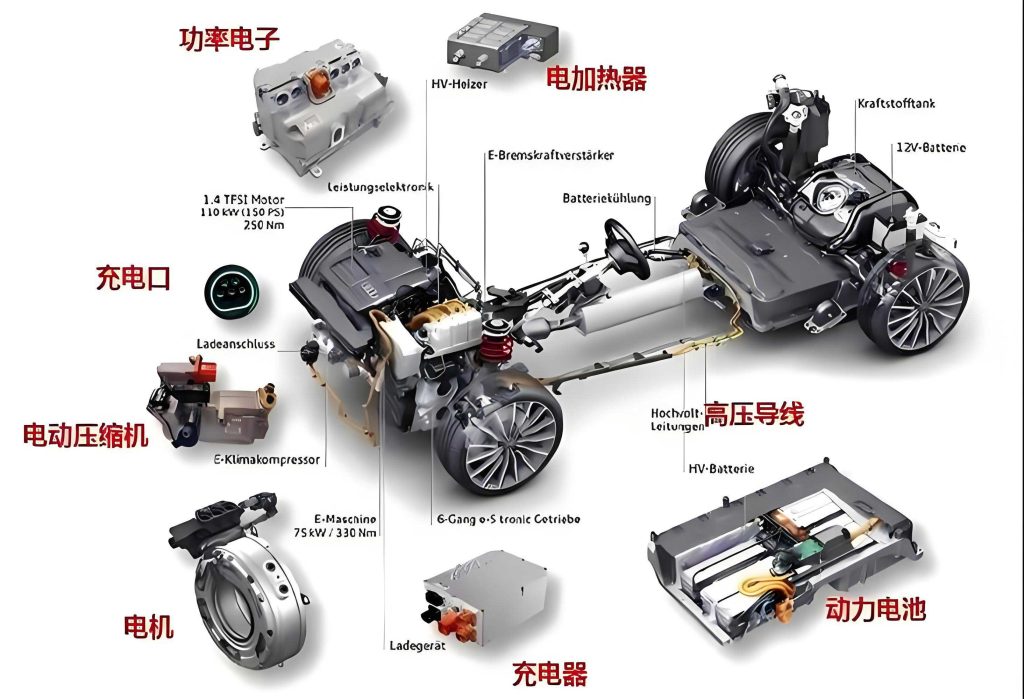
The core analytical engine of QFD is the House of Quality (HOQ), a conceptual matrix that facilitates the translation of customer needs into actionable technical characteristics. The construction of a comprehensive HOQ involves several interconnected compartments, each serving a distinct function in the design prioritization process.
The initial and most crucial step is the identification and weighting of Customer Requirements (CRs), which form the “left wall” of the HOQ. For this study, primary CRs for a battery electric vehicle were gathered and prioritized through survey methodology. The relative importance of each requirement was rated by potential and current users on a scale of 1 (Very Unimportant) to 5 (Very Important). The aggregated results are presented in Table 1.
| Customer Requirement (What) | Importance Rating (k_j) |
|---|---|
| Long Driving Range | 5.0 |
| Short Charging Time | 4.8 |
| High Safety | 4.5 |
| Low Purchase Price | 4.3 |
| Extensive & Accessible Charging Network | 4.0 |
| Excellent Driving Stability | 3.8 |
| Simple In-Car Controls | 3.5 |
| Elegant Exterior Design | 3.2 |
| Intelligent Voice System | 3.0 |
| Environmental Friendliness (Zero Pollution) | 4.7 |
The “ceiling” of the HOQ comprises the Engineering Characteristics (ECs) or Technical Requirements (Hows). These are measurable, design-oriented parameters that the company can control to satisfy the CRs. For a battery electric vehicle, relevant ECs were derived:
| Engineering Characteristic (How) | Unit |
|---|---|
| Battery Energy Density | Wh/kg |
| Peak Charging Power | kW |
| Vehicle Curb Weight | kg |
| Battery Pack Cost | $ per kWh |
| Number of Public Charging Stations | Count |
| Drag Coefficient (C_d) | – |
| Body Torsional Stiffness | N·m/deg |
| Integration of Advanced Driver-Assistance Systems (ADAS) | Level (0-5) |
The central “relationship matrix” (the room of the house) defines the correlations between each Customer Requirement (CR_i) and each Engineering Characteristic (EC_j). The strength of these relationships is typically denoted symbolically and assigned a numerical weight for calculation. The relationship weight ($r_{ij}$) is often scaled as: Strong = 9, Medium = 3, Weak = 1, and None = 0.
The “roof” of the HOQ is a correlation matrix that depicts the interrelationships among the Engineering Characteristics themselves. Positive (+) and negative (-) correlations help identify potential synergies or trade-offs (e.g., increasing battery capacity may negatively correlate with reducing vehicle curb weight).
The “right wall” involves competitive benchmarking. It assesses the company’s and its competitors’ performance in meeting each Customer Requirement. This analysis, combined with strategic goals, helps set improvement targets. The planned level for each CR is a strategic decision informed by the competitive analysis and importance rating.
The final output is generated in the “basement” of the HOQ. It involves calculating the absolute and relative importance weights for each Engineering Characteristic. The absolute importance ($AI_j$) for an EC is the sum of the products of the customer importance rating and the relationship weight for all related CRs. The relative importance ($RI_j$) is then its percentage of the total.
The absolute importance for Engineering Characteristic \(j\) is calculated as:
$$ AI_j = \sum_{i=1}^{m} (k_i \cdot r_{ij}) $$
where \(k_i\) is the importance rating of Customer Requirement \(i\), and \(r_{ij}\) is the relationship weight between CR_i and EC_j.
The relative importance is given by:
$$ RI_j = \frac{AI_j}{\sum_{j=1}^{n} AI_j} \times 100\% $$
A simplified, aggregated HOQ matrix for a battery electric vehicle, synthesizing the aforementioned components, is presented in Table 3. This matrix visually consolidates the translation from customer needs (“What”) to technical responses (“How”), guiding design priorities.
| Customer Requirements (Whats) | Importance (k_i) | Engineering Characteristics (Hows) | Competitive Benchmark (BYD vs. Comp. A) | Planned Target | |||||
|---|---|---|---|---|---|---|---|---|---|
| Battery Energy Density | Peak Charging Power | Vehicle Curb Weight | Battery Pack Cost | Body Stiffness | ADAS Level | ||||
| Long Driving Range | 5.0 | 9 | 3 | 3 | 1 | 1 | 0 | (4 vs 3) | 5 |
| Short Charging Time | 4.8 | 1 | 9 | 0 | 0 | 0 | 0 | (3 vs 4) | 5 |
| High Safety | 4.5 | 0 | 0 | 1 | 0 | 9 | 3 | (5 vs 4) | 5 |
| Low Purchase Price | 4.3 | 3 | 1 | 1 | 9 | 0 | 1 | (4 vs 3) | 5 |
| Extensive Charging Network | 4.0 | 0 | 3 | 0 | 0 | 0 | 0 | (4 vs 2) | 5 |
| Absolute Importance (AI_j) | 68.4 | 57.6 | 27.8 | 43.5 | 45.0 | 22.5 | |||
| Relative Importance (RI_j %) | 26.8% | 22.6% | 10.9% | 17.1% | 17.6% | 8.8% | |||
The QFD analysis reveals clear strategic priorities for the design and development of a competitive battery electric vehicle. The Engineering Characteristics with the highest relative importance—Battery Energy Density (26.8%), Peak Charging Power (22.6%), Battery Pack Cost (17.1%), and Body Stiffness (17.6%)—emerge as the critical focus areas. These directly correspond to the top-ranked Customer Requirements: Long Driving Range, Short Charging Time, Low Purchase Price, and High Safety. Applying this framework to BYD’s development process yields specific, actionable optimization pathways.
To address the paramount demand for Long Driving Range, the primary lever is enhancing Battery Energy Density. The optimization strategy is multi-faceted and can be modeled as a function of several variables. The effective vehicle range ($R$) can be expressed as a function of battery capacity, efficiency, and vehicle parameters:
$$ R \approx \frac{E_{batt} \cdot \eta_{sys}}{(F_{roll} + F_{aero} + F_{grade})} $$
where $E_{batt}$ is the total battery energy ($E_{batt} = \text{Energy Density} \times \text{Battery Mass}$), $\eta_{sys}$ is the drivetrain efficiency, and the denominator represents the sum of rolling resistance, aerodynamic drag, and grade resistance forces. Therefore, BYD’s R&D must focus on:
- Advanced Cell Chemistry: Investing in silicon-anode, lithium-metal, or solid-state battery technologies to significantly increase Wh/kg.
- Pack Integration Efficiency: Optimizing the battery pack structure to minimize non-cell mass (modules, cooling, casing) through Cell-to-Pack (CTP) or Cell-to-Chassis (CTC) architectures.
- Vehicle-Level Efficiency Gains: Reducing aerodynamic drag ($F_{aero} \propto C_d \cdot A \cdot v^2$) through streamlined design and lowering rolling resistance via lightweight materials and low-rolling-resistance tires.
The critical need for Short Charging Time is tackled by maximizing Peak Charging Power. The charging time for a significant portion of the battery capacity can be approximated by:
$$ t_{charge} \approx \frac{\Delta E_{batt}}{P_{charge} \cdot \eta_{charge}} $$
where $\Delta E_{batt}$ is the energy delivered, $P_{charge}$ is the charging power, and $\eta_{charge}$ is the charging efficiency. BYD’s strategy involves:
- High-Voltage Platform: Deploying 800V or higher electrical architectures to allow for higher power ($P = V \cdot I$) at lower currents, reducing heat generation and cable thickness.
- Battery Thermal Management: Developing advanced direct cooling systems (e.g., refrigerant cooling) to maintain optimal cell temperature during high-power charging, preventing degradation.
- Charging Infrastructure Synergy: Expanding partnerships to deploy ultra-fast charging stations compatible with its high-voltage platforms, ensuring the vehicle capability is matched by infrastructure availability.
The pursuit of a Low Purchase Price is fundamentally linked to reducing Battery Pack Cost, which remains the single most expensive component of a battery electric vehicle. The cost equation is complex:
$$ C_{pack} = (C_{cell} \cdot N_{cell}) + C_{BMS} + C_{structure} + C_{labor} $$
BYD, leveraging its vertical integration, can optimize across this chain:
- Economies of Scale & Material Innovation: Scaling LFP (Lithium Iron Phosphate) battery production, which uses cheaper, more abundant materials than high-nickel NMC chemistries, while continuing to improve its energy density.
- Manufacturing Innovation: Implementing more automated, high-yield production processes to reduce $C_{labor}$ and improve quality control.
- Design-to-Cost & Standardization: Standardizing battery modules and vehicle platforms across multiple models to spread R&D and tooling costs over higher production volumes.
Ensuring High Safety is non-negotiable and is strongly linked to Body Stiffness and the integration of robust ADAS. Structural safety in a collision is paramount for any battery electric vehicle. Key initiatives include:
- Integrated Safety Structure: Designing the vehicle platform with dedicated crash protection zones for the battery pack, using ultra-high-strength steel and aluminum alloys to maximize body stiffness and cabin integrity. This directly protects the battery from intrusion.
- Proactive Battery Safety: Enhancing the Battery Management System (BMS) with more precise sensors and algorithms for real-time monitoring of voltage, temperature, and insulation resistance to prevent thermal runaway.
- Comprehensive ADAS Suite: Systematically integrating preventive safety features like Automatic Emergency Braking (AEB), Lane Keeping Assist (LKA), and Blind Spot Detection (BSD) as standard to reduce accident probability.
This structured application of the QFD model provides a clear, traceable, and quantitative roadmap for BYD’s battery electric vehicle development. By focusing engineering resources on the high-priority technical characteristics derived directly from weighted customer voices, BYD can optimize its design process, allocate R&D investments efficiently, and develop vehicles that precisely meet market demands. The methodology moves beyond subjective guesswork, creating a direct feedback loop from the end-user to the design engineer. For the broader industry, this study demonstrates the potent utility of QFD as a strategic planning tool for navigating the complex trade-offs inherent in battery electric vehicle design—balancing range, cost, charging speed, and safety. Future research could integrate this QFD output with other innovation methodologies like TRIZ to solve the identified technical contradictions (e.g., increasing energy density while reducing cost) or employ multi-criteria decision analysis to select among specific technology alternatives for each high-priority engineering characteristic. The continuous iteration of this process, fueled by ongoing market feedback, will be essential for sustaining leadership in the dynamic and rapidly evolving global battery electric vehicle market.