
The proliferation of battery electric cars marks a significant shift towards sustainable mobility, driven by their advantages in low carbon emissions, environmental friendliness, and operational economy. However, this transition presents unique challenges in vehicle refinement, particularly concerning Noise, Vibration, and Harshness (NVH). The absence of internal combustion engine maskingsound unmasks previously subdued noises from the powertrain, making gear whine from the reduction gearbox especially prominent. This high-frequency tonal noise can severely degrade cabin comfort, perceived quality, and ultimately, the market acceptance of battery electric vehicles. Therefore, the analysis and mitigation of transmission whine is paramount for enhancing the overall performance and competitiveness of modern electric vehicles.
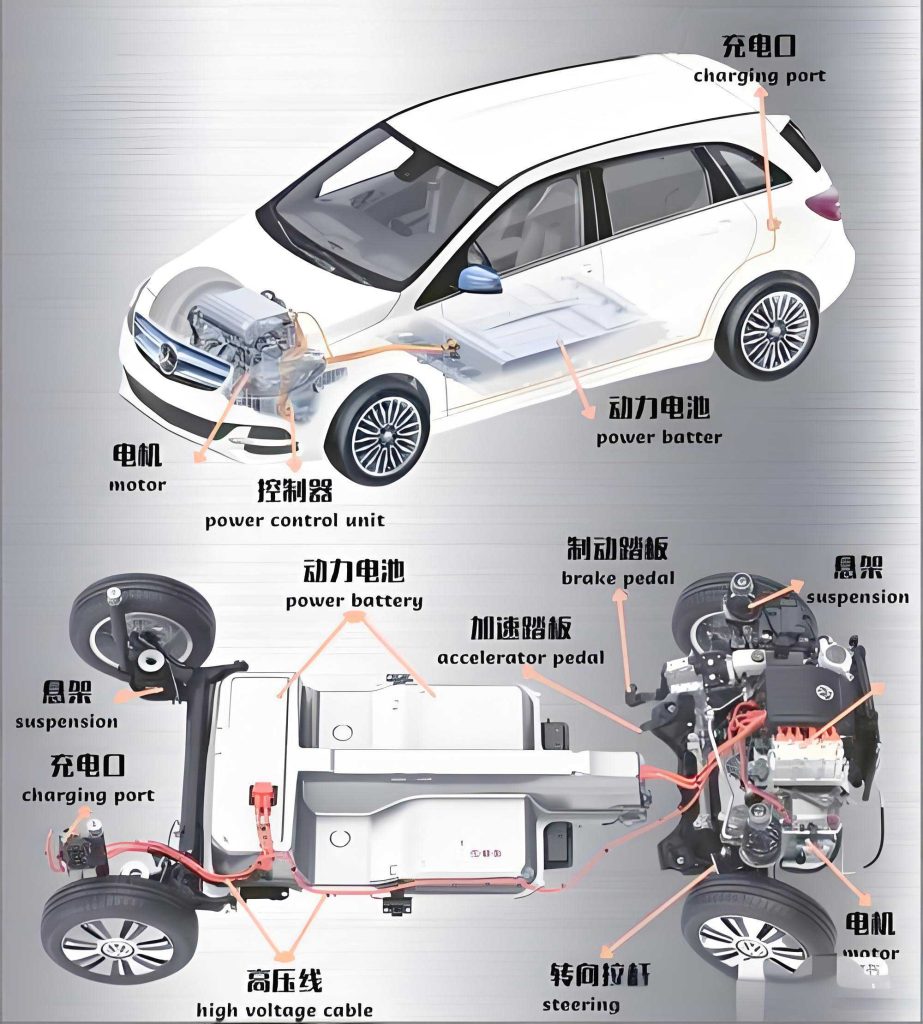
In a specific case involving a battery electric car, a pronounced whining noise was identified during semi-anechoic chamber testing of its single-speed, two-stage reduction gearbox. Order analysis of the acquired noise data pinpointed the 29th order, corresponding to the meshing frequency of the first-stage gear pair, as the dominant contributor. The noise level for this order significantly exceeded the target threshold, highlighting a critical NVH issue that necessitated immediate resolution. The objective of this work is to delve into the root causes of such gear whine and to present a comprehensive, parallel optimization methodology addressing both the source of excitation and the structural transmission path to achieve substantial noise reduction.
Theoretical Foundation of Gear Whine in EV Drivetrains
The whine noise emanating from the gearbox in a battery electric car is fundamentally a vibro-acoustic response resulting from dynamic excitations within a coupled rigid-flexible system. The primary source of gear whine is the transmission error (TE), defined as the deviation between the actual position of the driven gear and its theoretical position if the gears were perfectly conjugate, rigid bodies. This error arises due to several factors and manifests as a fluctuating excitation force.
The core mechanism is the periodic variation of mesh stiffness as gear teeth engage and disengage. This variation, combined with manufacturing inaccuracies, assembly misalignments, and load-induced deflections, causes a dynamic transmission error. The fluctuating TE acts as a kinematic excitation, leading to vibratory forces that propagate through the gearbox structure and radiate as audible noise, often perceived as a whine or whimper. The governing principle for the system’s total acoustic or vibrational response P can be described by the superposition of contributions from individual paths:
$$P=\sum_{i=1}^{N} P_i = \sum_{i=1}^{N} H_i(\omega) \cdot F_i(\omega)$$
Where:
$P$ is the total system response (e.g., sound pressure or vibration acceleration).
$N$ is the total number of transmission paths.
$P_i$ is the response contribution from the $i$-th path.
$H_i(\omega)$ is the frequency response function (FRF) or transfer function from the excitation point to the response point for the $i$-th path.
$F_i(\omega)$ is the excitation force spectrum applied at the $i$-th path.
This equation elegantly decomposes the problem into two fundamental domains which are critical for addressing noise in a battery electric car drivetrain:
1. Vibration Excitation Source ($F_i(\omega)$): This is predominantly governed by the gear mesh excitation, quantified by the Transmission Error. Key influencing factors include:
– Gear macro-geometry parameters (module, pressure angle, helix angle, number of teeth).
– Gear micro-geometry parameters (profile and lead crowning, tip and root relief, bias).
– Manufacturing errors (profile deviation, pitch error).
– Assembly errors (misalignment, shaft runout).
– Time-varying mesh stiffness.
2. Structural Transfer Path ($H_i(\omega)$): This represents how the excitation force is transmitted and amplified by the system’s dynamics. Key influencing factors include:
– Gear body and web support stiffness.
– Shaft bending and torsional stiffness.
– Bearing support stiffness and damping.
– Housing and casing dynamic characteristics (modal properties).
– Mounting system compliance.
Therefore, an effective optimization strategy for mitigating whine in a battery electric car transmission must concurrently address the minimization of the excitation source (TE) and the modification of the transfer path to reduce its sensitivity to the remaining excitation.
Parallel Optimization Methodology: Source and Path
To tackle the identified whine issue, a three-pronged parallel optimization approach was undertaken, targeting gear macro-geometry, micro-geometry, and gear body structure.
1. Optimization of Gear Macro-Geometry Parameters
The goal here is to redesign the basic gear dimensions to promote smoother meshing, thereby reducing the fundamental excitation. A key metric is the total contact ratio $\epsilon$, which is the sum of the transverse contact ratio $\epsilon_{\alpha}$ and the axial (overlap) contact ratio $\epsilon_{\beta}$.
For an external helical gear pair, these are calculated as:
Transverse Contact Ratio:
$$\epsilon_{\alpha} = \frac{1}{2\pi} \left[ z_1 (\tan\alpha_{a1} – \tan\alpha’) + z_2 (\tan\alpha_{a2} – \tan\alpha’) \right]$$
Axial Contact Ratio:
$$\epsilon_{\beta} = \frac{B \sin\beta}{\pi m_n}$$
Total Contact Ratio:
$$\epsilon = \epsilon_{\alpha} + \epsilon_{\beta}$$
Where $z$ is the number of teeth, $\alpha_a$ is the tip circle pressure angle, $\alpha’$ is the operating pressure angle, $B$ is the effective face width, $\beta$ is the helix angle, and $m_n$ is the normal module. A higher total contact ratio generally indicates a smoother load transfer between more tooth pairs, reducing average load per tooth and transmission error fluctuation. The design also aims to avoid conditions where $\epsilon_{\beta}$ is near an odd multiple of 0.5 while $\epsilon_{\alpha}$ is not an even multiple of 0.5, or vice-versa, as this can lead to significant periodic stiffness variations.
The optimization was conducted under the constraint of maintaining the overall gear ratio. Parameters such as normal module, pressure angle, and helix angle were fine-tuned. The comparative results are summarized below:
| Parameter | Original Design | Optimized Design |
|---|---|---|
| Pinion Teeth (z1) / Gear Teeth (z2) | 29 / 73 | 29 / 73 |
| Normal Module, $m_n$ (mm) | 1.40 | 1.35 |
| Normal Pressure Angle, $\alpha_n$ (°) | 17.6 | 16.1 |
| Helix Angle, $\beta$ (°) | 23.9 | 28.8 |
The impact on the contact ratios is profound, as shown in the following comparison:
| Contact Ratio Type | Original Design | Optimized Design |
|---|---|---|
| Transverse Contact Ratio ($\epsilon_{\alpha}$) | 1.711 | 1.801 |
| Axial Contact Ratio ($\epsilon_{\beta}$) | 2.211 | 3.067 |
| Total Contact Ratio ($\epsilon$) | 3.922 | 4.868 |
The optimized design achieves a significant increase in total contact ratio, moving $\epsilon_{\beta}$ closer to an even multiple of 0.5 and moving $\epsilon_{\alpha}$ away from an odd multiple, thus promoting more stable mesh stiffness. This foundational change is crucial for reducing excitation in the battery electric car gearbox.
2. Optimization of Gear Micro-Geometry Parameters
Micro-geometry optimization, or gear flank modification, involves intentionally removing minute amounts of material from the ideal tooth profile and lead to compensate for elastic deformations and misalignments under load. The primary objective is to minimize the peak-to-peak transmission error across the expected operating torque range, ensuring a conjugate contact pattern.
The optimization process involves iterative simulations to find the optimal combination of profile crowning and lead crowning. The key performance indicator is the contact pattern under load, which should cover approximately 70-80% of the available flank area to ensure low contact stress and stability. The modifications applied to the first-stage gear pair are summarized below:
| Modification Type | Original Design (Pinion/Gear) [µm] | Optimized Design (Pinion/Gear) [µm] |
|---|---|---|
| Profile Crowning | 8 / 7 | 3 / 2 |
| Lead Crowning | 6 / 9 | 2.5 / 3.5 |
The effect of this optimization, combined with the new macro-geometry, is evident in the loaded tooth contact analysis (LTCA). The optimized flank modifications yielded a more centered and slightly reduced contact patch, achieving the target area ratio and significantly lowering the maximum contact stress.
| Design | Contact Patch Area (vs. Theoretical) | Max. Contact Stress (at 50% Torque) |
|---|---|---|
| Original | Approx. 85% | 1105 MPa |
| Optimized | Approx. 73.6% | 957 MPa |
The reduction in maximum contact stress by approximately 13.4% indicates a more favorable pressure distribution and directly contributes to lower mesh excitation forces in the battery electric car transmission system.
3. Optimization of the Gear Web Structure (Transfer Path)
While minimizing the excitation is critical, managing the structural response is equally important for a comprehensive solution in a battery electric car. The original driven gear of the first stage featured a relatively thin web with a thickness of 8 mm, which could act as a compliant element, amplifying the transmission error excitation through local deformation.
To stiffen this critical path, the web thickness was increased from 8 mm to 12 mm. To quantify the improvement in dynamic stiffness, a free-free modal analysis of the gear-shaft assembly was performed using the Finite Element Method (FEM). The material properties for 20CrMnTiH steel were applied: Density $\rho = 7.85 \times 10^{-9}$ t/mm³, Young’s Modulus $E = 212$ GPa, and Poisson’s Ratio $\nu = 0.289$.
The first eight natural frequencies of the assembly were compared before and after the web modification. The results demonstrate a substantial increase in modal stiffness:
| Mode Order | Natural Frequency – Original (Hz) | Natural Frequency – Optimized (Hz) | Increase (Hz) | Increase (%) |
|---|---|---|---|---|
| 1 | 2831.7 | 3463.1 | 631.4 | 22.3% |
| 2 | 2831.8 | 3463.2 | 631.4 | 22.3% |
| 3 | 3453.6 | 4166.1 | 712.5 | 20.6% |
| 4 | 3453.7 | 4166.2 | 712.5 | 20.6% |
| 5 | 4046.1 | 4994.3 | 948.2 | 23.4% |
| 6 | 7096.7 | 7247.6 | 150.9 | 2.1% |
| 7 | 8300.3 | 8863.7 | 563.4 | 6.8% |
| 8 | 8300.5 | 8863.8 | 563.3 | 6.8% |
The first elastic mode, crucial for low-frequency whine, saw an increase of over 22%. This significant stiffening alters the transfer function $H_i(\omega)$, reducing the system’s dynamic response to the mesh forces, thereby attenuating the vibration and radiated noise along this critical path.
Integrated Analysis and Experimental Validation
Transmission Error Analysis
The combined effect of the parallel optimizations on the primary excitation source was evaluated by simulating the Transmission Error across a wide torque range. The model incorporated the full finite element representations of the shafts, gears, and housing to accurately capture system deflections. The results conclusively demonstrate the effectiveness of the holistic approach for the battery electric car application.
The peak-to-peak Transmission Error was reduced at all load points. The most dramatic improvement was observed at the 10% torque condition, which is often critical for whine under light load or coasting scenarios typical in urban driving for a battery electric car.
| Torque Condition | Peak-Peak TE – Original (µm) | Peak-Peak TE – Optimized (µm) | Reduction (µm) | Reduction (%) |
|---|---|---|---|---|
| 10% | 0.380 | 0.165 | 0.215 | 56.6% |
| 25% | 0.245 | 0.118 | 0.127 | 51.8% |
| 50% | 0.185 | 0.095 | 0.090 | 48.6% |
| 100% | 0.150 | 0.088 | 0.062 | 41.3% |
A reduction of 56.6% in TE at a key operating point represents a profound suppression of the fundamental vibro-acoustic excitation source within the transmission system.
Bench Test Validation
To validate the simulation results, physical prototypes of both the original and optimized gear sets were manufactured and assembled into identical gearbox units. NVH testing was conducted on a dynamometer within a semi-anechoic chamber. The drive motor was controlled in torque mode, and the load motor in speed mode, to replicate real-world operating conditions for a battery electric car.
The sound pressure level of the critical 29th order (first-stage mesh order) was measured across a sweep of input speeds. The results confirm the substantial improvement predicted by the analysis.
| Performance Metric | Original Design | Optimized Design | Improvement |
|---|---|---|---|
| Maximum 29th Order Noise Level | 78.5 dB(A) | 67.0 dB(A) | -11.5 dB(A) |
| Average 29th Order Noise Level (over sweep) | 72.3 dB(A) | 62.8 dB(A) | -9.5 dB(A) |
The parallel optimization strategy yielded a remarkable 14.6% reduction (11.5 dB(A)) in the maximum whine noise level. This level of attenuation is clearly audible and represents a major step forward in achieving the refined acoustic character expected in modern battery electric cars. The improvement is attributed to the synergistic effect of reducing the transmission error (source) and increasing the structural stiffness (path), preventing the remaining excitation from being amplified.
Conclusion and Broader Implications
This work successfully addressed a persistent gear whine issue in a battery electric car reduction gearbox through a systematic, parallel optimization framework. The methodology concurrently targeted the vibration excitation source by optimizing gear macro- and micro-geometry to minimize transmission error, and the structural transfer path by increasing gear web stiffness to reduce dynamic response.
The key outcomes include a 56.6% reduction in peak-to-peak transmission error at a critical light-load condition and a 14.6% (11.5 dB(A)) reduction in the maximum measured gear mesh order noise. The significant increase in gear contact ratio and modal stiffness were identified as primary contributors to this success.
The presented approach provides a robust and effective blueprint for tackling similar NVH challenges in electric vehicle drivetrains. For engineers developing transmissions for battery electric cars, it underscores the necessity of moving beyond isolated optimizations. A holistic view that integrates gear design for low excitation with structural design for high dynamic stiffness is essential to meet the stringent NVH standards of the silent EV cabin environment. Future work may explore the integration of advanced damping materials, the optimization of housing ribbing, and the use of active control strategies to further push the boundaries of quietness in electric mobility.