
The development of new energy vehicles is a crucial pathway towards achieving green and low-carbon transformation in the automotive industry. As battery electric cars progressively dominate the mainstream market, their air conditioning systems are evolving towards higher efficiency and energy savings. Addressing range limitation remains a key challenge for the advancement of battery electric cars. Regeneration cycle technology, based on the fundamental vapor-compression cycle, incorporates an internal heat exchanger (IHX) between the condenser and the evaporator. This component facilitates heat exchange between the high-pressure liquid refrigerant exiting the condenser and the low-pressure vapor refrigerant leaving the evaporator, thereby increasing subcooling before the expansion device and superheat at the compressor suction. This process enhances the system’s overall performance. Theoretical analyses have identified R290 (propane) as a promising alternative refrigerant with excellent thermodynamic properties, including high theoretical Coefficient of Performance (COP) and exergy efficiency. Its application in mobile air conditioning, particularly for battery electric cars, is attractive due to its low Global Warming Potential (GWP) and zero Ozone Depletion Potential (ODP). However, its flammable nature necessitates careful system design. Notably, R290 systems typically exhibit lower discharge temperatures compared to other refrigerants, which creates significant potential for performance improvement by implementing a regeneration cycle without exceeding safe operational limits.
This study focuses on designing, building, and experimentally evaluating an R290 heat pump air conditioning system with a regeneration cycle specifically for battery electric cars. To enhance safety and modularity, a secondary loop configuration is adopted on both the indoor (cabin) and outdoor (ambient) sides, using a 50% ethylene glycol solution as the heat transfer fluid. The refrigerant circuit includes a scroll compressor, a plate condenser, a plate evaporator, an internal heat exchanger (IHX), and an electronic expansion valve (EXV). The system operates in two primary modes: cooling and heating, switched via two four-way valves. The inclusion or bypass of the IHX is controlled by a three-way valve, allowing direct comparison between the regeneration cycle and the basic cycle.
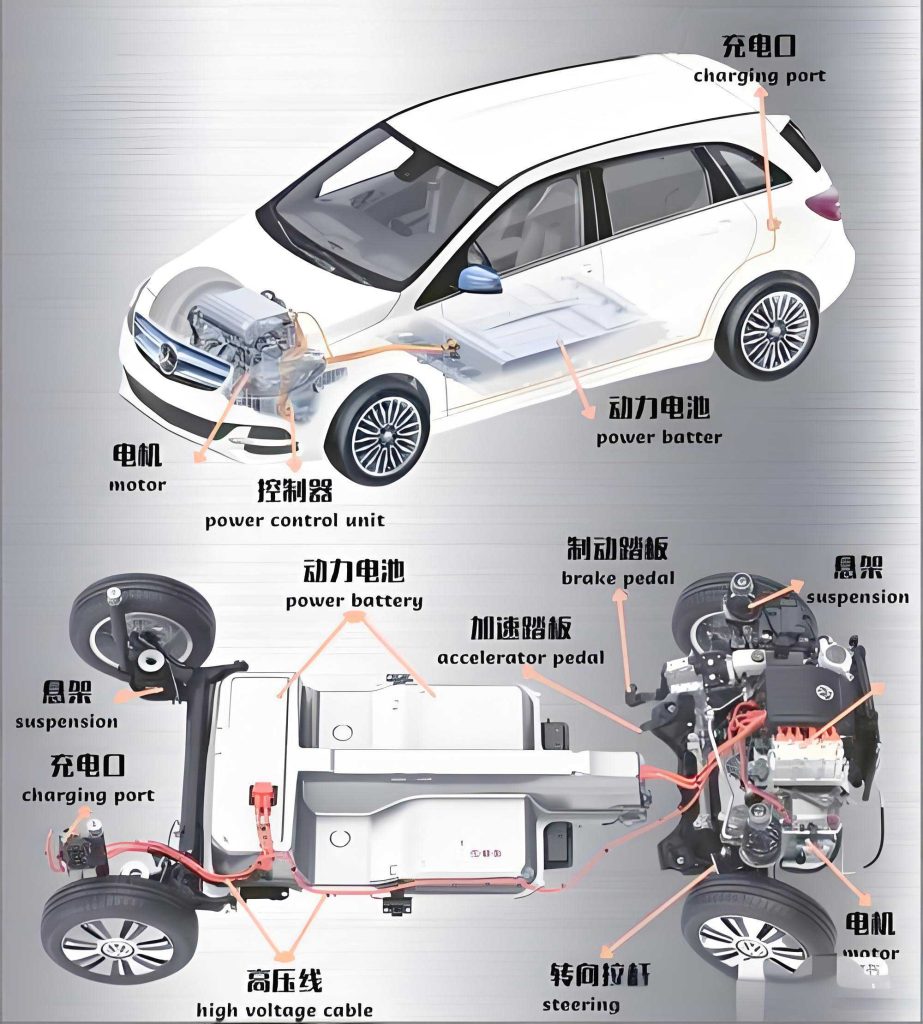
The performance of this system for a battery electric car was tested in a calibrated environmental chamber that simulates vehicle cabin and outdoor conditions. Tests were conducted under various ambient temperatures for both cooling and heating modes, comparing system performance with and without the internal heat exchanger (regeneration). Furthermore, the transient performance from system start-up to steady-set conditions was investigated. Finally, an exergy analysis was performed to identify sources of irreversibility and evaluate component efficiency.
1. System Design and Testing Methodology
1.1 System Configuration and Operating Principle
The schematic of the proposed R290 heat pump system for a battery electric car is shown in Figure 1. The core refrigerant circuit follows a standard vapor-compression layout but is integrated with an internal heat exchanger (IHX) and secondary fluid loops.
Refrigerant Circuit: The circuit comprises a scroll compressor (34 cm³ displacement), a plate-type condenser, a plate-type evaporator, a plate-type internal heat exchanger, and an electronic expansion valve (2.1 mm orifice). In the regeneration cycle, high-pressure liquid refrigerant from the condenser outlet flows through the IHX, where it is subcooled by rejecting heat to the low-pressure vapor refrigerant from the evaporator outlet. This process increases the enthalpy difference across both the evaporator and the compressor, potentially enhancing capacity and efficiency. The subcooled liquid then expands through the EXV. The suction gas, superheated in the IHX, enters the compressor.
Secondary Fluid Loops: Two independent secondary loops isolate the flammable R290 refrigerant from the air streams, enhancing safety—a critical consideration for a battery electric car. The indoor loop connects either the condenser (heating mode) or the evaporator (cooling mode) to a coolant-air heat exchanger (cooling coil or heating coil) located in the cabin air stream. The outdoor loop connects the opposite heat exchanger to a microchannel gas cooler positioned in the ambient air stream. Each loop contains a pump and a reservoir to circulate the 50% ethylene glycol solution.
Operating Modes:
Heating Mode: The four-way valves are positioned to connect the compressor discharge to the condenser. The indoor secondary loop absorbs heat from the condenser, and the warmed coolant heats the cabin air via the heating coil. The outdoor loop rejects heat from the evaporator to the ambient air via the gas cooler.
Cooling Mode: The four-way valves are switched. The compressor discharge is directed to the condenser, which now rejects heat to the ambient via the outdoor loop. The indoor loop absorbs heat from the cabin air via the cooling coil and transfers it to the evaporator.
The activation of the regeneration cycle is independent of the mode and is achieved by routing the suction line through the IHX via the three-way valve.
1.2 Experimental Setup and Test Conditions
The test bench was constructed according to the described principle. Key component specifications are summarized in Table 1.
| Component | Type | Length (mm) | Width (mm) | Note |
|---|---|---|---|---|
| Evaporator | Plate Heat Exchanger | 260 | 138 | 18 plates |
| Condenser | Plate Heat Exchanger | 125 | 94 | 28 plates |
| Internal Heat Exchanger (IHX) | Plate Heat Exchanger | 88 | 64 | 30 plates |
| Outdoor Gas Cooler | Microchannel | 593 | 27 | 62 tubes |
| Cabin Cooling Coil | Microchannel | 278.6 | 38 | 35 tubes |
| Cabin Heating Coil | Microchannel | 245 | 28 | 41 tubes |
Table 1: Specifications of main heat exchanger components for the battery electric car heat pump system.
Testing was performed in a psychrometric calorimeter room complying with relevant automotive air conditioning standards (e.g., GB/T 21361-2017). The room consists of two controlled environmental chambers simulating the cabin and ambient conditions for a battery electric car. Temperature, pressure, mass flow rate, and electrical power were measured with high-precision instruments. The cooling/heating capacity was determined from the secondary loop side measurements to ensure accuracy and safety.
The primary test matrix included steady-state performance evaluation under various conditions relevant to a battery electric car:
Cooling Mode: Outdoor ambient temperatures of 35°C, 43°C, and 50°C. Cabin inlet air was maintained at 27°C dry-bulb and 40% relative humidity.
Heating Mode: Outdoor ambient temperatures of -7°C, -15°C, and -25°C. Cabin inlet air was maintained at 20°C dry-bulb and 40% relative humidity.
For each condition, tests were conducted for both the basic cycle (IHX bypassed) and the regeneration cycle (IHX active). Additionally, transient behavior from a cold/warm start-up to the steady-set condition was investigated for specific cooling (50°C ambient) and heating (-15°C ambient) cases.
2. Performance Parameters and Exergy Analysis
2.1 Key Performance Indicators
The heating/cooling capacity ($Q$) was calculated from the secondary fluid side measurements using Eq. (1), which for cooling mode is:
$$Q_{cool} = \dot{m}_w \cdot c_{p,w} \cdot (T_{w,in} – T_{w,out}) \times 10^3$$
where $\dot{m}_w$ is the coolant mass flow rate (kg/s), $c_{p,w}$ is the specific heat capacity of the coolant (kJ/kg·°C) at its average temperature, and $T_{w,in}$ and $T_{w,out}$ are the inlet and outlet temperatures (°C) of the coolant at the indoor side plate heat exchanger (evaporator in cooling mode). The formula is analogous for heating mode.
The system Coefficient of Performance (COP) is defined as:
$$COP = \frac{Q}{W_{comp}}$$
where $W_{comp}$ is the compressor input power (W). A higher COP directly translates to lower energy consumption from the battery, extending the driving range of the battery electric car.
2.2 Exergy Analysis Methodology
Exergy analysis, based on the second law of thermodynamics, evaluates the quality of energy and identifies locations and magnitudes of irreversibility (exergy destruction). The specific exergy ($e$) at any state point $j$ in the refrigerant circuit is given by:
$$e_j = (h_j – h_0) – T_0(s_j – s_0)$$
where $h_j$ and $s_j$ are the specific enthalpy and entropy at state $j$, and $h_0$, $s_0$, and $T_0$ are the corresponding properties at the restricted dead state (environmental condition). For this analysis related to a battery electric car, $T_0$ was chosen as the outdoor ambient dry-bulb temperature. The exergy rate ($\dot{E}x$) is $\dot{m} \cdot e$.
The exergy destruction rate ($\dot{E}x_{dest}$) for each steady-flow component can be derived from an exergy balance. The formulations for key components are listed in Table 2.
| Component | Exergy Destruction Rate ($\dot{E}x_{dest}$) |
|---|---|
| Compressor | $W_{comp} + \dot{E}x_{suct} – \dot{E}x_{disch}$ |
| Expansion Valve | $\dot{E}x_{in,EXV} – \dot{E}x_{out,EXV}$ |
| Evaporator | $(\dot{E}x_{in} – \dot{E}x_{out})_{ref} + (\dot{E}x_{in} – \dot{E}x_{out})_{coolant}$ |
| Condenser | $(\dot{E}x_{in} – \dot{E}x_{out})_{ref} + (\dot{E}x_{in} – \dot{E}x_{out})_{coolant}$ |
| Internal HX (IHX) | $(\dot{E}x_{pri,in} – \dot{E}x_{pri,out}) + (\dot{E}x_{sec,in} – \dot{E}x_{sec,out})$ |
Table 2: Exergy destruction rate formulations for system components.
The exergy efficiency ($\eta_{ex}$) of a component or system is the ratio of useful exergy output (product) to the exergy input (fuel):
$$\eta_{ex} = \frac{\dot{E}x_{product}}{\dot{E}x_{fuel}}$$
For a heat exchanger, the product exergy is the increase in exergy of the cold stream, and the fuel exergy is the decrease in exergy of the hot stream.
3. Results and Discussion
3.1 Steady-State Performance: Basic vs. Regeneration Cycle
3.1.1 Cooling Mode Performance
The cooling performance of the heat pump system for a battery electric car under different high ambient temperatures is summarized in Figure 2 and Table 3. The regeneration cycle consistently outperforms the basic cycle.
$$ \text{Figure 2: Cooling capacity and COP with/without IHX at various ambients for a battery electric car.} $$
| Ambient Temp. (°C) | Cycle | Cooling Capacity (kW) | COP | Capacity Increase | COP Increase |
|---|---|---|---|---|---|
| 35 | Basic | 3.12 | 2.18 | 3.85% | 2.29% |
| Regeneration | 3.24 | 2.23 | |||
| 43 | Basic | 4.02 | 1.92 | 6.64% | 5.74% |
| Regeneration | 4.29 | 2.03 | |||
| 50 | Basic | 3.94 | 1.61 | 4.75% | 6.84% |
| Regeneration | 4.13 | 1.72 |
Table 3: Steady-state cooling performance comparison for the battery electric car system.
The performance improvement stems from the thermodynamic effect of the IHX. It subcools the liquid before expansion, reducing the vapor quality at the evaporator inlet and increasing the specific enthalpy difference across the evaporator. Simultaneously, it superheats the suction gas. However, a significant pressure drop on the low-pressure side of the IHX was observed, which reduces the suction pressure and compressor mass flow rate ($\dot{m}_{ref}$). At 50°C ambient, the IHX low-side pressure drop was 59 kPa, compared to only 17 kPa across the evaporator itself. Despite the ~7.6% reduction in mass flow rate at 50°C, the increase in specific refrigeration effect (≈29% higher enthalpy difference) resulted in a net gain in cooling capacity and COP. This trade-off is crucial for the design of the IHX in a battery electric car application.
3.1.2 Heating Mode Performance
The heating performance under low ambient temperatures critical for a battery electric car in winter is presented in Figure 3 and Table 4.
$$ \text{Figure 3: Heating capacity and COP with/without IHX at various low ambients.} $$
| Ambient Temp. (°C) | Cycle | Heating Capacity (kW) | COP | Capacity Increase | COP Increase |
|---|---|---|---|---|---|
| -7 | Basic | 5.61 | 2.51 | 3.19% | 3.19% |
| Regeneration | 5.79 | 2.59 | |||
| -15 | Basic | 4.41 | 2.16 | 3.24% | 10.17% |
| Regeneration | 4.55 | 2.38 | |||
| -25 | Basic | 2.72 | 1.58 | 5.07% | 3.17% |
| Regeneration | 2.86 | 1.63 |
Table 4: Steady-state heating performance comparison for the battery electric car system.
The regeneration cycle also improves heating performance. Notably, the low-side pressure drop in the IHX during heating mode is significantly lower (e.g., 38 kPa at -7°C) than in cooling mode. This is because the system mass flow rate is generally lower in heating mode for a given compressor speed due to lower suction pressure. Consequently, the penalty associated with the IHX pressure drop is reduced. The IHX increases suction superheat and, in heating mode, slightly raises the condensation pressure/temperature. The combined effect of increased mass flow rate (≈11-18%) and a moderately reduced specific heating effect led to a net increase in total heating capacity and COP. The COP at -15°C showed a remarkable 10.2% improvement, highlighting the significant benefit of regeneration for extending the range of a battery electric car in cold climates.
3.2 Transient Performance: Start-up vs. Set Condition
The performance of the air conditioning system in a battery electric car is not constant; it changes significantly from a hot or cold start until the cabin reaches the desired temperature. We analyzed the effect of regeneration during this transient phase for extreme cooling (50°C ambient, cabin start at 50°C) and heating (-15°C ambient, cabin start at -15°C) scenarios, comparing them to the steady-set condition (cabin at 27°C or 20°C). Results are condensed in Table 5.
| Mode | System State | Cabin Inlet Temp. (°C) | Performance Gain with IHX | Ref. Mass Flow Rate Change with IHX | IHX Low-Side $\Delta P$ |
|---|---|---|---|---|---|
| Cooling (50°C) | Start-up | 50 | Capacity: +6.41%, COP: +6.33% | -16.82% | 108 kPa |
| Set Condition | 27 | Capacity: +5.35%, COP: +6.84% | -8.06% | 59 kPa | |
| Heating (-15°C) | Start-up | -15 | Capacity: +8.19%, COP: +8.61% | +4.00% | 17 kPa |
| Set Condition | 20 | Capacity: +4.30%, COP: +9.69% | +11.53% | 28 kPa |
Table 5: Comparison of regeneration effects during start-up and set conditions for the battery electric car heat pump.
In cooling mode, during start-up with a hot cabin, the evaporating pressure and temperature are higher to meet the large cooling load. This leads to a higher refrigerant density and mass flow rate. The higher flow rate exacerbates the pressure drop in the IHX (108 kPa vs. 59 kPa at set condition), causing a more significant reduction in mass flow rate when the IHX is active (-16.82% vs. -8.06%). Despite this larger penalty, the absolute performance gain in capacity is higher at start-up because the system operates at higher temperature lifts where the benefits of subcooling are more pronounced.
In heating mode, during start-up with a cold cabin, the condensing pressure/temperature is lower, and the system mass flow rate is lower. This results in a smaller IHX pressure drop (17 kPa vs. 28 kPa at set condition). The relative increase in mass flow rate due to the IHX’s effect on suction conditions is smaller at start-up (+4.00% vs. +11.53%). The percentage gain in heating capacity is higher at start-up, likely due to more effective utilization of the IHX when the temperature difference between the two streams is larger.
3.3 Exergy Analysis Results
3.3.1 Component Exergy Destruction
The exergy analysis reveals the main sources of irreversibility, which represent lost potential for useful work and directly impact the efficiency of the battery electric car’s thermal management system. Figure 4 illustrates the distribution of exergy destruction among major components for both cycles at 43°C cooling and -15°C heating.
$$ \text{Figure 4: Exergy destruction distribution for basic and regeneration cycles.} $$
In the cooling mode, the compressor is the largest source of exergy destruction, followed by the expansion valve and the condenser. The introduction of the IHX increases the total system exergy destruction by approximately 7.4%. This increase comes from the intrinsic irreversibility of heat transfer across a finite temperature difference in the IHX itself and from increased irreversibility in the evaporator due to a larger refrigerant-to-coolant temperature difference.
In the heating mode, the condenser becomes the dominant contributor to exergy destruction. This is because heat is delivered at a high temperature (useful for cabin heating) from a relatively low ambient source, a process inherently irreversible. The IHX increases total exergy destruction by about 2.6%, a smaller relative increase than in cooling mode.
3.3.2 IHX Exergy Efficiency and Pressure Drop Correlation
A key finding is the relationship between the IHX’s exergy efficiency ($\eta_{ex,IHX}$) and its low-side pressure drop ($\Delta P_{LS}$). The exergy efficiency of the IHX is calculated considering the increase in exergy of the cold (suction) stream as the product and the decrease in exergy of the hot (liquid) stream as the fuel.
$$ \eta_{ex,IHX} = \frac{\dot{E}x_{cold,out} – \dot{E}x_{cold,in}}{\dot{E}x_{hot,in} – \dot{E}x_{hot,out}} $$
The results, plotted in Figure 5, show a clear negative correlation, particularly evident in cooling mode. A higher pressure drop on the low side reduces the suction pressure, diminishing the quality (exergy) of the suction gas even after it gains heat. This makes the heat transfer process less effective from an exergy perspective.
$$ \text{Figure 5: Correlation between IHX exergy efficiency and its low-side pressure drop across various test points.} $$
The IHX exergy efficiency is generally lower in cooling mode (around 25-35%) than in heating mode (around 45-50%). This is directly attributable to the significantly higher low-side pressure drops encountered in cooling mode due to higher system mass flow rates. The transient analysis further confirms this relationship: in cooling mode, moving from start-up (higher flow, $\Delta P_{LS}$=108 kPa) to set condition (lower flow, $\Delta P_{LS}$=59 kPa), $\eta_{ex,IHX}$ increased by about 6%. Conversely, in heating mode, moving from start-up (lower flow, $\Delta P_{LS}$=17 kPa) to set condition (higher flow, $\Delta P_{LS}$=28 kPa), $\eta_{ex,IHX}$ decreased by about 1%. This underscores that optimizing the IHX design—specifically its internal geometry to minimize pressure drop, especially on the vapor side—is paramount to maximizing its exergy and thus thermodynamic benefit in a battery electric car heat pump system.
4. Conclusion
This study comprehensively investigated the performance of an R290 heat pump air conditioning system with a regeneration cycle designed for battery electric cars. Through experimental testing and exergy analysis under a wide range of conditions, the following key conclusions are drawn:
- Performance Enhancement: The incorporation of an internal heat exchanger (IHX) consistently improves both cooling and heating performance of the R290 system across the tested temperature range (-25°C to 50°C ambient). For a battery electric car, this translates directly to extended driving range. At a high ambient of 43°C, cooling capacity and COP increased by 6.64% and 5.74%, respectively. At a severe low ambient of -25°C, heating capacity and COP increased by 5.07% and 3.17%, respectively.
- Trade-off Mechanism: The benefit of regeneration arises from increased specific enthalpy difference across the primary heat exchanger (evaporator in cooling, condenser in heating). However, this comes with a penalty: a significant pressure drop on the low-pressure (suction) side of the IHX, which reduces compressor mass flow rate. The net performance gain is the balance of these two opposing effects.
- Transient Behavior: The effectiveness of the IHX varies between system start-up and steady-state conditions. During cooling start-up with a hot cabin, the IHX pressure drop is higher, leading to a larger mass flow penalty but also a higher absolute capacity gain. During heating start-up with a cold cabin, the pressure drop is lower, and the percentage capacity gain is more significant.
- Exergy Insights: Exergy analysis identifies the compressor (cooling) and condenser (heating) as the largest sources of irreversibility. The IHX itself contributes additional exergy destruction. Crucially, a strong negative correlation exists between the IHX’s exergy efficiency and its low-side pressure drop. The IHX operates at a lower exergy efficiency in cooling mode due to higher associated pressure drops.
- Design Implication: To fully realize the potential of regeneration cycles in battery electric car thermal management systems, the internal heat exchanger must be meticulously optimized. The primary design objective should be to minimize the pressure drop on the low-pressure (vapor) side while maintaining effective heat transfer. This will maximize the IHX’s exergy efficiency and, consequently, the overall system COP, leading to greater energy savings and range extension for the battery electric car.
The R290 regeneration heat pump system presents a viable, efficient, and environmentally friendly solution for the climate control needs of modern battery electric cars, particularly effective in extreme weather conditions.