
As a researcher deeply immersed in the field of energy storage and public safety initiatives, I have witnessed a transformative shift towards more secure and efficient power sources. In recent years, the development of solid-state batteries has emerged as a pivotal advancement, promising to revolutionize industries from electric vehicles to grid storage. This technology, which replaces the liquid electrolyte in traditional batteries with a solid material, offers enhanced safety, higher energy density, and longer lifespan. My exploration into this domain is driven by the urgent need for sustainable energy solutions and the integration of scientific innovations into everyday life. The journey of solid-state batteries from laboratory concepts to commercial applications reflects a broader trend of technological convergence, where material science, engineering, and safety protocols intertwine to create resilient systems. In this article, I will delve into the intricacies of solid-state battery technology, its current progress, and the implications for future energy landscapes, all while emphasizing the critical role of safety awareness in adopting such advancements.
The core principle of solid-state batteries lies in their unique architecture. Unlike conventional lithium-ion batteries that use a liquid or gel electrolyte, solid-state batteries employ a solid electrolyte, which can be ceramic, polymer, or sulfide-based. This design mitigates risks such as leakage, thermal runaway, and combustion, making solid-state batteries inherently safer. From my perspective, this safety aspect is paramount, especially as society moves towards electrification in transportation and energy storage. The energy density of a battery is a key metric, often calculated using the formula: $$ E = \frac{C \times V}{m} $$ where \( E \) represents energy density (in Wh/kg), \( C \) is the capacity (in Ah), \( V \) is the voltage (in V), and \( m \) is the mass (in kg). For solid-state batteries, advancements in electrode materials have enabled higher capacities and voltages, leading to significant improvements in energy density. For instance, the use of high-nickel cathodes, such as nickel-cobalt-manganese (NCM) composites, can boost capacity while maintaining stability. The interfacial resistance between the solid electrolyte and electrodes is a critical challenge, often modeled by the equation: $$ R_{int} = \frac{\rho \cdot d}{A} $$ where \( R_{int} \) is the interfacial resistance, \( \rho \) is the resistivity of the electrolyte, \( d \) is the thickness, and \( A \) is the contact area. Reducing \( R_{int} \) is essential for enhancing performance, and recent innovations in composite coatings have made strides in this area.
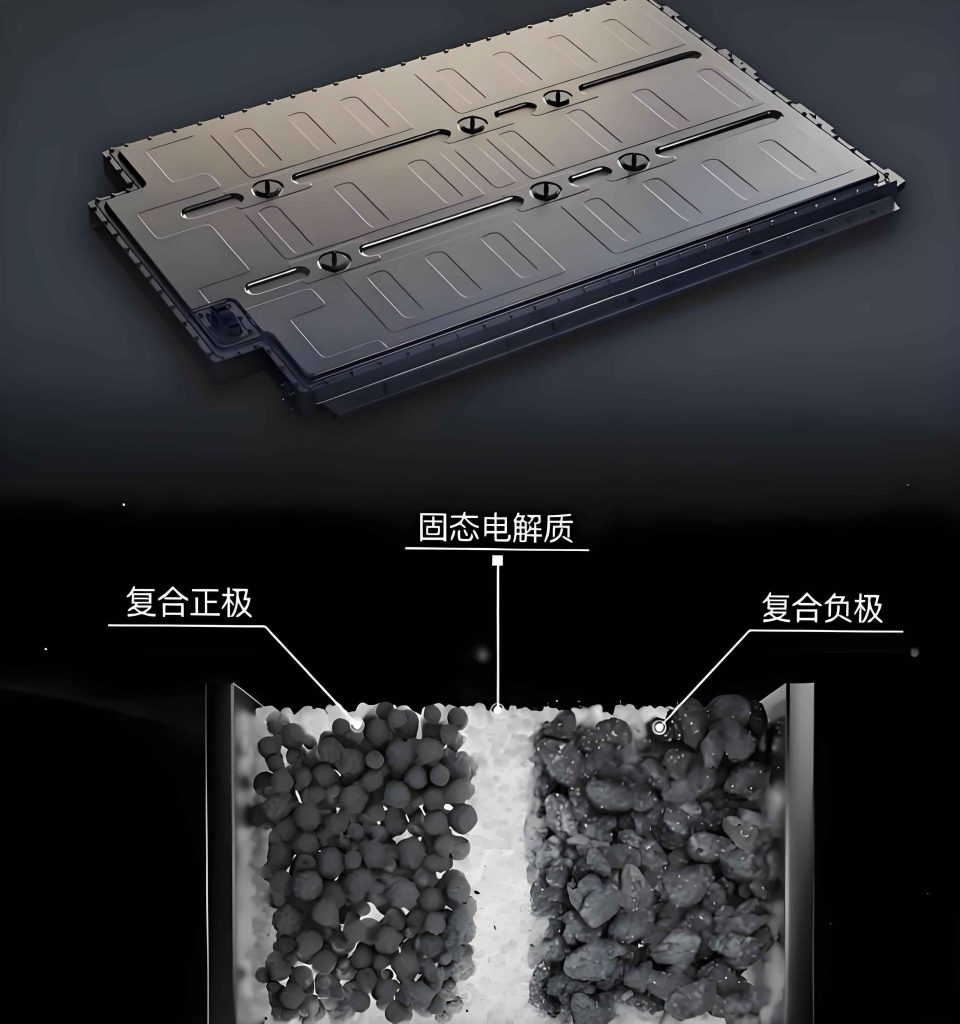
To illustrate the advantages of solid-state batteries over traditional technologies, consider the following comparison table. This table summarizes key parameters based on current research and development efforts, highlighting why solid-state batteries are considered a game-changer. As I analyze these factors, it becomes clear that the transition to solid-state systems is not merely an incremental improvement but a leap forward in energy storage capabilities.
| Parameter | Liquid Electrolyte Batteries | Solid-State Batteries | Improvement with Solid-State |
|---|---|---|---|
| Energy Density (Wh/kg) | 250-300 | 400-500 | ~60% increase |
| Safety Profile | Prone to leakage and fire | High resistance to thermal runaway | Enhanced safety |
| Cycle Life (cycles) | 500-1000 | 1000-2000 | Doubled lifespan |
| Operating Temperature Range (°C) | -20 to 60 | -40 to 100 | Wider range |
| Charging Time | 30-60 minutes | 10-20 minutes | Reduced by 50-70% |
The development of solid-state battery technology has been accelerated through strategic collaborations between material scientists and battery manufacturers. Recently, a notable partnership has yielded the first batch of cathode materials for semi-solid-state batteries, marking a significant milestone in industrialization. This achievement underscores the synergy between expertise in electrode fabrication and solid electrolyte integration. In my observation, such collaborations are crucial for overcoming the technical hurdles associated with solid-state batteries. The cathode materials involved often feature ultra-high nickel content, which enhances capacity but requires careful management of interfacial reactions. The performance of these materials can be quantified using the formula for capacity retention: $$ CR = \frac{C_{after}}{C_{initial}} \times 100\% $$ where \( CR \) is capacity retention percentage, \( C_{after} \) is capacity after cycles, and \( C_{initial} \) is initial capacity. For the new cathode materials, advanced composite coatings have improved \( CR \) values, thereby extending calendar life and reliability. This progress aligns with the global push towards sustainable energy, where solid-state batteries are poised to play a central role in electric mobility and renewable storage systems.
From a materials science perspective, the innovation in solid-state battery components is driven by the need to optimize ionic conductivity and mechanical stability. The solid electrolyte must facilitate rapid ion transport while preventing dendrite formation, which can cause short circuits. The ionic conductivity \( \sigma \) is given by the Nernst-Einstein relation: $$ \sigma = \frac{n q^2 D}{k_B T} $$ where \( n \) is the charge carrier density, \( q \) is the charge, \( D \) is the diffusion coefficient, \( k_B \) is Boltzmann’s constant, and \( T \) is temperature. Researchers are exploring various solid electrolyte materials, such as lithium garnets (e.g., Li7La3Zr2O12) and sulfides (e.g., Li10GeP2S12), to achieve high \( \sigma \) values at room temperature. In parallel, cathode materials like those based on nickel-rich NCM compositions are engineered with tailored coatings to reduce interfacial impedance. The effectiveness of these coatings can be assessed through electrochemical impedance spectroscopy (EIS), where the Nyquist plot reveals charge transfer resistances. As I delve deeper, it is evident that the success of solid-state batteries hinges on a multidisciplinary approach, combining chemistry, physics, and engineering to refine every component.
The applications of solid-state batteries extend far beyond consumer electronics. In the automotive sector, they enable longer driving ranges and faster charging, addressing key barriers to electric vehicle adoption. For example, a solid-state battery pack could provide an energy density of 500 Wh/kg, allowing a car to travel over 800 kilometers on a single charge. The power density \( P \) is also critical, calculated as: $$ P = \frac{E}{t} $$ where \( P \) is power density (in W/kg), \( E \) is energy delivered, and \( t \) is discharge time. Solid-state batteries exhibit superior power characteristics due to lower internal resistance, making them suitable for high-performance applications like electric aircraft and drones. Moreover, in grid storage, their enhanced safety and longevity reduce maintenance costs and risks, supporting the integration of intermittent renewable sources. As I reflect on these potentials, the societal impact of solid-state battery technology becomes profound, offering a pathway to decarbonize transportation and energy systems while enhancing resilience against disruptions.
Safety remains a cornerstone in the deployment of any advanced technology, and solid-state batteries are no exception. While inherently safer than liquid-based counterparts, they still require rigorous testing and public awareness. Initiatives to educate communities about emergency preparedness, such as those promoting “everyone talks safety, everyone can respond,” resonate with the need for safety in energy storage. In my view, fostering a culture of safety involves not only technical safeguards but also grassroots education. For instance, understanding the risks associated with battery handling—like thermal runaway or improper disposal—can prevent accidents. The probability of failure \( P_f \) in a battery system can be modeled using reliability engineering principles: $$ P_f = 1 – e^{-\lambda t} $$ where \( \lambda \) is the failure rate and \( t \) is time. By improving materials and designs, \( \lambda \) for solid-state batteries is minimized, but user education further reduces overall risk. Programs that disseminate knowledge about emergency response, such as using fire extinguishers for battery fires or recognizing warning signs, complement technological advances. This holistic approach ensures that the benefits of solid-state batteries are realized without compromising public safety.
The economic and environmental implications of solid-state battery adoption are significant. A cost analysis reveals that while current production expenses are higher than for traditional batteries, economies of scale and technological maturation are driving costs down. The levelized cost of storage (LCOS) can be expressed as: $$ LCOS = \frac{\sum_{t=1}^{n} (I_t + M_t + F_t)}{\sum_{t=1}^{n} E_t} $$ where \( I_t \) is investment cost in year \( t \), \( M_t \) is maintenance cost, \( F_t \) is fuel cost (zero for batteries), \( E_t \) is energy output, and \( n \) is lifespan. For solid-state batteries, longer lifespans and reduced maintenance lower LCOS, making them competitive over time. Environmentally, the use of less hazardous materials and improved recyclability reduces the ecological footprint. Life cycle assessments (LCA) show that solid-state batteries can achieve lower greenhouse gas emissions per kilowatt-hour compared to incumbent technologies. As I consider these factors, the transition to solid-state batteries aligns with global sustainability goals, offering a cleaner and more efficient energy future.
Looking ahead, the roadmap for solid-state battery technology involves continued research into novel materials and manufacturing processes. Key areas of focus include enhancing ionic conductivity in solid electrolytes, developing scalable production methods, and integrating batteries into smart grids. The following table outlines future research directions and their expected impacts, based on current trends and expert insights. From my perspective, collaboration across academia, industry, and government will be vital to accelerate innovation and address remaining challenges.
| Research Area | Current Challenges | Potential Solutions | Expected Timeline |
|---|---|---|---|
| Solid Electrolyte Development | Low ionic conductivity at room temperature | Nanostructured materials, doping strategies | 2025-2030 |
| Cathode-Electrolyte Interface | High interfacial resistance | Gradient coatings, in-situ polymerization | 2024-2028 |
| Anode Materials | Dendrite formation in lithium metal anodes | Composite anodes, protective layers | 2026-2032 |
| Manufacturing Scalability | High cost of solid-state fabrication | Roll-to-roll processing, automation | 2027-2035 |
| System Integration | Compatibility with existing infrastructure | Modular designs, standardization | 2025-2030 |
In conclusion, the advancement of solid-state battery technology represents a paradigm shift in energy storage, driven by relentless innovation and a commitment to safety. As I have explored, the technical merits—from higher energy densities to improved safety profiles—position solid-state batteries as a cornerstone for a sustainable future. The recent milestones in material delivery and collaboration highlight the rapid progress from concept to commercialization. Moreover, the integration of safety education initiatives ensures that societal adoption is both responsible and resilient. The journey ahead will require sustained effort, but the potential rewards—cleaner energy, enhanced mobility, and greater security—are immense. By embracing solid-state batteries, we can power a brighter, safer world for generations to come.
The narrative of solid-state battery evolution is intertwined with broader themes of technological empowerment and public welfare. As a participant in this field, I am optimistic about the trajectory, where each breakthrough brings us closer to realizing the full potential of solid-state energy systems. The formulas and tables presented herein encapsulate the quantitative essence of this progress, while the qualitative aspects—such as safety culture and collaborative spirit—underscore the human element. Moving forward, the continued emphasis on research, education, and innovation will solidify the role of solid-state batteries in shaping our energy landscape. Let us champion this technology with vigilance and enthusiasm, ensuring that every step forward is grounded in knowledge and care.