
In battery electric cars, the electrical contact points within the main circuit are susceptible to series arc faults due to poor contact, mechanical vibration, thermal expansion, and other factors. These faults can lead to fires, posing a severe threat to the safety of occupants and property. Therefore, accurately detecting arc faults in battery electric cars is a critical task to ensure safe operation. This study focuses on developing a detection model that balances accuracy, interpretability, and lightweight design, specifically for series arc faults in battery electric cars. The model leverages power supply terminal voltage data, which is less affected by load variations compared to current signals, enhancing reliability in complex operating conditions.
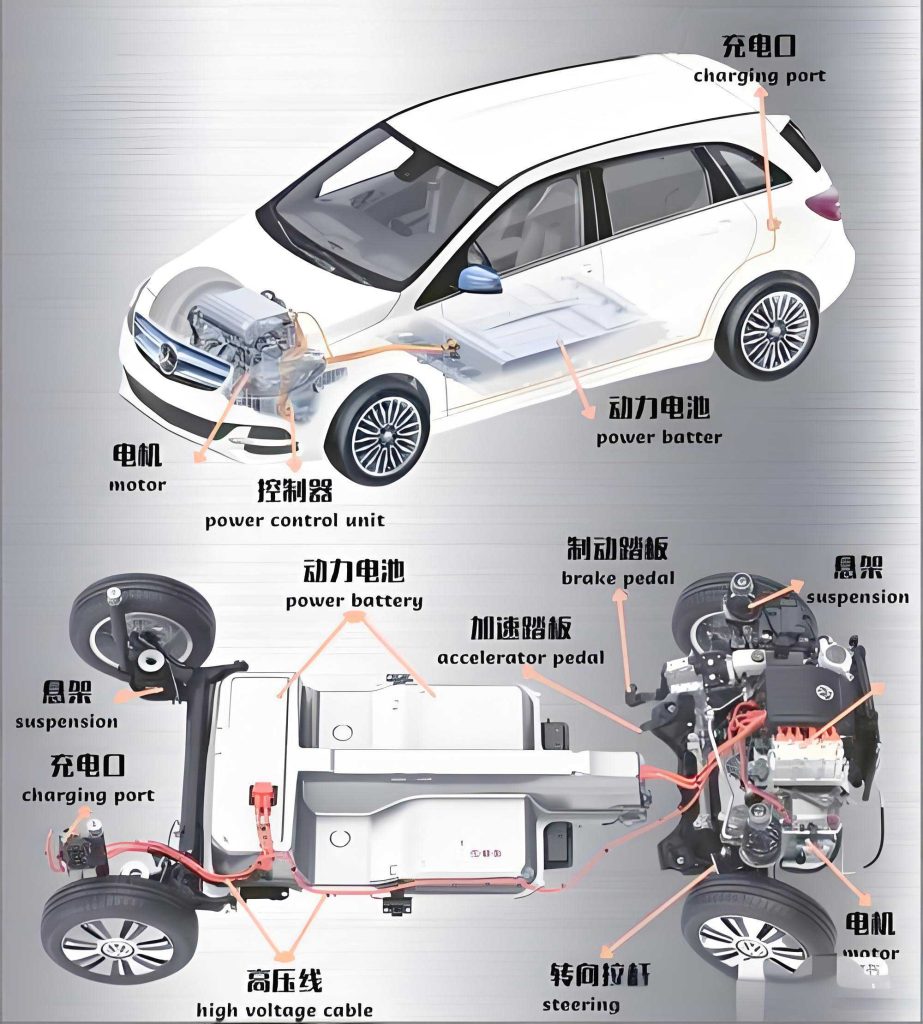
To address this issue, an experimental platform was built based on a Geely Emgrand EV450 battery electric car. The platform simulates real-world arc fault scenarios in battery electric cars by integrating an arc fault generator into the motor controller circuit. Voltage signals were collected at a sampling frequency of 60 kHz under various operating modes, including motor-only operation, heating, cooling, and acceleration/deceleration. The power supply terminal voltage waveforms exhibit pulse interference due to motor control actions, which complicates fault detection. In fault conditions, the voltage shows distinct stages: arc formation, combustion, and extinction, characterized by rapid fluctuations. This highlights the need for robust detection methods that can distinguish fault features from noise in battery electric cars.
The initial detection model, named MBconv_Initial_model, was constructed using a one-dimensional convolutional neural network (CNN). It consists of three convolutional layers, one MBConv module, and a fully connected layer, designed for binary classification (normal vs. fault). The model was trained on datasets derived from power supply terminal voltage signals of the battery electric car, with each sample comprising 2,000 consecutive time-series points. The training used an adaptive learning rate, Adam optimizer, and cross-entropy loss. The model achieved a classification accuracy of 95.67% on the test set. However, traditional deep learning models like this often suffer from poor interpretability and high computational complexity, making them less suitable for real-time applications in battery electric cars. To analyze interpretability, Class Activation Mapping (CAM) was applied to visualize the model’s focus areas. Results showed that misclassifications occurred when the model assigned high weights to noise rather than fault features, indicating a need for optimization to enhance attention on arc fault characteristics in battery electric cars.
To improve the model, a multi-objective network architecture search (NAS) strategy was employed. Unlike conventional NAS that prioritizes accuracy alone, this approach incorporated interpretability metrics and floating-point operations (FLOPs) as optimization targets. The interpretability was measured using the average sparsity of CAM outputs, where higher sparsity indicates reliance on fewer key features. FLOPs were used to assess computational efficiency, crucial for deployment in resource-constrained battery electric cars. The search space included parameters like channel numbers, kernel sizes, and strides. After NAS, the optimized model, named MBconv_NAS_model, achieved an accuracy of 98.08%, with improved focus on fault waveforms and reduced noise attention, as evidenced by CAM visualizations. This demonstrates the effectiveness of multi-objective optimization in enhancing both performance and transparency for battery electric car applications.
For lightweight design, a two-stage channel merging strategy was developed to reduce redundancy in the model. First, representative channels were selected using Dynamic Time Warping (DTW) to measure similarity between channel outputs and input sequences. DTW was applied to wavelet-transformed signals to emphasize fault features, ensuring that selected channels capture core arc characteristics in battery electric cars. The representative channels for each convolutional layer were identified as follows: channel 13 for layer 1, channel 4 for layer 2, and channel 8 for layer 3. Next, Particle Swarm Optimization (PSO) was used to broadly search for channels similar to the representatives based on pulse position, width, and count matching. Then, Simulated Annealing with a cosine schedule refined the merging set by evaluating fitness functions that combine accuracy changes, L1 distance, and KL divergence to maintain robustness. The final merged channel sets are summarized in Table 1.
| Convolutional Layer | Merged Channel Set |
|---|---|
| Layer 1 | [37, 27, 48, 8, 70, 1, 65, 33, 19, 59, 21, 3, 51, 39, 35, 46, 17, 10, 4, 9, 13, 41, 26, 62, 2, 55, 5, 31] |
| Layer 2 | [8, 3, 12, 4, 13, 11, 1] |
| Layer 3 | [22, 11, 21, 56, 48, 28, 26, 31, 91, 39, 78, 32, 19, 24, 23, 10, 63, 76, 66, 71, 90, 92, 8, 1, 40, 89, 64, 55, 70, 87, 12, 44, 72, 94, 59, 3, 36, 5, 41, 7, 95] |
The final model, MBconv_MC_model, was trained with the same hyperparameters, achieving an accuracy of 97.98% on the test set. The lightweight design significantly reduced parameters and detection time, making it suitable for real-time fault detection in battery electric cars. Information entropy analysis showed minimal information loss post-merging, and CAM confirmed sustained focus on fault features. The model’s performance metrics are compared in Table 2, highlighting improvements in accuracy and efficiency for battery electric car applications.
| Model | Total Parameters | Accuracy (%) | Detection Time (ms) |
|---|---|---|---|
| MBconv_Initial_model | 69,794 | 95.67 | 47.86 |
| MBconv_NAS_model | 69,794 | 98.08 | 24.00 |
| MBconv_MC_model | 25,188 | 97.98 | 5.46 |
The generalization capability of MBconv_MC_model was tested on datasets from heating and cooling modes of the battery electric car, achieving accuracies of 97.90% and 98.00%, respectively. Robustness was evaluated under noise conditions (white, multiplicative, and spike noise) and dynamic scenarios like acceleration, deceleration, and wiper operation. Results in Table 3 demonstrate the model’s strong anti-interference performance, essential for real-world battery electric car environments.
| Operating Mode | System State | Parameter Settings | Accuracy (%) |
|---|---|---|---|
| Acceleration | Normal | – | 99.80 |
| Deceleration | Normal | – | 100.00 |
| Wiper High | Normal | – | 100.00 |
| Wiper Low | Normal | – | 99.80 |
| White Noise | Normal/Fault | std=0.05 | 92.60 |
| Multiplicative Noise | Normal/Fault | mean=1, std=0.1 | 91.00 |
| Spike Noise | Normal/Fault | std=0.1, spike_frequency=0.005 | 95.80 |
Comparative analysis with other arc fault detection methods for battery electric cars is presented in Table 4. Methods based on traditional signal processing or deep learning often have lower accuracy or higher detection times. MBconv_MC_model outperforms these in terms of balance between accuracy and real-time performance, with a detection time of 5.46 ms, well below the 2.5 s standard in UL1699, making it ideal for battery electric car systems.
| Method | Accuracy (%) | Detection Time (ms) |
|---|---|---|
| Literature [2] (Filtering-based) | 51.61 | 26 |
| Literature [3] (VGG16-based) | 87.10 | 848 |
| Literature [4] (Genetic-optimized CNN) | 91.94 | 38 |
| Literature [5] (Random Forest) | 88.41 | 245 |
| Literature [24] (Raw data CNN) | 90.12 | 35 |
| Literature [29] (Lightweight CNN) | 84.78 | 26 |
| MBconv_MC_model | 97.98 | 5 |
In terms of parameter efficiency, MBconv_MC_model has the lowest parameter count among deep learning models, as shown in Table 5. This reduces memory overhead and computational complexity, facilitating deployment in battery electric car onboard systems for efficient signal processing.
| Model | Total Parameters | Accuracy (%) |
|---|---|---|
| MBconv_MC_model | 25,188 | 97.98 |
| Literature [3] (VGG16-based) | 134,268,738 | 87.10 |
| Literature [4] (Genetic-optimized CNN) | 135,602 | 91.94 |
| Literature [24] (Raw data CNN) | 157,378 | 90.12 |
| Literature [29] (Lightweight CNN) | 46,402 | 84.78 |
The mathematical foundation of the model involves convolution operations and optimization algorithms. For instance, the convolution operation for a one-dimensional input can be expressed as:
$$y(t) = \sum_{k=1}^{K} x(t – k) \cdot w(k) + b$$
where \(x\) is the input signal, \(w\) is the kernel weight, \(b\) is the bias, and \(y\) is the output. In the MBConv module, depthwise and pointwise convolutions reduce computations, which is critical for battery electric car applications. The fitness function in Simulated Annealing combines accuracy change and robustness metrics:
$$\text{Fitness} = \text{Accuracy}_{\text{change}} – \beta_{L1} \cdot L1_{\text{Avg}} – \beta_{KL} \cdot KL_{\text{Avg}}$$
with \(\beta_{L1} = 0.1\) and \(\beta_{KL} = 0.1\). The KL divergence is defined as:
$$D_{KL}(P \parallel Q) = \sum_i P(i) \log \frac{P(i)}{Q(i)}$$
These formulas underpin the model’s ability to maintain performance while achieving lightweight design for battery electric cars.
In conclusion, this study presents a series arc fault detection model tailored for battery electric cars, leveraging power supply terminal voltage data. By integrating multi-objective NAS and a two-stage channel merging strategy, the model achieves high accuracy (97.98%), interpretability through CAM, and lightweight design with minimal parameters (25,188) and fast detection time (5.46 ms). The model demonstrates strong generalization and robustness in various battery electric car operating conditions, outperforming existing methods. Future work could explore integration with battery management systems in battery electric cars to enhance overall safety and reliability. The advancements herein contribute significantly to the field of fault detection in battery electric cars, ensuring safer and more efficient transportation.