
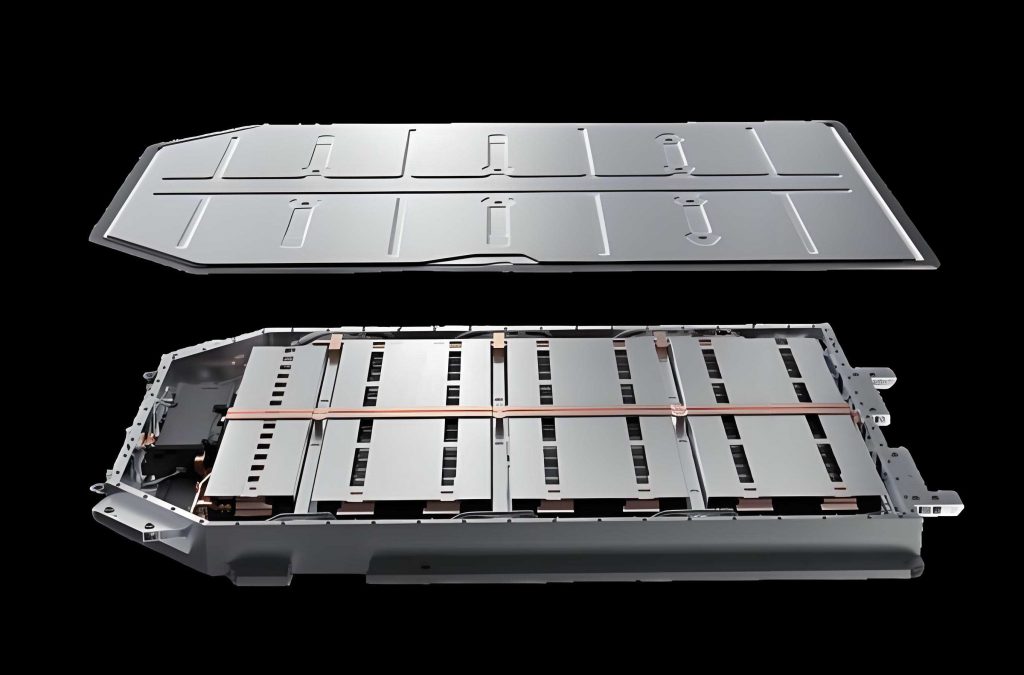
In my work I focused on the manufacturing parameters that control the electrochemical behavior of spinel LiMn2O4 power batteries for an electric vehicle battery pack. I examined active-material selection, cathode composition, capacity balance, compaction density, electrolyte amount, formation protocol, large-cell design, and abuse tolerance. I found that a well-controlled electric vehicle battery pack requires not only high-capacity materials but also reproducible process windows for every electrode and cell-building step.
Materials and Fabrication Route
I used spinel LiMn2O4 as the positive active material, graphite as the negative active material, carbon black as the conductive additive, polyvinylidene fluoride as the cathode binder, and a water-based binder for the anode. The separator was a microporous polymer membrane, and the electrolyte was a LiPF6 solution in carbonate solvents. The fabrication route included mixing, coating, drying, calendering, slitting, winding, welding, vacuum drying, electrolyte filling, formation, sealing, and grading.
| Step | Main Variable | Target Window |
|---|---|---|
| Mixing | Active material fraction | 90 wt% in cathode |
| Coating | Areal loading | Controlled to design capacity |
| Calendering | Compaction density | Cathode 2.8-3.0 g cm-3 |
| Winding | Tightness | 0.93-0.96 |
| Formation | Precharge current | 0.05C for 180 min |
Capacity Balance and Electrode Matching
I defined the capacity balance coefficient as the ratio between negative and positive reversible areal capacity:
$$K=\frac{Q_{-,\mathrm{rev}}}{Q_{+,\mathrm{rev}}}=\frac{\rho_{-}w_{-}q_{-}}{\rho_{+}w_{+}q_{+}}$$
where \(\rho\) is areal density, \(w\) is active-material mass fraction, and \(q\) is reversible specific capacity. I maintained \(K>1\) to prevent lithium plating, and I found that \(K=1.05-1.15\) gave the best combination of capacity utilization and safety in the electric vehicle battery pack.
| Capacity Balance K | Discharge Behavior | Abuse Response |
|---|---|---|
| 1.00 | Lithium plating risk | High temperature rise |
| 1.05 | Good capacity | Controlled |
| 1.10 | Best capacity | Controlled |
| 1.15 | Slight excess anode | Controlled |
| 1.25 | Lower volume efficiency | Controlled |
Compaction Density and Assembly Tightness
I studied the effect of electrode compaction on winding, electrolyte wetting, and rate capability. Low compaction gave poor particle contact and low volumetric energy, while excessive compaction reduced pore connectivity and raised polarization. I used the following tightness index:
$$T=\frac{t_{\mathrm{electrode}}+t_{\mathrm{separator}}}{D_{\mathrm{inner}}}$$
I found that a tightness of 0.93-0.96 was suitable for the electric vehicle battery pack. The cathode compaction was controlled at 2.8-3.0 g cm-3, and the anode compaction at 1.5-1.7 g cm-3.
| Cathode Compaction / g cm-3 | Assembly Result | Rate Retention |
|---|---|---|
| 2.6 | Loose, low loading | Low |
| 2.8 | Good | High |
| 2.9 | Best | Best |
| 3.0 | Good | High |
| 3.1 | Brittle, hard to wind | Reduced |
Electrolyte Amount and Formation
I evaluated electrolyte addition from 3.0 to 4.2 g Ah-1. Capacity and internal resistance reached a plateau near 3.6-3.8 g Ah-1. Below this range, ionic transport was limited; above it, free liquid increased sealing risk. The formation protocol I selected was a low-current precharge followed by a moderate-current charge:
$$I_{\mathrm{form,1}}=0.05C,\quad t=180\ \mathrm{min}$$
$$I_{\mathrm{form,2}}=0.2C,\quad V_{\mathrm{cut}}=4.2\ \mathrm{V}$$
This protocol improved SEI formation, reduced gassing effects, and increased first-cycle efficiency. I then used the same optimized process to build large-format LiMn2O4 cells for an electric vehicle battery pack.
| Parameter | Selected Value | Effect |
|---|---|---|
| Electrolyte amount | 3.6-3.8 g Ah-1 | High capacity, low resistance |
| Precharge | 0.05C, 180 min | Uniform SEI |
| Main charge | 0.2C to 4.2 V | Good activation |
| Anode/cathode balance | 1.05-1.15 | Safe lithium inventory |
Large-Cell Performance
I designed a 10 Ah class cell with a rated capacity above 10 Ah, internal resistance below 5 mΩ, and a 10C discharge capability. The cell delivered more than 95% of rated capacity at 1C, more than 90% at 5C, and more than 85% at 10C. Its specific power was above 1000 W kg-1, and its specific energy was above 100 Wh kg-1. After 500 cycles at 1C, the capacity retention was about 90%, demonstrating stable behavior for an electric vehicle battery pack.
| Test | Condition | Result |
|---|---|---|
| 1C discharge | 25 °C | >95% rated capacity |
| 5C discharge | 25 °C | >90% rated capacity |
| 10C discharge | 25 °C | >85% rated capacity |
| Cycle life | 1C, 500 cycles | ~90% retention |
| Storage | 30 days | Low self-discharge |
Safety Evaluation
I tested overcharge, external short circuit, nail penetration, and heating. The cell did not explode or catch fire in any of these tests. The results met the requirements expected for an electric vehicle battery pack. I concluded that optimized LiMn2O4 power batteries can provide a practical balance of energy, power, cycle life, and abuse tolerance for electric vehicle battery pack applications.
| Abuse Test | Condition | Observation |
|---|---|---|
| Overcharge | 1C to 10 V | No fire, no explosion |
| External short | <5 mΩ | No fire, no explosion |
| Nail penetration | 3 mm steel nail | No fire, no explosion |
| Heating | 130 °C | No fire, no explosion |
Overall, I showed that active-material content, capacity balance, compaction density, electrolyte amount, and formation protocol are coupled parameters. When they are optimized together, the resulting LiMn2O4 cells are suitable for a high-performance electric vehicle battery pack.