
The rapid evolution and market penetration of the battery electric car have fundamentally reshaped the automotive landscape. As consumer expectations pivot decisively towards extended driving range, enhanced safety, and superior overall performance, the thermal management of the vehicle’s high-voltage traction battery has emerged as a pivotal technological frontier. Effective thermal management is not merely an accessory system; it is a core determinant of a battery electric car’s competitiveness, longevity, and safety. My analysis delves into the technological and strategic developments in this domain, synthesizing insights to offer a forward-looking perspective for innovators and engineers.
The performance, longevity, and safety of lithium-ion batteries, the heart of any modern battery electric car, are profoundly sensitive to temperature. Operating outside an optimal window, typically between 15°C and 35°C, triggers significant degradation. At low temperatures, internal resistance skyrockets, drastically reducing available power, charging acceptance, and driving range. Conversely, high temperatures accelerate parasitic side reactions and calendar aging. During high-power charging or aggressive driving, the generation of ohmic heat can lead to excessive temperatures, potentially initiating a cascading failure known as thermal runaway—a critical safety hazard. Therefore, the thermal management system (TMS) for a battery electric car must perform a delicate balancing act: precise heating during cold starts and efficient, uniform cooling during operation and fast charging.
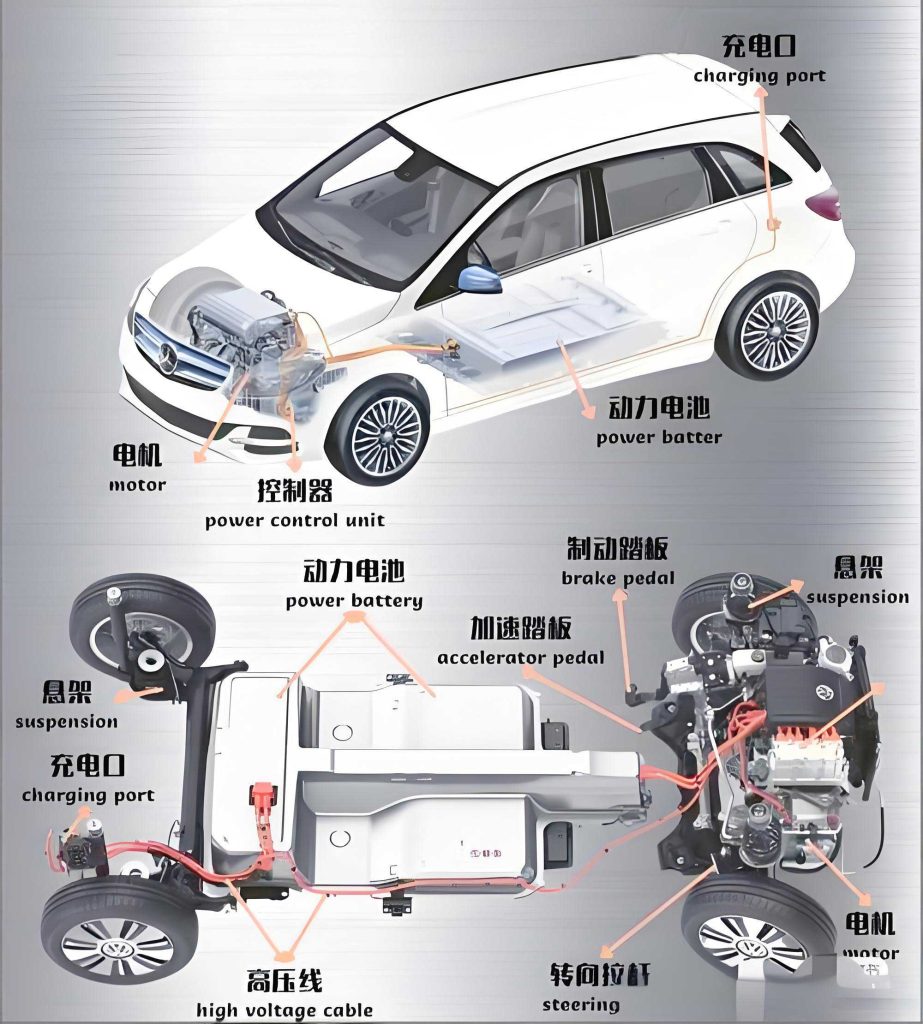
The thermal management system for a battery electric car is markedly more complex and energy-intensive than that of an internal combustion engine vehicle. The absence of abundant waste heat from an engine eliminates a straightforward heat source for cabin warming and battery preconditioning. Consequently, the TMS must manage multiple thermal zones—the battery pack, the electric traction motor and power electronics, and the passenger cabin—often in an integrated manner to maximize overall energy efficiency, directly impacting the vehicle’s range.
Core Technological Pillars of Battery Thermal Management
The architecture of a thermal management system for a battery electric car can be dissected into two primary functions: cooling and heating. Various technologies have been developed and commercialized, each with distinct advantages and trade-offs.
1. Battery Cooling Methodologies
Preventing battery overheating is paramount. The primary cooling strategies include:
A. Air Cooling: This is the simplest and most cost-effective approach. It relies on forced convection, using fans to circulate ambient or cabin air across the battery modules.
$$ \dot{Q}_{cooling} = h A (T_{battery} – T_{air}) $$
Where \(\dot{Q}_{cooling}\) is the heat removal rate, \(h\) is the convective heat transfer coefficient, \(A\) is the effective surface area, and \(T\) denotes temperature. Its main limitations are low specific heat capacity and poor temperature uniformity, making it suitable primarily for lower-power or smaller battery packs in a budget-oriented battery electric car.
B. Liquid Cooling: This is the dominant solution for high-performance and long-range battery electric cars. A coolant (often a water-glycol mixture) circulates through cold plates or tubular channels integrated into the battery pack.
$$ \dot{Q}_{cooling} = \dot{m} C_p (T_{out} – T_{in}) $$
Here, \(\dot{m}\) is the mass flow rate of the coolant, and \(C_p\) is its specific heat capacity. Liquid systems offer superior heat transfer coefficients, better temperature homogeneity, and compact packaging but add complexity, weight, and cost.
C. Phase Change Material (PCM) Cooling: PCMs absorb large amounts of latent heat during their phase transition (e.g., solid to liquid), acting as a passive thermal buffer.
$$ Q = m (C_{p,s} \Delta T_s + L + C_{p,l} \Delta T_l) $$
Where \(m\) is mass, \(C_p\) is specific heat, \(L\) is latent heat, and subscripts \(s\) and \(l\) denote solid and liquid phases. While excellent for peak shaving and improving uniformity, pure PCMs have low thermal conductivity. Research focuses on composite PCMs with conductive additives.
D. Heat Pipe Cooling: Heat pipes are highly efficient passive two-phase heat transfer devices. They can rapidly transport heat from hotspots within a battery electric car’s pack to remote cold plates or fins.
$$ Q_{hp} = \frac{T_{hot} – T_{cold}}{R_{total}} $$
\(R_{total}\) represents the total thermal resistance of the heat pipe. Their application is growing, particularly for targeting localized high-temperature zones and enhancing uniformity.
| Cooling Technology | Key Mechanism | Advantages | Disadvantages | Suitability for Battery Electric Car |
|---|---|---|---|---|
| Air Cooling | Forced Convection | Simple, low cost, lightweight | Low cooling power, poor uniformity, bulky ducts | Entry-level, low-power density packs |
| Liquid Cooling | Conduction & Convection | High cooling power, excellent uniformity, compact | Complex, heavier, risk of leakage | Mainstream & high-performance vehicles |
| PCM Cooling | Latent Heat Absorption | Passive, excellent for peak shaving, improves uniformity | Low conductivity (pure PCM), adds weight, volume change | Supplementary role, niche applications |
| Heat Pipe Cooling | Two-Phase Passive Transport | Very high effective conductivity, passive, excellent for hotspot mitigation | Higher cost, design integration challenges | Targeted hotspot cooling, complementing other systems |
2. Battery Heating Methodologies
Enabling a battery electric car to operate efficiently in cold climates requires reliable heating.
A. Positive Temperature Coefficient (PTC) Heaters: These are resistive heaters whose resistance increases with temperature, providing self-regulating heating. They are widely used due to their simplicity and rapid response.
$$ P_{heating} = V^2 / R(T) $$
However, they consume significant electrical energy directly from the battery, which is a major penalty for the driving range of a battery electric car in winter.
B. Heat Pump Systems: This is the most energy-efficient method for heating. A heat pump “moves” thermal energy from a lower-temperature source (outside air or the vehicle’s waste heat) to a higher-temperature sink (the cabin or battery).
$$ COP_{heating} = \frac{Q_H}{W_{in}} $$
The Coefficient of Performance (COP) is typically greater than 2-3, meaning it delivers 2-3 units of heat for every 1 unit of electrical energy consumed. Integrating the battery into the heat pump circuit is a key trend for maximizing the efficiency of a battery electric car.
C. Pulse Heating: This involves using the battery’s internal resistance by applying high-frequency alternating current or controlled discharge/charge pulses to generate heat internally.
$$ Q_{pulse} = I_{rms}^2 R_{internal} \Delta t $$
This method can be very efficient as it heats the cell core directly, but it requires sophisticated battery management system (BMS) control to avoid lithium plating.
The Rise of Intelligent and Integrated Thermal Management
The modern paradigm for a high-efficiency battery electric car has shifted from discrete, independent thermal loops to a unified, intelligent system. The goal is to synergistically manage all thermal loads—battery, powertrain, cabin, and even power electronics—to minimize total energy consumption.
Integrated System Architecture: Advanced thermal systems use complex valve matrices and refrigerant-coolant heat exchangers (chillers) to dynamically route thermal energy. For instance, waste heat from the motor or electronics can be directed to warm the battery or cabin. Conversely, during fast charging, the battery’s cooling loop can be coupled with the high-power cabin air conditioning compressor for maximum heat rejection.
Predictive & Adaptive Control Strategies: Moving beyond simple feedback control (e.g., turning on cooling when T > 30°C), next-generation systems use predictive algorithms. By integrating navigation data (e.g., upcoming mountainous terrain requiring high power), ambient weather forecasts, and driver behavior, the BMS and thermal management controller can pre-condition the battery to an optimal temperature state. This proactive approach, often called “thermal pre-conditioning,” enhances both performance and longevity. The control logic can be based on model predictive control (MPC) frameworks:
$$ \min_{u} \int_{t_0}^{t_f} [ \alpha (T_{bat} – T_{ref})^2 + \beta P_{TMS} ] dt $$
Subject to: $$ \frac{dT_{bat}}{dt} = f(T_{bat}, u, I_{load}, T_{amb}) $$
Where \(u\) represents control inputs (pump speed, valve positions, compressor speed), \(P_{TMS}\) is the power consumption of the thermal system, and the function \(f\) describes the battery’s thermal dynamics.
Thermal Runaway Prevention and Management
As energy density increases, managing the risk of thermal runaway becomes non-negotiable for the safety of a battery electric car. The strategy is multi-layered: prevention, early detection, and mitigation.
Prevention: This is the primary role of the operational TMS—maintaining the battery within its safe operating window under all conditions, especially during demanding events like DC fast charging.
Early Detection: Advanced BMS algorithms monitor not just cell voltage and temperature, but also their rates of change, cell-to-cell pressure, and even gas composition (via gas sensors) within the pack. Anomalies can trigger early warnings. A simplified detection logic could be:
$$ \text{Alert if: } (T_{cell} > T_{crit1}) \ \text{OR} \ (\frac{dT}{dt} > \left(\frac{dT}{dt}\right)_{crit}) \ \text{OR} \ (V_{cell\_delta} > V_{crit}) $$
Mitigation: If an incipient thermal runaway is detected, the system executes a fail-safe protocol. This includes immediately commanding the battery contactors to open (disconnecting high voltage), alerting occupants via the dashboard and audible alarms to exit the vehicle, and activating dedicated battery fire suppression systems if equipped. Furthermore, modern vehicle architecture can broadcast the emergency via telematics to emergency services.
| Safety Phase | Key Objectives | Technological & Control Measures |
|---|---|---|
| Prevention | Maintain safe operating temperature | Robust liquid cooling, predictive thermal control, charge current limiting based on temperature. |
| Early Detection | Identify pre-failure anomalies | BMS monitoring of voltage/temperature divergence, pressure sensors, gas detection (VOC, CO), internal short circuit detection algorithms. |
| Mitigation & Response | Contain event, protect occupants | High-voltage disconnect, passenger compartment alerts, thermal barrier materials between cells, venting channels, integrated fire suppression, emergency e-call. |
Future Trajectories and Strategic Considerations
The evolution of thermal management for the battery electric car is driven by the relentless pursuit of higher efficiency, greater range, faster charging, and absolute safety. Several clear trajectories are emerging:
1. Deeper Integration and Software-Defined Thermal Management: The future system will be a fully interconnected “thermal bus,” where any source of heat or cold can be intelligently allocated to any sink based on real-time efficiency optimization algorithms. The software controlling this network will become a key differentiator.
2. Advanced Materials and Passive Solutions: Research into higher thermal conductivity composite PCMs, more efficient heat pipe designs, and even thermoelectric devices (for localized cooling/heating or energy harvesting) will continue. The goal is to reduce the parasitic load of active systems.
3. Direct Cooling Innovations: Immersion cooling, where battery cells are directly submerged in a dielectric fluid, offers unparalleled temperature uniformity and heat removal rates, making it a strong candidate for extreme fast-charging applications in the next-generation battery electric car.
4. Focus on Low-Temperature Performance: Innovations in pulse heating, more efficient and cold-climate capable heat pumps (e.g., with CO₂ refrigerant), and advanced internal battery chemistries less susceptible to cold will be critical to expanding the viable market for battery electric cars in all geographies.
From a strategic standpoint, innovation in this field is intense. Technical progress is reflected in a diverse and growing patent landscape, highlighting a focus on control algorithms, system integration architectures, and safety mechanisms. Success for any developer in this space will hinge not just on individual component performance but on the holistic, intelligent, and efficient orchestration of the entire thermal ecosystem of the vehicle. The thermal management system is, therefore, far more than a supporting subsystem; it is a central engineering pillar defining the capability and appeal of the modern battery electric car.
| Innovation Frontier | Description | Potential Impact on Battery Electric Car |
|---|---|---|
| AI-Driven Predictive Control | Using machine learning to predict thermal loads and optimize system response in real-time. | Significant range extension (5-10%), improved battery life, enhanced occupant comfort. |
| Immersion Cooling | Submerging cells in dielectric fluid for direct, uniform heat transfer. | Enables ultra-fast charging (>4C), potentially improves safety by suppressing thermal runaway propagation. |
| Solid-State Battery Integration | Adapting TMS for the different thermal characteristics and potentially higher operating temperatures of solid-state batteries. | May simplify cooling needs but require precise high-temperature control; new system architectures. |
| Waste Heat Recovery (WHR) | Using thermoelectric generators or Rankine cycles to convert waste heat from powertrain/battery back to electricity. | Marginal but valuable range increase, especially in cold weather or high-load conditions. |