
As battery electric cars continue to evolve rapidly, the transmission system stands as a critical component for power delivery, directly impacting vehicle performance and safety. Gear faults within the transmission are common and can lead to severe operational issues, emphasizing the need for accurate and efficient diagnostic methods. In this study, I develop a fault diagnosis model that integrates wavelet packet decomposition for feature extraction, Chicken Swarm Optimization (CSO) for initial parameter tuning, and an Improved Particle Swarm Optimization (IPSO) algorithm for training a Back Propagation (BP) neural network. This approach aims to enhance the speed and precision of gear fault diagnosis in battery electric cars, ensuring reliable operation. The model is validated through experimental analysis, demonstrating its effectiveness in real-world scenarios.
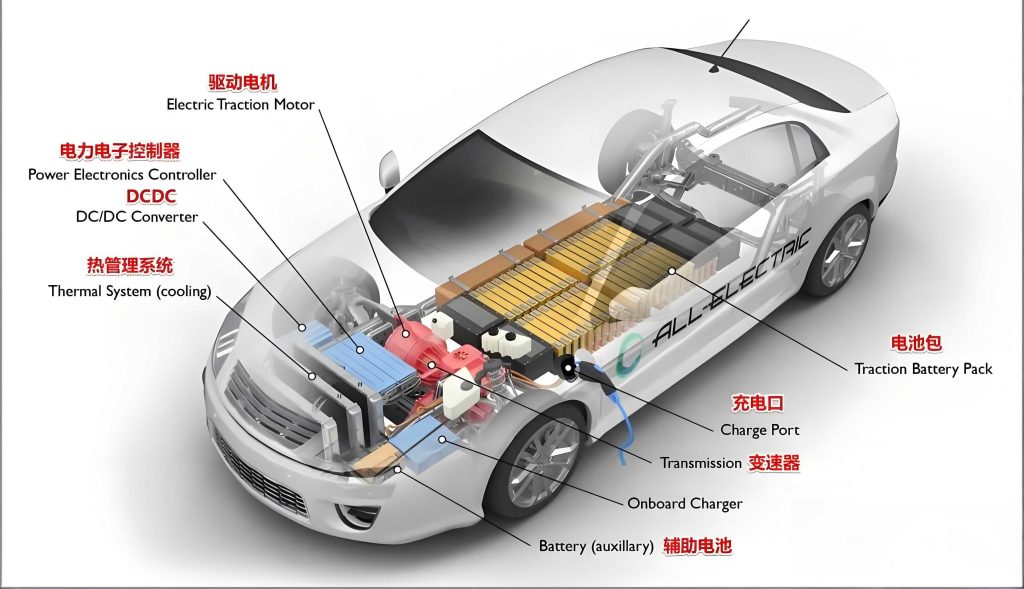
The adoption of battery electric cars is driven by their environmental benefits, low noise, and high energy efficiency. However, the transmission, a key part of the drivetrain, is prone to faults such as gear wear, pitting, and breakage, which can compromise safety and performance. Traditional diagnostic methods often struggle with the non-stationary nature of vibration signals from gear systems. To address this, I propose a hybrid intelligent model that leverages advanced signal processing and machine learning techniques. This model focuses on extracting discriminative features from vibration data and optimizing neural network parameters to achieve robust fault classification. The integration of CSO and IPSO algorithms helps overcome limitations like local minima and slow convergence in BP networks, making it suitable for real-time applications in battery electric cars.
Gear faults in battery electric car transmissions typically include tooth surface spalling, wear, pitting, adhesion, and breakage. These faults alter vibration patterns, which can be captured via sensors. The diagnostic process involves signal acquisition, feature extraction, neural network optimization, and fault state output. The core of my model is a BP neural network with an 8-10-3 architecture, where inputs are feature vectors from wavelet packet decomposition, and outputs are encoded fault states. The optimization steps ensure that the network initializes effectively and trains efficiently, leading to high diagnostic accuracy. In the following sections, I detail each component of the model, supported by tables and formulas for clarity.
Gear Fault Diagnosis Model Overview
The proposed model for battery electric car transmission gear fault diagnosis consists of several interconnected stages. First, vibration signals are collected from sensors installed on the transmission gears. These signals are non-stationary and contain rich information about fault conditions. Next, wavelet packet decomposition is applied to extract energy features across different frequency bands. These features are normalized to form input vectors for the BP neural network. To enhance the network’s performance, the initial weights and thresholds are optimized using the Chicken Swarm Algorithm, which mimics the social hierarchy of chickens for global search. Subsequently, the network is trained with an Improved Particle Swarm Optimization algorithm, incorporating adaptive parameter adjustments to accelerate convergence and avoid local optima. The output layer provides a binary encoding representing various fault states, enabling precise classification. This integrated approach ensures that the model is both accurate and computationally efficient, meeting the demands of battery electric car maintenance.
Feature Extraction Using Wavelet Packet Decomposition
Wavelet packet decomposition offers a refined method for analyzing vibration signals from battery electric car transmission gears by decomposing both low and high-frequency components. This overcomes the limitations of standard wavelet analysis, providing better frequency resolution. For a 3-level decomposition, the structure includes nodes (m, u), where m denotes the decomposition level and u the node index. The reconstructed signal at node (3, u) is denoted as B(3, u)(t), and its energy N(3, u) is computed as:
$$N(3,u) = \int |B(3,u)(t)|^2 dt = \sum_{k=1}^{n} H_{ku}^2,$$
where Hku represents the discrete amplitude values of the reconstructed signal, and n is the number of sampling points. The total energy at the third level is the sum across all nodes:
$$N_3 = \sum_{u=0}^{7} N(3,u).$$
To normalize the energy values and form feature vectors, I apply:
$$N_{3u}^* = \frac{N(3,u)}{N_3}.$$
Thus, the feature vector for battery electric car gear fault diagnosis is represented as:
$$N_{3u}^* = (N_{30}^*, N_{31}^*, N_{32}^*, N_{33}^*, N_{34}^*, N_{35}^*, N_{36}^*, N_{37}^*).$$
This vector captures the energy distribution across frequency bands, which shifts significantly when faults occur, making it effective for distinguishing fault types in battery electric car transmissions.
Optimization and Training of BP Neural Network
The BP neural network serves as the classifier in this model, but its performance heavily depends on initial parameters like weights and thresholds. To optimize these, I employ the Chicken Swarm Algorithm, which simulates the behavior of chickens in a flock. The algorithm divides the population into roosters, hens, and chicks, each with unique update rules. Roosters update their positions based on fitness and random influences:
$$x_{ij}(t+1) = x_{ij}(t)[1 + \text{randn}(0, \delta^2)],$$
with $$\delta^2 = \begin{cases} 1, & \text{if } f_i \leq f_k \\ \exp\left(\frac{f_k – f_i}{|f_i| + \lambda}\right), & \text{if } f_i > f_k \end{cases},$$
where xij(t) is the position in dimension j at iteration t, fi and fk are fitness values, and λ is a small constant. Hens update their positions by following roosters and considering other individuals:
$$x_{ij}(t+1) = x_{ij}(t) + B_1 \cdot \text{rand} \cdot (x_{uj}(t) – x_{ij}(t)) + B_2 \cdot \text{rand} \cdot (x_{vj}(t) – x_{ij}(t)),$$
where B1 and B2 are influence factors calculated from fitness differences. Chicks update their positions with guidance from their mother hen and a rooster:
$$x_{ij}(t+1) = \tau x_{ij}(t) + H (x_{rj}(t) – x_{ij}(t)) + M (x_{sj}(t) – x_{ij}(t)),$$
with τ as the self-learning coefficient, H as the hen influence factor, and M as the rooster learning factor. This optimization ensures that the BP network starts with near-optimal parameters, improving training efficiency for battery electric car applications.
After optimization, the BP network is trained using an Improved Particle Swarm Optimization algorithm. IPSO enhances basic PSO by adaptively adjusting inertia weight, individual learning factor, and social learning factor through nonlinear functions:
$$\omega = 3^{-(\omega_{\text{max}} – \omega_{\text{min}}) t / t_{\text{max}}},$$
$$c_1 = 3^{c_{1\text{min}} + (c_{1\text{max}} – c_{1\text{min}}) t / t_{\text{max}}},$$
$$c_2 = 3^{c_{2\text{max}} – (c_{2\text{max}} – c_{2\text{min}}) t / t_{\text{max}}},$$
where ω is inertia weight, c1 and c2 are learning factors, t is current iteration, and tmax is maximum iterations. These adjustments promote faster convergence and better local search, crucial for handling the complex vibration data from battery electric car transmissions.
Experimental Analysis and Results
To validate the model, I conducted experiments using vibration data from a battery electric car transmission. The dataset includes samples for normal operation and various fault types: tooth spalling, wear, pitting, and breakage. Each sample was processed through wavelet packet decomposition to extract the 8-dimensional feature vector. The data was normalized using:
$$N^* = \frac{N – N_{\text{min}}}{N_{\text{max}} – N_{\text{min}}},$$
where N is the original value, and Nmin and Nmax are the minimum and maximum values in the dataset. This normalization ensures that all inputs are scaled between 0 and 1, facilitating neural network training. The fault types are encoded as binary outputs, as shown in Table 1.
| Fault Type | Output Encoding Q1 Q2 Q3 |
|---|---|
| Normal | 0 0 0 |
| Tooth Spalling | 0 0 1 |
| Tooth Wear | 0 1 0 |
| Tooth Pitting | 0 1 1 |
| Tooth Breakage | 1 0 0 |
A total of 98 samples were used, with 80 for training and 18 for testing. The training samples cover all fault types to ensure comprehensive learning. Table 2 presents a subset of the training data, illustrating the feature vectors and corresponding expected outputs for battery electric car gear conditions.
| Sample | Feature Vector N30* to N37* (Normalized) | Expected Output Q1 Q2 Q3 | Fault Type |
|---|---|---|---|
| 1 | 0.0355, 0.0925, 0.0567, 0.0389, 0.1735, 0.1335, 0.2436, 0.1850 | 0 0 0 | Normal |
| 2 | 0.0685, 0.1122, 0.0635, 0.1350, 0.1858, 0.1306, 0.2285, 0.1556 | 0 0 1 | Tooth Spalling |
| 3 | 0.0227, 0.0632, 0.0976, 0.0535, 0.1316, 0.1907, 0.1486, 0.2617 | 1 0 0 | Tooth Breakage |
| 4 | 0.0886, 0.1603, 0.1762, 0.1520, 0.1570, 0.1551, 0.0817, 0.0920 | 0 0 0 | Normal |
The BP neural network was configured with an 8-10-3 structure: 8 input nodes for features, 10 hidden nodes, and 3 output nodes for encoding. The CSO parameters were set as: population size 150 (36 roosters, 78 hens, 36 chicks), influence factors H=0.75 and M=0.86, self-learning coefficient τ=0.45, and maximum iterations 130. The IPSO parameters included: swarm size 100, maximum iterations 500, ωmax=0.8, ωmin=0.2, c1max=1.85, c1min=0.35, c2max=0.85, c2min=0.25. The training target error was set to 0.0001. After optimization and training, the network converged in 95 steps, indicating efficient learning for battery electric car gear fault diagnosis.
The testing phase involved 18 unseen samples, with results summarized in Table 3. The network’s actual outputs closely matched the expected values, demonstrating high diagnostic accuracy. To quantify performance, I calculated the Mean Squared Error (EMS) for each test sample:
$$EMS = \frac{1}{3} \sum_{b=1}^{3} (Q_b – Y_b)^2,$$
where Qb is the expected output and Yb is the actual output for output node b. The EMS values for all test samples are plotted in Figure 1, showing a maximum error of only 0.022, which confirms the model’s precision in diagnosing battery electric car transmission gear faults.
| Sample | Expected Output Q1 Q2 Q3 | Actual Output Y1 Y2 Y3 | Diagnosis Conclusion |
|---|---|---|---|
| 81 | 0 0 1 | 0.0684 0.1267 0.8855 | Tooth Spalling |
| 82 | 0 1 0 | 0.1443 0.8964 0.1556 | Tooth Wear |
| 95 | 0 1 1 | 0.9035 0.8752 0.1072 | Tooth Pitting |
| 96 | 0 0 1 | 0.9038 0.1873 0.8967 | Tooth Spalling |
| 97 | 1 0 0 | 0.1950 0.9186 0.1760 | Tooth Breakage |
| 98 | 0 0 1 | 0.0725 0.9139 0.0985 | Tooth Spalling |
The low EMS values indicate that the model reliably classifies faults, making it suitable for real-world deployment in battery electric cars. This performance stems from the effective feature extraction and optimization strategies, which handle the non-stationary vibration signals characteristic of battery electric car transmissions.
Discussion on Model Advantages
The proposed model offers several advantages for battery electric car transmission gear fault diagnosis. First, wavelet packet decomposition provides detailed frequency analysis, capturing subtle changes in vibration energy across bands. This is crucial for early fault detection in battery electric cars, where minor gear irregularities can escalate quickly. Second, the Chicken Swarm Algorithm optimizes initial network parameters, reducing the risk of poor convergence due to random initialization. Third, the Improved Particle Swarm Optimization enhances training speed and accuracy through adaptive parameter tuning, which is vital for processing large datasets from battery electric car monitoring systems. Compared to traditional methods like standalone BP networks or basic signal processing, this hybrid approach achieves higher diagnostic precision and faster response times. Additionally, the model’s scalability allows it to adapt to different battery electric car models and transmission types, supporting widespread application. The use of binary output encoding simplifies fault interpretation, enabling maintenance personnel to quickly identify issues and take corrective actions, thereby enhancing the reliability and safety of battery electric cars.
Conclusion
In summary, I have developed an intelligent diagnosis model for gear faults in battery electric car transmissions, combining wavelet packet decomposition, Chicken Swarm Optimization, and Improved Particle Swarm Optimization with a BP neural network. This model effectively extracts vibration signal features, optimizes network parameters, and trains the classifier to achieve high diagnostic accuracy and speed. Experimental results demonstrate its robustness in classifying various fault types, with minimal error rates. The approach addresses key challenges in battery electric car maintenance, such as handling non-stationary signals and avoiding local optima in neural networks. By integrating advanced algorithms, this model provides a reliable solution for real-time fault detection, contributing to the operational efficiency and safety of battery electric cars. Future work could explore deep learning extensions or real-time implementation on embedded systems for onboard diagnostics in battery electric cars.