
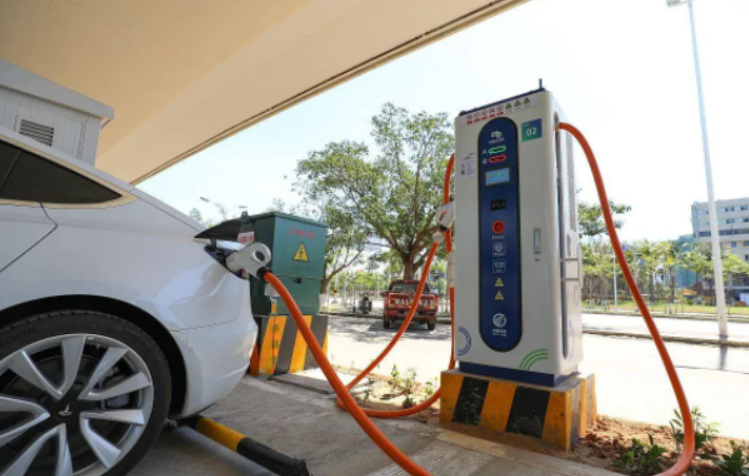
I begin with the practical fact that electric vehicle charging has become a trade-settlement activity rather than a purely technical energy-transfer process. An alternating-current electric vehicle charging pile and an off-board direct-current electric vehicle charging machine both convert and record electrical energy that eventually appears on a consumer bill. For that reason, the accuracy of the electric energy measurement inside electric vehicle charging equipment directly affects the interests of every consumer, the credibility of the operator, and the fairness of the electricity market. I treat electric vehicle charging piles as measuring instruments under mandatory verification and I examine how their metrological status can be monitored, traced, and improved.
The regulatory background is important because it shapes the data. Trade-settlement electric vehicle charging piles that directly provide charging services to the public are included in mandatory metrological management, and mandatory verification has been implemented since 1 January 2023. Across the country, institutions have explored verification methods and supervision models for electric vehicle charging. However, mandatory verification of electric vehicle charging piles has faced difficulties such as long verification time, low efficiency, high energy consumption, heavy load equipment, and uneven product quality. I therefore combine a public metrology service platform, big-data monitoring, and station-level verification research to examine the current state of mandatory verification for electric vehicle charging infrastructure. My purpose is to identify the real qualification pattern, analyze non-compliance causes, study traceability and load-point selection, and propose a smart monitoring path that can support nationwide electric vehicle charging metrology.
I use a three-part architecture that I refer to as a remote online monitoring platform, tamper-resistant electric vehicle charging piles, and dummy-load verification. This architecture allows me to analyze large samples of electric vehicle charging data and to connect field verification with online monitoring. I focus on four questions. First, what is the qualification rate of electric vehicle charging piles under mandatory verification? Second, which operators and manufacturers show weaker metrological performance? Third, what working-error distribution appears in unqualified electric vehicle charging piles, and how should traceability and load points be selected? Fourth, how can electric vehicle charging infrastructure be upgraded so that accuracy, anti-tampering, and online monitoring are achieved together?
My data sample covers a city with 36 operating platforms. One electric vehicle charging pile normally has one or two charging guns. The total number of public charging guns used for external trade settlement, including alternating-current electric vehicle charging piles and direct-current electric vehicle charging machines, is 30,962. The ten largest operating platforms hold 21,967 charging guns, which is 71% of the city total. The concentration is clear, but the operator layer is highly fragmented: the monitoring platform shows 348 operators, and a single operating platform can have as many as 112 subordinate operators. This combination of platform concentration and operator fragmentation is one reason why mandatory verification and supervision of electric vehicle charging are difficult.
| Operating platform | Charging guns | Share of city total (%) |
|---|---|---|
| 1 | 5,215 | 16.8 |
| 2 | 4,704 | 15.2 |
| 3 | 2,625 | 8.5 |
| 4 | 2,117 | 6.8 |
| 5 | 1,781 | 5.8 |
| 6 | 1,247 | 4.0 |
| 7 | 1,158 | 3.7 |
| 8 | 1,109 | 3.6 |
| 9 | 1,034 | 3.3 |
| 10 | 977 | 3.2 |
| Top ten total | 21,967 | 71.0 |
| City total | 30,962 | 100.0 |
I next examine mandatory verification results for 2023. A total of 17,342 electric vehicle charging guns were verified. Among them, 579 were unqualified, giving an overall qualification rate of 96.7%. A total of 186 operators applied for mandatory verification of electric vehicle charging piles; 38 operators had at least one unqualified gun, while 148 operators achieved a 100% qualification rate. This distribution suggests that the overall quality of electric vehicle charging metrology is acceptable but not uniform. A small number of operators account for a disproportionate share of non-compliance, and operator-level management is therefore a key variable in electric vehicle charging measurement quality.
I define the qualification rate used in my analysis as
$$R_q=\frac{N_{\mathrm{pass}}}{N_{\mathrm{total}}}\times 100\%$$
where \(N_{\mathrm{pass}}\) is the number of verified electric vehicle charging guns that meet all applicable requirements and \(N_{\mathrm{total}}\) is the number of guns verified. For the 2023 sample, \(N_{\mathrm{pass}}=17,342-579=16,763\), so \(R_q=96.7\%\). I use this same formula for operators, manufacturers, and technology groups.
| Operator | Verified guns | Qualification rate (%) |
|---|---|---|
| 1 | 3,265 | 94.2 |
| 2 | 1,233 | 97.6 |
| 3 | 1,079 | 95.6 |
| 4 | 916 | 96.0 |
| 5 | 662 | 98.0 |
| 6 | 544 | 98.7 |
| 7 | 376 | 92.8 |
| 8 | 355 | 99.7 |
| 9 | 334 | 99.4 |
| 10 | 301 | 99.7 |
| Top ten total | 9,065 | — |
The ten operators with the largest verification volumes account for 9,065 electric vehicle charging guns. Their qualification rates are mostly above 95.0%, which indicates that large operators generally have better metrological maintenance and management of electric vehicle charging equipment. Two operators fall in the 92% to 95% range, and the overall data show that 17 operators had qualification rates below 90%. The pattern is consistent with a scale effect: large operating platforms usually have more standardized installation, maintenance, and firmware-update procedures, while smaller operators may lack the technical capacity to keep electric vehicle charging piles within metrological limits.
| Operator | Unqualified guns | Verified guns | Qualification rate (%) |
|---|---|---|---|
| 1 | 15 | 30 | 50.0 |
| 2 | 2 | 4 | 50.0 |
| 3 | 13 | 27 | 51.8 |
| 4 | 4 | 10 | 60.0 |
| 5 | 2 | 6 | 66.7 |
| 6 | 16 | 52 | 69.2 |
| 7 | 16 | 52 | 69.2 |
| 8 | 7 | 28 | 75.0 |
| 9 | 12 | 58 | 79.3 |
| 10 | 2 | 10 | 80.0 |
| 11 | 16 | 82 | 80.5 |
| 12 | 5 | 29 | 82.8 |
| 13 | 3 | 19 | 84.2 |
| 14 | 3 | 22 | 86.4 |
| 15 | 7 | 54 | 87.0 |
| 16 | 3 | 27 | 88.9 |
| 17 | 4 | 38 | 89.5 |
I interpret the low-rate operators carefully. Several of them have very small verification volumes, so a single unqualified electric vehicle charging gun can move the qualification rate substantially. Even so, the concentration of failures in small operators is meaningful. It indicates that the weakest link in electric vehicle charging metrology is not only the measuring chip or the electricity meter but also the operational maintenance system around the pile. When an operator lacks routine inspection, firmware control, and traceable maintenance records, the probability that an electric vehicle charging pile drifts outside its maximum permissible error increases.
I also analyzed the manufacturers of the unqualified electric vehicle charging guns. Among the 579 unqualified certificates, 16 manufacturers had relatively large numbers of unqualified guns or relatively low qualification rates. The manufacturer-level data must be read together with market share. A manufacturer with many verified guns may have a large absolute number of failures but still maintain a high qualification rate. A manufacturer with a small volume may show an extreme rate because of a few appearance defects. I therefore use both absolute unqualified counts and qualification rates when I assess manufacturer performance in electric vehicle charging metrology.
| Manufacturer | Unqualified guns | Verified guns | Qualification rate (%) |
|---|---|---|---|
| 1 | 187 | 3,265 | 94.3 |
| 2 | 36 | 1,228 | 97.1 |
| 3 | 34 | 1,042 | 96.7 |
| 4 | 27 | 2,185 | 98.7 |
| 5 | 26 | 376 | 93.1 |
| 6 | 23 | 161 | 85.7 |
| 7 | 22 | 139 | 84.2 |
| 8 | 16 | 32 | 50.0 |
| 9 | 16 | 89 | 82.0 |
| 10 | 11 | 201 | 94.5 |
| 11 | 10 | 388 | 97.4 |
| 12 | 9 | 175 | 94.8 |
| 13 | 8 | 67 | 88.1 |
| 14 | 7 | 451 | 98.4 |
| 15 | 6 | 104 | 94.2 |
| 16 | 6 | 156 | 96.1 |
The most striking manufacturer case is the one with a 50.0% qualification rate. All of its unqualified electric vehicle charging guns failed for appearance reasons rather than for working error. Some nameplates used nonstandard voltage and current symbols, and some lacked an accuracy class. After rectification, the same electric vehicle charging piles passed verification. This example shows that appearance and nameplate compliance are not cosmetic issues in electric vehicle charging metrology. They determine whether the instrument can be legally identified, whether its accuracy class is known, and whether the user can interpret its measurement results. When appearance or clock failures occur, rectification or network time synchronization usually brings the electric vehicle charging pile back into compliance. Working-error failures are more serious because they require adjustment of the measurement chain or correction of the data path.
I now turn to the measurement data. Under the applicable verification regulations for alternating-current electric vehicle charging piles and off-board direct-current electric vehicle charging machines, the verification items include appearance and function checks, working error, and clock indication error. Among the 579 unqualified reports, 36 guns exceeded the clock-error limit, 136 guns failed appearance, and 414 guns failed working error. A small number of guns failed more than one item. This ranking is important: working error is the dominant non-compliance mode, while appearance and clock failures are more often correctable through administrative or software measures. I separate the three items because they require different corrective actions and different traceability strategies.
| Working-error interval (%) | Class 1 unqualified | Class 2 unqualified | Total unqualified |
|---|---|---|---|
| (-51, -20] | 0 | 14 | 14 |
| (-20, -10] | 0 | 5 | 5 |
| (-10, -5] | 1 | 36 | 37 |
| (-5, -1] | 9 | 111 | 120 |
| (1, 5] | 15 | 210 | 225 |
| (5, 10] | 4 | 5 | 9 |
| (10, 27] | 0 | 4 | 4 |
I define the relative working error of an electric vehicle charging pile as
$$\delta=\frac{E_{\mathrm{ind}}-E_{\mathrm{ref}}}{E_{\mathrm{ref}}}\times 100\%$$
where \(E_{\mathrm{ind}}\) is the indicated or settlement energy and \(E_{\mathrm{ref}}\) is the reference energy measured by the standard. For a class 1 electric vehicle charging pile, the maximum permissible error is 1%, and for a class 2 electric vehicle charging pile, the maximum permissible error is 2%. I therefore write the acceptance condition as
$$\left|\delta\right|\le \mathrm{MPE}_{c},\qquad \mathrm{MPE}_{1}=1\%,\qquad \mathrm{MPE}_{2}=2\%$$
For older electric vehicle charging piles without a marked accuracy class, I follow the conservative practice of judging them against class 2. This is important because the field population contains legacy equipment, and the absence of a marked class should not be treated as permission for wider error.
The working-error distribution in my sample shows 176 guns with negative error, or 42.5% of the working-error failures, and 238 guns with positive error, or 57.5%. A negative error means that the energy indicated by the electric vehicle charging pile is lower than the reference energy, so the consumer’s vehicle receives less energy than the settlement record suggests. A positive error means that the indicated energy is higher than the reference energy, so the consumer receives more energy than the settlement record suggests. The positive errors are mostly concentrated in the (1, 5]% interval. This is a favorable direction from the consumer-protection perspective, but it is still non-compliant because mandatory verification is symmetric. An electric vehicle charging operator cannot rely on a favorable bias to excuse an out-of-tolerance instrument.
I find that the measurement chain between the terminal control unit and the electricity meter is a decisive factor in working error. The terminal control unit controls charging, metering, and billing, and it must read the electricity meter correctly at the start and end of each charging order. When the terminal control unit and the meter are not jointly debugged, the displayed energy can differ from the meter energy even if the meter itself is accurate. In the city I studied, many electric vehicle charging piles use new smart electricity meters, and such piles show a high qualification rate. The minority that fail often have a joint-debugging problem: the terminal control unit reads the meter energy incorrectly or uses inconsistent start and end times. When the operator updates the firmware so that the meter and the display device use the same start and end timestamps, the working error returns to the compliant range.
The contrast between old and new electric vehicle charging piles is strong. Piles installed and used before 2023 have a higher unqualified rate, while piles newly installed in 2023 have a higher qualification rate. I attribute the old-pile problem to four causes. The first is line aging. The second is aging and mismatching of the metering system, including current transformers and electricity meters. The third is degradation of conventional metering devices such as metering chips and power meters under long-term use and complex electromagnetic environments. The fourth is incorrect configuration of the terminal control unit when reading meter energy, especially when the start and end energy values of a charging order are not captured correctly. These causes are not independent. An aged meter with a small error can become a large settlement error if the terminal control unit samples the wrong time window or applies a wrong correction.
Appearance and function checks are the second major category. The nameplate must contain the name and model, manufacturer, standard on which the product is based, serial number and year of manufacture, maximum voltage, minimum voltage, minimum current, maximum current, constant, accuracy class, and measurement unit. For an alternating-current electric vehicle charging pile, the nominal voltage is the relevant voltage reference. The minimum current cannot be zero. The measurement unit may be displayed on the screen, but the unit must be correct. I observed three main appearance problems. First, nameplate information was nonstandard, for example output voltage was written in an irregular form or the unit kWh was written with incorrect capitalization. Second, nameplate information was incomplete, for example minimum current was missing, accuracy class was absent, or the product standard was not stated. Third, the basic function was abnormal and the electric vehicle charging pile could not charge. These failures matter because a legally mandated verification cannot be separated from the identity and basic operability of the instrument.
Clock indication is the third category. A common problem is that the display module of the electric vehicle charging pile, including the pile body and the application display, shows time only to the minute. For an electric vehicle charging machine with time-of-use billing, the verification regulation requires that the clock indication error at first verification should not exceed 5 seconds and at subsequent verification should not exceed 3 minutes. I express the clock error as
$$\Delta t=t_{\mathrm{pile}}-t_{\mathrm{ref}}$$
where \(t_{\mathrm{pile}}\) is the pile clock reading and \(t_{\mathrm{ref}}\) is the reference time. The acceptance condition is
$$\left|\Delta t\right|\le 5\ \mathrm{s}\ \text{at first verification},\qquad \left|\Delta t\right|\le 3\ \mathrm{min}\ \text{at subsequent verification}$$
Clock error is usually easy to correct through network synchronization, but it should not be ignored. In time-of-use billing, a clock offset shifts the boundary between price periods and can create a settlement dispute even when the energy measurement itself is accurate. For this reason, I treat clock verification as part of the metrological integrity of electric vehicle charging, not as a separate software issue.
I next examine load-point selection and traceability. The verification regulations suggest that the load point for working-error verification should be chosen at 50% or more of the maximum load of the electric vehicle charging pile. The working-error verification table allows one load point to be selected among heavy load, medium load, and light load. In practice, many verification bodies choose a portable electric vehicle charging pile calibrator with a load of about 7 kW because it is convenient to transport and operate. That choice is understandable for field work, but it creates a traceability weakness when the actual electric vehicle charging pile operates mostly at high load.
I define the load factor of a verification point as
$$L_p=\frac{P_{\mathrm{test}}}{P_{\mathrm{max}}}\times 100\%$$
where \(P_{\mathrm{test}}\) is the test power and \(P_{\mathrm{max}}\) is the rated maximum power of the electric vehicle charging pile. A 7 kW test on a 60 kW electric vehicle charging pile gives \(L_p=11.7\%\), which is a light-load verification. The charging curve of an electric vehicle charging pile shows that most operating time is spent under heavy load. For a 60 kW pile, the operating load is often above 50 kW. The actual load state is determined by the vehicle, which sends instructions to the pile according to its battery condition. Therefore, a low-load working-error verification alone does not provide strong data support for the accuracy of electric vehicle charging settlement. I prefer a verification strategy that covers a medium-load or heavy-load point and, where possible, supplements it with a light-load check.
| Load category | Approximate \(L_p\) | Typical field condition | Metrological role |
|---|---|---|---|
| Light load | 0% to 25% | Portable calibrator, low-power test | Convenient screening, but weak representation of normal electric vehicle charging operation |
| Medium load | 25% to 75% | Partial-power test, moderate equipment | Balanced representation and field feasibility |
| Heavy load | 75% to 100% | High-power operation, large load bank | Closest to normal high-power electric vehicle charging, but difficult with actual load |
I distinguish two verification methods: actual-load verification and dummy-load verification. Actual-load verification usually uses a resistive load. It has high energy consumption, low verification efficiency, and a large physical footprint. In field practice, an ordinary commercial vehicle can carry at most about 120 kW of load. This is already insufficient for modern high-power electric vehicle charging. Supercharging piles are moving toward much higher power. Some high-end systems reach 600 kW, 250 kW, 350 kW, 480 kW, or 520 kW depending on the product generation and market. If I use actual-load verification at a medium or heavy load point for such equipment, the resistive load becomes a transport problem, and safety at high power becomes a serious problem. If I choose only a light load, the verification is limited and does not represent the dominant operating state of electric vehicle charging.
Dummy-load verification solves the power problem by feeding current and voltage into the electricity meter separately. The method requires only a small output power to reach a full-load verification condition. In principle, the dummy-load power can be a small fraction of the actual load power. I express the dummy-load condition as
$$P_d=U_d I_d \cos\varphi_d,\qquad P_d\ll P_{\mathrm{actual}}$$
where \(U_d\), \(I_d\), and \(\cos\varphi_d\) are the dummy voltage, dummy current, and dummy power factor. In a practical implementation, the standard source provides the electrical energy, and the verification procedure can be automated over multiple load points. One insertion of the charging gun can complete the working-error verification. This avoids the problems of oversized equipment, high energy consumption, unstable resistive-load output, and poor compatibility with the electric vehicle charging pile. For high-power electric vehicle charging, dummy-load verification is not merely convenient; it is a necessary condition for full-load traceability.
| Criterion | Actual-load verification | Dummy-load verification |
|---|---|---|
| Energy consumption | High | Low |
| Equipment size | Large resistive load | Compact standard source |
| High-power coverage | Limited by transport and safety | Can reach full-load condition |
| Automation | Difficult for multiple points | Programmable multi-point verification |
| Field efficiency | Low | High, one insertion can complete a working-error check |
| Suitability for electric vehicle charging | Better for low and medium power | Better for high-power and supercharging electric vehicle charging |
My traceability analysis starts from the standard energy meter and ends at the settlement data displayed to the consumer. I regard the traceability chain as a sequence of comparisons in which each level has a calibrated correction and an uncertainty. The chain is not complete if the electric vehicle charging pile meter is calibrated but the terminal control unit reads the meter with a time offset or a scaling error. The chain must therefore include the data path.
| Level | Device or process | Metrological function |
|---|---|---|
| Reference | Standard energy meter | Provides reference energy with known uncertainty |
| Transfer | Portable or laboratory calibrator | Compares standard energy with the electric vehicle charging pile under test |
| Instrument | Electricity meter inside the electric vehicle charging pile | Measures energy delivered to the vehicle |
| Data path | Terminal control unit, MCU, platform, application | Transfers, displays, and stores settlement energy |
| Supervision | Remote online monitoring platform | Checks consistency between meter data and displayed data |
I express the combined standard uncertainty of the working-error verification as
$$u_c^2=\sum_{i=1}^{n} u_i^2$$
where the terms include the standard meter uncertainty, the calibrator uncertainty, repeatability, resolution, load-point stability, temperature effect, and the uncertainty introduced by the data path. The expanded uncertainty is
$$U=k u_c,\qquad k=2$$
I do not treat uncertainty as a formality. When the measured working error is close to the maximum permissible error, the uncertainty determines whether a pass decision is robust. For electric vehicle charging piles at class 1, the 1% limit leaves little room for an optimistic uncertainty statement. A rigorous verification should report both the measured error and the uncertainty, and the decision rule should be stated in advance.
| Symbol | Component | Typical source |
|---|---|---|
| \(u_1\) | Reference meter | Calibration uncertainty of the standard energy meter |
| \(u_2\) | Calibrator | Transfer uncertainty of the portable verification equipment |
| \(u_3\) | Repeatability | Variation among repeated electric vehicle charging measurements |
| \(u_4\) | Resolution | Display resolution of the electric vehicle charging pile |
| \(u_5\) | Load stability | Fluctuation of voltage, current, and power factor |
| \(u_6\) | Data path | Timestamp offset, scaling, or rounding in the terminal control unit |
I now consider the smart monitoring system. A direct-current electric vehicle charging pile integrates power electronics, embedded control, and IoT communication. The displayed energy is not necessarily the raw meter data. In a typical data path, the electricity meter sends data to the MCU, the MCU sends data to the platform through IoT communication, and the platform displays the result in an application or mini-program. Every transfer step creates a risk of tampering or misreading. Even the data on the electric vehicle charging pile display can be changed by a technician through a mobile device. I have seen cases in which the same charging order showed a 20% difference in energy across different platforms. This is a serious warning for both ex-ante and ex-post supervision of electric vehicle charging.
To quantify data-path consistency, I define the platform-meter discrepancy as
$$\Delta E=\frac{E_{\mathrm{platform}}-E_{\mathrm{meter}}}{E_{\mathrm{meter}}}\times 100\%$$
where \(E_{\mathrm{platform}}\) is the energy shown by the platform and \(E_{\mathrm{meter}}\) is the energy recorded by the electricity meter. A robust monitoring platform should compare \(\Delta E\) against a threshold derived from the meter uncertainty and the allowed data-transfer tolerance. If the discrepancy exceeds the threshold, the platform should flag the order and trigger an inspection. This is a practical use of big-data monitoring in electric vehicle charging metrology.
The three-part architecture I recommend is therefore not a collection of unrelated technologies. The remote online monitoring platform provides continuous observation. The tamper-resistant electric vehicle charging pile provides trustworthy data acquisition. Dummy-load verification provides full-load traceability without excessive field power. Together they form a closed loop: the platform detects anomalies, the tamper-resistant hardware protects the measurement data, and the dummy-load method verifies the electric vehicle charging pile at representative load points. I consider this closed loop to be a smart metrology system rather than a simple inspection campaign.
For hardware, I recommend an intelligent electricity meter with encrypted data transmission and an electronic seal. The electronic seal complements the physical seal. A physical seal protects the meter enclosure, but it cannot detect software-level changes in the data path. An electronic seal can record access events and protect configuration parameters. When the meter supports encrypted communication, the platform can authenticate the source of the metering data. This reduces the risk that an electric vehicle charging operator or a third-party service provider changes the displayed energy without changing the meter energy. The combination of physical sealing, electronic sealing, and encrypted transmission is especially important for public electric vehicle charging, where the consumer cannot inspect the internal measurement chain.
I also recommend that the monitoring platform compare the original metering data with the displayed data for each charging order. The platform should filter abnormal orders, issue warnings, and preserve evidence. This function supports trade settlement accuracy and consumer protection. If the same electric vehicle charging order appears with different energy values on different platforms, the monitoring platform should identify the inconsistency and require the operator to explain the data path. A secure charging data governance platform can perform this function continuously, whereas periodic on-site verification can only sample the population.
My analysis of the city data supports several conclusions. First, the overall qualification rate of electric vehicle charging piles under mandatory verification is high, at 96.7%, but the distribution is uneven. Large operators generally perform better, while small operators are more likely to have low qualification rates. Second, working error is the dominant failure mode, with 414 of 579 unqualified reports. Appearance and clock failures are less numerous and are usually correctable. Third, the working-error distribution is not one-sided. Negative errors account for 42.5% of working-error failures, and positive errors account for 57.5%. This means that consumer harm can occur in both directions, and symmetric enforcement is necessary. Fourth, old electric vehicle charging piles have a higher failure rate than new piles, which points to aging, mismatching, electromagnetic degradation, and data-path configuration as key causes. Fifth, low-load verification alone is insufficient for high-power electric vehicle charging. Medium-load actual-load verification and dummy-load verification are more appropriate. Sixth, smart metering hardware and a remote monitoring platform are needed to protect the data path after verification.
I further note that the manufacturer data should not be reduced to a single ranking. A manufacturer with a 50.0% qualification rate in the sample failed entirely because of appearance defects, and the same electric vehicle charging piles passed after rectification. Another manufacturer with a large absolute number of failures still had a qualification rate above 94%. The correct interpretation depends on the failure type. Appearance failures indicate documentation and nameplate control problems. Clock failures indicate time synchronization and software configuration problems. Working-error failures indicate measurement-chain, meter, or data-path problems. A regulator should separate these categories when deciding whether to require a design change, a firmware update, a nameplate correction, or a full metrological re-verification.
I propose a risk-based verification strategy for electric vehicle charging. The strategy should use the online platform to rank operators and stations by risk. Inputs could include historical qualification rate, age of the electric vehicle charging pile, manufacturer, meter type, data-path discrepancy, complaint rate, and charging-order anomalies. The risk score can be written as a weighted sum:
$$S_{\mathrm{risk}}=w_1 f_{\mathrm{history}}+w_2 f_{\mathrm{age}}+w_3 f_{\mathrm{data}}+w_4 f_{\mathrm{complaint}}+w_5 f_{\mathrm{station}}$$
where each \(f_i\) is a normalized risk factor and the weights sum to one. A high-risk score would trigger earlier on-site verification or a dummy-load check. A low-risk score could be monitored remotely with a longer verification interval. This approach would allocate limited verification resources to the electric vehicle charging piles that are most likely to be non-compliant.
I also propose that the verification record should include the load point, the accuracy class, the measured working error, the uncertainty, the clock error, the appearance result, and the data-path consistency result. A verification certificate that reports only pass or fail cannot support later trend analysis. If the working error at a medium load point is 0.8% for a class 1 electric vehicle charging pile, that result is close to the 1% limit and should be flagged for follow-up even if it passes. A trend database would allow the regulator to detect drift before a failure occurs. This is particularly valuable for electric vehicle charging because the population is large, the equipment is distributed, and on-site visits are expensive.
I emphasize that electric vehicle charging metrology is not only a laboratory activity. The field environment includes temperature variation, dust, vibration, electromagnetic interference, network latency, and firmware updates. These factors can change the working error after verification. The remote online monitoring platform can observe some of these effects through repeated charging orders. If the platform sees a sudden shift in the ratio between meter energy and displayed energy after a firmware update, it can trigger a targeted inspection. This is a more efficient use of supervision than a fixed calendar-based verification cycle. The platform does not replace legal verification, but it can prioritize legal verification and provide evidence for enforcement.
For high-power electric vehicle charging, I recommend a two-stage verification. In the first stage, dummy-load verification covers the full load range, including heavy load and medium load, and records the working error at multiple points. In the second stage, actual-load verification at a medium load point confirms that the electric vehicle charging pile behaves correctly when connected to a real vehicle or a real load. The medium-load actual-load test provides a field-relevant check without requiring an impractically large resistive load. The dummy-load test provides full-range traceability without excessive energy consumption. Together they give both coverage and realism.
I express the two-stage decision rule as
$$\text{Pass}=\left(\left|\delta_d\right|\le \mathrm{MPE}_c\right)\land\left(\left|\delta_a\right|\le \mathrm{MPE}_c\right)\land\left(\left|\Delta t\right|\le \Delta t_{\max}\right)\land A_{\mathrm{appearance}}=\mathrm{pass}$$
where \(\delta_d\) is the dummy-load working error, \(\delta_a\) is the actual-load working error, \(\Delta t\) is the clock error, and \(A_{\mathrm{appearance}}\) is the appearance and function result. This rule prevents a situation in which a narrow light-load check passes while the heavy-load behavior of the same electric vehicle charging pile fails.
I also recommend periodic comparison between the electric vehicle charging pile meter and the platform data. The comparison should not be limited to total energy. It should include the start energy, end energy, start time, end time, and order identifier. If the meter and the platform disagree on the start or end time, the energy can still be correct in a steady-load test but wrong in a real charging session. This is why the data path must be part of the traceability chain. The metrological property of an electric vehicle charging pile is not only the accuracy of its meter; it is the accuracy of the settlement value that the consumer sees.
In my view, the most important policy lesson is that mandatory verification should be connected to smart monitoring. A one-time verification confirms that an electric vehicle charging pile was compliant at the moment of test. It does not guarantee that the pile remains compliant after a firmware update, a meter replacement, or a change in the data path. The remote platform can monitor the pile continuously and can detect anomalies that justify a re-verification. The tamper-resistant hardware can protect the measurement data from unauthorized changes. The dummy-load method can verify high-power electric vehicle charging piles without a massive load bank. This three-part system is a practical response to the scale and complexity of electric vehicle charging.
I conclude that the 2023 mandatory verification data provide a useful baseline. The overall qualification rate of 96.7% is encouraging, but the 579 unqualified electric vehicle charging guns reveal specific weaknesses. Working error dominates, and the causes include joint-debugging errors, meter aging, data-path misreading, and legacy equipment. Appearance and clock failures are smaller in number but should not be ignored because they affect legal identification and time-of-use billing. Small operators need more technical support and stricter supervision. Manufacturers should improve nameplate control and meter integration. Regulators should move from pure calendar-based verification toward risk-based verification supported by online monitoring. Verification bodies should select medium-load or heavy-load points and use dummy-load methods for high-power electric vehicle charging. The ultimate goal is not simply a higher pass rate but a trustworthy measurement chain for every electric vehicle charging transaction.
I finish with the observation that electric vehicle charging is expanding quickly, and the metrological system must expand with it. A city with 30,962 public charging guns and 348 operators cannot rely only on manual inspection. The combination of remote online monitoring, tamper-resistant electric vehicle charging piles, and dummy-load verification gives a scalable path. It supports mandatory verification, enables online monitoring of metrological status, and protects consumers in electric vehicle charging settlement. I believe this approach can be adapted to other cities and can provide a reference for the nationwide verification of electric vehicle charging piles.