
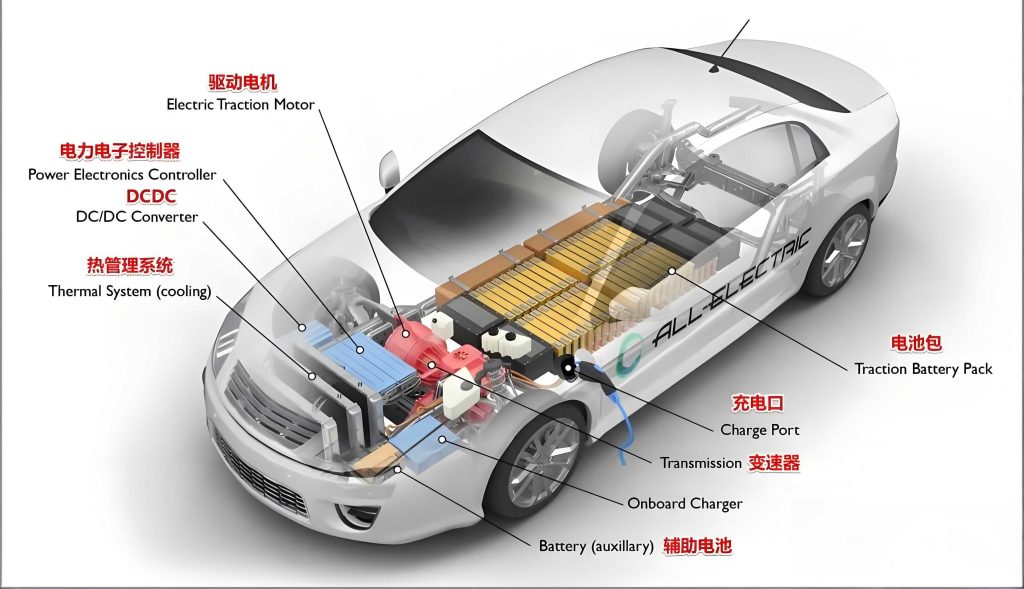
The rapid expansion of the battery electric car market has placed immense importance on its supporting infrastructure, particularly charging piles. The metrological accuracy, safety, usability, and overall user experience of these charging points are critical for consumer trust and the sustainable development of the new energy vehicle industry. Following regulatory mandates, such as their inclusion in China’s compulsory verification catalog, a significant number of public charging piles have undergone mandatory verification. This process, conducted from a first-person perspective as a verification engineer, has uncovered a series of prevalent and systemic issues that span design, manufacturing, installation, operation, and maintenance. This article provides a detailed analysis of these problems, supported by technical data, formulas, and tables, and offers constructive recommendations for industry stakeholders.
1. Issues in Appearance and Functional Checks
The initial visual and functional inspection often reveals fundamental non-conformities related to labeling and information presentation, which undermine transparency and traceability.
1.1 Inconsistent Naming and Model Identification
There is a conspicuous lack of standardization in the naming conventions and model numbers for charging piles. Different manufacturers, and sometimes even the same manufacturer, use arbitrary naming schemes. This creates confusion for verification, maintenance, and consumer identification. For instance, model names often incorporate rated power or voltage, but these may not match the actual specifications printed on the nameplate.
1.2 Misuse of Metrological Terminology and Unit Symbols
Frequent errors are found in the use of metrological terms and unit symbols on nameplates and displays. Common mistakes include:
- Confusing terms like “accuracy class,” “precision grade,” and “measurement accuracy.”
- Incorrect representation of ranges (e.g., “200 ~ 750 V” instead of “(200–750) V”).
- Erroneous unit symbols: using “kw” or “KW” for kilowatt (kW), “KWh” for kilowatt-hour (kW·h), and lowercase “dc” or “ac.”
1.3 Missing Essential Information on Nameplates
As per verification regulations JJG 1148-2022 and JJG 1149-2022, the nameplate must contain specific information. Common omissions include:
- Minimum output current.
- Accuracy class.
- Correct measurement unit (e.g., using “degree” instead of “kW·h”).
- Pulse constant (k), or insufficient technical documentation to confirm it.
The table below summarizes common non-conformities found during appearance checks.
| Check Item | Regulatory Requirement (JJG 1148/1149) | Common Issue Found | Impact |
|---|---|---|---|
| Nameplate Completeness | Must include: Model, Mfr., Serial No., Year, V/I range, k, Accuracy Class, Unit. | Missing min. current, accuracy class, unit; incorrect k. | Hinders verification, lacks traceability, misinforms user. |
| Measurement Unit | Energy must be in “kW·h”. | Display shows “degree” or uses incorrect symbol (KWh). | Non-standard trade unit, potential consumer dispute. |
| Terminology | Clear and correct metrological terms. | “Precision grade” used instead of “Accuracy class”. | Professional impropriety, ambiguity. |
| Model/Type Designation | Should be clear and match specs. | Inconsistent naming; model number doesn’t match rated output. | Difficulties in asset management and technical support. |
2. Technical and Design Flaws
Beyond labeling, deeper technical shortcomings related to design standards and parameters have been identified.
2.1 Referenced Standards and Minimum Current
Nameplates often cite incorrect or outdated manufacturing standards (e.g., listing verification regulations as product standards). Furthermore, a critical design flaw is specifying an unrealistically low or zero minimum output current ($I_{min}$). Since verification and actual charging cannot occur at zero current, a practical minimum must be defined. The regulation mandates that if $I_{min} < 5A$, it should still be testable. A common incorrect specification is $I_{min} = 0A$. The requirement can be expressed as:
$$ I_{min} > 0A \quad \text{and practically, } I_{min} \text{ should be within the verifiable range of the meter.} $$
2.2 Pulse Constant (k) Mismatch
The pulse constant $k$, defined in impulses per kilowatt-hour (imp/kW·h), is a crucial parameter linking measured energy to the test output. The value on the nameplate must match the actual constant of the installed energy meter or metering module. Issues arise from:
- Production batches using meters with different $k$ values while nameplates are not updated.
- Replacement of faulty meters with a new meter having a different $k$, without updating the nameplate.
This mismatch invalidates the verification process, as the calculation of error ($E$) depends on the correct $k$:
$$ E = \frac{n_{display} – n_{std}}{n_{std}} \times 100\% $$
Where $n_{display}$ is derived from the displayed energy and the nameplate $k$, and $n_{std}$ is the count from the standard. A $k$ mismatch directly causes an error in $n_{display}$.
3. Analysis of Excessive Working Error
The core of mandatory verification is assessing the working error of the energy measurement. Multiple factors contribute to errors exceeding the Maximum Permissible Error (MPE), typically Class 2 (e.g., ±1.0%).
3.1 Line Losses
Excessive resistance in the cables connecting the pile’s meter to the vehicle connector causes voltage drop and energy loss ($W_{loss}$). This loss is not registered by the pile’s meter but is supplied by the grid, leading to a negative error from the consumer’s perspective. The power loss is given by:
$$ P_{loss} = I^2 \cdot R_{cable} $$
and the energy loss over time $t$ is:
$$ W_{loss} = I^2 \cdot R_{cable} \cdot t $$
Causes include undersized cables, long cable runs, poor connections, corrosion, or damaged insulation.
3.2 Inaccurate Energy Meter
The fundamental measurement inaccuracy of the DC energy meter itself is a major cause. Many meters in the market may not have undergone rigorous type evaluation or lack certification. Their performance can degrade significantly under influence quantities like temperature variations, ripple, or electromagnetic interference (EMI).
3.3 Data Manipulation in Backend Systems
A serious issue is the potential for backend software to manipulate billing data. Some operators add arbitrary “loss compensation” factors or employ different rounding algorithms in their payment platforms versus the pile’s display. If the communication between the pile and the backend is unencrypted, parameters or raw data could be altered, intentionally or otherwise, skewing the final settled energy ($W_{settled}$) from the meter’s actual reading ($W_{meter}$):
$$ W_{settled} = f(W_{meter}) \quad \text{where } f \text{ is a non-transparent, potentially biasing function.} $$
3.4 Insufficient Energy Accumulation During Test
Verification protocols require measuring error at specific load points by accumulating a minimum energy (e.g., 0.5 kW·h). With meters having a low pulse constant $k$ (e.g., 25 imp/kW·h), the number of pulses in 0.5 kW·h is only 12.5. If the test equipment stops precisely at the target energy, it may truncate a partial pulse, causing significant measurement variability. The relative error introduced by missing one pulse is:
$$ \text{Error from 1 missed pulse} \approx \frac{1}{n_{total}} \times 100\% $$
For $n_{total}=12$, this is ~8.3%. Therefore, for low $k$ meters, a larger accumulated energy (e.g., ≥1.0 kW·h) is recommended to reduce this quantization error.
3.5 Issues with Verification Instruments
The performance of the field verification standard itself can contribute. Using inappropriate voltage/current ranges, relying on unstable auto-ranging functions in early-generation testers, or improper configuration can introduce measurement noise and error. The standard’s own uncertainty $u_{std}$ must be sufficiently small relative to the Charging Pile’s MPE.
3.6 Settlement Decimal Rounding Issues
A prevalent and significant cause of error stems from the number of decimal places used in settlement. Regulations require energy display with three decimal places. However, many systems internally use only two decimal places, applying rounding (or truncation) for the third digit on the display or in the user app. This “pseudo three-digit” display introduces a systematic rounding error. The maximum possible error from this is ±0.0005 kW·h per transaction. For a small test accumulation of 0.05 kW·h, this can cause an error of:
$$ \frac{\pm 0.0005}{0.05} \times 100\% = \pm 1.0\% $$
This alone can consume the entire error budget for a Class 2 charger. More problematic are non-standard practices like “round-down-only,” which systematically biases the error in the operator’s favor. The table below illustrates this problem with real data.
| Accumulated Energy (kW·h) | Standard Value $E_0$ (kW·h) | Pile Display (2 decimal, rounded) | App Display (Pseudo 3-digit, round-down) | Error from Pile Display | Error from App Display |
|---|---|---|---|---|---|
| ~0.250 | 0.2582 | 0.26 | 0.25 | +0.69% | -3.17% |
| ~0.500 | 0.5124 | 0.51 | 0.50 | -0.47% | -2.42% |
| ~1.000 | 1.0065 | 1.01 | 1.00 | +0.35% | -0.65% |
Formula: Error = $(E’ – E_0)/E_0 \times 100\%$, where $E’$ is the settlement value.
3.7 Inconsistency Between Pile Display and User App
Discrepancies are often found between the energy value shown on the charging pile’s physical screen at the end of a session and the value presented in the mobile application for payment. This indicates different software systems reading the meter data at slightly different times (e.g., at stop command vs. after full shutdown) or applying different data processing algorithms. This inconsistency confuses users and raises questions about which value is the correct basis for trade.
3.8 Communication Instability
Poor network connectivity (4G/5G/wired) at the charging site can cause transaction anomalies. Delays or failures in transmitting the “stop charging” command can lead to a mismatch between the energy the user intended to buy and the energy actually billed, indirectly affecting the perceived accuracy. It can also hinder remote monitoring and data integrity.
4. Safety, Maintenance, and Operational Concerns
The reliability and safety of the battery electric car charging experience depend heavily on ongoing operations.
4.1 Safety Hazards
Verification visits reveal physical safety issues: damaged gun heads, faulty temperature sensors in connectors, broken mechanical locks, and non-functional emergency stop buttons. These defects can lead to electric shock, fire, or connector overheating during charging.
4.2 Inadequate Pre-commissioning Acceptance
Many charging stations were put into operation after inspections focusing only on basic electrical safety and function, without formal verification of their metrological performance. This allows substandard piles to enter the market.
4.3 Lack of Systematic Maintenance
Poor maintenance is evident: dirty vents leading to overheating, improperly stowed charging cables prone to damage, and a general lack of preventive upkeep schedules. User misuse (e.g., using the emergency stop for routine shutdown) is also common due to lack of guidance.
5. Regulatory and Supervision Challenges
Effective oversight is crucial for ensuring a fair and reliable charging ecosystem for every battery electric car owner.
5.1 Management of Verification Marks and Seals
Applying durable, weather-proof verification “passed” labels with QR codes is standard practice. A greater challenge is the effective sealing of the metering compartment (meter, shunt) to prevent tampering. Older pile designs with diverse meter types make standardized sealing difficult. Modern solutions integrate the shunt and meter with electronic seals for better anti-tamper monitoring.
5.2 Handling Non-compliant Piles
A clear procedure is needed for piles that fail verification: issuing failure notices, applying “out of service” tags, physically sealing the gun, and de-listing them from operator networks. Effective follow-up to ensure repair and re-verification is essential.
5.3 Building a Comprehensive Supervision System
A robust system requires:
- Remote Online Monitoring: A government or third-party platform that collects real-time operational and metrological data from piles for big-data analysis and anomaly detection.
- Smart, Anti-tamper Charging Piles: Incentivizing or mandating the use of new piles with built-in monitoring and sealing features.
- Regular Sampling and Audits: Market surveillance authorities conducting random on-site checks.
- Consumer Empowerment: Enabling users to report issues (e.g., via QR code on the verification mark) easily.
6. Conclusion and Recommendations
The mandatory verification of EV charging piles has been instrumental in uncovering critical issues affecting the fairness and safety of the charging infrastructure for battery electric car users. The problems are multifaceted, involving manufacturers, installers, operators, and regulators.
Key recommendations include:
- For Manufacturers: Strictly adhere to naming, labeling, and design standards. Ensure minimum current is specified correctly, pulse constants are accurate, and meters used are certified and robust against environmental influences.
- For Standards Bodies: Further refine verification protocols to address low pulse-constant meters (by increasing minimum accumulation energy) and explicitly mandate three-decimal-place processing without biasing rounding methods.
- For Operators & Installers: Use high-quality cables and proper installation to minimize line loss. Implement rigorous pre-operation acceptance tests that include metrological verification. Establish proactive maintenance schedules. Ensure backend systems do not manipulate settlement data and that displays are consistent across platforms.
- For Regulators: Enforce type approval for charging pile meters. Promote and support the deployment of integrated remote online monitoring systems. Implement clear, strict protocols for sealing and managing non-compliant piles. Conduct regular market surveillance audits.
As technology evolves towards ultra-fast charging (e.g., 800V systems) and wireless charging, the associated standards and verification methodologies must continuously adapt. Addressing the current issues is a necessary foundation for building a trustworthy, efficient, and sustainable charging network that supports the global transition to electric mobility. Ensuring every battery electric car owner pays for the exact energy received is not just a technical requirement but a cornerstone of market confidence and equitable trade.