
With the rapid expansion of the electric vehicle (EV) market globally, the performance and safety of traction batteries under extreme conditions have become critical concerns. In particular, the China EV battery industry faces significant challenges in low-temperature environments, where lithium-ion batteries experience severe performance degradation, including reduced reaction kinetics, increased internal resistance, and the risk of lithium plating. These issues not only limit the driving range but also accelerate battery aging, posing safety hazards. To address these challenges, we develop an advanced alternating current (AC) heating strategy tailored for EV power batteries throughout their entire lifecycle, ensuring efficient warming while minimizing degradation.
Our study focuses on the 18650 lithium-ion cells commonly used in China EV battery systems. We begin by conducting accelerated aging experiments to obtain batteries at different states of health (SOH), simulating real-world usage scenarios. The SOH is defined as:
$$S_{\text{soh}} = \frac{C}{C_N} \times 100\%$$
where $C$ is the actual capacity after aging, and $C_N$ is the nominal capacity of a new battery. Through cyclic charge-discharge tests at 25°C, we categorize batteries into SOH levels of approximately 95%, 90%, 85%, and 80%, representing the full lifecycle of EV power batteries.
To accurately model battery behavior, we perform electrochemical impedance spectroscopy (EIS) tests across temperatures from -20°C to 25°C at 5°C intervals. The results reveal that as temperature decreases, the total impedance of China EV battery cells increases significantly, especially below -15°C. For instance, at 5°C, the total impedance rises from 0.0256 Ω for a new battery (SOH 100%) to 0.0407 Ω for an aged battery (SOH 80.14%), marking a 58.98% increase. This underscores the importance of accounting for aging effects in heating strategies.
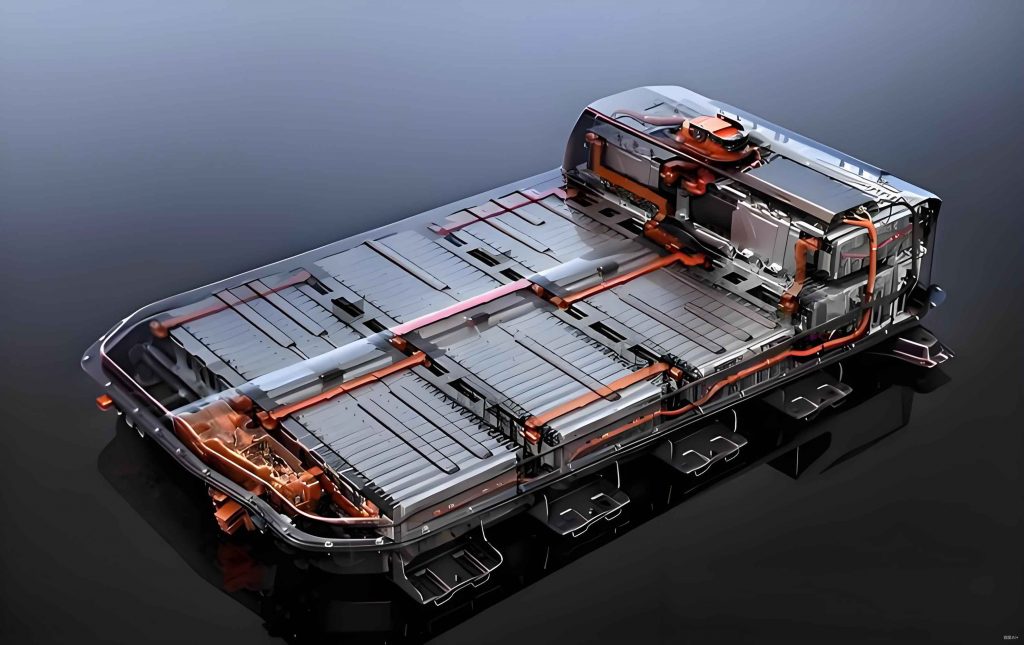
We develop a high-fidelity electro-thermal-aging coupled model to simulate battery dynamics. The core component is a second-order RQ equivalent circuit model, which incorporates a constant phase element (CPE) to capture non-ideal capacitive behaviors, such as the dispersion effect at electrode interfaces. The model equations are:
$$U_t = U_{\text{OCV}} + L \frac{dI}{dt} + R_0 I + U_{\text{SEI}} + U_{\text{ct}}$$
$$\frac{\partial U_{\text{SEI}}}{\partial t} = -\frac{1}{R_{\text{SEI}} C_{\text{SEI}}^{n_{\text{SEI}}} } U_{\text{SEI}} + \frac{1}{C_{\text{SEI}}^{n_{\text{SEI}}} } I$$
$$\frac{\partial U_{\text{ct}}}{\partial t} = -\frac{1}{R_{\text{ct}} C_{\text{dl}}^{n_{\text{dl}}} } U_{\text{ct}} + \frac{1}{C_{\text{dl}}^{n_{\text{dl}}} } I$$
where $U_t$ is the terminal voltage, $U_{\text{OCV}}$ is the open-circuit voltage, $I$ is the current, $L$ is the inductance, $R_0$ is the ohmic resistance, and $U_{\text{SEI}}$ and $U_{\text{ct}}$ represent voltages across the SEI film and charge transfer elements, respectively. The CPE impedance is given by:
$$Z_{\text{CPE}} = \frac{1}{C (j\omega)^n} = \frac{1}{C (2\pi f)^n \left( \cos\left(\frac{n\pi}{2}\right) + j \sin\left(\frac{n\pi}{2}\right) \right)}$$
The thermal model is based on the energy balance equation, where the heat generation rate during AC heating is derived from the Bernardi equation:
$$Q = I (U_{\text{OCV}} – U_t) – I T \frac{\partial U_{\text{OCV}}}{\partial T}$$
For sinusoidal AC excitation, the average heat generation rate simplifies to:
$$Q = \frac{I_{\text{ac}}^2}{2} \text{Re}(Z)$$
where $\text{Re}(Z)$ is the real part of the battery impedance, which depends on temperature, SOH, and AC frequency. The thermal dynamics are described by:
$$mc \frac{\partial T}{\partial t} = Q – hA (T – T_f)$$
with $m$ as mass, $c$ as specific heat capacity, $h$ as convection coefficient, $A$ as surface area, and $T_f$ as ambient temperature.
The aging model captures the nonlinear degradation of EV power battery parameters over the lifecycle. We use a分段 approach: linear decay for initial cycles and stretched exponential decay for later stages. The SOH degradation model is fitted as:
$$S_{\text{soh}}(N) = -0.024N + 99.25 \quad \text{for} \quad N \leq 544$$
$$S_{\text{soh}}(N) = 86.05 – 17.10 \left(1 – \exp\left(-4 \times 10^{-3} (N – 544)^{1.79}\right)\right) \quad \text{for} \quad N > 544$$
Parameter aging interactions are modeled to reflect changes in internal resistance, capacitance, and other factors. For example, the ohmic resistance $R_0$ varies with temperature $T$ and SOH:
$$R_0(T, S_{\text{soh}}) = (3.3 \times 10^{-5} T^2 + 3.33 \times 10^{-4} T + 3.116 \times 10^{-2}) \exp\left(-1.031(1 – S_{\text{soh}}/100) + 0.058 T (1 – S_{\text{soh}}/100)\right)$$
Similar expressions are derived for other parameters, ensuring the model adapts to the evolving characteristics of China EV battery cells.
| Parameter | Aging Interaction Model |
|---|---|
| Inductance $L$ | $L = (-1.021 \times 10^{-10} T^2 + 8.184 \times 10^{-7} T + 5.362 \times 10^{-3}) \left[1 + 0.208(1 – S_{\text{soh}}/100) – 4.8 \times 10^{-3} T (1 – S_{\text{soh}}/100)\right]$ |
| SEI Resistance $R_{\text{SEI}}$ | $R_{\text{SEI}} = 0.011 \exp\left(-0.115 T – (7.3 \times 10^{-3} T + 2.11 \times 10^{-3}) S_{\text{soh}}/100\right)$ |
| CPE Coefficient $Q_{\text{SEI}}$ | $Q_{\text{SEI}} = 0.529 \exp\left(-1.25 \times 10^{-2} T + (1.16 \times 10^{-2} T – 1.35 \times 10^{-3} T^2 – 7.40 \times 10^{-5} S_{\text{soh}})\right)$ |
| Charge Transfer Resistance $R_{\text{ct}}$ | $R_{\text{ct}} = 1.54 \times 10^{-9} \exp\left(8.51(100 – S_{\text{soh}})\right) / (T + 95.86) + 816 – 0.675 S_{\text{soh}}$ |
The model’s accuracy is validated against experimental data, with maximum root-mean-square errors (RMSE) of 30.4 mV for voltage and 0.31°C for temperature, demonstrating its reliability for China EV battery applications.
Based on this model, we formulate an optimal AC heating strategy that maximizes the heat generation rate while adhering to dual safety constraints: lithium plating avoidance and voltage limits. The lithium plating constraint ensures the negative electrode potential does not drop below 0 V, while voltage constraints prevent over-charge or over-discharge. The optimal AC frequency $f_{\text{opt}}$ and amplitude $I_{\text{ac, opt}}$ are computed for each temperature interval, targeting the highest possible $\text{Re}(Z)$ and safe $I_{\text{ac}}$.
For example, at SOH 95.03%, the strategy parameters are:
| Temperature Range | Amplitude (A) | Frequency (Hz) | Heat Generation Rate (W) |
|---|---|---|---|
| -20°C to -15°C | 9.08 | 4.475 | 2.25 |
| -15°C to -10°C | 12.94 | 2.312 | 3.22 |
| -10°C to -5°C | 13.57 | 1.955 | 3.38 |
| -5°C to 0°C | 13.79 | 1.820 | 3.43 |
| 0°C to 5°C | 14.04 | 1.618 | 3.50 |
Experimental results confirm the effectiveness of this strategy for China EV battery cells. The average temperature rise rates are 2.70°C/min, 2.45°C/min, 2.36°C/min, and 1.90°C/min for SOH levels of 95.03%, 89.97%, 84.54%, and 80.14%, respectively. In contrast, a fixed 1.5C-100 Hz AC heating only achieves 0.51°C/min, highlighting the superiority of our adaptive approach. The voltage and temperature profiles during heating align closely with simulations, with RMSE values consistently low, proving the model’s precision for EV power battery systems.
To assess long-term impact, we conduct cyclic heating experiments on batteries with initial SOH of 95%. After 500 cycles using our optimal strategy, the SOH degradation is only 2.2%, whereas a fixed 1.5C-100 Hz strategy causes rapid degradation, with SOH dropping significantly in just 50 cycles. Incremental capacity (IC) analysis shows minimal changes in peak shapes and positions after cycling, indicating no substantial loss of active materials. This verifies that our AC heating strategy preserves the health of China EV battery cells across their lifecycle.
In conclusion, our electro-thermal-aging coupled model and optimized AC heating strategy provide a robust solution for low-temperature challenges in EV power batteries. By dynamically adjusting frequency and amplitude based on real-time SOH and temperature, we achieve efficient heating without compromising safety or longevity. This work lays a foundation for advancing thermal management systems in the China EV battery industry, ensuring reliable performance in diverse climatic conditions. Future research will focus on parameter sensitivity analysis and extension to battery modules for broader applications.