
As an observer of the automotive industry, I have closely followed the evolution of autonomous driving technologies, particularly the intense rivalry between Tesla and BYD in the Chinese market. The recent introduction of Tesla’s Full Self-Driving (FSD) feature in China, albeit as a simplified “intelligent assisted driving” version, marks a pivotal moment in this competition. This event has not only accelerated technological advancements but also highlighted the stark contrasts between Tesla’s pure vision approach and BYD’s multi-sensor fusion strategy. In this analysis, I will delve into the technical, economic, and strategic dimensions of the Tesla vs BYD showdown, using data-driven insights to unravel the complexities of this high-stakes battle.
The core of the Tesla vs BYD conflict lies in their divergent technological philosophies. Tesla’s FSD relies on a pure vision system, utilizing eight cameras and an end-to-end neural network to perceive and control the vehicle. This approach eliminates the need for expensive hardware like LiDAR, significantly reducing costs. However, in China, where road complexity is substantially higher, this method faces significant challenges. For instance, research from Tsinghua University indicates that Chinese roads are 4.7 times more complex than those in North America, necessitating robust sensor fusion. BYD, on the other hand, employs a multi-sensor integration strategy, combining cameras, LiDAR, and radar to enhance accuracy in unpredictable scenarios, such as detecting sudden pedestrian movements or navigating dense urban areas.
To quantify the technological disparities, consider the following table comparing key aspects of Tesla and BYD’s autonomous systems:
| Feature | Tesla FSD | BYD “God’s Eye” |
|---|---|---|
| Sensor Type | 8 Cameras (Pure Vision) | Multi-Sensor Fusion (LiDAR, Radar, Cameras) |
| Hardware Cost | Lower (No LiDAR) | Higher (Includes LiDAR) |
| Data Processing | Cloud-based, Global Data | Localized Data with Edge Computing |
| Adaptability to Chinese Roads | Limited (Relies on Public Data) | High (Uses Real-time Local Data) |
| Training Cycle Time | ~72 Hours (Global Model) | Varies (Localized Updates) |
The mathematical foundation of these systems can be expressed through formulas that model their performance. For example, the effectiveness of Tesla’s pure vision system in complex environments can be represented as:
$$ E_v = \frac{1}{1 + e^{-k \cdot (D_c – D_t)}} $$
where \( E_v \) is the vision system efficiency, \( D_c \) is the complexity of the Chinese road environment, \( D_t \) is the training data threshold, and \( k \) is a constant related to sensor accuracy. In contrast, BYD’s multi-sensor fusion approach enhances reliability through sensor redundancy, which can be modeled as:
$$ R_f = \sum_{i=1}^{n} w_i \cdot S_i $$
where \( R_f \) is the overall fusion reliability, \( S_i \) represents individual sensor inputs (e.g., LiDAR, camera), and \( w_i \) are weights assigned based on sensor performance in specific conditions. This equation highlights how BYD’s strategy mitigates risks in high-complexity scenarios, whereas Tesla’s system may struggle when \( D_c \) exceeds \( D_t \).
In my assessment, the real-world performance of Tesla FSD in China has been suboptimal, largely due to its inability to adapt to local traffic norms. For instance, FSD frequently misinterprets traffic signals and fails to handle non-motorized vehicles, leading to violations like running red lights or illegal lane changes. This “cultural mismatch” stems from Tesla’s reliance on global data, which lacks sufficient Chinese-specific scenarios. BYD, by contrast, leverages localized data from its extensive fleet in China, enabling quicker iterations and better contextual understanding. The following table summarizes common issues reported by users:
| Issue Category | Tesla FSD Examples | BYD Countermeasures |
|---|---|---|
| Traffic Law Non-compliance | Red light running, illegal lane changes | Real-time traffic rule integration |
| Complex Urban Navigation | Struggles with narrow alleys and mixed traffic | Multi-sensor path planning |
| Hardware Limitations | HW4.0 chip required, high upgrade cost | Cost-effective LiDAR in affordable models |
Economically, the Tesla vs BYD rivalry is reshaping industry business models. Tesla’s FSD is priced at approximately 64,000 yuan for activation, whereas BYD has democratized access by integrating advanced features into vehicles priced as low as 70,000 yuan. This disparity forces Tesla to reconsider its pricing strategy, especially as Chinese consumers prioritize affordability. The cost-benefit analysis can be illustrated with:
$$ C_{ratio} = \frac{P_{FSD}}{P_{BYD}} \cdot \frac{A_{BYD}}{A_{FSD}} $$
where \( C_{ratio} \) represents the cost-effectiveness ratio, \( P_{FSD} \) and \( P_{BYD} \) are the prices of Tesla and BYD systems, respectively, and \( A_{FSD} \) and \( A_{BYD} \) denote their adaptability scores in Chinese conditions. A ratio greater than 1 indicates BYD’s superior value, which is often the case in current assessments.
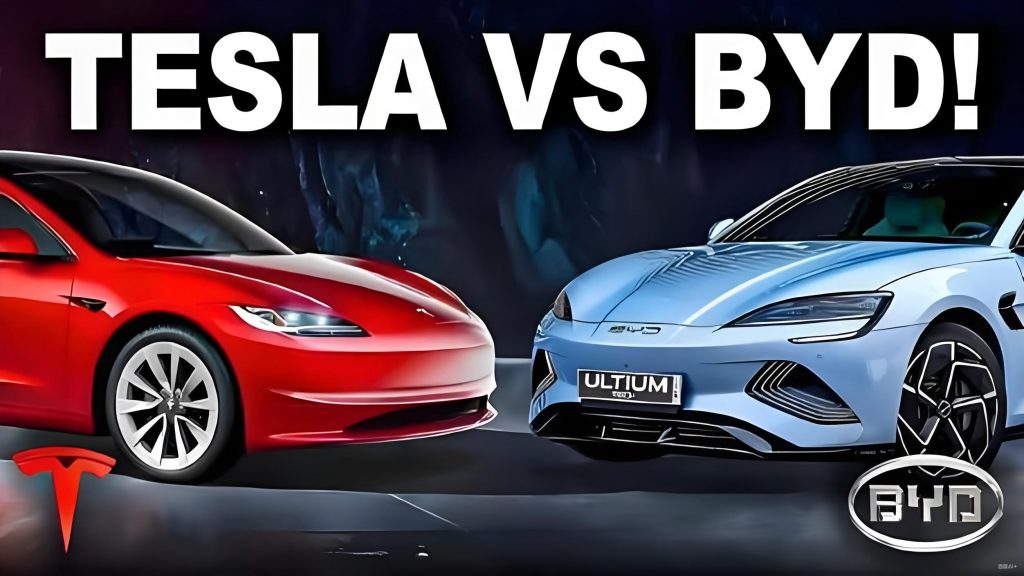
Looking ahead, the Tesla vs BYD competition will intensify as both companies innovate. Tesla is deploying engineers to optimize algorithms for Chinese scenarios, such as dedicated bus lanes and sudden pedestrian appearances, while BYD focuses on scaling its technology across mass-market models. Policy developments, like Shenzhen’s L3 accident liability laws, add another layer of complexity, pushing both players to enhance safety redundancies. The evolutionary trajectory of these systems can be modeled using a logistic growth function:
$$ M(t) = \frac{K}{1 + e^{-r(t – t_0)}} $$
where \( M(t) \) is the market penetration of autonomous features, \( K \) is the carrying capacity (maximum adoption in China), \( r \) is the growth rate influenced by factors like data localization, and \( t_0 \) is the time of FSD’s introduction. For Tesla, achieving data localization闭环训练 is critical to improving \( r \), but geopolitical constraints on data transfer to the U.S. pose significant hurdles. In contrast, BYD benefits from inherent localization, allowing faster iteration cycles.
In conclusion, the Tesla vs BYD dynamic is not merely a technological contest but a broader struggle for market dominance in the world’s largest automotive arena. As a commentator, I believe this rivalry will drive unprecedented innovation, benefiting consumers with safer, more affordable autonomous solutions. However, Tesla must address its data and adaptability gaps to avoid being overshadowed by nimble local players like BYD. The future of autonomous driving in China will be shaped by this ongoing Tesla vs BYD narrative, where collaboration and competition coexist to push the boundaries of what is possible.