
In recent years, electric vehicles have become widely adopted, with power batteries serving as a core component. The performance and stability of these batteries directly impact vehicle safety and lifespan, making fault diagnosis and exclusion critically important in EV repair. I will explore the architecture of electric vehicle power battery systems, analyze common fault types, and detail diagnostic and exclusion methods to enhance repair efficiency and safety in electrical car repair. This comprehensive approach aims to address the growing demands of the automotive industry for reliable and sustainable solutions.
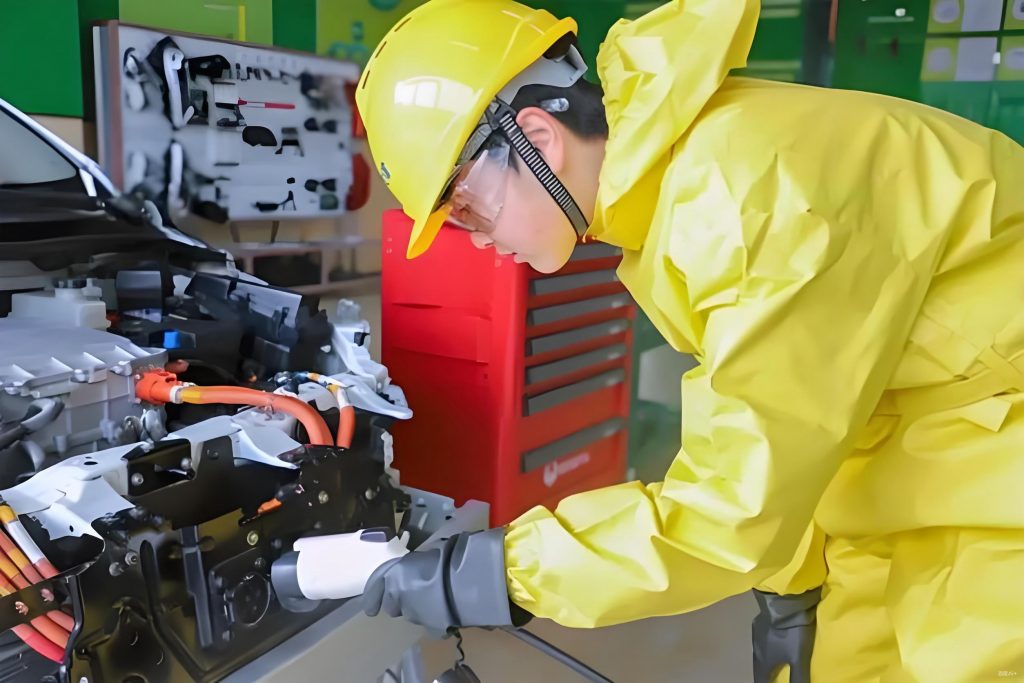
The power battery system in electric vehicles consists of three main parts: the battery pack, the Battery Disconnect Unit (BDU), and the Battery Management System (BMS). When designing this system, factors such as voltage platform requirements, power performance standards, and driving range targets are carefully considered to select appropriate cell types and optimize module structures. This ensures that the vehicle meets operational performance goals, which is essential for effective EV repair. The BDU integrates key functional modules like fuses, relays, and pre-charge circuits, connecting via high-voltage connectors and harnesses to components such as motors and onboard chargers. This setup provides robust control over charging and discharging processes, addressing complex demands in electrical car repair. The BMS, comprising control boards, sensors, and communication harnesses, plays a central role in safety management. It performs real-time fault diagnosis, monitors battery parameters, regulates cell balancing, assesses state of charge, and manages data storage. Additionally, the BMS controls charging and discharging sequences, monitors insulation status, executes high-voltage interlock checks, and triggers safety alarms when necessary, all of which are vital for reliable EV repair operations.
| Component | Key Functions | Role in EV Repair |
|---|---|---|
| Battery Pack | Stores energy, consists of cells and modules optimized for performance and range. | Focus on cell selection and module integrity during diagnostics. |
| Battery Disconnect Unit (BDU) | Integrates fuses, relays, pre-charge circuits; manages high-voltage connections. | Critical for isolating faults in charging/discharging in electrical car repair. |
| Battery Management System (BMS) | Monitors parameters, performs fault diagnosis, ensures safety controls. | Central to diagnostic processes in EV repair, using data for exclusion. |
Common fault types in electric vehicle power batteries include temperature anomalies, insulation faults, and voltage abnormalities, each posing unique challenges in EV repair. Temperature anomalies often arise from散热系统 failures, such as malfunctioning fans or clogged散热器s, BMS sensor errors, internal cell issues like short circuits, or extreme environmental conditions. For instance, in electrical car repair, overheating can lead to reduced battery life or safety hazards, while low temperatures may cause charging inefficiencies. Insulation faults typically result from worn wiring, moisture ingress due to poor sealing, or corroded connections, which can trigger warnings and power interruptions. Voltage abnormalities, such as over-voltage or under-voltage in individual cells, are frequently caused by data采集 errors, BMS均衡 failures, or cell degradation. These faults necessitate precise diagnostic approaches in EV repair to prevent further damage.
| Fault Type | Common Causes | Potential Impacts |
|---|---|---|
| Temperature Anomalies | 散热系统 failure, BMS sensor faults, internal shorts, environmental factors. | Reduced performance, safety risks, shortened lifespan—key concerns in EV repair. |
| Insulation Faults | Worn wiring, moisture ingress, loose or corroded connections. | Power loss, insulation resistance drop, critical in electrical car repair safety. |
| Voltage Abnormalities | Data采集 errors, BMS均衡 issues, cell capacity loss or self-discharge. | Charging/discharging failures, protection triggers—common in EV repair scenarios. |
The fault diagnosis process in EV repair involves reading fault information, testing battery parameters, and conducting拆解检查 when necessary. Initially, technicians use diagnostic tools to retrieve fault codes (DTCs) from the BMS, such as those indicating initialization errors or sensor failures. This step, combined with visual inspections and parameter monitoring, helps identify whether issues lie in the battery pack, BMS, or other components. For example, in electrical car repair, diagnosing a “P1A40-00” code might point to a temperature sensor fault, guiding subsequent tests. Battery parameter testing is crucial and includes measuring单体电池 voltage, current, temperature, and insulation resistance. Key formulas used in this phase ensure accuracy: for charging, the maximum单体电池 voltage should satisfy $$V_{\text{max,charge}} < 3.8 \, \text{V}$$; for discharge protection, the断电保护 voltage is $$V_{\text{cell}} < 2.2 \, \text{V}$$ and the system alarm voltage is $$V_{\text{cell}} < 2.4 \, \text{V}$$. Insulation resistance must exceed $$R_{\text{insulation}} > 100 \, \Omega/\text{V}$$, calculated based on standard testing procedures. If non-invasive methods fail,拆解检查 is performed under safe conditions—disconnecting the battery, wearing protective gear, and inspecting for physical damage, leaks, or connection issues. This thorough approach in EV repair ensures precise fault localization.
| Step | Tools/Methods | Purpose |
|---|---|---|
| Fault Information Reading | Diagnostic tools, DTC retrieval, parameter monitoring. | Identify fault type and location in electrical car repair. |
| Battery Parameter Testing | Multimeters, insulation testers, thermal imagers. | Measure voltage, current, temperature, insulation—key in EV repair. |
| Battery拆解检查 | Visual inspection, component replacement tests. | Locate internal faults not detectable externally in EV repair. |
Fault exclusion methods in electrical car repair target specific issues like temperature anomalies, insulation faults, and voltage abnormalities. For temperature-related problems, technicians address overheating by cleaning散热器s, testing fans, and using thermal imaging to spot faulty cells or sensors. In cases of low temperatures, they check保温层 integrity and employ pre-heating systems, adjusting charging methods to avoid lithium plating—a common concern in EV repair. The formula for temperature protection during charging is often based on thresholds, such as triggering protection when $$T_{\text{battery}} > 65^\circ \text{C}$$. Insulation fault exclusion involves measuring insulation resistance with specialized tools, inspecting for cracks, moisture, or worn wiring, and sealing gaps to prevent shorts. For instance, if insulation resistance falls below $$R_{\text{insulation}} < 100 \, \Omega/\text{V}$$, repairs focus on replacing damaged components. Voltage abnormalities are resolved by testing单体电池 voltages against standards, checking connections, and performing internal resistance tests. If a cell shows significant deviation, it may need replacement, or BMS software updates might be applied. In all cases, EV repair emphasizes safety, with technicians using insulated tools and following protocols to mitigate risks.
| Fault Type | Exclusion Methods | Tools and Formulas |
|---|---|---|
| Temperature Anomalies | Clean散热系统, replace fans/sensors, use thermal imaging, adjust charging. | Thermal imagers, multimeters; $$T_{\text{battery}} > 65^\circ \text{C}$$ for protection. |
| Insulation Faults | Measure resistance, inspect seals/wiring, repair or replace components. | Insulation testers; maintain $$R_{\text{insulation}} > 100 \, \Omega/\text{V}$$ in EV repair. |
| Voltage Abnormalities | Test单体电池 voltages, check connections, update BMS, replace cells. | Multimeters, BMS tools; enforce $$V_{\text{cell}} < 2.4 \, \text{V}$$ for alarms. |
Comprehensive fault investigation and prevention in EV repair involve addressing performance degradation, charging anomalies, and communication issues. Technicians start by analyzing historical data, such as charge-discharge cycles and depth of discharge, to assess battery health. For charging problems, they inspect chargers, interfaces, and BMS strategies, while communication faults require checking线路 and protocols. Preventive measures include regular均衡性 testing, insulation checks, and cooling system validations. In electrical car repair, training drivers on proper battery maintenance—like avoiding deep discharges—can reduce faults. Additionally, maintaining detailed records of usage and repairs supports future diagnostics. This holistic approach not only resolves immediate issues but also extends battery life, highlighting the importance of proactive strategies in EV repair.
In summary, the methods outlined for diagnosing and excluding faults in electric vehicle power batteries provide a robust framework for improving repair outcomes. By integrating systematic testing, precise formulas, and safety protocols, technicians in EV repair can enhance efficiency and ensure vehicle reliability. As the adoption of electric vehicles grows, mastering these techniques will be essential for advancing electrical car repair practices and supporting sustainable transportation.