
As an experienced professional in the field of electrical car repair, I have observed that voltage imbalance in power batteries is a common issue in electric vehicles (EVs). This problem significantly impacts battery pack performance and vehicle range, making it a critical area of focus in EV repair. In this article, I will analyze the causes of voltage imbalance, discuss diagnostic techniques, and explore repair methods, all from a first-person perspective. I will incorporate tables and formulas to summarize key points, ensuring a comprehensive understanding for practitioners in electrical car repair.
Voltage imbalance occurs when individual cells in a battery pack exhibit differences in voltage, leading to reduced efficiency and potential safety hazards. In my work, I have found that this imbalance stems from several factors, including cell inconsistency, improper battery management system (BMS) control strategies, and external environmental conditions. Addressing these issues is essential for effective EV repair, as it helps maintain battery health and prolongs the lifespan of electric vehicles.
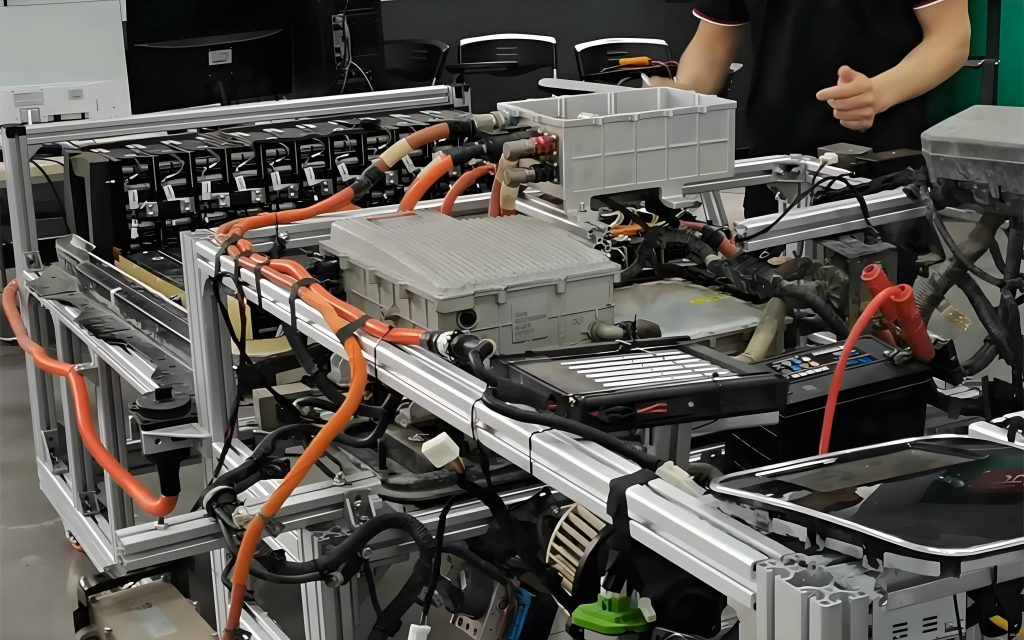
One primary cause of voltage imbalance is the inconsistency among individual cells. Even cells from the same production batch can vary in capacity and internal resistance due to manufacturing tolerances. When these cells are connected in series, those with lower capacity or higher resistance reach full charge or discharge earlier, creating voltage differences. This inconsistency accelerates over time, exacerbating the imbalance and necessitating frequent EV repair interventions. For instance, after hundreds of cycles, a minor initial capacity difference can amplify, leading to significant performance degradation. Improving cell consistency through advanced manufacturing processes is crucial, but in electrical car repair, we often deal with the aftermath of such variations.
To quantify cell inconsistency, we can use statistical measures. Let the capacity of each cell be denoted as $C_i$, where $i$ ranges from 1 to $n$ for a battery pack with $n$ cells. The standard deviation of capacities, $\sigma_C$, indicates the level of inconsistency:
$$\sigma_C = \sqrt{\frac{1}{n} \sum_{i=1}^{n} (C_i – \bar{C})^2}$$
where $\bar{C}$ is the mean capacity. A higher $\sigma_C$ value suggests greater inconsistency, which correlates with increased voltage imbalance risk. In EV repair, monitoring this parameter helps in early diagnosis.
| Cause | Description | Effect on Voltage Imbalance |
|---|---|---|
| Manufacturing Variations | Differences in electrode thickness or electrolyte composition | Leads to divergent aging rates and capacity fade |
| Usage Patterns | Irregular charging and discharging cycles | Causes uneven stress on cells, amplifying differences |
| Environmental Exposure | Temperature fluctuations during operation | Alters internal resistance and self-discharge rates |
Another significant factor is the BMS control strategy. The BMS acts as the brain of the battery pack, monitoring parameters like voltage, current, and temperature. However, if the BMS employs inadequate均衡 algorithms or uses suboptimal components, it can worsen voltage imbalances. In my experience with electrical car repair, I have seen cases where poor BMS design led to overcharging of certain cells, increasing the压差. Adaptive均衡 strategies, which adjust based on state-of-charge (SOC) and temperature, are essential. For example, the均衡 current $I_{bal}$ can be modeled as:
$$I_{bal} = k \cdot (V_{max} – V_{min})$$
where $V_{max}$ and $V_{min}$ are the maximum and minimum cell voltages, and $k$ is a gain factor determined by the BMS. This approach helps in maintaining balance during charging and discharging, reducing the need for extensive EV repair.
External temperature also plays a critical role in voltage imbalance. Batteries are sensitive to thermal conditions; low temperatures increase internal resistance, while high temperatures accelerate aging. The internal resistance $R_{int}$ of a cell can be expressed as a function of temperature $T$:
$$R_{int}(T) = R_0 \cdot e^{\frac{E_a}{k_B T}}$$
where $R_0$ is the baseline resistance, $E_a$ is the activation energy, and $k_B$ is Boltzmann’s constant. Temperature gradients across the battery pack cause non-uniform behavior, leading to压差. In EV repair, implementing effective thermal management systems, such as liquid cooling, is vital to mitigate this issue.
Moving on to diagnostic techniques, voltage-based methods are widely used in electrical car repair. By采集 cell voltages, we can detect imbalances early. Common approaches include total voltage sampling, multiplexed sampling, and independent sampling. Each has its advantages and limitations, as summarized in the table below.
| Method | Description | Advantages | Disadvantages |
|---|---|---|---|
| Total Voltage Sampling | Measures total pack voltage and divides by cell count | Simple circuit, low cost | Low accuracy, cannot detect individual cell issues |
| Multiplexed Sampling | Uses switches to sample cells sequentially | Balances cost and precision | Longer sampling周期 |
| Independent Sampling | Each cell has dedicated sampling circuit | High speed and accuracy | Complex design, higher cost |
In practice, I often use independent sampling for precise diagnosis in EV repair, as it allows real-time monitoring of each cell’s voltage $V_i$. The压差 $\Delta V$ can be calculated as:
$$\Delta V = \max(V_i) – \min(V_i)$$
If $\Delta V$ exceeds a threshold, say 50 mV, it indicates a potential imbalance requiring attention.
Internal resistance testing is another valuable diagnostic tool in electrical car repair. As cells age, their internal resistance increases, contributing to压差. DC internal resistance testing involves applying a constant current $I_{test}$ and measuring the voltage change $\Delta V_{test}$:
$$R_{dc} = \frac{\Delta V_{test}}{I_{test}}$$
This method is straightforward but can be affected by operational conditions. Alternatively, AC impedance spectroscopy provides a more detailed analysis by measuring impedance across frequencies, yielding parameters like charge transfer resistance and double-layer capacitance. For example, the impedance $Z(f)$ at frequency $f$ can be fitted to an equivalent circuit model to assess cell health.
Model-based diagnosis is gaining traction in advanced EV repair systems. By developing mathematical models of the battery pack, we can predict压差 before it becomes critical. Equivalent circuit models (ECMs) use resistors and capacitors to simulate battery behavior. A common ECM includes a voltage source $V_{oc}$ (open-circuit voltage), series resistance $R_s$, and RC pairs representing polarization effects. The terminal voltage $V_t$ is given by:
$$V_t = V_{oc} – I \cdot R_s – V_{p}$$
where $V_{p}$ is the polarization voltage. ECMs are computationally efficient but lack mechanistic depth. In contrast, electrochemical models (EChMs), such as the pseudo-two-dimensional (P2D) model, describe ion diffusion and reaction kinetics using partial differential equations. For instance, the lithium concentration $c_s$ in solid particles can be modeled as:
$$\frac{\partial c_s}{\partial t} = D_s \nabla^2 c_s$$
where $D_s$ is the diffusion coefficient. These models help in identifying subtle changes that lead to压差, enabling proactive EV repair.
When it comes to repair techniques, discharge均衡 is a common method in electrical car repair. It involves dissipating excess energy from overcharged cells to balance the pack. The energy dissipated $E_{diss}$ can be expressed as:
$$E_{diss} = \int I_{bal} \cdot V_{cell} dt$$
where $I_{bal}$ is the均衡 current and $V_{cell}$ is the cell voltage. Passive均衡 uses resistors to burn off energy, while active均衡, such as inductor-based transfer, moves energy between cells. For example, in an inductor均衡 circuit, the energy transfer efficiency $\eta$ is:
$$\eta = \frac{P_{out}}{P_{in}}$$
where $P_{out}$ is the power delivered to the undercharged cell and $P_{in}$ is the power from the overcharged cell. This approach minimizes energy loss, making it favorable in EV repair.
Battery重组 is another technique I employ in electrical car repair for severe cases where cells have irreversible degradation. This involves replacing faulty cells and reassembling the pack with matched cells. The goal is to ensure that the new cells have similar characteristics to the existing ones. The capacity matching criterion can be defined as:
$$|C_{new} – C_{avg}| < \delta$$
where $C_{new}$ is the capacity of the new cell, $C_{avg}$ is the average capacity of the pack, and $\delta$ is a tolerance value, typically 2-5%. Automated systems in modern EV repair facilities use robotics for precise welding and assembly, reducing human error.
Short-circuit detection and isolation are critical for safety in electrical car repair. Internal shorts can cause rapid voltage drops and thermal runaway. Detection algorithms monitor voltage derivatives or temperature changes. For instance, the voltage derivative $\frac{dV}{dt}$ can indicate a short if it falls below a threshold:
$$\frac{dV}{dt} < -\alpha$$
where $\alpha$ is a positive constant. Similarly, temperature rise rate $\frac{dT}{dt}$ can signal thermal issues:
$$\frac{dT}{dt} > \beta$$
Once detected, the faulty cell must be isolated using switches or fuses to prevent cascading failures. This proactive approach is essential in EV repair to avoid catastrophic events.
Looking ahead, intelligent BMS with self-learning capabilities will revolutionize EV repair. Machine learning algorithms can analyze historical data to predict压差 and optimize均衡 strategies. For example, a neural network can be trained to estimate SOC and health state, reducing the need for manual intervention. Additionally, connected BMS platforms enable remote monitoring and predictive maintenance, allowing for timely EV repair before issues escalate. Data-driven models, such as support vector machines or recurrent neural networks, can process vast datasets to identify patterns associated with voltage imbalance.
In conclusion, voltage imbalance in power batteries is a multifaceted challenge in electrical car repair. By understanding its causes, applying advanced diagnostics, and implementing effective repair methods, we can enhance the reliability and longevity of electric vehicles. As technology evolves, integrating smart systems will further streamline EV repair processes, making them more efficient and proactive. Through continuous learning and adaptation, I am committed to advancing the field of EV repair, ensuring that electric vehicles remain a sustainable transportation solution.