
As an experienced professional in the automotive industry, I have witnessed the rapid evolution of electric vehicles (EVs) and the growing importance of electronic diagnosis in electrical car repair. The shift from traditional internal combustion engines to sophisticated electric powertrains has introduced unique challenges, making electronic diagnosis not just an option but a necessity for efficient and accurate repairs. In this article, I will delve into the applications, benefits, and practical implementations of electronic diagnosis in EV repair, drawing from my firsthand experiences to highlight how this technology is transforming the landscape of electrical car repair. By incorporating tables, formulas, and real-world examples, I aim to provide a comprehensive guide that underscores the critical role of electronic diagnosis in maintaining and repairing modern electric vehicles.
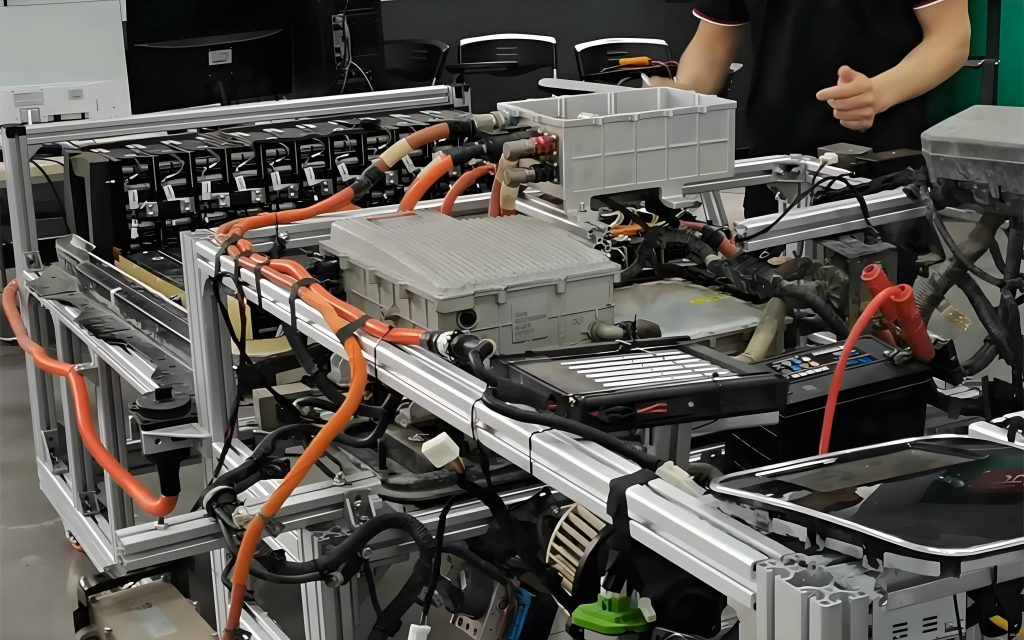
The rise of electric vehicles has brought about a paradigm shift in automotive repair, where electronic systems dominate over mechanical components. In my work, I rely heavily on electronic diagnosis to address issues in EV repair, such as battery management, motor control, and complex circuitry. Unlike traditional methods, electronic diagnosis allows for non-invasive testing, reducing downtime and costs. For instance, when dealing with a faulty battery in an electrical car repair scenario, I use diagnostic tools to measure state of charge (SOC) and state of health (SOH). The SOC can be calculated using the formula: $$ SOC = \frac{Q_{remaining}}{Q_{max}} \times 100\% $$ where \( Q_{remaining} \) is the remaining charge and \( Q_{max} \) is the maximum capacity. Similarly, SOH is determined by: $$ SOH = \frac{C_{actual}}{C_{rated}} \times 100\% $$ where \( C_{actual} \) is the current capacity and \( C_{rated} \) is the rated capacity. These metrics are crucial for assessing battery performance and predicting failures in EV repair.
One of the key aspects I emphasize in electrical car repair is the application value of electronic diagnosis. It enables rapid fault identification, preventive maintenance, enhanced safety, improved customer experience, and remote support. To illustrate this, I often refer to a table that summarizes these values, which I have compiled based on my observations in various EV repair cases.
| Value | Description | Impact on Electrical Car Repair |
|---|---|---|
| Rapid Fault Diagnosis | Quick identification of issues in ECUs, BMS, and MCU through error codes and data streams. | Reduces repair time by up to 50%, minimizing vehicle downtime. |
| Preventive Maintenance | Early detection of potential failures using historical data and predictive algorithms. | Extends vehicle lifespan and prevents costly breakdowns in EV repair. |
| Safety Enhancement | Monitoring critical systems like brakes and batteries to prevent hazards. | Lowers risk of accidents and ensures compliance with safety standards in electrical car repair. |
| Customer Experience | Providing detailed reports and faster service turnaround. | Increases trust and satisfaction, fostering repeat business in EV repair. |
| Remote Diagnosis | Cloud-based access to data and expert support for on-site technicians. | Enables efficient repairs in remote areas, enhancing scalability of electrical car repair services. |
In my daily practice of EV repair, I apply electronic diagnosis to various systems, starting with the motor drive system. When a vehicle exhibits issues like poor acceleration or unusual noises, I connect diagnostic tools to the OBD-II port to retrieve fault codes from the motor control unit (MCU). For example, if the motor overheats, the diagnostic system might flag a code related to temperature sensors. I then analyze real-time data streams to pinpoint the root cause, such as a failing inverter or worn-out bearings. The power output of the motor can be modeled using: $$ P = V \times I $$ where \( P \) is power, \( V \) is voltage, and \( I \) is current. By comparing expected and actual values, I can identify deviations indicative of faults. This approach has proven invaluable in electrical car repair, as it allows for targeted interventions without unnecessary disassembly.
Another critical area in EV repair is the diagnosis of power battery systems. Batteries are the heart of electric vehicles, and their complexity demands advanced diagnostic techniques. I often encounter cases where batteries fail to charge, which can stem from issues like damaged preheating fuses or degraded cells. Using electronic diagnosis, I assess parameters such as internal resistance and voltage drop. The internal resistance \( R_{internal} \) can be estimated from: $$ R_{internal} = \frac{V_{open} – V_{load}}{I_{load}} $$ where \( V_{open} \) is the open-circuit voltage and \( V_{load} \) is the voltage under load. This helps in evaluating battery health and planning replacements. Additionally, I use tables to track battery performance over time, as shown below, which aids in preventive maintenance for electrical car repair.
| Parameter | Normal Range | Fault Indicator | Diagnostic Action in Electrical Car Repair |
|---|---|---|---|
| Voltage | 300-400 V | Below 250 V | Check for cell imbalance or short circuits. |
| Temperature | 15-35°C | Above 45°C | Inspect cooling system and thermal management. |
| State of Health (SOH) | 80-100% | Below 70% | Recommend battery replacement or reconditioning. |
| Charge Rate | 1-2 C | Fluctuating | Diagnose charging circuitry and BMS faults. |
Circuit diagnosis is another domain where electronic diagnosis excels in EV repair. The intricate wiring and numerous electronic control units (ECUs) in electric vehicles make circuit faults common and challenging to trace. I employ diagnostic scanners to measure resistance, capacitance, and signal integrity across circuits. For instance, if a vehicle experiences intermittent power loss, I might use the formula for voltage drop: $$ V_{drop} = I \times R $$ where \( I \) is current and \( R \) is resistance, to identify high-resistance connections. This method is essential in electrical car repair for isolating faults in power distribution networks or communication buses like CAN. By integrating these diagnostics, I can quickly resolve issues that would otherwise require extensive manual testing.
In the realm of electronic control systems, such as the anti-lock braking system (ABS), electronic diagnosis plays a pivotal role in ensuring safety during EV repair. When the ABS warning light remains illuminated, I access the system’s ECU to retrieve fault codes and data logs. The braking force can be analyzed using: $$ F = m \times a $$ where \( F \) is force, \( m \) is mass, and \( a \) is deceleration. By correlating sensor data with expected values, I can detect anomalies like worn brake pads or faulty wheel speed sensors. This proactive approach in electrical car repair not only fixes immediate issues but also prevents potential accidents, highlighting the life-saving potential of electronic diagnosis.
Moving to application essentials, remote detection has revolutionized how I handle EV repair. With cloud-connected diagnostic systems, I can monitor vehicles in real-time, receiving alerts for anomalies such as battery overvoltage or motor overload. For example, if a remote system detects repeated faults in a vehicle’s charging system, it might trigger an alarm and initiate a diagnostic sequence. The probability of a fault occurring can be modeled using a Poisson distribution: $$ P(k) = \frac{\lambda^k e^{-\lambda}}{k!} $$ where \( P(k) \) is the probability of \( k \) faults in a given time, and \( \lambda \) is the average fault rate. This statistical approach helps in prioritizing repairs and allocating resources efficiently in electrical car repair operations.
Intelligent diagnosis systems represent the next frontier in EV repair, combining artificial intelligence with electronic data to enhance accuracy. In my experience, these systems use machine learning algorithms to predict failures based on historical data. For instance, a neural network might analyze patterns in battery degradation to forecast replacement needs. The error in prediction can be minimized using gradient descent: $$ \theta_{new} = \theta_{old} – \alpha \nabla J(\theta) $$ where \( \theta \) represents model parameters, \( \alpha \) is the learning rate, and \( J(\theta) \) is the cost function. By integrating such models, I can offer predictive maintenance plans that reduce unexpected breakdowns in electrical car repair, ultimately saving time and money for customers.
Fault data analysis is a cornerstone of effective EV repair, and I leverage electronic diagnosis to collect and interpret vast amounts of information. By building fault models, I can identify common issues and their root causes. For example, I might use a table to categorize faults based on frequency and severity, which guides my diagnostic strategy in electrical car repair.
| Fault Type | Frequency | Severity | Common Causes in Electrical Car Repair |
|---|---|---|---|
| Battery Failure | High | Critical | Cell imbalance, thermal runaway, aging. |
| Motor Issues | Medium | High | Overheating, bearing wear, inverter faults. |
| Circuit Faults | High | Medium | Short circuits, corrosion, loose connections. |
| Control System Errors | Low | Critical | Software bugs, sensor failures, ECU malfunctions. |
To further optimize electrical car repair, I apply formulas like the failure rate \( \lambda \) from reliability engineering: $$ \lambda = \frac{1}{MTBF} $$ where MTBF is mean time between failures. This helps in scheduling maintenance and stocking spare parts, ensuring that my EV repair services are both proactive and efficient.
In conclusion, electronic diagnosis has become an indispensable tool in my arsenal for EV repair, enabling precise, efficient, and safe maintenance of electric vehicles. From motor systems to batteries and circuits, the integration of diagnostic technologies has elevated the standards of electrical car repair, reducing costs and enhancing customer trust. As the EV industry continues to grow, I believe that advancements in electronic diagnosis will further streamline repair processes, making electrical car repair more accessible and reliable. Through continuous learning and adaptation, I am committed to leveraging these technologies to address the evolving challenges in EV repair, ultimately contributing to a sustainable automotive future.