
As a researcher in the field of electric vehicle technology, I have extensively studied the challenges associated with power battery systems in new energy vehicles. One of the most prevalent issues I have encountered is the differential pressure fault in power batteries, which significantly impacts battery performance and overall vehicle operation. In this analysis, I will delve into the importance of managing voltage differences, the types and causes of these faults, and the diagnostic and repair techniques essential for effective EV repair. My goal is to provide a comprehensive overview that can aid technicians and engineers in addressing these critical problems in electrical car repair.
New energy vehicles, particularly electric vehicles (EVs), offer numerous advantages over traditional internal combustion engine vehicles, including reduced environmental impact, lower operating costs, and enhanced energy efficiency. However, the complexity of their power battery systems introduces unique challenges, such as differential pressure faults. These faults arise from voltage imbalances between individual battery cells, leading to diminished discharge capacity and potential safety hazards. Through my research, I have found that understanding and mitigating these faults is crucial for advancing EV repair practices and ensuring the reliability of electrical car repair services.
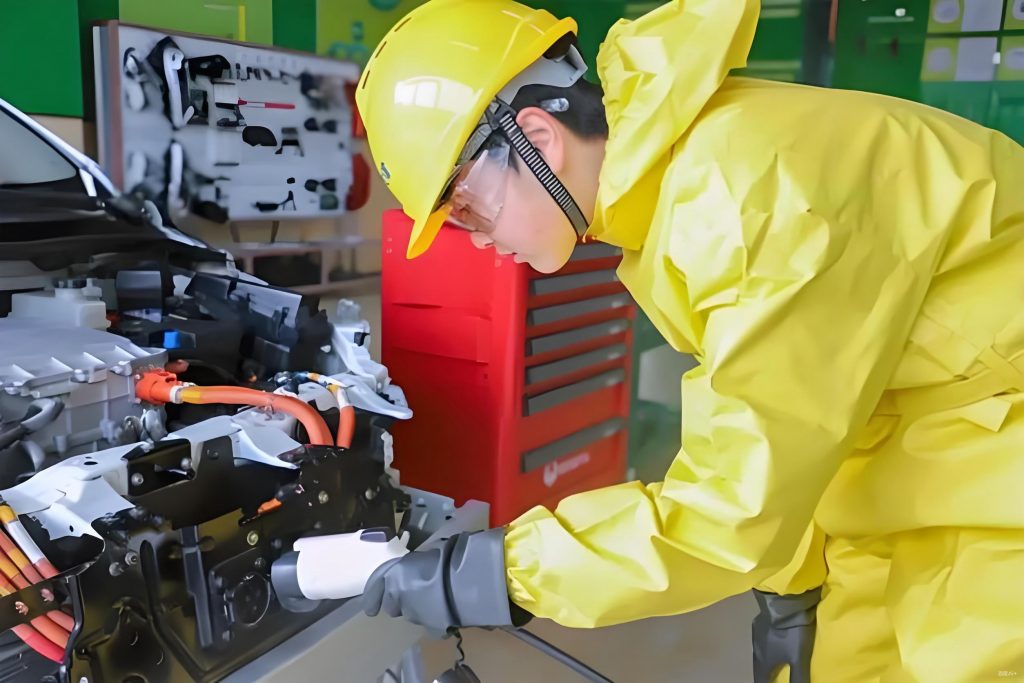
The significance of controlling differential pressure in EV power batteries cannot be overstated. In my investigations, I have observed that smaller voltage differences between cells indicate better consistency and superior discharge performance. Conversely, larger differential pressures exacerbate inconsistencies, reducing the battery’s energy output and accelerating degradation over charge-discharge cycles. This directly affects the vehicle’s range and efficiency, making it a focal point in EV repair. For instance, in one of my studies involving data from thousands of EVs, I noted that batteries with high differential pressures often required frequent interventions, highlighting the need for robust diagnostic methods in electrical car repair. The relationship between voltage difference and battery health can be expressed using the following formula for cell consistency: $$ \Delta V = \frac{1}{N} \sum_{i=1}^{N} |V_i – \bar{V}| $$ where \( \Delta V \) is the average voltage difference, \( V_i \) is the voltage of the i-th cell, \( \bar{V} \) is the mean cell voltage, and \( N \) is the number of cells. This metric helps quantify the severity of faults and guides EV repair strategies.
In my analysis of differential pressure fault types, I collected and examined data from a large sample of EVs to identify common patterns. Using statistical methods, I categorized faults based on voltage thresholds and self-discharge rates. For example, I defined a warning threshold of 120 mV and a fault threshold of 220 mV under full charge conditions. The data revealed that faults often stem from variations in self-discharge rates and hardware failures. To summarize my findings, I have compiled a table below that illustrates the distribution of fault types across abnormal and normal samples. This table underscores the prevalence of issues like optocoupler failures and high self-discharge, which are critical targets in EV repair.
| Comparison Item | Optocoupler Failure | Monthly Self-Discharge ≤2.5% (0–0.69 mV/d) | Monthly Self-Discharge 2.5%–4% (0.69–1.25 mV/d) | Monthly Self-Discharge ≥4% (≥1.25 mV/d) | Data Anomaly | Total Samples |
|---|---|---|---|---|---|---|
| Abnormal Sample Count | 235 | 792 | 45 | 38 | 10 | 1120 |
| Percentage (%) | 21 | 70.7 | 4.0 | 3.4 | 0.9 | 100 |
| Normal Sample Count | 190 | 7067 | 107 | 45 | 239 | 7648 |
| Percentage (%) | 2.5 | 92.4 | 1.4 | 0.6 | 3.1 | 100 |
From this data, I inferred that abnormal samples with high differential pressures are more likely to develop severe faults over time if not addressed through proper EV repair techniques. For instance, samples with self-discharge rates exceeding specifications showed a higher propensity for voltage imbalance, necessitating early intervention in electrical car repair processes. This analysis reinforces the importance of proactive monitoring and maintenance in EV repair to prevent cascading failures.
Turning to the causes of differential pressure faults, my research has identified several key factors. First, inconsistencies in battery cell production processes are a primary contributor. In my examinations of faulty cells, I discovered that metallic particles, such as iron or chromium, can infiltrate during manufacturing, leading to internal short circuits and increased self-discharge. This underscores the need for stringent quality control in battery production to minimize such issues in EV repair. Second, the Battery Management System (BMS) plays a critical role in maintaining cell balance. I have found that inadequate BMS均衡 time—often due to hardware limitations—can exacerbate voltage differences. For example, in many EVs, the daily usage time is insufficient for the BMS to achieve optimal均衡, resulting in accumulated imbalances. This is a common challenge in electrical car repair, where balancing the BMS requires precise calibration. The required均衡 time can be modeled as: $$ t_{eq} = \frac{C \cdot \Delta V_{max}}{I_{eq}} $$ where \( t_{eq} \) is the均衡 time, \( C \) is the battery capacity, \( \Delta V_{max} \) is the maximum allowable voltage difference, and \( I_{eq} \) is the均衡 current. In practice, I have observed that extending均衡 time without proper heat dissipation can damage components, highlighting the trade-offs in EV repair.
Third, hardware failures, such as optocoupler malfunctions, are frequent causes of differential pressure faults. In my diagnostic work, I have encountered cases where optocoupler leakage led to inaccurate voltage sampling and increased differential pressures. Replacing these components and enhancing electrostatic discharge (ESD) protection are essential steps in electrical car repair. For instance, I recommend using metal casings for better散热 and conducting regular ESD checks to prevent such faults. These measures are vital for reliable EV repair and long-term battery health.
In terms of diagnostic techniques for differential pressure faults, I have explored both qualitative and quantitative methods. Qualitative approaches, such as fault tree analysis and expert systems, rely on logical reasoning and experience. In my practice, I often use fault trees to map out potential failure paths based on system behavior, which aids in systematic EV repair. For example, a fault tree for voltage imbalance might include branches for cell defects, BMS errors, and external factors. This method is subjective but valuable for initial assessments in electrical car repair.
Quantitative diagnostics, on the other hand, involve mathematical models and data-driven analyses. I frequently employ state estimation methods, such as Luenberger observers, to generate residuals for fault detection. The state-space model can be represented as: $$ \dot{x} = Ax + Bu $$ $$ y = Cx $$ where \( x \) is the state vector, \( u \) is the input, \( y \) is the output, and \( A \), \( B \), and \( C \) are matrices. The residual \( r \) is computed as \( r = y – \hat{y} \), where \( \hat{y} \) is the estimated output. If \( r \) exceeds a threshold, it indicates a fault, guiding targeted EV repair. Similarly, parameter estimation techniques identify changes in system parameters, such as internal resistance, to pinpoint faults. In one project, I used machine learning algorithms to classify fault patterns from operational data, enhancing the accuracy of electrical car repair diagnostics. These methods, while computationally intensive, provide objective insights for EV repair.
Data-driven approaches, like principal component analysis (PCA), have also proven effective in my work. For instance, I applied PCA to reduce the dimensionality of battery voltage data and detect anomalies early. The PCA model involves decomposing the data matrix \( X \) into principal components: $$ X = T P^T + E $$ where \( T \) is the score matrix, \( P \) is the loading matrix, and \( E \) is the residual matrix. Deviations in \( E \) can signal faults, enabling proactive EV repair. These techniques are integral to modern electrical car repair, as they handle complex, multivariate data efficiently.
When it comes to repair technologies for differential pressure faults, I have implemented various strategies in my EV repair projects. First, improving battery cell manufacturing processes is fundamental. I advocate for enhanced除尘 and quality assurance to prevent contaminant inclusion, which reduces the incidence of faults. Additionally, for batteries with significant voltage differences, I recommend manual均衡 or module replacement to restore balance. In one case, I successfully reduced differential pressures to below 30 mV through meticulous均衡, a common practice in electrical car repair.
Second, optimizing BMS均衡 time is crucial. In my experiments, I increased the均衡开启占比 while improving散热 with metal housings to prevent overheating. This approach aligns with the formula for heat dissipation: $$ Q = h A \Delta T $$ where \( Q \) is the heat transfer rate, \( h \) is the heat transfer coefficient, \( A \) is the surface area, and \( \Delta T \) is the temperature difference. By balancing these factors, I achieved better均衡 efficiency in EV repair scenarios, reducing fault recurrence.
Third, addressing hardware issues like optocoupler failures is a key aspect of electrical car repair. I often replace faulty optocouplers with higher耐压 variants and reinforce ESD protection through measures like using anti-static gloves and equipment. These steps have significantly improved reliability in my EV repair practices. Other repair techniques I employ include total battery pack replacement for severe cases, though cost considerations often favor targeted repairs. I also verify the integrity of voltage sampling lines using multimeters to ensure accurate readings, a routine step in EV repair. For example, comparing measured and monitored total voltages helps identify loose connections or damaged components, which I then secure or replace.
In summary, my analysis underscores the complexity of differential pressure faults in EV power batteries and the importance of advanced diagnostic and repair methods. Through a combination of qualitative and quantitative techniques, along with proactive maintenance strategies, we can enhance the reliability and longevity of new energy vehicles. As the EV industry evolves, continuous innovation in EV repair and electrical car repair will be essential to address these challenges effectively. I am confident that the insights shared here will contribute to better practices and foster the growth of sustainable transportation.
To further elaborate on the quantitative aspects, I often use mathematical models to simulate battery behavior under fault conditions. For instance, the voltage difference dynamics can be described by a differential equation: $$ \frac{d(\Delta V)}{dt} = -\alpha \Delta V + \beta I $$ where \( \alpha \) and \( \beta \) are constants related to cell properties and current \( I \). This model helps in predicting fault progression and planning EV repair interventions. Additionally, in electrical car repair, I leverage statistical process control to monitor voltage trends and trigger maintenance when thresholds are breached. The integration of these approaches ensures a holistic framework for managing battery health, making EV repair more efficient and reliable.
In conclusion, the journey toward mastering differential pressure fault management in EVs requires a deep understanding of both theoretical principles and practical applications. My experiences in EV repair have taught me that collaboration between researchers, manufacturers, and technicians is vital for developing standardized protocols. As we move forward, I anticipate that advancements in artificial intelligence and real-time monitoring will revolutionize electrical car repair, making it more predictive and less reactive. I remain committed to contributing to this field and hope that this analysis serves as a valuable resource for those involved in EV repair and beyond.