
As electric vehicles (EVs) gain prominence due to their energy efficiency and environmental benefits, the motor drive system has emerged as a critical component influencing vehicle performance and safety. In my experience, the harsh operating conditions and frequent usage of EVs often lead to various failures in the motor drive system. Therefore, mastering the inspection, troubleshooting, and repair techniques for these systems is essential for effective EV repair. This article delves into the composition, working principles, common faults, diagnostic methods, and practical maintenance cases for electric vehicle motor drive systems, with a focus on enhancing skills in electrical car repair. I will use tables and formulas to summarize key concepts, ensuring a comprehensive understanding for professionals in the field.
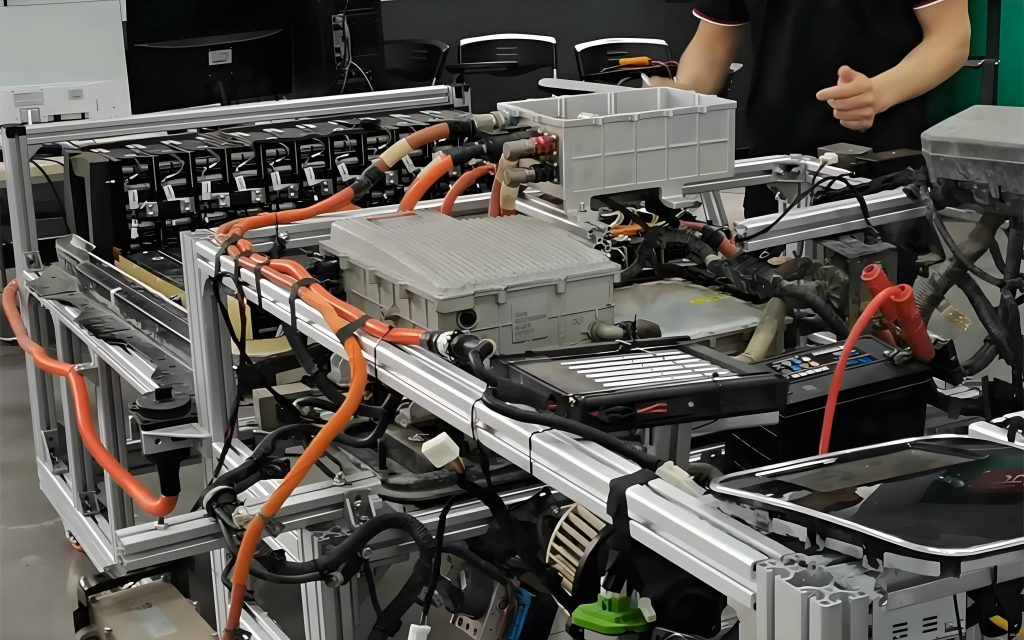
The motor drive system in an electric vehicle is responsible for converting electrical energy into mechanical motion, directly impacting acceleration, efficiency, and reliability. From my perspective, a thorough grasp of its components and operation is fundamental to any EV repair task. The system primarily consists of the motor, power converter, controller, and sensors. Each element plays a vital role: the motor transforms electrical energy into torque, the power converter adjusts voltage and current, the controller processes inputs for precise control, and sensors provide real-time feedback. Understanding these interactions is crucial for diagnosing issues in electrical car repair scenarios. For instance, the controller interprets driver commands and sensor data to compute the required voltage and current, which the power converter then uses to generate AC power for the motor. This process can be modeled using equations like the torque equation for motors: $$T = k_t \cdot I$$, where \(T\) is torque, \(k_t\) is the torque constant, and \(I\) is current. Such formulas are indispensable in EV repair for predicting system behavior under fault conditions.
To better illustrate the components, I have compiled Table 1, which outlines the key parts of the motor drive system, their functions, and common issues encountered in EV repair. This table serves as a quick reference for technicians involved in electrical car repair, helping them identify potential problem areas during inspections.
| Component | Function | Common Issues in EV Repair |
|---|---|---|
| Motor | Converts electrical energy to mechanical energy; types include DC, AC induction, and permanent magnet synchronous motors. | Winding short circuits, open circuits, bearing wear; these often require detailed inspection in electrical car repair. |
| Power Converter | Regulates voltage and current; typically involves inverters for DC to AC conversion. | IGBT failures, capacitor degradation; critical in EV repair for power stability. |
| Controller | Processes sensor data and driver inputs to control the power converter; the brain of the system. | Software errors, hardware faults like chip damage; a focus area in modern electrical car repair. |
| Sensors | Monitors parameters such as speed, position, and temperature; provides feedback for control. | Resolver or temperature sensor failures; often overlooked in EV repair but vital for accuracy. |
In terms of working principles, the motor drive system operates based on electromagnetic induction and control theory. For example, in a permanent magnet synchronous motor, the rotating magnetic field is generated by the stator windings, and the rotor follows synchronously. The power output can be expressed using the power equation: $$P = V \cdot I \cdot \cos(\phi)$$, where \(P\) is power, \(V\) is voltage, \(I\) is current, and \(\cos(\phi)\) is the power factor. This equation is frequently applied in EV repair to assess efficiency losses. Moreover, the controller uses algorithms, such as PID control, to maintain optimal performance: $$u(t) = K_p e(t) + K_i \int e(t) dt + K_d \frac{de(t)}{dt}$$, where \(u(t)\) is the control output, \(e(t)\) is the error, and \(K_p\), \(K_i\), \(K_d\) are gains. Understanding these principles is essential for effective electrical car repair, as they help in simulating faults and testing solutions.
Moving on to common fault types, I have observed that motor drive systems are prone to a range of issues due to thermal stress, mechanical wear, and electrical overloads. These faults can severely impact vehicle safety and performance, making prompt EV repair a priority. For instance, motor faults often involve winding failures, which may result from insulation breakdown or overheating. The resistance change in a short-circuited winding can be modeled with Ohm’s law: $$V = I \cdot R$$, where a drop in \(R\) indicates a short. Similarly, power converter faults, like IGBT failures, are common in EV repair and can be analyzed using switching loss formulas: $$P_{sw} = f_{sw} \cdot (E_{on} + E_{off})$$, where \(P_{sw}\) is switching power loss, \(f_{sw}\) is switching frequency, and \(E_{on}\) and \(E_{off}\) are energy losses during turn-on and turn-off. To provide a clear overview, Table 2 summarizes the typical faults, their causes, and implications for electrical car repair.
| Fault Type | Causes | Effects on System | Relevance to EV Repair |
|---|---|---|---|
| Motor Winding Short Circuit | Insulation damage, moisture, overheating; often due to prolonged use in harsh conditions. | Increased current, excessive heat, potential motor burnout; requires immediate attention in electrical car repair. | High; necessitates insulation testing and rewinding in EV repair procedures. |
| Motor Bearing Failure | Wear, lubrication issues, contamination; common in high-mileage EVs. | Noise, vibration, reduced efficiency; a frequent issue in EV repair that affects drivability. | Medium; involves replacement and alignment in electrical car repair. |
| Power Converter IGBT Damage | Overcurrent, overvoltage, thermal stress; exacerbated by rapid acceleration or braking. | Irregular output, system shutdown; critical in EV repair for power integrity. | High; requires module replacement and calibration in electrical car repair. |
| Controller Software Error | Programming bugs, data corruption; can arise from software updates or electromagnetic interference. | Unstable motor control, erratic behavior; a growing concern in modern EV repair. | High; involves reprogramming and debugging in electrical car repair. |
| Sensor Malfunction | Physical damage, calibration drift; often due to environmental exposure. | Inaccurate feedback, control errors; emphasizes the need for precision in EV repair. | Medium; requires sensor testing and replacement in electrical car repair. |
When it comes to fault diagnosis methods, I recommend a multi-faceted approach to ensure comprehensive EV repair. The intuitive inspection method involves visually examining the system for obvious signs like burns, cracks, or loose connections. This is a quick first step in electrical car repair but may miss internal issues. For more accurate detection, instrument-based methods are essential. Using a multimeter, oscilloscope, or insulation tester, technicians can measure parameters such as resistance, voltage waveforms, and insulation resistance. For example, the insulation resistance \(R_{ins}\) can be calculated as $$R_{ins} = \frac{V}{I_{leakage}}$$, where \(V\) is test voltage and \(I_{leakage}\) is leakage current. Values below thresholds indicate faults, guiding further EV repair actions. Functional testing, another key method, involves operating the system under various conditions—like startup, speed variation, and braking—to observe performance. This is particularly useful in electrical car repair for identifying intermittent issues. Lastly, fault code diagnosis leverages the built-in self-diagnostic system of EVs; reading codes via OBD-II scanners helps narrow down problems, streamlining the EV repair process. Table 3 compares these methods, highlighting their applications and limitations in electrical car repair.
| Method | Description | Tools Used | Advantages in EV Repair | Limitations |
|---|---|---|---|---|
| Intuitive Inspection | Visual check for external abnormalities; first line of defense in electrical car repair. | None or basic tools like magnifying glass. | Quick, low-cost; ideal for initial assessment in EV repair. | Misses internal faults; not sufficient for complex issues. |
| Instrument Detection | Measures electrical parameters using specialized devices; core of technical EV repair. | Multimeter, oscilloscope, insulation tester. | Accurate for electrical faults; essential for precise electrical car repair. | Requires expertise; time-consuming for comprehensive checks. |
| Functional Testing | Tests system operations under simulated conditions; validates performance in EV repair. | Diagnostic software, load testers. | Holistic view of system behavior; useful for functional electrical car repair. | May not isolate specific components; depends on test conditions. |
| Fault Code Diagnosis | Reads stored error codes from the system; modern approach to EV repair. | OBD-II scanner, proprietary tools. | Fast fault localization; improves efficiency in electrical car repair. | Limited to predefined codes; may not cover all scenarios. |
In practical maintenance cases, I have encountered numerous scenarios that underscore the importance of systematic EV repair. For example, a case involving motor winding short circuits typically begins with symptoms like abnormal heating and power loss. During diagnosis, I use an insulation resistance tester to measure the resistance between phases. If one phase shows a significantly lower value, say below 1 MΩ, it confirms a short circuit based on the formula $$R_{ins} < R_{threshold}$$, where \(R_{threshold}\) is the minimum acceptable insulation resistance. The repair involves disassembling the motor, replacing the damaged winding, and applying new insulation. Post-repair, I verify the fix by testing the motor under load, ensuring it meets original specifications—a critical step in electrical car repair to prevent recurrences.
Another common case in EV repair is power converter IGBT failure, often indicated by unusual noises and startup issues. Here, I employ an oscilloscope to analyze the output waveforms; distorted patterns suggest IGBT problems. The power loss in a faulty IGBT can be estimated using $$P_{loss} = I_c^2 \cdot R_{on}$$, where \(I_c\) is collector current and \(R_{on}\) is on-state resistance. After identifying the damaged module, I replace it and recalibrate the converter, followed by functional tests to ensure stable operation. This process highlights the iterative nature of electrical car repair, where diagnosis and correction go hand-in-hand.
Controller software faults represent a more modern challenge in EV repair. In one instance, erratic motor behavior was traced to a software glitch through fault code analysis. Using diagnostic equipment, I reflashed the controller software, applying updates to correct programming errors. The control algorithm’s stability can be checked using the Laplace transform for system response: $$G(s) = \frac{Y(s)}{U(s)}$$, where \(G(s)\) is the transfer function, \(Y(s)\) is output, and \(U(s)\) is input. This mathematical approach ensures that the repair restores precise control, a key aspect of electrical car repair in today’s connected vehicles.
Looking ahead, the field of EV repair is evolving towards intelligent diagnostics, modular maintenance, and standardized safety protocols. As an advocate for advanced electrical car repair, I believe that technicians must expand their knowledge beyond traditional mechanics to include power electronics and control theory. Formulas like those for efficiency $$\eta = \frac{P_{out}}{P_{in}} \times 100\%$$, where \(\eta\) is efficiency, \(P_{out}\) is output power, and \(P_{in}\) is input power, will become even more relevant in optimizing repairs. Moreover, the integration of AI and machine learning in diagnostic tools promises to revolutionize EV repair by predicting faults before they occur. In conclusion, mastering the motor drive system through a combination of theoretical understanding and hands-on practice is indispensable for anyone involved in electrical car repair. By applying the methods and cases discussed, technicians can enhance their skills, contributing to the reliability and sustainability of electric vehicles. This comprehensive approach to EV repair not only addresses current challenges but also prepares for future advancements in the automotive industry.