
As an expert in electrical car repair, I have encountered numerous cases where electric vehicle (EV) drive motors fail due to a variety of issues. In this comprehensive guide, I will delve into the common fault types, their underlying causes, and the essential repair techniques that are critical for maintaining EV performance and safety. The drive motor is the heart of an electric vehicle, and its reliability directly impacts the vehicle’s efficiency, longevity, and overall driving experience. Through my experience in EV repair, I have found that a systematic approach to diagnosis and repair can significantly reduce downtime and costs. This article aims to provide a detailed overview, incorporating tables and formulas to summarize key points, ensuring that professionals in electrical car repair can apply these insights effectively.
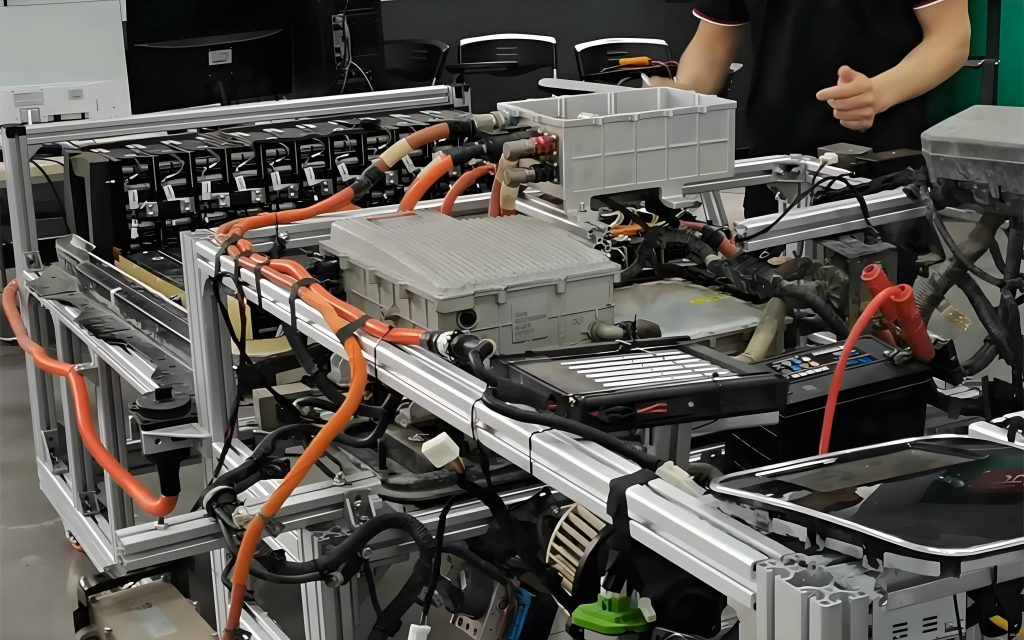
In the realm of EV repair, understanding the intricacies of drive motor faults is paramount. I will begin by exploring the common fault types, which I categorize into electrical, mechanical, and thermal management systems. Each category presents unique challenges that require specialized knowledge in electrical car repair. For instance, electrical faults often involve complex circuitry and insulation issues, while mechanical faults relate to physical wear and balance. Thermal management, on the other hand, deals with heat dissipation and sensor accuracy. By breaking down these areas, I hope to equip readers with a holistic view of EV drive motor maintenance, emphasizing the importance of proactive measures in electrical car repair to prevent catastrophic failures.
Common Fault Types in EV Drive Motors
In my work with EV repair, I have identified several recurring fault types that affect drive motors. These faults can be broadly classified into electrical system faults, mechanical system faults, and thermal management system faults. Each type has distinct causes and symptoms, which I will detail in this section. Understanding these is crucial for effective diagnosis in electrical car repair. For example, electrical faults might manifest as sudden power loss or erratic behavior, while mechanical faults often produce unusual noises or vibrations. Thermal issues, meanwhile, can lead to overheating and reduced efficiency. Below, I provide a summary table of common fault types and their primary causes, followed by in-depth discussions.
| Fault Category | Specific Fault | Primary Causes | Common Symptoms |
|---|---|---|---|
| Electrical System | Winding Faults | Insulation aging, short circuits, open circuits | Reduced power, overheating, electrical leaks |
| Inverter Control Failure | Signal abnormalities, power module overheating | Motor stalling, torque fluctuations | |
| Power Supply Issues | Voltage anomalies, contact problems | Insufficient output, sudden shutdowns | |
| Mechanical System | Bearing Wear | Lubrication failure, contamination, overloading | Increased vibration, noise |
| Rotor Imbalance | Manufacturing defects, fatigue fractures | Vibration, reduced efficiency | |
| Air Gap Irregularity | Misalignment, thermal deformation | Abnormal heating, efficiency drop | |
| Thermal Management | Cooling System Failure | Blockages, leaks, fan issues | Overheating, performance degradation |
| Temperature Sensor Drift | Long-term exposure to high temperatures | Inaccurate temperature readings, false alarms |
Electrical System Faults
In my experience with electrical car repair, electrical system faults are among the most prevalent issues in EV drive motors. These faults primarily involve the windings, inverter, and power supply modules. For instance, winding faults often result from insulation degradation due to prolonged high-temperature operation. This can lead to inter-turn short circuits or ground faults, compromising motor performance. I have seen cases where manufacturing defects, such as damaged enamel wires, exacerbate these problems. Additionally, environmental factors like humidity and dust accelerate insulation breakdown, increasing the risk of electrical leaks. In EV repair, it is essential to address these issues promptly to prevent further damage.
Another critical aspect is inverter control failure. The inverter, which converts DC power to AC for the motor, can suffer from drive signal abnormalities or power module overheating. For example, IGBT modules may experience overcurrent or overvoltage conditions, triggering protective shutdowns. This can cause the motor to stall unexpectedly, posing safety risks in electrical car repair scenarios. Moreover, electromagnetic interference can distort signals, leading to PWM modulation errors and torque fluctuations. To quantify this, the power loss in an inverter can be modeled using the formula for switching losses: $$ P_{sw} = f_{sw} \cdot (E_{on} + E_{off}) \cdot I^2 $$ where \( P_{sw} \) is the switching loss, \( f_{sw} \) is the switching frequency, \( E_{on} \) and \( E_{off} \) are the turn-on and turn-off energies, and \( I \) is the current. This highlights the importance of proper inverter maintenance in EV repair.
Power supply issues also play a significant role in electrical system faults. I have observed that voltage irregularities, such as low battery voltage due to cell imbalance, can reduce motor output power. Contact problems in high-voltage relays or pre-charge resistors can cause bus voltage spikes, leading to inverter protection triggers. In electrical car repair, verifying the power supply integrity is a fundamental step. The relationship between voltage and power output can be expressed as: $$ P_{out} = V \cdot I \cdot \eta $$ where \( P_{out} \) is the output power, \( V \) is the voltage, \( I \) is the current, and \( \eta \) is the efficiency. This formula underscores the need for stable voltage in EV drive systems.
Mechanical System Faults
Mechanical system faults in EV drive motors often stem from wear and tear on rotating components. As a practitioner in EV repair, I frequently deal with bearing wear, which is a common issue due to inadequate lubrication or contamination. For instance, lubricants can degrade under high temperatures, leading to increased friction and vibration. In one case, I measured vibration frequencies that exceeded acceptable limits, indicating severe bearing damage. The vibration velocity \( v \) can be related to the bearing condition using: $$ v = \frac{1}{2\pi} \sqrt{\frac{k}{m}} $$ where \( k \) is the stiffness and \( m \) is the mass. This emphasizes the need for regular lubrication checks in electrical car repair.
Rotor imbalance is another frequent mechanical fault I encounter in EV repair. This can arise from manufacturing imperfections like voids or inclusions, causing uneven mass distribution. Over time, fatigue from overloading can lead to broken bars or end rings, worsening the imbalance. The unbalanced force \( F \) can be calculated as: $$ F = m \cdot r \cdot \omega^2 $$ where \( m \) is the unbalanced mass, \( r \) is the radius, and \( \omega \) is the angular velocity. Addressing this requires dynamic balancing, which I will discuss in the repair section. Additionally, air gap irregularity between the stator and rotor can result from misalignment or thermal expansion. This increases magnetic reluctance and eddy current losses, leading to efficiency drops. The magnetic reluctance \( \mathcal{R} \) is given by: $$ \mathcal{R} = \frac{l}{\mu A} $$ where \( l \) is the length of the magnetic path, \( \mu \) is the permeability, and \( A \) is the cross-sectional area. In electrical car repair, ensuring proper alignment is crucial to minimize these issues.
Thermal Management System Faults
Thermal management system faults are critical in EV drive motors, as they can directly cause performance degradation or even motor burnout. In my EV repair practice, I often see cooling system failures, such as blockages in liquid cooling channels due to scale buildup or debris. This impedes heat dissipation, leading to uncontrolled temperature rises. For example, a clogged cooler can reduce the heat transfer coefficient, which is modeled by: $$ Q = h \cdot A \cdot \Delta T $$ where \( Q \) is the heat transfer rate, \( h \) is the heat transfer coefficient, \( A \) is the surface area, and \( \Delta T \) is the temperature difference. Regular maintenance, including coolant replacement, is vital in electrical car repair to prevent such issues.
Temperature sensor drift is another common thermal fault I deal with in EV repair. Sensors like PT100 or NTC thermistors can experience parameter shifts over time, especially in high-temperature environments. This leads to inaccurate readings, where the controller might trigger unnecessary protection measures or fail to detect actual overheating. The resistance-temperature relationship for an NTC thermistor is: $$ R(T) = R_0 \cdot e^{\beta \left( \frac{1}{T} – \frac{1}{T_0} \right)} $$ where \( R(T) \) is the resistance at temperature \( T \), \( R_0 \) is the reference resistance at \( T_0 \), and \( \beta \) is the material constant. Calibrating these sensors is a key step in electrical car repair to ensure accurate thermal monitoring. I have compiled a table below summarizing thermal fault causes and mitigation strategies.
| Fault Type | Root Cause | Impact | Repair Action |
|---|---|---|---|
| Cooling System Failure | Blockages, leaks, fan malfunctions | Overheating, efficiency loss | Flush channels, replace coolant |
| Sensor Drift | Long-term exposure to heat | Inaccurate readings, false alarms | Calibrate or replace sensors |
EV Drive Motor Repair Techniques
In this section, I will outline the essential repair techniques for EV drive motors, drawing from my extensive experience in electrical car repair. These methods focus on restoring functionality and ensuring long-term reliability. I will cover electrical system repairs, mechanical system repairs, and thermal management system repairs, each with specific steps and validations. The goal is to provide a practical guide that technicians in EV repair can follow, incorporating formulas and tables to standardize procedures. For instance, electrical repairs involve insulation testing and parameter matching, while mechanical repairs require precision balancing and alignment. Thermal repairs, on the other hand, emphasize cooling efficiency and sensor accuracy. By adhering to these techniques, professionals in electrical car repair can enhance motor performance and safety.
Electrical System Repair
When dealing with electrical system faults in EV repair, I always prioritize safety and parameter accuracy. For winding repairs, minor issues like surface insulation cracks can be addressed with epoxy impregnation. This involves cleaning the area thoroughly and applying the resin to restore insulation. After repair, I perform a withstand voltage test, applying 500 V AC for one minute to ensure no breakdown occurs. The insulation resistance \( R_{ins} \) should satisfy: $$ R_{ins} \geq \frac{V}{I_{leak}} $$ where \( V \) is the test voltage and \( I_{leak} \) is the leakage current. For severe faults like inter-turn short circuits, I recommend replacing the entire stator assembly. The new windings must match the original parameters, such as turns count and wire diameter, to maintain electromagnetic compatibility. In EV repair, verifying these parameters through no-load current tests is crucial.
Inverter module replacement is another critical aspect of electrical car repair. I follow a strict process: power disconnection, capacitor discharge, and calibration. Before installation, I ensure compatibility with the drive signals and heat sink. Then, I recalibrate control parameters like dead time and PWM frequency. For example, the dead time \( t_d \) can be optimized using: $$ t_d = \frac{Q_g}{I_g} $$ where \( Q_g \) is the gate charge and \( I_g \) is the gate current. After replacement, I use an oscilloscope to check the three-phase output waveforms, ensuring a 120-degree phase difference and symmetrical amplitudes. This prevents motor reversal or vibration, common issues in EV repair if not addressed properly.
Mechanical System Repair
Mechanical system repair in EV repair focuses on restoring precision and balance. For bearing replacement, I select identical models and verify fit tolerances. I prefer the hot mounting method, heating the bearing to 80–100°C to avoid damage during installation. Preload control is vital; I measure axial clearance to keep it below 0.05 mm. The preload force \( F_p \) can be estimated as: $$ F_p = k \cdot \delta $$ where \( k \) is the stiffness and \( \delta \) is the deflection. After assembly, I conduct a no-load run-in test at rated speed for two hours, monitoring temperature and vibration. This step is essential in electrical car repair to ensure smooth operation.
Rotor dynamic balancing is a key procedure I perform in EV repair to eliminate vibration sources. Using a two-plane balancing machine, I add counterweights to reduce the residual unbalance to within 1 g·mm/kg of rotor mass. The balancing process involves calculating the required mass \( m_c \) at a radius \( r_c \) using: $$ m_c \cdot r_c = m_u \cdot r_u $$ where \( m_u \) and \( r_u \) are the unbalance mass and radius. I then test the rotor across its speed range to validate vibration suppression, especially near critical speeds. This ensures stability in electrical car repair applications.
Thermal Management System Repair
Thermal management system repair in EV repair involves restoring cooling efficiency and calibrating sensors. For coolant replacement, I drain the old fluid and flush the channels with deionized water to remove deposits. In cases of stubborn scale, I use chemical cleaners like citric acid solutions, sometimes with ultrasonic assistance. After cleaning, I perform a pressure test to check for leaks, as even minor leaks can cause electrical shorts in EV drive motors. The pressure drop \( \Delta P \) across the system should be minimal, governed by: $$ \Delta P = \frac{f \cdot L \cdot \rho \cdot v^2}{2 \cdot D} $$ where \( f \) is the friction factor, \( L \) is the length, \( \rho \) is the density, \( v \) is the velocity, and \( D \) is the diameter. This highlights the importance of unobstructed flow in electrical car repair.
Temperature sensor calibration is another critical task in EV repair. I place sensors in a controlled temperature bath and compare their readings to a reference thermometer. If the error exceeds ±2°C, I replace the sensor. I also conduct dynamic response tests to assess lag, ensuring timely overheating protection. The time constant \( \tau \) for a sensor can be modeled as: $$ \tau = R \cdot C $$ where \( R \) is the thermal resistance and \( C \) is the thermal capacitance. Proper calibration in electrical car repair helps prevent false triggers and ensures accurate thermal management.
Conclusion
In summary, EV drive motor repair requires a meticulous approach that integrates technical standardization, precise parameter matching, and rigorous testing. From my perspective in electrical car repair, I emphasize the importance of addressing electrical, mechanical, and thermal faults with tailored strategies. Electrical repairs must adhere to insulation safety and signal integrity, mechanical repairs demand balanced components and proper alignment, and thermal repairs rely on efficient cooling and accurate sensing. Post-repair, I recommend comprehensive testing under various conditions, such as load and endurance tests, to verify motor stability in extreme environments. By following these guidelines, professionals in EV repair can achieve reliable outcomes, contributing to the sustainability and safety of electric vehicles. Ultimately, the evolution of electrical car repair techniques will play a pivotal role in the widespread adoption of EVs, and I am committed to advancing this field through continuous learning and application.