
In recent years, the rapid advancement of new energy vehicles has significantly transformed the automotive industry, driven by global emphasis on energy conservation and environmental protection. As an educator in vocational education, I have observed a growing demand for skilled professionals in EV repair and maintenance. This surge necessitates a reevaluation of talent training models in vocational schools to align with industry needs. In this article, I explore the optimization of training approaches for electrical car repair, focusing on practical strategies that integrate theoretical knowledge with hands-on experience. By emphasizing key areas such as curriculum design, industry collaboration, and practical training, I aim to outline a comprehensive framework that enhances the quality of education in this field. The inclusion of tables and formulas will help summarize complex concepts, ensuring clarity and applicability for educators and students alike.
The development of new energy vehicles has introduced unique challenges in maintenance and repair, requiring specialized skills in handling high-voltage systems, battery management, and advanced diagnostics. As I delve into this topic, I will discuss the evolving requirements of the industry and the corresponding adjustments needed in vocational training. For instance, the integration of data analysis and safety protocols in electrical car repair is crucial for preparing students to address real-world issues. Through this exploration, I hope to contribute to the ongoing efforts in refining educational models, ultimately fostering a generation of technicians proficient in EV repair.
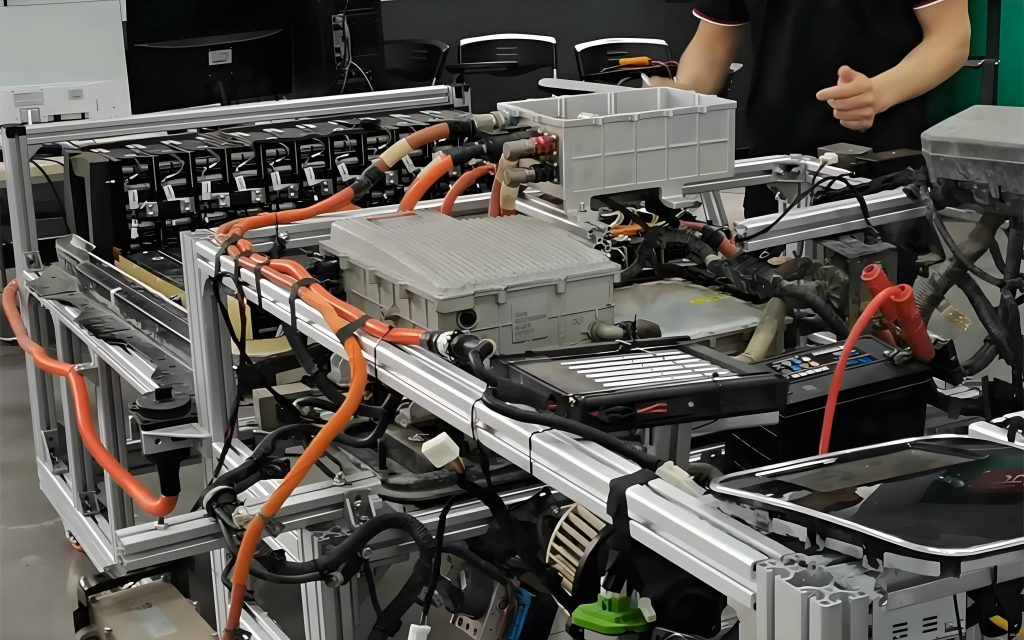
One of the primary aspects I consider in EV repair education is the alignment with industry demands. The automotive sector’s shift toward electrification has created a need for technicians who can perform diagnostics and repairs on complex systems. For example, battery performance degradation can be modeled using formulas like $$ C(t) = C_0 \cdot e^{-\lambda t} $$, where \( C(t) \) represents the battery capacity at time \( t \), \( C_0 \) is the initial capacity, and \( \lambda \) is the decay rate. Understanding such equations is essential for effective electrical car repair, as it helps in predicting maintenance needs and optimizing vehicle longevity. Additionally, the demand for EV repair professionals extends beyond technical skills to include soft skills like teamwork and communication, which I will address in subsequent sections.
To meet these demands, vocational schools must establish clear training objectives. I propose that the goal should be to cultivate technicians who are not only skilled in EV repair but also adaptable to technological advancements. This involves a balanced approach between theory and practice, as summarized in Table 1, which outlines the core components of a training program. The table highlights how different modules contribute to overall competency in electrical car repair, ensuring that students gain a holistic understanding.
| Module | Focus Area | Key Skills Developed |
|---|---|---|
| Battery Systems | Diagnosis and Maintenance | Capacity testing, safety protocols |
| Electric Motors | Performance Analysis | Torque calculation, efficiency metrics |
| Charging Infrastructure | Installation and Repair | Voltage regulation, network integration |
| Data Diagnostics | Fault Detection | Algorithm application, real-time monitoring |
In optimizing the curriculum, I emphasize the importance of a structured course system that integrates foundational knowledge with specialized training. For instance, courses on electrical car repair should cover topics like circuit analysis, where Ohm’s law $$ V = I \cdot R $$ is applied to troubleshoot electrical issues in vehicles. This formula, where \( V \) is voltage, \( I \) is current, and \( R \) is resistance, is fundamental for diagnosing problems in EV systems. By incorporating such equations into the curriculum, students can develop a deeper understanding of the principles underlying EV repair. Moreover, practical sessions should simulate real-world scenarios, such as using diagnostic tools to measure parameters and apply corrective measures.
Another critical element I advocate for is strengthening industry-academia collaboration. Through partnerships with automotive companies, vocational schools can provide students with hands-on experience in EV repair workshops. This collaboration can take various forms, as detailed in Table 2, which compares different models of校企合作 (school-enterprise cooperation). By engaging in internships and joint projects, students gain exposure to the latest technologies and practices in electrical car repair, enhancing their employability. I have found that such initiatives not only bridge the gap between education and industry but also foster innovation in training methodologies.
| Cooperation Model | Description | Benefits for Students |
|---|---|---|
| Internship Programs | Placements in repair centers | Real-world experience, skill application |
| Joint Research Projects | Collaborative innovation on EV technologies | Exposure to cutting-edge developments |
| Apprenticeship Schemes | Mentorship by industry experts | Personalized guidance, career networking |
| Equipment Sharing | Access to advanced tools and facilities | Hands-on training with modern devices |
Furthermore, the development of a robust faculty is essential for delivering high-quality education in EV repair. I recommend that vocational schools invest in continuous professional development for instructors, focusing on both technical expertise and pedagogical skills. For example, training programs can include modules on the latest diagnostic techniques, such as using formulas for fault probability calculation: $$ P(fault) = \frac{N_{\text{detected}}}{N_{\text{total}}} $$, where \( P(fault) \) is the probability of a fault, \( N_{\text{detected}} \) is the number of detected issues, and \( N_{\text{total}} \) is the total number of inspections. This statistical approach is vital for efficient electrical car repair, as it helps in prioritizing maintenance tasks. By equipping teachers with such knowledge, they can better guide students in applying theoretical concepts to practical scenarios.
In building a practical training system, I stress the need for well-equipped labs and simulation environments. These facilities should allow students to engage in hands-on EV repair activities, such as battery replacement or motor diagnostics. For instance, the energy efficiency of an electric vehicle can be evaluated using the formula $$ \eta = \frac{P_{\text{output}}}{P_{\text{input}}} \times 100\% $$, where \( \eta \) is efficiency, \( P_{\text{output}} \) is the useful power output, and \( P_{\text{input}} \) is the power input. By conducting experiments based on this formula, students can analyze performance issues and propose solutions, thereby reinforcing their skills in electrical car repair. Additionally, virtual platforms can supplement physical labs, offering scalable and safe training options.
Assessment mechanisms play a pivotal role in evaluating student progress in EV repair programs. I propose a combination of formative and summative evaluations, as illustrated in Table 3, which outlines key metrics for assessing competencies in electrical car repair. This table includes criteria such as technical accuracy, safety adherence, and problem-solving ability, ensuring a comprehensive evaluation. By regularly monitoring these indicators, educators can identify areas for improvement and tailor instruction to meet individual needs. Moreover, incorporating peer reviews and self-assessments can foster a collaborative learning environment, essential for mastering complex EV repair tasks.
| Evaluation Type | Criteria | Weightage (%) |
|---|---|---|
| Formative Assessment | Class participation, quiz scores | 30 |
| Practical Skills | Hands-on repair tasks, tool usage | 40 |
| Safety Compliance | Adherence to protocols, risk management | 20 |
| Innovation and Ethics | Problem-solving, ethical decision-making | 10 |
To support these initiatives, I emphasize the importance of establishing保障机制 (safeguard mechanisms) that ensure the sustainability of training programs. This includes securing government support for funding and policy frameworks that promote EV repair education. For example, grants can be allocated for updating lab equipment or developing new curricula focused on electrical car repair. Additionally, a dynamic adjustment mechanism should be implemented to regularly update training content based on industry feedback. By staying responsive to technological shifts, vocational schools can maintain the relevance of their programs, ultimately producing graduates who excel in the evolving field of EV repair.
In conclusion, the exploration of talent training models for EV repair in vocational education highlights the need for a multifaceted approach that integrates theory, practice, and industry collaboration. As I have discussed, key strategies include defining clear objectives, optimizing curricula, fostering partnerships, enhancing faculty capabilities, building practical training systems, and implementing robust evaluation methods. By repeatedly emphasizing terms like EV repair and electrical car repair throughout this article, I aim to underscore their centrality in modern automotive education. The use of tables and formulas, such as those for battery decay and efficiency calculations, provides tangible tools for educators to apply in their programs. Moving forward, continuous innovation and adaptation will be crucial for preparing skilled professionals capable of meeting the demands of the new energy vehicle sector. Through these efforts, vocational schools can play a pivotal role in advancing sustainable transportation and fostering economic growth.
Finally, I encourage educators to leverage these insights to refine their own EV repair training models, ensuring that students are equipped with the knowledge and skills needed for successful careers. By prioritizing hands-on experience and ethical practices, we can build a workforce that not only excels in electrical car repair but also contributes to a greener future. The integration of advanced technologies, such as AI-driven diagnostics, could further enhance these training programs, offering exciting opportunities for growth and development in the years to come.