
As the automotive industry rapidly evolves towards sustainable solutions, I have observed a significant surge in the adoption of new energy vehicles, particularly electric vehicles (EVs). This shift is driven by their low-carbon emissions, energy efficiency, and reduced environmental impact compared to traditional internal combustion engine vehicles. However, the unique architecture of EVs, including their power systems and electrical components, presents novel challenges in the realm of EV repair and maintenance. In my experience, the growing prevalence of EVs necessitates a deeper understanding of their maintenance requirements to ensure safety, reliability, and longevity. This article delves into the common issues, advanced repair techniques, and optimization strategies for electrical car repair, aiming to provide a thorough guide for professionals and enthusiasts alike. Through this analysis, I will explore how innovations in diagnostics and upkeep can address the complexities of modern EVs, supported by practical insights and technical details.
The classification of new energy vehicles primarily includes pure electric vehicles (BEVs) and hybrid electric vehicles (HEVs). BEVs rely solely on electric motors powered by batteries, while HEVs combine an internal combustion engine with an electric propulsion system. This distinction is crucial in EV repair, as each type demands specific maintenance approaches. For instance, BEVs focus extensively on battery management, whereas HEVs require integration between electrical and mechanical systems. The following table summarizes key characteristics of these vehicle types, highlighting aspects relevant to electrical car repair:
| Vehicle Type | Power Source | Common EV Repair Focus Areas | Maintenance Frequency |
|---|---|---|---|
| Pure Electric Vehicle (BEV) | Battery and Electric Motor | Battery health, motor efficiency, charging system | Every 10,000 km or 6 months |
| Hybrid Electric Vehicle (HEV) | Combination of Engine and Electric Motor | Battery balancing, engine-motor integration, regenerative braking | Every 8,000 km or 6 months |
In my work with EVs, I have found that understanding these categories helps tailor repair strategies effectively. For example, the battery capacity in BEVs can be modeled using the formula for state of charge (SOC): $$SOC(t) = SOC_0 – \frac{1}{C} \int_0^t I(\tau) d\tau$$ where \( SOC_0 \) is the initial charge, \( C \) is the battery capacity, and \( I \) is the current. This equation is fundamental in EV repair for diagnosing battery degradation and planning maintenance schedules. As the industry progresses, the demand for specialized electrical car repair services continues to grow, emphasizing the need for continuous learning and adaptation.
One of the most prevalent issues in EV repair involves power battery failures. These batteries are the heart of EVs, and their performance directly impacts vehicle range and safety. Common problems include capacity fade, internal short circuits, and voltage imbalances among cells. From my perspective, these issues often arise from prolonged high-voltage operation, thermal stress, or inadequate battery management system (BMS) functionality. For instance, a faulty BMS may fail to monitor cell voltages accurately, leading to overcharging or deep discharge, which accelerates battery aging. In electrical car repair, diagnosing such faults requires precise measurement of parameters like internal resistance and open-circuit voltage. The internal resistance \( R_i \) can be calculated using: $$R_i = \frac{V_{oc} – V_{load}}{I}$$ where \( V_{oc} \) is the open-circuit voltage, \( V_{load} \) is the voltage under load, and \( I \) is the current. This helps identify degraded cells that need rebalancing or replacement. Regular maintenance, including capacity tests and thermal management checks, is essential to mitigate these EV repair challenges and extend battery life.
Another critical area in EV repair is drive motor faults. The electric motor serves as the primary propulsion unit, and its failure can lead to complete vehicle breakdown. I have encountered various motor issues, such as bearing wear, winding insulation breakdown, and rotor imbalances. These often result from mechanical stress, high-speed operation, or electrical overloads. For example, in one case of electrical car repair, a noisy motor was traced to unbalanced rotors, causing excessive vibrations. The efficiency of a drive motor can be expressed as: $$\eta = \frac{P_{out}}{P_{in}} \times 100\%$$ where \( P_{out} \) is the mechanical output power and \( P_{in} \) is the electrical input power. Monitoring this efficiency during diagnostics helps pinpoint inefficiencies due to friction or electrical losses. In EV repair, techniques like vibration analysis and insulation resistance tests are employed to detect early signs of motor wear. The following table outlines common drive motor faults and their diagnostic methods in electrical car repair:
| Motor Fault Type | Symptoms | EV Repair Diagnostic Technique | Recommended Action |
|---|---|---|---|
| Bearing Wear | Unusual noise, vibration | Vibration analysis, acoustic testing | Replace bearings, lubricate |
| Winding Short Circuit | Overheating, reduced power | Insulation resistance test, megger test | Rewind or replace motor |
| Rotor Imbalance | Shaking at high speeds | Dynamic balancing equipment | Balance rotor assembly |
Drive system malfunctions are also frequent in EVs, often indicated by warning lights on the dashboard. In my experience with EV repair, these issues can stem from inverter failures, sensor errors, or software glitches. For instance, an overheated motor might trigger a temperature warning, while a faulty speed sensor could cause erratic performance. The torque output of the drive system can be related to current and motor constants: $$T = k_t \cdot I$$ where \( T \) is torque, \( k_t \) is the motor torque constant, and \( I \) is the current. This formula is vital in electrical car repair for verifying that the drive system delivers expected performance under load. Diagnostics typically involve scanning for error codes, testing sensor outputs, and inspecting mechanical linkages. Proactive maintenance, such as checking connector integrity and updating software, can prevent many drive system issues, reducing the need for extensive EV repair.
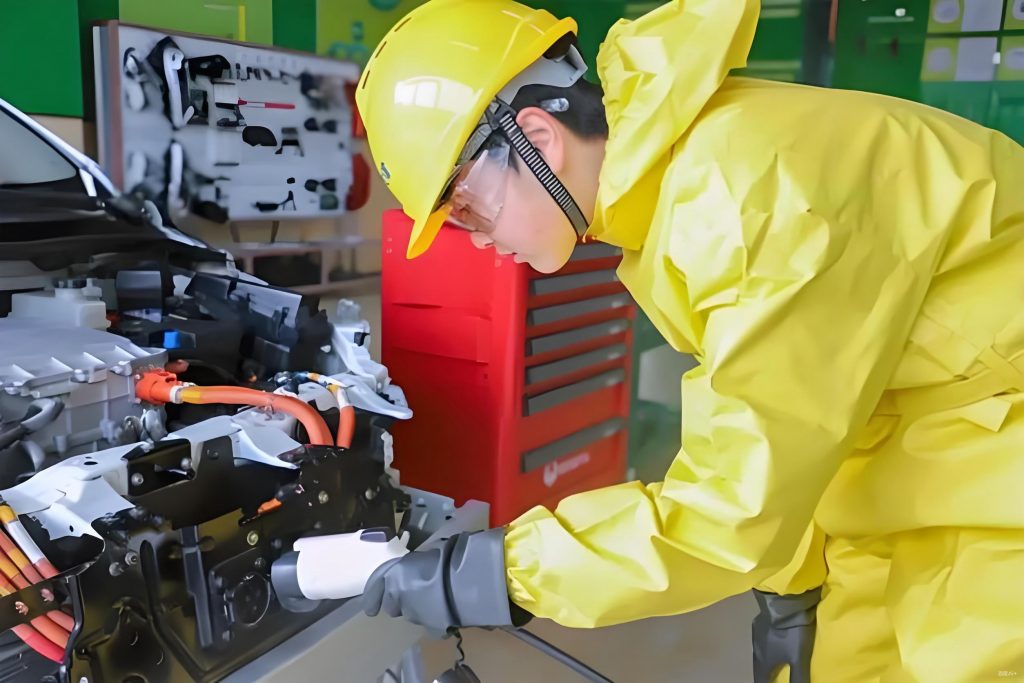
Air conditioning system failures are another common concern in EV repair, affecting passenger comfort and overall vehicle efficiency. I have dealt with numerous cases involving refrigerant leaks, compressor failures, and reduced cooling performance. These problems often arise from seal degradation, component wear, or electrical faults in the AC motor. For example, a leaking evaporator due to aged seals can lead to insufficient cooling, while a damaged compressor might cause system shutdowns. The cooling capacity of an AC system can be modeled using: $$Q = \dot{m} \cdot c_p \cdot \Delta T$$ where \( Q \) is the heat removal rate, \( \dot{m} \) is the mass flow rate of refrigerant, \( c_p \) is the specific heat, and \( \Delta T \) is the temperature difference. In electrical car repair, technicians use this to assess system performance and identify blockages or leaks. Repair methods include pressure testing, component replacement, and refrigerant recharge. Regular inspections of hoses, seals, and electrical connections are crucial to maintain optimal AC function and minimize EV repair incidents.
To address these challenges, advanced repair techniques have been developed for EV repair. For power batteries, cell balancing and module replacement are common practices. In my work, I utilize specialized equipment like battery cyclers and thermal cameras to perform these tasks safely. The state of health (SOH) of a battery can be estimated with: $$SOH = \frac{C_{actual}}{C_{rated}} \times 100\%$$ where \( C_{actual} \) is the measured capacity and \( C_{rated} \) is the rated capacity. This is integral to electrical car repair for determining when batteries require servicing. Similarly, for drive motors, techniques such as dynamic balancing and winding insulation upgrades are employed. The power loss in a motor due to resistance can be calculated as: $$P_{loss} = I^2 \cdot R$$ where \( I \) is current and \( R \) is resistance, aiding in diagnostics during EV repair. The table below summarizes key repair techniques for common EV issues in electrical car repair:
| Repair Area | Technique | Tools Used | Application in EV Repair |
|---|---|---|---|
| Power Battery | Cell Balancing | Battery tester, balancer | Equalize cell voltages to extend life |
| Drive Motor | Winding Repair | Megger, soldering iron | Fix insulation breaks to restore efficiency |
| AC System | Refrigerant Leak Detection | Leak detector, UV dye | Locate and seal leaks for improved cooling |
Optimizing EV repair and maintenance requires a multifaceted approach. First, investing in advanced diagnostic equipment is essential. From my perspective, tools like high-voltage insulation testers, battery management system analyzers, and motor dynamometers are indispensable for accurate fault identification in electrical car repair. For instance, an insulation tester can detect leakage currents in high-voltage circuits, preventing potential hazards. Second, enhancing technician skills through continuous training is critical. I advocate for hands-on workshops and certification programs focused on EV-specific systems, such as high-voltage safety protocols and software diagnostics. This not only improves repair quality but also fosters innovation in electrical car repair methods. Additionally, implementing predictive maintenance using data analytics can reduce downtime. By monitoring vehicle parameters in real-time, issues can be addressed proactively, aligning with the evolving demands of EV repair.
In conclusion, the rise of new energy vehicles underscores the importance of specialized EV repair and maintenance practices. As I have discussed, common faults in batteries, motors, drive systems, and AC units require tailored solutions that leverage advanced formulas and diagnostic tools. The integration of techniques like battery health monitoring and motor efficiency analysis is pivotal in electrical car repair for ensuring vehicle reliability and safety. Moving forward, the industry must prioritize equipment upgrades and skill development to keep pace with technological advancements. By doing so, we can support the sustainable growth of EVs and address the unique challenges they present. Ultimately, a proactive approach to EV repair will not only enhance performance but also contribute to a greener automotive future.