
As a professional in the field of electric vehicle repair, I have witnessed the rapid growth of the new energy vehicle industry, driven by technological advancements and increasing environmental awareness. Electric vehicles (EVs) offer significant advantages over traditional internal combustion engine vehicles, including lower operating costs, reduced emissions, enhanced driving experiences, and advanced智能化 features. However, like any complex machinery, EVs are prone to various faults during operation, necessitating regular inspection and maintenance to identify and resolve potential issues promptly. In this article, I will provide an in-depth analysis of common faults in electric vehicles, discuss effective diagnosis methods, and propose practical repair strategies to enhance the efficiency of EV repair and electrical car repair processes. My goal is to contribute to the sustainable development of the electric vehicle industry by sharing insights based on hands-on experience and theoretical knowledge.
Electric vehicles primarily include battery electric vehicles (BEVs), hybrid electric vehicles (HEVs), and fuel cell electric vehicles (FCEVs), each with distinct characteristics. BEVs are celebrated for their zero-emission capabilities, but they face challenges such as limited battery energy storage, high costs, and technological bottlenecks in high-energy-density batteries, which hinder broader market adoption. HEVs combine traditional engines with electric propulsion systems, offering extended range and energy recovery features, yet their higher purchase and maintenance costs, along with modest energy savings, limit their appeal. FCEVs utilize onboard fuel cells for power generation, boasting high efficiency and zero emissions, but they suffer from immature core technologies and underdeveloped infrastructure, constraining their growth. Understanding these vehicle types is crucial for effective EV repair, as each presents unique fault patterns and maintenance requirements.
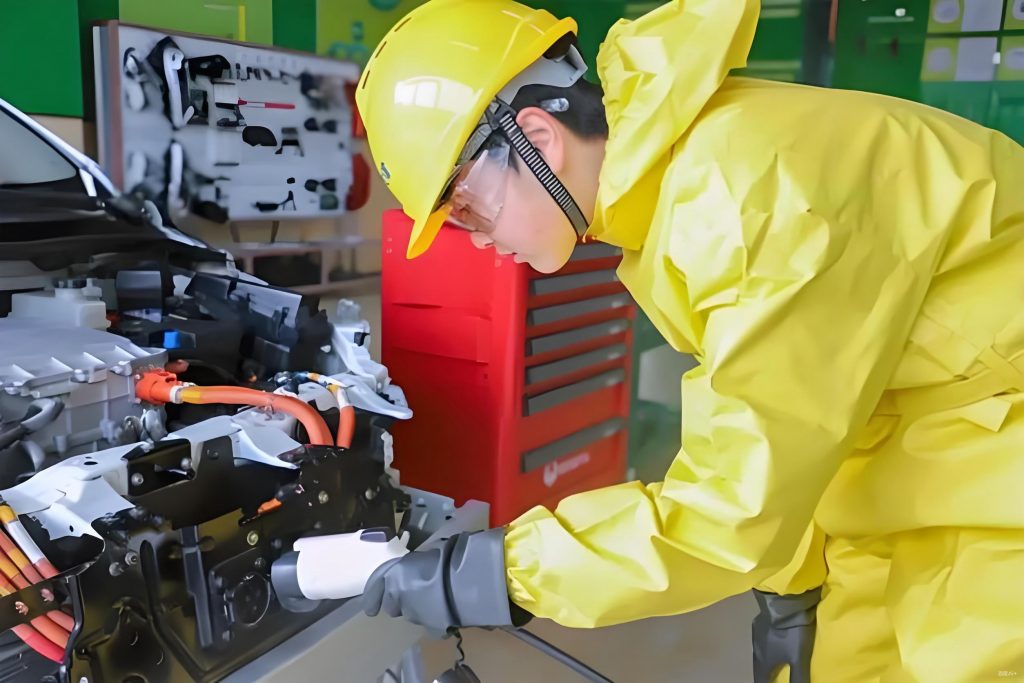
In my work, I frequently encounter common faults in electric vehicles, which can be categorized into power battery issues, motor drive system failures, and air conditioning system malfunctions. The power battery, often a lithium-ion type, is the heart of an EV, directly influencing range and safety. Faults may arise from prolonged high-voltage operation, external environmental factors like temperature extremes, or internal degradation, leading to reduced performance or complete failure. For instance, ion channel blockages or electrode wear can cause abnormal discharge, necessitating precise diagnostics. The motor drive system, essential for vehicle propulsion, may experience mechanical faults such as bearing wear or electronic issues like circuit failures, potentially resulting in sparks, noise, or even accidents. Similarly, the air conditioning system, critical for passenger comfort, often suffers from refrigerant leaks or compressor inefficiencies due to sealant aging or harsh operating conditions. Addressing these faults requires a systematic approach to EV repair, combining observational skills with advanced tools.
| Fault Type | Common Symptoms | Potential Causes |
|---|---|---|
| Power Battery Fault | Reduced range, voltage fluctuations, overheating | High-voltage stress, environmental factors, internal degradation |
| Motor Drive System Fault | Unusual noises, sparks, loss of power | Mechanical wear, electronic circuit failures, magnetic issues |
| Air Conditioning System Fault | Insufficient cooling, refrigerant leaks, compressor failure | Sealant aging, lubricant issues, high operational stress |
To diagnose these faults effectively, I employ several methods, including intuitive diagnosis, ammeter testing, short-circuit diagnosis, and electronic diagnosis techniques. Intuitive diagnosis relies on my sensory observations and experience; for example, I look for visual cues like smoke, sparks, or unusual smells to quickly locate circuit faults. In cases of suspected open circuits, I use断路 methods by disconnecting sections of wiring to observe changes in fault behavior, narrowing down the problematic area. Ammeter testing involves connecting an ammeter in series with the device under test to detect abnormalities. If the ammeter needle remains stationary, it indicates an open circuit, whereas a sudden deflection to the negative maximum suggests a short circuit. For instance, when diagnosing ignition system issues in EVs, a non-responsive ammeter may point to low-voltage circuit faults, while excessive current flow signals potential shorts. Short-circuit diagnosis is another straightforward approach where I temporarily short-circuit suspicious components using tools like screwdrivers and monitor instrument responses. If the dashboard pointer shifts negatively, it confirms faults in switches or related circuits. Electronic diagnosis, however, represents the pinnacle of modern EV repair, integrating artificial intelligence and specialized equipment for precise fault identification. This non-invasive method allows me to scan vehicle models, transmit data to diagnostic systems, and receive targeted analyses without disassembling sensitive components, thereby reducing repair time and costs while ensuring accuracy.
In electrical car repair, mathematical models and formulas play a vital role in understanding and diagnosing faults. For example, Ohm’s law is fundamental for circuit analysis: $$V = I \times R$$, where V is voltage, I is current, and R is resistance. This helps in calculating expected current flows and identifying deviations indicative of faults. Similarly, for battery performance, the state of charge (SOC) can be estimated using integral formulas: $$\text{SOC} = \text{SOC}_0 – \frac{1}{C} \int I \, dt$$, where C is battery capacity, I is current, and t is time. This aids in assessing battery health and predicting failures. In motor systems, torque and power relationships are crucial: $$P = T \times \omega$$, where P is power, T is torque, and ω is angular velocity. By applying these formulas, I can model system behaviors and pinpoint inefficiencies during EV repair.
| Method | Procedure | Applications |
|---|---|---|
| Intuitive Diagnosis | Visual and sensory inspection for signs like sparks or odors | Circuit faults, mechanical issues |
| Ammeter Testing | Series connection of ammeter to measure current flow | Open/short circuits in ignition systems |
| Short-Circuit Diagnosis | Temporary shorting of components to observe instrument responses | Switch and circuit faults |
| Electronic Diagnosis | Use of AI-based tools for non-invasive scanning and analysis | Complex electronic component faults |
When it comes to repair strategies, I focus on tailored approaches for each fault type. For power battery faults, I begin by analyzing the battery’s electrode characteristics and internal circuit layout. Regular checks for vacuum tube leaks, aging, or damage are essential; if abnormalities are detected, I immediately replace wiring or components to restore system stability. Additionally, I optimize the battery’s operating environment to mitigate external stressors, extending its lifespan. In EV repair, understanding ion transport mechanisms is key, and I often use formulas like the Nernst equation for electrode potential: $$E = E^0 – \frac{RT}{nF} \ln Q$$, where E is cell potential, E⁰ is standard potential, R is gas constant, T is temperature, n is number of electrons, F is Faraday constant, and Q is reaction quotient. This helps in diagnosing ion-related issues and guiding repairs.
For motor drive system faults, I combine intuitive and electronic diagnosis methods. I visually inspect components for surface anomalies, such as discoloration or physical damage, while using electronic diagnostic devices to pinpoint exact fault locations. By correlating instrument readings with observed symptoms, I can accurately identify issues like winding failures or bearing wear. Repair involves replacing faulty parts, recalibrating systems, and ensuring proper lubrication. In electrical car repair, I also apply thermal management principles; for instance, heat dissipation can be modeled with Fourier’s law: $$q = -k \nabla T$$, where q is heat flux, k is thermal conductivity, and ∇T is temperature gradient. This aids in preventing overheating and ensuring reliable operation.
Air conditioning system repairs require comprehensive checks, including testing lubricant levels in cooling equipment and ensuring refrigerant quantities meet specifications. I follow standardized procedures for adding冷媒 and inspecting compressors. For high-pressure electric compressor faults, I use specialized tools to assess performance and develop maintenance plans with clear cycles and standards. In EV repair, I often refer to thermodynamic cycles, such as the vapor compression cycle, described by the coefficient of performance (COP): $$\text{COP} = \frac{Q_L}{W}$$, where Q_L is heat removed and W is work input. This formula helps in evaluating system efficiency and guiding optimizations.
| Fault Type | Repair Strategy | Key Actions |
|---|---|---|
| Power Battery Fault | Electrode and circuit inspection, environment optimization | Replace damaged parts, monitor voltage and current |
| Motor Drive System Fault | Combined visual and electronic diagnosis, part replacement | Check windings, bearings, and electronic controls |
| Air Conditioning System Fault | Lubricant and refrigerant testing, compressor maintenance | Adjust冷媒 levels, inspect seals and compressors |
In conclusion, effective fault diagnosis and repair are paramount for the safety and reliability of electric vehicles. As a practitioner in EV repair, I emphasize the importance of continuous learning and adherence to rigorous standards. By integrating traditional methods with advanced technologies, we can enhance diagnostic accuracy and repair efficiency. The future of electrical car repair lies in innovation and collaboration, driving the industry toward sustainability. Through diligent practice and knowledge sharing, we can overcome challenges and ensure that electric vehicles remain a viable and eco-friendly transportation solution for years to come.