
As a researcher deeply immersed in the field of automotive technology, I have observed the transformative potential of digital twin technology in addressing the evolving challenges of electric car repair. This innovative approach not only enhances the efficiency of maintenance processes but also revolutionizes how technicians are trained. In this article, I will explore the fundamental aspects of digital twin technology, the pressing issues in electric car repair training, and the practical applications that make it indispensable. Through detailed analysis, including tables and mathematical formulations, I aim to provide a comprehensive perspective on how this technology can shape the future of EV repair.
Digital twin technology involves creating a virtual replica of a physical entity, such as an electric vehicle, and enabling real-time data exchange between the two. This bidirectional mapping allows for continuous monitoring, simulation, and optimization. Key characteristics include virtual-real integration, precise simulation, predictive capabilities, and iterative optimization. For instance, in the context of EV repair, a digital twin can simulate the entire electrical system, including high-voltage components, to predict failures and guide repairs. The mathematical representation of this process can be expressed using state-space models, where the physical system’s behavior is captured through differential equations. For example, the state of a battery management system (BMS) can be modeled as: $$ \frac{d\mathbf{x}}{dt} = A\mathbf{x} + B\mathbf{u} $$ where $\mathbf{x}$ represents the state vector (e.g., voltage, temperature), $A$ and $B$ are matrices defining system dynamics, and $\mathbf{u}$ is the input vector. This enables accurate predictions and enhances the reliability of electric car repair simulations.
The adoption of digital twin technology in EV repair training is driven by several critical challenges. Electric vehicles incorporate complex systems like battery packs, electric motors, and power electronics, which require specialized knowledge for effective maintenance. The high voltages involved, often exceeding 400V, pose significant safety risks during hands-on training. Additionally, the cost of procuring and maintaining real vehicles for training purposes is substantial, and limited access to expert instructors further complicates the learning process. To summarize these challenges, I have compiled Table 1, which outlines the primary obstacles in electric car repair training and their implications.
| Challenge | Description | Impact on EV Repair |
|---|---|---|
| Technical Complexity | Involves multi-disciplinary systems like BMS and power electronics | Increases learning curve and requires advanced skills |
| High Operational Risks | Exposure to high-voltage systems leading to potential electrocution | Threatens technician safety and limits practical training |
| Substantial Training Costs | High expenses for vehicles, equipment, and maintenance | Restricts accessibility and scalability of training programs |
| Limited Training Resources | Shortage of qualified instructors and up-to-date materials | Hinders skill development and adaptation to new technologies |
In response to these challenges, digital twin technology offers practical applications that redefine EV repair training. One of the most significant uses is the construction of virtual maintenance environments. These scenarios allow technicians to interact with detailed models of electric vehicles, examining components like inverters and charging systems from multiple angles. For example, a digital twin can replicate the thermal management system of a battery, enabling trainees to visualize heat dissipation and identify potential issues. This virtual approach eliminates the risks associated with high-voltage systems, making electric car repair safer and more accessible.
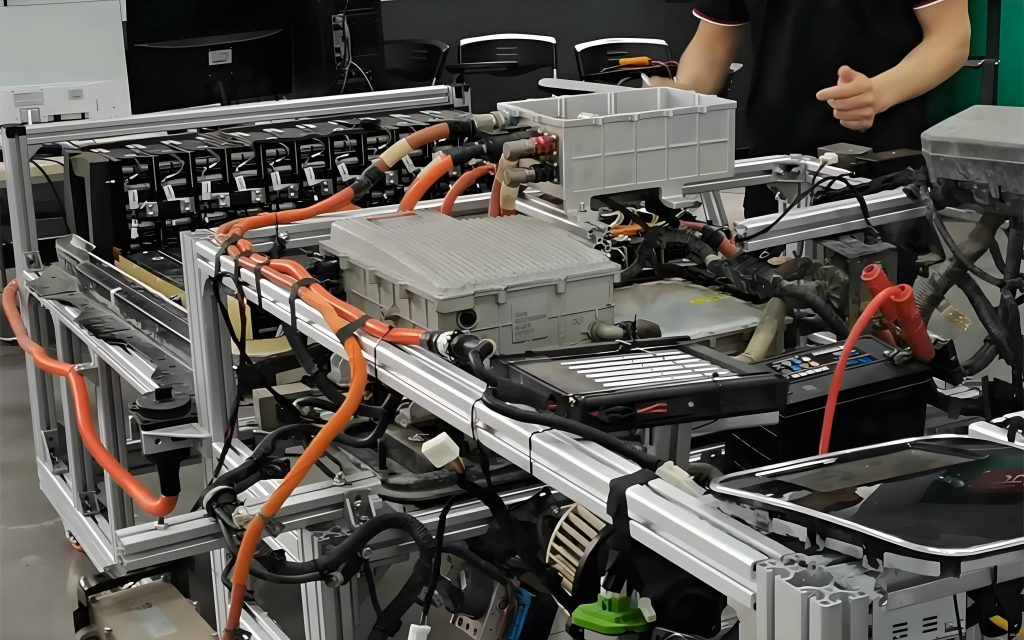
Another key application is the simulation of faults and repair procedures. Digital twins can generate a wide range of fault conditions, such as battery cell imbalances or motor controller failures, and allow technicians to practice diagnostic and corrective actions. The system provides immediate feedback based on the accuracy of their interventions. Mathematically, this can be modeled using probability distributions to represent fault occurrences. For instance, the likelihood of a specific failure in an EV component can be expressed as: $$ P(F) = \int_{0}^{t} \lambda(\tau) d\tau $$ where $P(F)$ is the probability of failure over time $t$, and $\lambda(\tau)$ is the failure rate function. This helps in designing realistic training modules for electric car repair. Table 2 summarizes the core applications of digital twin technology in this domain, highlighting how each addresses the aforementioned challenges.
| Application | Description | Benefits for Electric Car Repair |
|---|---|---|
| Virtual Maintenance Scenarios | Creation of immersive environments for component inspection and interaction | Reduces physical risks and enhances understanding of complex systems |
| Fault and Repair Simulation | Generation of various fault modes for hands-on diagnostic practice | Improves problem-solving skills and allows repetitive training |
| Remote Collaborative Training | Enables real-time interaction between instructors and trainees across locations | Increases resource accessibility and lowers travel costs |
| Training Evaluation and Feedback | Data-driven assessment of technician performance and progress | Facilitates personalized learning and continuous improvement |
Remote collaborative training is another area where digital twin technology excels. By leveraging network communications, instructors can demonstrate repair techniques on virtual models while trainees participate from distant locations. This not only breaks geographical barriers but also fosters knowledge sharing among professionals in the EV repair industry. For instance, a technician in one region can learn from an expert in another, discussing best practices for handling high-voltage systems in electric cars. The efficiency of such collaborations can be quantified using metrics like training throughput, defined as: $$ \text{Throughput} = \frac{N_{\text{trained}}}{T_{\text{total}}} $$ where $N_{\text{trained}}$ is the number of technicians trained and $T_{\text{total}}$ is the total time invested. This demonstrates how digital twins optimize resource utilization in electric car repair training.
Moreover, the evaluation of training outcomes is enhanced through data analytics. Digital twin systems record every action taken by trainees, such as time spent on tasks and error rates, enabling objective assessments. These data can be analyzed using statistical models to identify areas for improvement. For example, a regression analysis might reveal correlations between specific training modules and performance in real-world EV repair scenarios: $$ Y = \beta_0 + \beta_1 X_1 + \beta_2 X_2 + \epsilon $$ where $Y$ represents repair proficiency, $X_1$ and $X_2$ are training variables, and $\epsilon$ is the error term. This iterative feedback loop ensures that training programs remain aligned with the demands of electric car repair.
The advantages of integrating digital twin technology into EV repair training are multifaceted. Firstly, it elevates the quality of education by providing a risk-free environment for experimentation. Technicians can repeatedly practice complex procedures, such as diagnosing battery faults or calibrating sensors, without the fear of damaging expensive equipment or endangering themselves. This hands-on experience is crucial for mastering the intricacies of electric car repair. Secondly, cost reductions are substantial, as virtual training minimizes the need for physical vehicles and accessories. For example, the total cost of ownership for a digital twin-based program can be modeled as: $$ C_{\text{total}} = C_{\text{development}} + C_{\text{maintenance}} – S_{\text{savings}} $$ where $C_{\text{development}}$ includes initial setup costs, $C_{\text{maintenance}}$ covers updates, and $S_{\text{savings}}$ accounts for reduced expenses on hardware and travel. Table 3 elaborates on these benefits, illustrating how they contribute to sustainable EV repair training ecosystems.
| Advantage | Description | Impact on EV Repair Industry |
|---|---|---|
| Enhanced Training Quality | Immersive simulations and real-time feedback improve skill acquisition | Produces competent technicians capable of handling complex repairs |
| Reduced Training Costs | Lower expenses on vehicles, equipment, and logistical arrangements | Makes training more affordable and scalable for wider audiences |
| Improved Safety Assurance | Elimination of physical risks associated with high-voltage systems | Encourages more practitioners to enter the electric car repair field |
| Adaptability to Technological Changes | Easy updates to virtual models reflecting new EV designs and features | Ensures training remains relevant amid rapid industry evolution |
Safety is a paramount concern in electric car repair, and digital twin technology addresses this by providing a completely virtual training ground. Technicians can explore worst-case scenarios, such as short circuits or thermal runaways, without any real-world consequences. This not only builds confidence but also ingrains safety protocols essential for EV repair. Furthermore, the technology’s adaptability ensures that training programs can keep pace with the fast-evolving automotive landscape. As new models with advanced features, like autonomous driving systems or enhanced battery technologies, emerge, digital twins can be swiftly updated to include these elements. This flexibility is vital for maintaining the relevance of electric car repair training.
Looking ahead, the future of digital twin technology in EV repair training is poised for significant advancements. I anticipate a trend toward greater integration with other emerging technologies, such as artificial intelligence and the Internet of Things (IoT). For example, AI algorithms could analyze training data to personalize learning paths for each technician, optimizing their progression in electric car repair skills. The convergence of these technologies can be represented by a unified framework: $$ \text{System Efficiency} = f(\text{DT}, \text{AI}, \text{IoT}) $$ where DT denotes digital twin capabilities, AI contributes adaptive learning, and IoT enables real-time data collection from physical vehicles. This synergy will lead to more intelligent and responsive training systems.
Additionally, training scenarios will become more diverse, covering a broader range of electric car repair situations, from routine maintenance to emergency responses. The proliferation of smart training platforms will make high-quality education accessible to a global audience, democratizing expertise in EV repair. Table 4 outlines these developmental trends, highlighting their potential to reshape the industry.
| Trend | Description | Expected Impact on Electric Car Repair |
|---|---|---|
| Technology Integration | Combination with AI, IoT, and cloud computing for enhanced functionality | Enables predictive maintenance and automated skill assessments |
| Diversified Training Scenarios | Expansion to include rare faults, environmental factors, and new vehicle types | Prepares technicians for a wider array of real-world challenges |
| Intelligent Training Systems | Adoption of adaptive learning platforms that customize content based on performance | Increases training efficiency and effectiveness in electric car repair |
In conclusion, as I reflect on the journey of digital twin technology in the realm of EV repair, it is clear that its impact is profound and far-reaching. By addressing critical training challenges and offering scalable solutions, it empowers technicians to excel in electric car repair. The continuous evolution of this technology, coupled with its ability to integrate with other innovations, ensures that it will remain a cornerstone of automotive education. I am confident that as we move forward, digital twin-based training will not only enhance individual competencies but also drive the overall growth and sustainability of the electric car repair industry, making it more resilient and adaptive to future demands.