
As an experienced professional in the field of EV repair, I have witnessed the rapid growth of electric vehicles and the increasing complexity of their power battery systems. Power batteries are the heart of electric vehicles, providing the necessary energy for propulsion. However, with advancements in technology, these batteries are prone to various faults that can impact vehicle performance and safety. In this article, I will delve into the common faults encountered in EV power batteries, discuss diagnostic approaches, and provide detailed repair strategies. My aim is to share insights that can aid technicians and enthusiasts in electrical car repair, ensuring efficient and reliable maintenance practices. Throughout this discussion, I will incorporate tables and formulas to summarize key points, making the information accessible for practical application in EV repair scenarios.
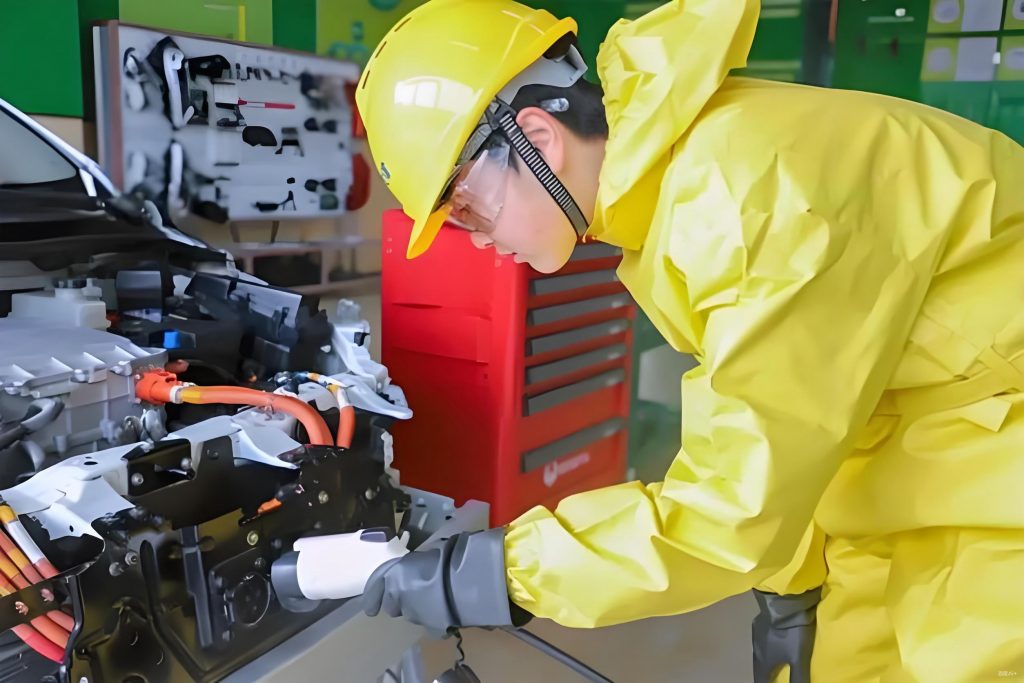
In my work with electrical car repair, I often encounter issues related to power battery failures. One of the most frequent problems is fuse damage. Fuses in EV power battery systems act as protective devices, safeguarding against overcurrent conditions that could lead to severe damage. When a fuse blows, it typically results from excessive current flow, which may be caused by faulty circuit design, aging wiring, or poor connections. To diagnose this, I use multimeters and specialized EV repair diagnostic tools to measure current and voltage levels. For instance, the current $I$ can be calculated using Ohm’s law: $$I = \frac{V}{R}$$ where $V$ is the voltage and $R$ is the resistance. If the measured current exceeds the fuse’s rating, it indicates an underlying issue that needs addressing. In many cases, environmental factors like high temperatures can exacerbate these problems, leading to premature fuse failure. After identifying the cause, I replace the fuse and conduct a test drive to ensure the system functions correctly. This process is crucial in EV repair to prevent recurrent issues and maintain vehicle safety.
Another common issue I face in electrical car repair is loose connection plugs. These connectors are vital for maintaining stable electrical flow within the battery system. Over time, vibrations from driving, frequent plugging and unplugging, or improper installation can cause connectors to loosen, leading to intermittent power loss or erratic behavior. To diagnose this, I perform a visual inspection and use continuity testers to check for secure connections. I often ask vehicle owners about their maintenance history to identify if the connectors have been serviced before. In severe cases, loose connections can cause arcing, which generates heat and further damages the system. The power loss $P$ due to resistance in a loose connection can be estimated by: $$P = I^2 \times R$$ where $I$ is the current and $R$ is the resistance at the connection point. If $P$ is high, it indicates significant energy loss and potential overheating. Replacing or tightening the connectors is a standard procedure in EV repair, but it must be done carefully to avoid introducing new faults. Regular inspections are essential to prevent such issues in electric vehicles.
Battery temperature anomalies are also prevalent in my EV repair practice. The thermal management system in EVs is designed to keep the battery within an optimal temperature range, but failures can lead to overheating or undercooling. This can stem from faulty cooling fans, blocked vents, extreme ambient temperatures, or internal battery defects like short circuits. When a vehicle exhibits temperature-related issues, I use infrared thermometers and data loggers to monitor battery temperature $T$ over time. The heat generation in a battery can be modeled using: $$Q = I^2 \times R \times t$$ where $Q$ is the heat energy, $I$ is the current, $R$ is the internal resistance, and $t$ is time. If $Q$ accumulates rapidly, it suggests inadequate散热. In cases of overheating, I inspect the散热 system for obstructions or malfunctions and replace components as needed. For undercooling, I check if the battery is exposed to low temperatures and recommend insulation or pre-heating solutions. This aspect of electrical car repair requires a thorough understanding of thermodynamics and battery chemistry to ensure accurate diagnosis and repair.
| Fault Type | Common Causes | Diagnostic Tools | Key Symptoms |
|---|---|---|---|
| Fuse Damage | Overcurrent, aging wires, poor design | Multimeter, diagnostic scanner | Vehicle won’t start, blown fuse indicator |
| Loose Connectors | Vibration, wear, improper installation | Continuity tester, visual inspection | Intermittent power, voltage fluctuations |
| Temperature Anomalies | 散热 failure, extreme environments, internal faults | Thermometer, data logger | Overheating warnings, reduced performance |
In electrical car repair, diagnosing power battery faults often involves a systematic approach. For fuse-related issues, I start by checking the battery management system (BMS) for error codes. The BMS monitors parameters like voltage, current, and temperature, and any deviations can signal problems. I use the formula for power dissipation: $$P_{\text{diss}} = V \times I$$ to assess if the system is operating within safe limits. If $P_{\text{diss}}$ is too high, it could indicate a short circuit or overload, leading to fuse failure. Similarly, for connector issues, I measure the contact resistance $R_c$ using a micro-ohmmeter. A high $R_c$ value suggests corrosion or looseness, which requires cleaning or replacement. In temperature-related cases, I analyze the thermal coefficient of the battery, which can be expressed as: $$\alpha = \frac{1}{R} \frac{dR}{dT}$$ where $\alpha$ is the temperature coefficient, $R$ is resistance, and $T$ is temperature. This helps in understanding how temperature changes affect battery performance. By integrating these diagnostic methods, I can pinpoint faults accurately and apply targeted repairs in EV repair scenarios.
When it comes to repair strategies for EV power batteries, I emphasize a proactive approach. For fuse damage, after replacing the fuse, I investigate the root cause, such as upgrading the wiring or improving circuit protection. In one instance, I encountered a vehicle where repeated fuse blows were due to a design flaw in the battery pack; by recalibrating the current limits in the BMS, I resolved the issue. This highlights the importance of comprehensive EV repair practices that go beyond simple replacements. For loose connectors, I ensure that all connections are torqued to manufacturer specifications and use anti-vibration locks where necessary. The force $F$ required to secure a connector can be related to the material properties: $$F = k \times x$$ where $k$ is the stiffness constant and $x$ is the displacement. By applying the correct $F$, I prevent over-tightening or under-tightening, which are common pitfalls in electrical car repair.
| Fault Type | Repair Actions | Tools Required | Preventive Measures |
|---|---|---|---|
| Fuse Damage | Replace fuse, inspect wiring, update BMS | Fuse puller, soldering iron, diagnostic tool | Regular current checks, use high-quality fuses |
| Loose Connectors | Tighten or replace connectors, apply sealant | Torque wrench, continuity tester | Routine inspections, use locking mechanisms |
| Temperature Anomalies | Repair散热 system, replace faulty sensors | Thermal camera, coolant refill kit | Monitor environment, maintain cooling system |
Battery temperature management is a critical aspect of EV repair that I frequently address. In cases of overheating, I inspect the散热 system components, such as coolant pumps and radiators, for blockages or leaks. The heat transfer rate $\dot{Q}$ can be calculated using: $$\dot{Q} = h \times A \times \Delta T$$ where $h$ is the heat transfer coefficient, $A$ is the surface area, and $\Delta T$ is the temperature difference. If $\dot{Q}$ is insufficient, it indicates a problem with the散热 efficiency. I often recommend flushing the coolant system or replacing thermal paste on battery modules to improve heat dissipation. For low-temperature issues, I install battery heaters or advise owners to park in warmer locations. These repairs not only fix immediate problems but also enhance the longevity of the power battery, which is a key goal in electrical car repair.
In my experience with EV repair, I have found that integrating advanced diagnostic techniques can significantly improve fault resolution. For example, I use impedance spectroscopy to assess battery health by measuring the complex impedance $Z$: $$Z = R + jX$$ where $R$ is the resistance and $X$ is the reactance. This helps in detecting internal faults like electrode degradation before they cause major failures. Additionally, I employ data analytics from the BMS to predict potential issues based on historical trends. The state of charge (SOC) can be estimated using: $$\text{SOC} = \text{SOC}_0 – \frac{1}{C} \int I \, dt$$ where $\text{SOC}_0$ is the initial state, $C$ is the capacity, and $I$ is the current. By monitoring SOC variations, I can identify abnormalities that might lead to fuse blows or temperature spikes. This proactive approach in electrical car repair minimizes downtime and costs for vehicle owners.
Another area I focus on in EV repair is the impact of environmental factors on power battery performance. Extreme temperatures, both hot and cold, can accelerate battery aging and increase the likelihood of faults. The Arrhenius equation is useful here: $$k = A e^{-E_a / (RT)}$$ where $k$ is the rate constant for degradation, $A$ is the pre-exponential factor, $E_a$ is the activation energy, $R$ is the gas constant, and $T$ is temperature. This equation shows that as $T$ increases, $k$ increases, leading to faster degradation. In practical terms, I advise customers to avoid exposing their EVs to extreme conditions and to use thermal management features proactively. For instance, pre-conditioning the battery before driving in cold weather can prevent temperature-related issues. This holistic view is essential in modern electrical car repair, as it addresses not just the symptoms but also the underlying causes of battery faults.
To summarize, the common faults in EV power batteries—fuse damage, loose connectors, and temperature anomalies—require a methodical diagnostic and repair approach. In my work, I combine traditional tools with advanced formulas and data analysis to ensure accurate results. For instance, when dealing with fuse issues, I calculate the expected current draw and compare it to actual measurements to identify discrepancies. Similarly, for temperature problems, I model the thermal behavior to pinpoint inefficiencies. The integration of tables, such as the ones provided, helps in organizing information and streamlining the EV repair process. As electric vehicles continue to evolve, staying updated with the latest diagnostic techniques and repair methodologies is crucial for anyone involved in electrical car repair. By sharing these insights, I hope to contribute to the broader knowledge base and support the growth of sustainable transportation.
In conclusion, the field of EV repair is dynamic and requires continuous learning. Through my experiences, I have developed a deep appreciation for the intricacies of power battery systems and the importance of precise diagnostics. Whether it’s replacing a simple fuse or recalibrating a complex thermal management system, every repair task in electrical car repair demands attention to detail and a solid understanding of underlying principles. I encourage fellow technicians to embrace these methods and tools to enhance their practice. As we move towards a future dominated by electric vehicles, the role of skilled professionals in EV repair will only become more vital, ensuring that these advanced machines operate safely and efficiently for years to come.