
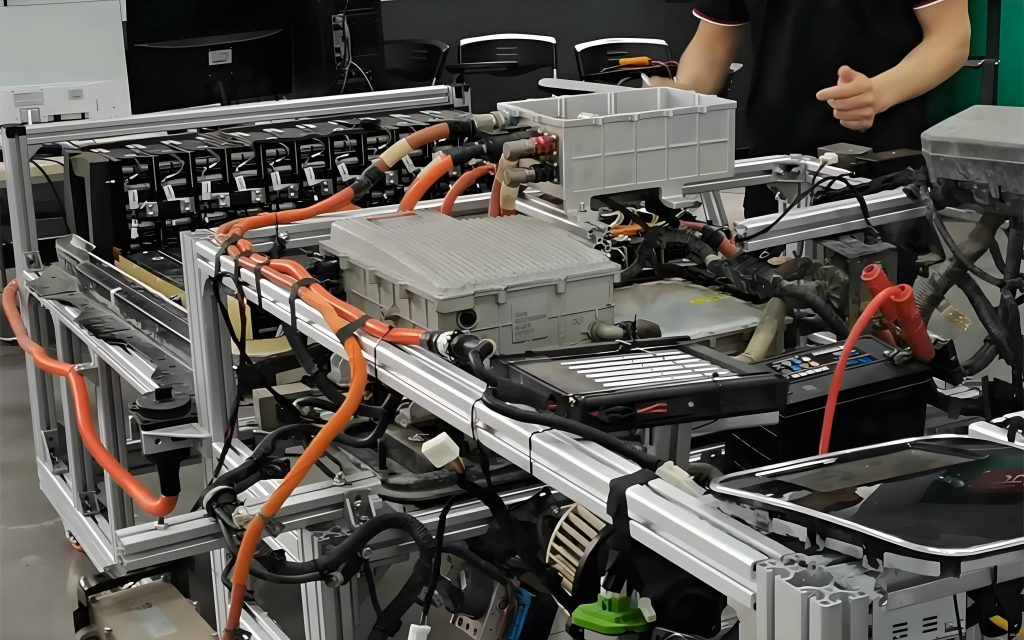
In recent years, the global push for environmental sustainability has accelerated the adoption of new energy vehicles, particularly electric vehicles (EVs), as a key solution to reduce carbon emissions in the transportation sector. This shift has brought forth new challenges and demands in terms of energy usage and vehicle maintenance, emphasizing the need for advanced technologies to ensure efficient and safe operations. Electronic control technology has emerged as a cornerstone in the realm of EV repair, enabling precise fault diagnosis, enhanced safety, and optimized performance. As a researcher in this field, I have observed how electronic control systems integrate seamlessly with various vehicle components, from power systems to energy management, to address the complexities of modern electrical car repair. This article delves into the application of electronic control technology in EV repair, highlighting its advantages, specific use cases, and the integration of data-driven methods to foster innovation in the automotive industry. Through detailed discussions, tables, and mathematical models, we aim to provide a comprehensive overview that supports the ongoing evolution of electrical car repair practices.
Overview of Electronic Control Technology
Electronic control technology refers to the utilization of electronic systems to manage and optimize critical functions in electric vehicles, including the power train, control mechanisms, and energy distribution. This technology relies on sophisticated electronic control units (ECUs) that facilitate real-time monitoring and fault diagnosis, forming a robust framework for EV repair. Essentially, it combines online and offline diagnostic modes to create a holistic approach to vehicle maintenance. Online diagnosis involves continuous surveillance of the vehicle’s operational state during runtime, where anomalies trigger predefined algorithms to identify fault types and store relevant codes. This allows for immediate activation of backup modules, ensuring that the vehicle can be safely driven to a service center. Offline diagnosis, on the other hand, depends on external diagnostic tools that communicate with the ECU to retrieve detailed fault information, enabling in-depth analysis. Key diagnostic protocols, such as those standardized by ISO and SAE, ensure interoperability across different systems, which is vital for efficient electrical car repair. In my experience, the integration of these modes has revolutionized how we approach EV repair, reducing downtime and improving accuracy. For instance, the online system can detect issues like battery degradation or motor inefficiencies, while offline tools provide the granularity needed for component-level repairs. The following table summarizes the core components of electronic control technology in the context of EV repair:
| Component | Function | Role in EV Repair |
|---|---|---|
| Electronic Control Unit (ECU) | Central processing for vehicle systems | Coordinates fault diagnosis and data storage |
| Sensors | Monitor parameters like voltage, current, temperature | Provide real-time data for anomaly detection |
| Actuators | Execute control commands | Enable corrective actions during repairs |
| Diagnostic Interface | Facilitates communication with external tools | Supports offline analysis and code retrieval |
Moreover, the mathematical foundation of electronic control technology often involves algorithms for fault detection. For example, a common approach uses threshold-based models where a fault is identified if sensor readings exceed predefined limits. This can be expressed as: $$ F = \begin{cases} 1 & \text{if } |x – x_{\text{normal}}| > \theta \\ 0 & \text{otherwise} \end{cases} $$ where \( F \) represents the fault indicator, \( x \) is the sensor value, \( x_{\text{normal}} \) is the expected normal value, and \( \theta \) is the threshold. Such formulas are integral to automating EV repair processes, allowing for rapid response in electrical car repair scenarios. As we advance, the fusion of machine learning with these electronic systems promises even greater precision, making EV repair more proactive and reliable.
Advantages of Electronic Control Technology in EV Repair
The application of electronic control technology in EV repair offers numerous benefits that enhance overall maintenance efficiency, safety, and cost-effectiveness. From my perspective, these advantages are pivotal in addressing the unique challenges of electrical car repair, such as the complexity of high-voltage systems and the need for specialized diagnostics. Firstly, electronic control technology significantly improves diagnosis efficiency by enabling real-time data analysis and fault code interpretation. Instead of relying on traditional manual inspections, repair technicians can quickly pinpoint issues through automated systems, reducing the time required for EV repair. For instance, in a typical electrical car repair scenario, the technology can identify a faulty battery cell within minutes, whereas conventional methods might take hours. Secondly, it enhances repair accuracy by leveraging advanced algorithms that minimize human error. This is crucial in EV repair, where imprecise interventions can lead to further damage or safety hazards. Thirdly, safety is bolstered through built-in mechanisms that automatically isolate faulty components, such as disconnecting high-voltage circuits during emergencies. This protective feature is indispensable in electrical car repair, given the risks associated with battery and power system handling. Lastly, the technology fosters intelligence in EV repair by incorporating predictive analytics and adaptive learning, which anticipate potential failures and recommend preventive measures. The table below elaborates on these advantages with specific examples relevant to EV repair:
| Advantage | Description | Impact on EV Repair |
|---|---|---|
| Diagnosis Efficiency | Rapid fault localization via real-time monitoring | Reduces repair time by up to 50% in electrical car repair cases |
| Repair Accuracy | Precise identification of fault types and scopes | Minimizes unnecessary part replacements in EV repair |
| Safety Enhancement | Automatic shutdown of hazardous systems | Prevents accidents during electrical car repair procedures |
| Intelligent Support | Predictive maintenance and data-driven insights | Extends vehicle lifespan and optimizes EV repair schedules |
To quantify these benefits, we can use mathematical models. For example, the improvement in repair efficiency can be represented as: $$ E_{\text{repair}} = \frac{T_{\text{traditional}} – T_{\text{electronic}}}{T_{\text{traditional}}} \times 100\% $$ where \( E_{\text{repair}} \) is the efficiency gain, \( T_{\text{traditional}} \) is the time taken with traditional methods, and \( T_{\text{electronic}} \) is the time with electronic control technology. In practice, values of \( E_{\text{repair}} \) often exceed 30%, underscoring the transformative impact on EV repair. Additionally, safety metrics can be modeled using probability theory: $$ P_{\text{safe}} = 1 – \prod_{i=1}^{n} (1 – p_i) $$ where \( P_{\text{safe}} \) is the overall safety probability, and \( p_i \) represents the reliability of each electronic control component in an electrical car repair context. By iterating these models, we can continuously refine EV repair protocols, ensuring they align with industry standards and consumer expectations.
Specific Applications in EV Repair
Electronic control technology finds diverse applications in EV repair, each addressing specific subsystems to ensure comprehensive maintenance. In my work, I have focused on several key areas where this technology proves indispensable for effective electrical car repair.
Application in Anti-lock Braking System (ABS) Repair
The Anti-lock Braking System (ABS) is critical for vehicle safety, preventing wheel lock-up during braking and maintaining steering control. In EV repair, electronic control technology enables precise diagnosis and maintenance of ABS components. For example, sensors monitor wheel speed and compare it to vehicle velocity, with faults detected when discrepancies exceed thresholds. The control logic can be represented as: $$ \Delta v = |v_{\text{wheel}} – v_{\text{vehicle}}| $$ where a fault is flagged if \( \Delta v > \delta \), with \( \delta \) being a calibrated value. During electrical car repair, technicians use electronic tools to read fault codes and analyze data streams, identifying issues like sensor failures or hydraulic malfunctions. The table below outlines common ABS faults and their electronic control-based solutions in EV repair:
| Fault Type | Symptoms | Electronic Control Solution in EV Repair |
|---|---|---|
| Sensor Failure | ABS warning light, erratic braking | Real-time data analysis and code retrieval for replacement |
| Hydraulic Issue | Reduced braking efficiency | Actuator control adjustments and system reset |
| ECU Communication Error | Intermittent ABS activation | Protocol checks and software updates |
Furthermore, preventive maintenance in ABS for EV repair involves monitoring wear patterns using formulas like: $$ W = k \int_{0}^{t} F_{\text{brake}} \, dt $$ where \( W \) is the wear index, \( k \) is a material constant, and \( F_{\text{brake}} \) is the braking force. By integrating electronic control data, repair schedules can be optimized, reducing downtime in electrical car repair.
Application in Battery Diagnosis
Batteries are the heart of electric vehicles, and their diagnosis is a cornerstone of EV repair. Electronic control technology, through Battery Management Systems (BMS), continuously monitors parameters such as voltage, current, temperature, and state of charge (SOC). For instance, SOC estimation is vital for assessing battery health and can be calculated using: $$ SOC = SOC_0 – \frac{1}{Q_{\text{nominal}}} \int_{0}^{t} I \, dt $$ where \( SOC_0 \) is the initial charge, \( Q_{\text{nominal}} \) is the nominal capacity, and \( I \) is the current. In electrical car repair, deviations in SOC or voltage often indicate faults like cell imbalance or degradation. The following table summarizes key battery parameters and their role in EV repair:
| Parameter | Symbol | Importance in EV Repair |
|---|---|---|
| Voltage | V | Detects overcharge or undercharge in electrical car repair |
| Current | I | Identifies abnormal power flow during EV repair |
| Temperature | T | Prevents thermal runaway in batteries |
| State of Health (SOH) | SOH | Guides replacement decisions in electrical car repair |
Additionally, SOH can be modeled as: $$ SOH = \frac{C_{\text{measured}}}{C_{\text{original}}} \times 100\% $$ where \( C_{\text{measured}} \) is the current capacity and \( C_{\text{original}} \) is the original capacity. By applying these formulas, electronic control systems provide actionable insights for EV repair, such as balancing cells or recommending battery replacements, thereby enhancing the reliability of electrical car repair processes.
Application in Motor Control System Repair
The motor control system dictates the performance of electric vehicles, influencing acceleration, efficiency, and stability. In EV repair, electronic control technology facilitates fault diagnosis by monitoring variables like torque, speed, and temperature. For example, a common issue in electrical car repair is motor overheating, which can be detected using: $$ T_{\text{motor}} > T_{\text{max}} $$ where \( T_{\text{motor}} \) is the motor temperature and \( T_{\text{max}} \) is the safe limit. Electronic systems then trigger cooling mechanisms or reduce power output to prevent damage. The power output of the motor is given by: $$ P = \tau \omega $$ where \( \tau \) is torque and \( \omega \) is angular velocity. During EV repair, technicians analyze these parameters to identify inefficiencies or failures. The table below highlights typical motor-related faults and electronic control interventions in electrical car repair:
| Fault Type | Diagnostic Approach | Repair Action in EV Repair |
|---|---|---|
| Overheating | Temperature sensor data analysis | Cooling system check or control algorithm adjustment |
| Torque Loss | Current and voltage monitoring | Inverter or winding inspection |
| Vibration Anomalies | Vibration sensor feedback | Rotor balancing or mounting fixes |
Moreover, efficiency optimization in motor control for EV repair can be expressed as: $$ \eta = \frac{P_{\text{out}}}{P_{\text{in}}} \times 100\% $$ where \( \eta \) is efficiency, \( P_{\text{out}} \) is output power, and \( P_{\text{in}} \) is input power. By refining control strategies based on electronic data, repair outcomes in electrical car repair are significantly improved, leading to longer motor life and better vehicle performance.
Application in Body Control System Repair
Body control systems in electric vehicles manage functions like windows, doors, seating, and climate control, relying on a network of electronic components. In EV repair, electronic control technology enables comprehensive diagnosis of communication errors or component failures. For instance, a fault in the window mechanism might be detected using checksum formulas in data communication: $$ \text{Checksum} = \left( \sum_{i=1}^{n} data_i \right) \mod M $$ where \( M \) is a modulus value, and a mismatch indicates corruption. During electrical car repair, technicians use diagnostic tools to reset systems or update software, ensuring seamless operation. The table below outlines common body control issues and their resolutions in EV repair:
| Component | Common Faults | Electronic Control Solution in EV Repair |
|---|---|---|
| Window Regulator | Unresponsive movement | Sensor calibration and actuator testing |
| Door Lock System | Intermittent locking | Communication protocol verification |
| Climate Control | Temperature fluctuations | Algorithm-based adjustment and sensor replacement |
Additionally, software updates are crucial in body control system repair, often involving version control models like: $$ V_{\text{new}} = V_{\text{old}} + \Delta V $$ where \( V_{\text{new}} \) is the updated software version and \( \Delta V \) represents patches or improvements. This approach minimizes physical interventions in electrical car repair, reducing costs and enhancing user satisfaction.
Application in Remote Fault Diagnosis and Maintenance
With the integration of IoT and cloud computing, remote diagnosis has become a game-changer in EV repair. Electronic control technology allows vehicles to transmit real-time data to centralized servers, where algorithms analyze trends and predict faults. For example, a predictive model for battery failure might use regression: $$ y = \beta_0 + \beta_1 x_1 + \beta_2 x_2 + \cdots + \beta_n x_n $$ where \( y \) is the probability of failure, and \( x_i \) are variables like voltage drop or temperature rise. In electrical car repair, this enables proactive maintenance, with alerts sent to technicians before issues escalate. The table below summarizes the elements of remote diagnosis in EV repair:
| Element | Function | Benefit in EV Repair |
|---|---|---|
| Onboard Sensors | Collect operational data | Provides continuous monitoring for electrical car repair |
| Cloud Analytics | Process data using machine learning | Predicts faults and suggests repairs in EV repair |
| Remote Updates | Deploy software fixes wirelessly | Reduces need for physical visits in electrical car repair |
Moreover, the efficiency of remote EV repair can be quantified using availability metrics: $$ A = \frac{\text{MTBF}}{\text{MTBF} + \text{MTTR}} $$ where \( A \) is availability, MTBF is mean time between failures, and MTTR is mean time to repair. By leveraging electronic control technology, MTTR is minimized, making electrical car repair more responsive and reliable. This remote capability not only streamlines operations but also supports the scalability of EV repair services globally.
Conclusion
The evolution of electronic control technology has profoundly impacted the field of EV repair, offering innovative solutions that address the intricacies of modern electric vehicles. From enhancing diagnosis accuracy to enabling remote maintenance, this technology has become indispensable in electrical car repair. As we move forward, continued research and development in electronic systems will further refine EV repair practices, ensuring they meet the demands of safety, efficiency, and sustainability. By embracing these advancements, the automotive industry can foster a robust ecosystem for electrical car repair, ultimately contributing to the widespread adoption of electric vehicles and a greener future.