
In the rapidly evolving field of electric vehicle (EV) technology, drive motor failures represent a critical area of focus for professionals engaged in EV repair and electrical car repair. As an expert with extensive experience in diagnosing and maintaining these systems, I have encountered numerous cases where improper handling of motor faults led to severe performance issues or complete breakdowns. This guide delves into the common faults in EV drive motors, including stator winding issues, rotor bar breakages, and bearing failures, providing detailed diagnostic methods and repair strategies. By incorporating practical examples, tables, and mathematical models, I aim to equip technicians with the knowledge needed to efficiently address these challenges in electrical car repair. The insights shared here are based on real-world scenarios, emphasizing the importance of systematic approaches in EV repair to ensure vehicle reliability and safety.
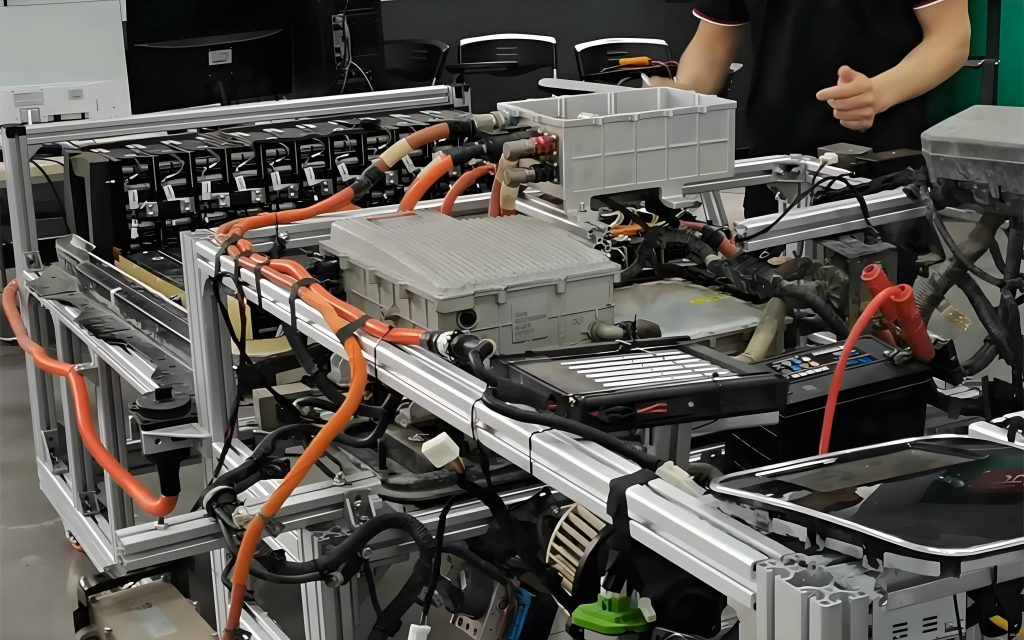
Drive motors in electric vehicles are the heart of the propulsion system, and their failure can result in significant downtime and costs. In my practice of EV repair, I have observed that stator winding faults are among the most prevalent issues. These include short circuits, open circuits, insulation degradation, and overheating. For instance, inter-turn short circuits often arise from insulation aging or manufacturing defects, leading to localized current surges and excessive heat. If left unchecked, this can cause motor burnout, a common scenario in electrical car repair. Similarly, phase-to-phase short circuits result from damaged insulation materials or inadequate spacing, triggering unbalanced currents and vibrations. Ground faults, where windings contact the stator core, pose serious safety risks like electric leakage, often activating protection systems in EVs. Open circuits, due to broken wires or poor soldering, reduce torque output and produce abnormal noises, highlighting the need for precise diagnostics in EV repair.
To diagnose stator winding faults, I employ a combination of visual inspection and electrical testing. Initially, I disassemble the motor to examine the windings for signs of burning, cracks, or contamination. This visual check is a foundational step in electrical car repair, as it can reveal obvious issues like coolant leaks or dust accumulation. For electrical assessments, I use tools such as megohmmeters to measure insulation resistance. A key formula I rely on is the insulation resistance threshold: $$ R_{ins} \geq 20 \, \text{M}\Omega $$ where values below this indicate potential insulation failure. Additionally, I measure the DC resistance of three-phase windings with a multimeter; if the deviation exceeds 5%, it suggests an open circuit or poor connection. For inter-turn short circuits, I utilize a surge tester and compare waveform differences across phases. During operation, infrared thermography helps identify hot spots, while vibration analysis and current monitoring with an oscilloscope detect anomalies like waveform distortion, which are critical in EV repair for preventing cascading failures.
| Fault Type | Common Causes | Diagnostic Tools | Normal Values/Indicators |
|---|---|---|---|
| Inter-turn Short Circuit | Insulation aging, overheating | Surge tester, IR thermography | Waveform consistency; temperature uniformity |
| Open Circuit | Broken wires, poor soldering | Multimeter, visual inspection | DC resistance balance within 5% |
| Insulation Degradation | Moisture, coolant leaks | Megohmmeter | Insulation resistance ≥20 MΩ |
| Overheating | Cooling system failure, overload | IR camera, temperature sensors | Stable temperature below 100°C |
Repairing stator winding faults requires tailored approaches based on the fault severity. For localized inter-turn short circuits, I often strip the damaged insulation and rewrap it with high-temperature tape or replace the affected wires. In cases of widespread damage, rewinding the entire stator by specialized facilities is necessary, a common procedure in advanced EV repair. Phase-to-phase short circuits demand replacement of insulation materials like paper or sleeves to restore proper spacing. Ground faults involve identifying the contact point, repairing the insulation, and sometimes applying varnish treatments to enhance dielectric strength. For open circuits, I re-solder broken connections and insulate them with high-temperature tape. If the break is internal, rewinding or replacing the stator assembly becomes essential. Insulation degradation due to moisture requires baking the windings at 80–100°C for 12–24 hours, while severe cases may need varnish immersion. Overheating issues necessitate cooling system checks, such as refilling coolant or replacing pumps, to ensure efficient heat dissipation in electrical car repair.
In one instance of EV repair, I handled a case where a vehicle displayed “EV功能受限” on the dashboard, with the motor temperature reading 147°C. After disconnecting the temperature sensor, I measured its resistance at 1.2 kΩ, far from the standard 100 kΩ at 25°C. Since the sensor was encapsulated with the windings, replacing the entire motor assembly was the only viable solution, which resolved the issue. This underscores the importance of integrated components in modern electrical car repair.
Rotor bar breakages are another frequent issue in EV drive motors, often resulting from material fatigue or manufacturing defects. In my experience with EV repair, these faults disrupt magnetic field uniformity, reducing power output and efficiency. They can also cause abnormal noises and vibrations due to imbalanced rotation, increasing the risk of damage to bearings and other components. In severe cases, rotor-stator contact may lead to mechanical failures or fires, emphasizing the need for proactive diagnostics in electrical car repair.
To diagnose rotor bar faults, I use methods like the stethoscope test for abnormal sounds or the current signature analysis. For example, when applying a low-voltage AC supply to one phase and slowly rotating the rotor, I monitor the current with a clamp meter. If the current fluctuates periodically, it indicates broken bars. This can be modeled with the formula for current variation: $$ \Delta I = \frac{|I_a – I_b| + |I_b – I_c| + |I_c – I_a|}{3} $$ where a high ΔI suggests rotor issues. Vibration analysis with accelerometers helps detect characteristic frequencies, while infrared thermography identifies localized heating. Substitution with a known-good rotor is a straightforward confirmatory test in EV repair, and disassembly allows direct inspection for breaks or cracks.
| Method | Procedure | Tools Used | Positive Indicator |
|---|---|---|---|
| Stethoscope Test | Listen for unusual noises during operation | Acoustic stethoscope | Cyclic rubbing or grinding sounds |
| Current Analysis | Apply AC and measure current fluctuations | Clamp meter, oscilloscope | Periodic current swings |
| Vibration Analysis | Capture and analyze vibration spectra | Accelerometer, FFT analyzer | Peaks at fault frequencies |
| Thermal Imaging | Scan rotor area for hot spots | IR camera | Localized temperature rises |
Repair strategies for rotor bar breakages depend on the fault extent. For accessible breaks, I perform welding repairs after heating the rotor, followed by grinding to maintain dimensional accuracy. However, for cast aluminum rotors common in EVs, welding is often impractical, necessitating replacement. This highlights the material-specific challenges in electrical car repair. In a case involving a vehicle with power loss and vibrations, current analysis revealed significant fluctuations, and substitution confirmed rotor breakage. Since it was a cast aluminum type, replacement was the only option, restoring normal performance—a typical resolution in EV repair.
Bearing failures in EV drive motors manifest as noises, vibrations, elevated temperatures, and reduced efficiency. From my work in EV repair, I have found that causes include lubricant degradation, contamination, improper assembly, or electrical erosion from PWM currents. For instance,轴电流 (shaft currents) can puncture the oil film, leading to pitting and premature failure. Symptoms like “rotor position abnormal” error codes or excessive heat often prompt diagnostics in electrical car repair.
I diagnose bearing faults using auditory and tactile methods, such as listening with a stethoscope for rhythmic sounds or feeling for vibrations correlated with speed. Vibration analysis is particularly effective; I calculate characteristic frequencies using formulas like the inner race fault frequency: $$ f_i = \frac{n}{2} \left(1 + \frac{B_d}{P_d} \cos \phi\right) $$ where \( n \) is the rotational speed, \( B_d \) is the ball diameter, \( P_d \) is the pitch diameter, and \( \phi \) is the contact angle. Values deviating from norms indicate faults. Infrared thermography detects temperature anomalies, with differences over 15–25°C suggesting issues. Insulation resistance measurements and data stream analysis of temperature sensors further aid in pinpointing bearing problems in EV repair.
| Symptom | Possible Cause | Diagnostic Approach | Repair Action |
|---|---|---|---|
| Abnormal Noise | Wear, contamination | Stethoscope, vibration analysis | Lubrication or replacement |
| Increased Vibration | Imbalance, damage | Accelerometer, FFT | Realignment or bearing swap |
| High Temperature | Poor lubrication, overload | IR camera, data logging | Refill grease or upgrade bearing |
| Error Codes | Electrical erosion, sensor faults | OBD-II scanner, resistance test | Install grounding brushes |
For minor bearing faults, I focus on lubrication and sealing. After disassembling the end cover, I clean components with kerosene, replace seals, and apply new grease using vacuum filling to achieve 1/3 to 1/2 cavity volume—this prevents overheating from overfilling. In severe cases with pitting or cracks, I replace bearings, preferring ceramic types for their thermal stability. Alignment is critical; I use laser tools to ensure shaft coaxiality within 0.03 mm. Adding grounding brushes diverts stray currents, mitigating electrical erosion—a proactive measure in modern electrical car repair. In one EV repair case, a vehicle exhibited noises and high bearing temperatures; thermal imaging and frequency analysis confirmed inner race damage. Replacing with a larger-clearance bearing and adding temperature sensors resolved the issue, demonstrating the value of integrated diagnostics.
In conclusion, effective fault diagnosis and repair in EV drive motors are essential for maintaining vehicle performance and safety. Through systematic approaches—combining visual inspections, electrical tests, and advanced tools—technicians can address common issues like stator winding faults, rotor bar breakages, and bearing failures. The integration of mathematical models, such as resistance thresholds and frequency analyses, enhances precision in EV repair. As the electric vehicle industry grows, standardizing these practices will be crucial for sustainable development. My experience in electrical car repair reaffirms that continuous learning and adaptation to new technologies are key to overcoming emerging challenges, ensuring reliable and efficient EVs for the future.
The field of EV repair is evolving rapidly, and I encourage technicians to embrace data-driven methods. For example, predictive maintenance using real-time monitoring can reduce downtime. Formulas like the general motor efficiency equation: $$ \eta = \frac{P_{out}}{P_{in}} \times 100\% $$ where \( P_{out} \) is output power and \( P_{in} \) is input power, help assess performance degradation over time. By leveraging such tools, electrical car repair can transition from reactive to proactive, ultimately benefiting consumers and the environment alike.