
As the global energy structure shifts and environmental awareness rises, the electric vehicle industry has experienced rapid growth. In this context, secondary vocational schools play a critical role in supplying and training qualified professionals for EV repair and electrical car repair sectors. The quality of training directly impacts industry development. However, for a considerable period, the training objectives for secondary vocational students have been vague, particularly in terms of articulation with higher vocational education, leading to issues such as disjointed learning, fragmented knowledge, and repetition when students advance. To address industry needs, the Ministry of Education issued new vocational education teaching standards in February 2025, providing clearer and more specific requirements for training objectives in the electric vehicle repair and maintenance specialty.
The new standards resonate with industry development demands. I aim to analyze the characteristics and changes in these standards, explore the restructuring of the curriculum system, and reform practical teaching. Optimizing, adjusting, and revising the professional talent training plan is of practical significance for effectively bridging the positioning of talent at different levels—secondary and higher vocational education—and meeting the evolving needs of the industry for skilled professionals in EV repair and electrical car repair.
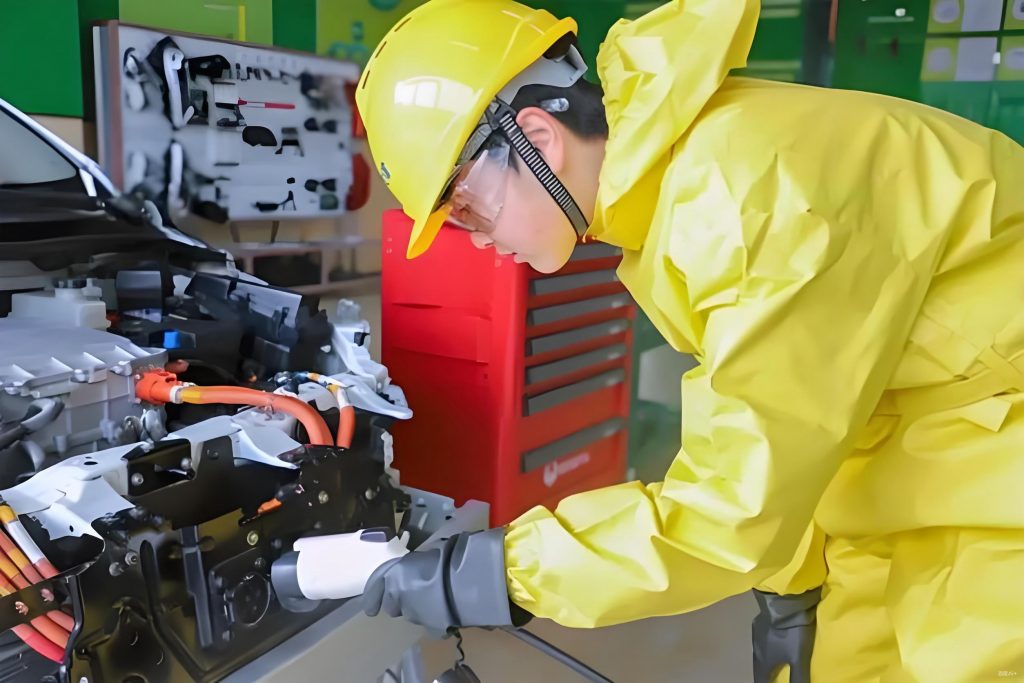
Characteristics and Changes in the New Standards
The new standards introduce several key shifts that redefine the approach to EV repair and electrical car repair training. These changes focus on clarifying talent positioning, enhancing practical components, and ensuring seamless educational progression.
Shift in Training Objectives from “Technical-Skills” to “Skills-Based” Talent
In the new standards, the training objectives have been explicitly refined: secondary vocational education aims to cultivate “skills-based” talent, higher vocational education targets “high-skills” talent, and vocational undergraduate education focuses on “high-end skilled” talent. This marks a clear departure from the previous “technical-skills” talent orientation. The distinction between “technical” and “skills” is significant; technical aspects emphasize the comprehensive application of theoretical knowledge systems, focusing on problem analysis, logical reasoning, and extrapolation, whereas skills-based approaches prioritize the practical application of knowledge in real-world scenarios, emphasizing the resolution of specific problems and the development of actionable competencies in EV repair and electrical car repair.
To quantify this shift, consider the relationship between theoretical knowledge (TK) and practical skills (PS) in the curriculum. The emphasis can be modeled using a simple formula: $$ \text{Emphasis Ratio} = \frac{\text{PS}}{\text{TK}} $$ where a higher ratio indicates a stronger focus on hands-on training. For secondary vocational programs, this ratio should exceed 1, reflecting the dominance of practical skills in EV repair and electrical car repair contexts.
| Educational Level | Previous Objective | New Objective | Key Focus Areas |
|---|---|---|---|
| Secondary Vocational | Technical-Skills Talent | Skills-Based Talent | Basic troubleshooting, routine maintenance in EV repair |
| Higher Vocational | Technical-Skills Talent | High-Skills Talent | Diagnosis, analysis, and integration in electrical car repair |
| Vocational Undergraduate | Not Specified | High-End Skilled Talent | Innovation and management in EV repair systems |
Enhanced Requirements for Practical Teaching
The new standards place a strong emphasis on practical teaching, with specific requirements for internship hours, training facility construction, and teacher competencies. This is crucial for developing proficiency in EV repair and electrical car repair.
First, internship and training hours have been concretized. The total hours for on-campus practical training must account for at least 50% of the overall curriculum. Additionally, secondary vocational education, which previously balanced employment and further education, now prioritizes升学 (advancement to higher education) over employment, with off-campus internships limited to a maximum of three months. This can be expressed mathematically: if total hours are represented as \( T \), then practical training hours \( P \) must satisfy \( P \geq 0.5T \). For a typical program with \( T = 3540 \) hours, \( P \geq 1770 \) hours, ensuring ample hands-on experience in EV repair.
Second, training facility requirements are clearly outlined. Schools must ensure that laboratories can support at least eight key practical activities, including electric vehicle power electronics, maintenance of electric vehicles, construction and repair of electric vehicle power battery systems, and construction and repair of electric vehicle drive systems. This aligns with the growing demands of the electrical car repair industry.
Third, teacher practical abilities are strengthened. Full-time teachers are required to engage in enterprise or productive training base practice for at least one month annually, with a cumulative total of no less than six months over five years. This ensures that instructors remain updated with the latest EV repair techniques and can effectively guide students.
| Component | Requirement | Impact on EV Repair Training |
|---|---|---|
| Internship Hours | ≥50% of total hours | Enhances hands-on skills in electrical car repair |
| Off-Campus Internship | ≤3 months | Focuses on foundational practice |
| Training Facilities | Support for 8 key activities | Ensures comprehensive EV repair training |
| Teacher Practice | 1 month/year, 6 months/5 years | Improves instruction quality in electrical car repair |
Clarified Talent Positioning Between Secondary and Higher Vocational Education
The new standards provide a clearer distinction between secondary and higher vocational education in terms of talent specifications. Secondary vocational education focuses on foundational skills, such as the ability to handle simple faults and routine system inspections, use basic tools for disassembly, maintenance, adjustment, replacement, fault verification, functional checks, and physical connection assessments. This cultivates initial problem analysis and resolution capabilities, which are essential for entry-level roles in EV repair.
In contrast, higher vocational education aims to develop talents who can master basic knowledge in electric vehicle maintenance, repair, inspection, and fault diagnosis. They should be proficient in using common or specialized tools for fault detection, preliminary fault cause judgment, assembly debugging, result recording, data analysis, and standardized completion of work orders. Additionally, they need to possess abilities for inquiry learning, lifelong learning, sustainability, and integrating knowledge to analyze and solve problems comprehensively in electrical car repair contexts.
This hierarchical positioning can be represented using a progression formula: $$ \text{Skill Level} = \text{Base} + \sum_{i=1}^{n} (\text{Advanced Competencies}_i) $$ where the base represents secondary vocational skills, and the summation captures the additive competencies from higher levels. For instance, in EV repair, secondary skills might include basic maintenance, while higher levels incorporate diagnostic and analytical skills.
| Aspect | Secondary Vocational Education | Higher Vocational Education |
|---|---|---|
| Focus | Basic troubleshooting and maintenance | Diagnosis, analysis, and integration |
| Tool Usage | Common basic tools | Common and specialized tools |
| Problem-Solving | Initial analysis and resolution | Comprehensive analysis and sustainable solutions |
| Key Abilities | Routine checks in EV repair | Data analysis and lifelong learning in electrical car repair |
Development and Adjustment of the Talent Training Plan
Based on the new standards, I have revised the talent training plan for the electric vehicle repair and maintenance specialty. This involves restructuring the curriculum system and enhancing practical training components to better align with industry needs in EV repair and electrical car repair.
Curriculum System
The curriculum system has been adjusted in terms of breadth and depth to reflect the new standards and ensure effective training for EV repair professionals.
First, the breadth of the curriculum has been modified. According to the new teaching standards, courses that belong to the higher vocational system, such as “Principles and Repair of Vehicle Control Systems,” have been removed. Instead, new courses like “Construction and Repair of Charging Piles,” “Intelligent Shared Mobility,” and “Introduction to Intelligent Connected Vehicles” have been added. To accommodate students who may enter the workforce directly, the course “Troubleshooting and Elimination of Electric Vehicle Faults” has been retained. This expansion ensures that the curriculum covers emerging areas in electrical car repair, such as charging infrastructure and smart technologies.
Second, the depth of course content has been adjusted. Topics like automotive automatic air conditioning control principles and automotive bus control principles have been reduced, while content on high-voltage basic protection, use of basic tools, and electric shock first aid has been increased. Additionally, the hours for related courses have been recalibrated to emphasize practical skills in EV repair. The course system for the secondary vocational electric vehicle repair and maintenance specialty is summarized in the table below.
| Course Category | Course Examples | Focus Areas | Relevance to EV Repair |
|---|---|---|---|
| Public Foundation Courses | Mathematics, Language | Basic knowledge and skills | Supports analytical thinking for electrical car repair |
| Professional Skill Courses | Electric Vehicle Power Systems | Core technical knowledge | Direct application in EV repair tasks |
| Professional Extension Courses | Charging Pile Construction | Specialized topics | Enhances expertise in electrical car repair niches |
| Practical Training | Hands-on workshops | Skill development | Critical for competency in EV repair |
The allocation of hours across the curriculum can be expressed using a formula for total hours: $$ T = T_{\text{public}} + T_{\text{skill}} + T_{\text{extension}} + T_{\text{practical}} $$ where \( T_{\text{public}} \) represents public foundation courses, \( T_{\text{skill}} \) for professional skill courses, \( T_{\text{extension}} \) for professional extension courses, and \( T_{\text{practical}} \) for practical training. In the revised plan, with \( T = 3540 \) hours, the values are \( T_{\text{public}} = 1206 \) hours (34.1%), \( T_{\text{skill}} = 1116 \) hours (31.5%), \( T_{\text{extension}} = 396 \) hours (11.2%), and \( T_{\text{practical}} = 1968 \) hours (55.6%), meeting the new standard’s requirement for practical emphasis in EV repair.
Internship and Practical Training
Practical training is a cornerstone of the revised plan, with specific arrangements for internships and skill assessments to ensure students gain real-world experience in EV repair and electrical car repair.
Students’ post placements are scheduled in the sixth semester, with a three-month internship followed by return to school for skill certification training and assessment. The practical training projects are detailed in the table below, covering various aspects of electric vehicle systems. This structured approach helps bridge the gap between theory and practice, preparing students for challenges in the electrical car repair industry.
| Sequence Number | Project Name | Hours | Distribution by Semester (in weeks) |
|---|---|---|---|
| 1 | Orientation and Military Training | 30 | 1 (Semester 1) |
| 2 | Automotive Cognition Training | 30 | 1 (Semester 2) |
| 3 | Electric Vehicle Power Electronics Training | 30 | 1 (Semester 2) |
| 4 | Electric Vehicle Drive Motor Comprehensive Training | 30 | 1 (Semester 3) |
| 5 | Electric Vehicle Chassis Comprehensive Training | 30 | 1 (Semester 3) |
| 6 | Electric Vehicle Power Battery Comprehensive Training | 30 | 1 (Semester 4) |
| 7 | Electric Vehicle Electrical System Comprehensive Training | 30 | 1 (Semester 4) |
| 8 | Electric Vehicle Maintenance Comprehensive Training | 30 | 1 (Semester 5) |
| 9 | Electric Vehicle Charging Pile System Comprehensive Training | 30 | 1 (Semester 5) |
| 10 | Post Internship | 360 | 12 (Semester 6) |
| 11 | Vocational Skill Level Certification Training and Assessment | 210 | 7 (Semester 6) |
| Total | 840 | 19 weeks over 6 semesters |
The total practical hours can be calculated as the sum of course training hours and internship hours: $$ T_{\text{practical}} = T_{\text{course}} + T_{\text{internship}} $$ where \( T_{\text{course}} = 1128 \) hours and \( T_{\text{internship}} = 840 \) hours, resulting in \( T_{\text{practical}} = 1968 \) hours. This exceeds the 50% threshold, underscoring the commitment to hands-on learning in EV repair.
Furthermore, the teaching schedule has been revised based on these changes. Each academic year consists of 52 weeks, with 40 weeks dedicated to teaching (including review and exams), and a weekly schedule of 30 hours. Excluding one week for graduation education and one week for public service labor, the total teaching weeks over two years are 118, with a total of 3540 hours. The revised talent training plan ensures that public foundation courses account for 1206 hours (34.1%), professional skill courses for 1116 hours (31.5%), professional extension courses for 396 hours (11.2%), and practical teaching for 1968 hours (55.6%), fully complying with the new standards for electrical car repair education.
Conclusion
The new teaching standards are set to guide future educational reforms in the EV repair and electrical car repair sectors. By scientifically positioning the training objectives for secondary vocational education, clarifying the differentiated roles between secondary and higher vocational levels, optimizing the curriculum structure, and strengthening practical components, we can develop more scientific and rational talent training plans. This approach effectively enhances the quality of talent cultivation, providing robust support for the development of the electric vehicle industry. Through continuous refinement and adaptation, these programs will ensure that graduates are well-equipped to meet the dynamic demands of the EV repair and electrical car repair fields, fostering innovation and sustainability in the industry.