
As a researcher in the field of automotive technology, I have observed the rapid growth of electric vehicles (EVs) as a solution to global energy crises and environmental pollution. The shift from traditional internal combustion engines to electric powertrains has introduced new complexities in maintenance and repair. In this article, I will delve into the current state of EV repair and electrical car repair, highlighting the challenges, trends, and future directions. The evolution of EV repair is critical for ensuring vehicle safety, reliability, and user satisfaction, and it requires a deep understanding of the unique components and systems involved.
EVs encompass a range of technologies, including battery electric vehicles (BEVs), hybrid electric vehicles (HEVs), and fuel cell electric vehicles (FCEVs). Each type presents distinct repair needs, particularly in areas like battery management, motor control, and power electronics. The core technologies in EVs include advanced battery systems, electric motors, and complex electronic control units (ECUs). For instance, lithium-ion batteries, which are prevalent in modern EVs, have high energy density but require precise monitoring to prevent issues like thermal runaway. The electric motors, often using permanent magnet or induction designs, demand specialized knowledge for repair, as they differ significantly from combustion engines. Moreover, the integration of software and hardware in EVs adds layers of complexity to electrical car repair processes.
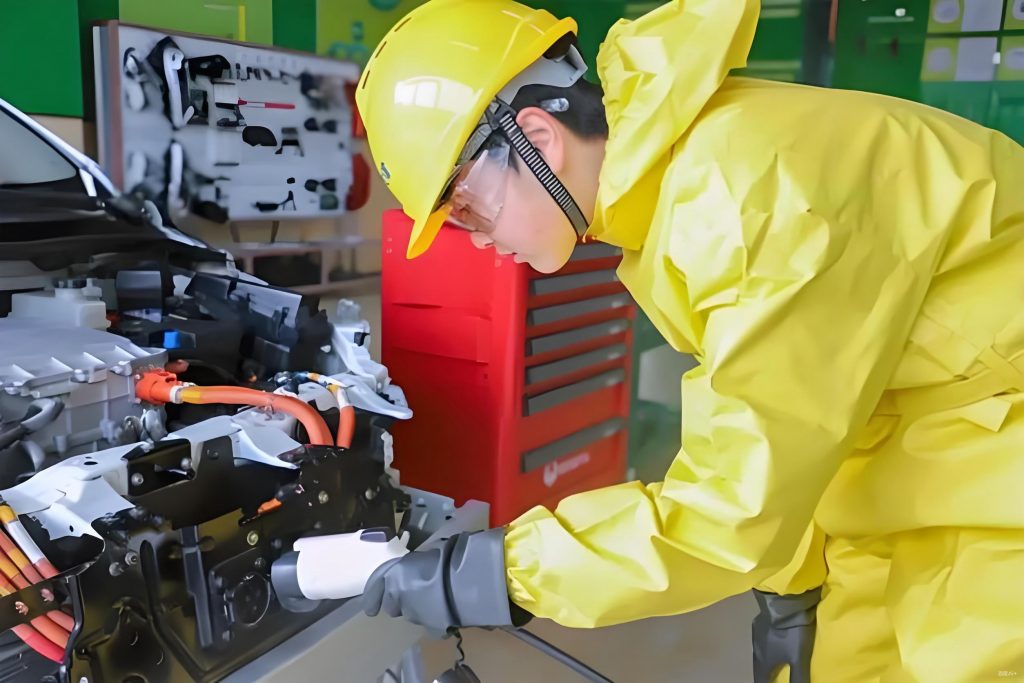
To better illustrate the diversity in EV technologies and their repair implications, I have compiled a table comparing key aspects. This table emphasizes how different EV types influence the approach to EV repair and electrical car repair, focusing on components like batteries and motors.
| EV Type | Key Components | Common Repair Issues | Repair Complexity |
|---|---|---|---|
| Battery Electric Vehicle (BEV) | High-voltage battery, electric motor, power inverter | Battery degradation, motor winding faults | High (requires specialized tools and training) |
| Hybrid Electric Vehicle (HEV) | Combination of battery, motor, and internal combustion engine | System integration errors, battery balancing | Medium to High (involves both electrical and mechanical systems) |
| Fuel Cell Electric Vehicle (FCEV) | Fuel cell stack, hydrogen storage, electric motor | Fuel cell membrane issues, hydrogen leakage | Very High (demands safety protocols and advanced diagnostics) |
The development of EVs has been driven by technological advancements and policy support, leading to increased market penetration. However, this growth has exposed gaps in the EV repair infrastructure. Currently, EV repair practices are still maturing, with many technicians relying on traditional automotive knowledge that falls short for electrical systems. For example, diagnosing faults in EV powertrains often involves using specialized diagnostic tools to read error codes from ECUs, but the lack of standardized procedures can lead to inconsistent results. In my analysis, I have found that the application of EV repair techniques varies widely, with some shops excelling in battery repair—such as using cell balancing to extend battery life—while others struggle with motor or inverter issues.
Mathematically, the degradation of EV batteries can be modeled to predict repair needs. A common approach uses an exponential decay model for battery capacity over time: $$ C(t) = C_0 \cdot e^{-\lambda t} $$ where \( C(t) \) is the capacity at time \( t \), \( C_0 \) is the initial capacity, and \( \lambda \) is the degradation rate constant. This equation helps in planning preventive EV repair, such as when to schedule battery maintenance. Similarly, for motor repair, the efficiency \( \eta \) of an electric motor can be expressed as: $$ \eta = \frac{P_{out}}{P_{in}} \times 100\% $$ where \( P_{out} \) is the mechanical power output and \( P_{in} \) is the electrical power input. Deviations from expected values often indicate faults requiring electrical car repair.
Despite progress, several problems hinder the advancement of EV repair. Firstly, the absence of unified technical standards complicates diagnostics and repairs. For instance, different manufacturers use proprietary systems, making it difficult for repair shops to access data or follow consistent procedures. This lack of standardization not only affects repair quality but also increases costs and time. Secondly, there is a significant shortage of skilled technicians trained in EV repair and electrical car repair. The multidisciplinary nature of EVs—combining electrical engineering, software, and mechanical systems—requires comprehensive training that many current programs lack. As a result, repair errors are common, leading to safety risks and reduced customer trust.
To quantify the impact of these issues, I have created a table summarizing the key challenges in EV repair and their implications. This highlights the urgent need for improvements in training and standardization.
| Challenge | Description | Impact on Repair |
|---|---|---|
| Lack of Standardization | Inconsistent diagnostic codes and repair protocols across EV models | Increased repair time, higher error rates |
| Skill Gap | Insufficient training in high-voltage systems and software diagnostics | Safety hazards, inefficient repairs |
| High Repair Costs | Expensive replacement parts and specialized equipment | Reduced affordability for consumers |
Looking ahead, the trends in EV repair are shifting towards智能化, remote, and green technologies. Intelligent repair systems, for example, leverage artificial intelligence and IoT sensors to predict failures before they occur. In EV repair, this means using machine learning algorithms to analyze vehicle data and identify patterns indicative of impending issues. A predictive model might use historical data to estimate the probability of a battery fault: $$ P(fault|data) = \frac{P(data|fault) \cdot P(fault)}{P(data)} $$ where \( P(fault|data) \) is the posterior probability of a fault given the data. This approach enhances the precision of electrical car repair by enabling proactive maintenance.
Remote repair technologies are another promising trend, facilitated by 5G and cloud computing. In EV repair, this allows technicians to diagnose and even resolve issues from a distance. For instance, if an EV displays an error code, the data can be transmitted to a central repair hub where experts analyze it and provide guidance. This not only reduces downtime but also makes electrical car repair more accessible in remote areas. Additionally, green repair practices focus on sustainability, such as recycling batteries or remanufacturing components. In EV repair, this involves techniques like battery repurposing for second-life applications, which minimizes waste and environmental impact.
To support these trends, I propose several development strategies. First, establishing comprehensive technical standards for EV repair is essential. This includes standardizing fault diagnosis protocols and repair procedures for key components like batteries and motors. For example, a unified standard for battery testing could involve specific voltage and current thresholds: $$ V_{min} \leq V_{battery} \leq V_{max} $$ where \( V_{battery} \) is the battery voltage, ensuring safe and efficient repairs. Second, enhancing education and training programs for EV repair and electrical car repair is crucial. This can be achieved through industry-academia collaborations, where students gain hands-on experience with real-world EV systems. By integrating these elements, the EV repair sector can overcome current limitations and align with future demands.
In conclusion, the field of EV repair and electrical car repair is at a pivotal point, with immense potential for growth through innovation. The current challenges in standardization and workforce development must be addressed to harness the benefits of intelligent, remote, and green repair technologies. As I have discussed, mathematical models and standardized tables can aid in understanding and improving repair processes. Moving forward, a concerted effort from industry, government, and educational institutions will be key to advancing EV repair, ensuring that it keeps pace with the rapid evolution of electric vehicles and contributes to a sustainable automotive ecosystem.